To avoid these ads, REGISTER NOW!

Craftsman Date/Mfr. Code Question

tombell572

Well-known member
Joined
Oct 3, 2015
Messages
1,034
Location
Sea Cliff, NY & Portland, OR
My apologies in advance if this has been thrashed out at an earlier date but my search couldn't find it. I began buying my first Craftsman tools in about 1967-68 starting with a set of 3/8 ratchet and sockets, continuing to buy until the mid-70's. I still have them and while not a serious collector, for the few additions I've needed in recent years I've bought used at tag sales or eBay and I've tried to stay consistent with the "V" code.

My question is the difference, if any, between the -V- and =V= codes. Even with tools I bought new I've noticed some mixing of the codes. I don't think its called out clearly on Lauver's great reference work. Can anyone shed some light on the difference(s)?

Tom B.
 
To avoid these ads, REGISTER NOW!

DadsTools

Well-known member
Joined
Jul 27, 2017
Messages
1,852
The general consensus seems to be that the =v= series was made by Moore Drop Forging about 1946 to 1968. Easco then bought out MDF and the code changed to -v-. Since they were supposedly made in the same facility, I'm not sure if there's any difference in quality, though I'm sure there are serious Craftsman collectors who believe so. There is also a later VV code that is supposed to be Easco too. I believe at some point, the MDF Mass. facility was shuttered and production went to NC, but I don't know if there is a connection between this move and the mfr codes.

It's believed that model numbers began to appear on the wrenches about the mid-1970s. I have a few small size -v- with no model number, but all the larger ones I've seen have them, so the omission on the small ones may have been a space issue. I don't recall having ever seen a =v= wrench with a model number, so this may help dating also.

It seems that every time someone thinks these mfr codes are finally nailed down, someone comes up with an exception to the rule. My conclusion is that dates for them are close thumbnails.
 
OP
T

tombell572

Well-known member
Joined
Oct 3, 2015
Messages
1,034
Location
Sea Cliff, NY & Portland, OR
Thanks, Dads, that may explain some of the overlap in the codes. as I noted in my first post, I began accumulating Craftsmen tools, mostly wrenches, screwdrivers and pliers in the late 60's which would coincide with the buyout/merger of Easco and Moore. There is no difference that is discernable to me in either quality or appearance other than the slight difference in the code although that may not be the case with serious collectors.

Tom B.
 

Judiandave

Member
Joined
Oct 5, 2017
Messages
9
Everything you need to know about date codes is on this thread:

https://www.garagejournal.com/forum/showthread.php?t=84807&page=1

"Just an opinion: when seeking quality, follow the ownership. Moore Drop Forge ( =V= ) were tool guys. Easco ( -V- ) (Eastern Stainless Company) were steel guys looking to control the outlet of their steel. I believe both would have been cognizant of steel quality. I'm suspect however of the Easco ( VV ) series for one main reason; At that time the ( -V- ) series was still active. Why have two marks active unless they are different? I think they were playing around with the metallurgy. I suspect they decreased some of the alloys namely Vanadium. The wrenches got fatter to compensate for the cheaper steel. When Easco was bought out in 1986 they were bought out by investment bankers...money guys. It went downhill from there. Danaher was just a shell company. They were about making money not about making tools. VΛ tools may sell well on e-bay but I think they are just not as good. I'll stick with =V= and -V- before 1974 when they added the model number.

I'm an engineer and my theory is that they were messing around with the Vanadium content. Craftsman at one point was stamping "Vanadium" in some of their tools. Wish we could find somebody that was there that knew something about the metallurgy. 1964 thru 68 Vanadium was $1.15; in 1971 it spiked to $2.85 by 1976 it was $3.38. Money guys would be looking to cut that cost increase.
 

Judiandave

Member
Joined
Oct 5, 2017
Messages
9
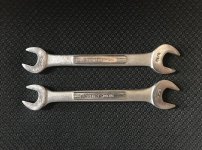
An example of the -V- code with and without the part number
 

Attachments

  • IMG_2122 (2).jpg
    IMG_2122 (2).jpg
    155.4 KB · Views: 121

Judiandave

Member
Joined
Oct 5, 2017
Messages
9
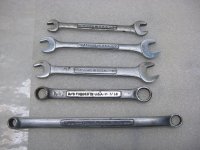
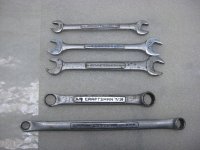
Note the difference in size of the exact same wrench. The =V= code has a much thinner body. There are slight differences in the -VV- and -V^- particularly where the body transitions into the head.

I know it's kind of an **** discussion but there are differences. Unless you put a cheater bar on these, I doubt you'll break any one of them. I just like the look and feel of the =V=
 

Attachments

  • IMG_2121 (2).jpg
    IMG_2121 (2).jpg
    157.4 KB · Views: 107

DadsTools

Well-known member
Joined
Jul 27, 2017
Messages
1,852
An example of the -V- code with and without the part number
Thanks for the contribution of the photos with the observed geometry and marking changes, as well as your thoughts on the vanadium issue. I found it interesting that your -v- marked wrench with no model number has the thinner profile like earlier =v= whereas the one with the model number is beefier. However, I've often observed the same variations in metal thickness within the =v= series itself, as per the 5/8 combos in the attached photo. I've also noticed that, at least in the ones I've encountered, early CMan wrenches in the post-war "=v=" style but NOT having a maker mark all seem to be the 'skinny' design. This led me to believe that all the skinny =v= style wrenches are earlier while the 'fat' ones are later, but what dates might correspond with fat or shinny versions is anybody's guess. And that assumes there was indeed a cut-off date during the =v= series between fat and skinny, or if they were making both during the same time. But Juliandave's photo of a skinny (no number) and fat (number) -v- side by side demonstrates these variations also exist this late in the game. :dunno:

Playing with the metal content seems to be a viable idea. As commodity prices were rising during the 1960s, it doesn't make sense that mfrs would be adding more metal, weight and size instead of trying to get these values down to lower cost. It does appear from examples I've seen that once model numbers began appearing on the wrenches, the skinny versions were gone forever.

As I mentioned in another post (I believe in the thread mentioned on CMan date codes) I talked about a period of philosophical change within Sears that was more company-wide than just in the tool line. This seems to roughly correspond to the years 1958 through about the late-1970s. This was marked by a radical change to the long-standing 1923 company logo in 1958 followed by another in 1963. The change was evident in other product lines, like the introduction of the Ted Williams sporting goods line circa 1960 (believe it was Sears' fist time at introducing a celebrity-named brand) and the phasing out of JC Higgins. In the tool line, we saw a switch from the traditional Dunlap brand to just plain SEARS, introduction of the crown logo, and the beginning of the BF JAPAN marked tools around 1964.

Based on this general information concerning the change in Sears' marketing strategies, and what we can find in the artifacts themselves, were I to offer a guess as to when skinny vs fat took place, I'd guess that all wrenches prior to the BF Japan era--or at least during the earlier Dunlap era--are all skinny. The fat versions maybe started appearing post BF-JAPAN (1964). For some unknown reason, both variations appear to have been made during both the =v= and -v- eras until model numbers appeared around 1974-75, by which time all the wrenches were fat. Perhaps someone could tie this down even more precisely.
 

Attachments

  • IMG_0998.jpg
    IMG_0998.jpg
    146.6 KB · Views: 69
Last edited:

Judiandave

Member
Joined
Oct 5, 2017
Messages
9
Thanks for your insight DadsTools...always enjoy your posts.

Stillgot...I think you are spot on...it may be fatter but cheaper to produce.
 

Jim C.

Well-known member
Joined
Jan 8, 2010
Messages
2,598
An example of the -V- code with and without the part number

The wrench on the top in reply #6 above is actually from the =V= (skinny shank) era. The smaller size wrenches back then were marked with a single line (-V-) and no part number. Skinny shank wrenches are generally early =V= era even if they have the single line. Look at the word “Craftsman” on the other side of the wrench. If the letter “A” is pointed, rather than flat, in the word CR”A”FTSM”A”N, it’s a skinny shank era, that is, earlier =V= era wrench.

Jim C.
 
Last edited:

DadsTools

Well-known member
Joined
Jul 27, 2017
Messages
1,852
The wrench on the top in reply #6 above is actually from the =V= (skinny shank) era. The smaller size wrenches back then were marked with a single line (-V-) and no part number. Skinny shank wrenches are generally early =V= era even if they have the single line. Look at the word “Craftsman” on the other side of the wrench. If the letter “A” is pointed, rather than flat, in the word CR”A”FTSM”A”N, it’s a skinny shank era, that is, earlier =V= era wrench.

Jim C.
I think there's something to this. Could be that on the very small wrenches there was insufficient vertical space to position a double line with enough consistency so that if it was a little off it wouldn't look odd. I don't have any small size examples right now to help validate this. The challenge would then be for someone to produce let's say a small 1/4" size wrench with the =v= double dash mark. I do have a DOE -v- in 1/4 x 5/16 that is also single line with no number and is a skinny format compared to the same wrench in a -v- with a number. The skinny one also has a pointed A.

If your proposal is correct, Jim C., then it leads me to look at these marks a little differently. What I mean by this is that it makes me think about the double line in a different way. When the CMan logo was changed post-war, it was characterized by a double line on both sides of the Craftsman name. The intent on the wrenches appears to be that the double line extends nearly the entire length of the raised panel. On the reverse side, the design intent seems the same on either side of the FORGED IN USA mark, being interrupted only by the wrench size and the v code. If this perspective is correct, then it may be that there is really no such thing as a =v= code. The double lines are actually part of the logo design, and a break in the lines is provided for the v. In other words, the == is not an intended part of the code on these double-line wrenches.

If we look at the small size single line skinny -v- wrench, it appears we have the same knid of idea, only with a single line because of the limited vertical space on the recess. The CRAFTSMAN side shows the single line extending from the sides of the name to the end of the panel, with the reverse recess being of the same design, the single line extending from each side of the FORGED IN USA to the end of the panel, interrupted only by the space needed for the v. If this holds true, then there really isn't a =v= or a -v- in these earlier wrenches, but only a v, the line or lines reflecting an intent to be consistent with the logo.

Now, based on my examples I have, at some point in time, it appears that the intent was to make the lines a part of the code mark itself as a way to delineate it from the characters before and after. This seems most obvious with the introduction of the model numbers. But I'm thinking now that many of these variations have to do with a space issue on the raised panels. My next post will have some phots and examples of what I suspect.
 
Last edited:

d42jeep

Well-known member
Joined
Oct 22, 2014
Messages
16,537
Location
Northern California
I’ve seen small sockets where there wasn’t room for the two lines so the markings look kind of like this. :v: I guess I’ll have to start checking the -v- tools I normally don’t pick up for pointed “A”s. Nothing is as simple at it seems.
-Don
 

d42jeep

Well-known member
Joined
Oct 22, 2014
Messages
16,537
Location
Northern California
Okay, let me muddy the water a little more. I took some pictures of some -v- examples. First a metric DOE. I’m not sure if this has a pointed a but it’s much more pointed than the later wrench.
-Don
 

Attachments

  • 2E0FE8EA-DDF6-4950-930D-90C851918718.jpg
    2E0FE8EA-DDF6-4950-930D-90C851918718.jpg
    150 KB · Views: 63
  • 44CBF72E-CD05-4BFE-AE09-476197134F89.jpg
    44CBF72E-CD05-4BFE-AE09-476197134F89.jpg
    146 KB · Views: 57
  • D2D24B1D-3E77-4FD7-B7CA-F49760F08631.jpg
    D2D24B1D-3E77-4FD7-B7CA-F49760F08631.jpg
    145.9 KB · Views: 60

DadsTools

Well-known member
Joined
Jul 27, 2017
Messages
1,852
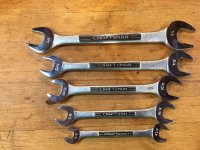
OK. Attached are photos of the fronts and backs of 5 smaller size wrenches, all -v-. From top to bottom:

#1. 1/4 x 5/16 DOE
#2. 3/8 x 7/16 DOE skinny
#3. 3/8 x 7/16 DOE fat
#4. 3/8 x 7/16 DBE
#5. 7mm x 9mm DBE

#1 seems to confirm that a single logo line was used on both sides because of the difficulty in properly centering the characters on the small size panels. Note how low on the panel the USA side is stamped. If this had been a double line, it would have been a mess. This also re-enforces Jim C.'s suggestion that these are still double-line era wrenches, since it's obvious why the double line could not have been used here.

#2 and #3 are the same size wrench, both -v-, but #2 is a skinny. Note also that the #2 has a pointed top A whereas the #3 has a flat top A. It suggests that the pointed A corresponds to the earlier skinny style with the flat A being the later fat. However, this alone may not be able to distinguish between what is normally considered =v= and -v-. Many more examples would need to be examined. But it appears that pointed A vs flat A and skinny vs. fat may actually be more accurate in dating a wrench than considering =v= or -v-.

#4 is pre-model number. Smaller size, so we'd expect the single line. However, it's also apparent that because it's a DBE, there was no end flat on which to stamp the sizes, so they had to go on the panel. In this instance, there is no attempt to express either a single or a double line as a detail of the logo design because there was simply no room. The line is then relegated to a little dash to the left and right of the v, serving here more as a delineater between adjacent characters than actually being intended as part of the mfr code. This has a flat A.

#5 is a long pattern DBE, so the panel has enough room for lines, but because it is a small size only a single line is used, and appears to be used as part of the logo design. On both sides the lines extend from the center Craftsman and USA out to the sizes, just like a logo, but with only a small break in which to insert the v. this one also has a flat A.

I do not have enough examples to determine whether or not #4 and #5 are skinny or fat, so this is a detail that needs to be confirmed by someone else's examples. But if the supposition is correct that the pointed A is skinny and the flat A is fat, then both these should be fat examples. If they are not, then this is not a solid correlation either.

Interestingly enough, of all the combo Cman v wrenches I have that are 5/8 or larger, the only =v= I can find are those with no model numbers. All the -v- I have all have model numbers. This also suggests that the double dash or single dash has more to do with the size of the wrench and the available space on the panel than if it were made during a specific set of years. It suggests that in reality there is only a v code that covers all the Moore/Easco years--there is no =v= or -v-.

I easily have close to 200 wrenches that are -v- marked. When I went back over them now, I was surprised to find out that every larger wrench 9/16 and up that has a -v- either has the model number also on the panel or the wrench sizes on the panel. If there is no such thing as a -v- mark on a 9/16 or larger wrench without model or size numbers on the panel, then we have for years been looking at this v code business all wrong. The difference between =v= and -v- may then have nothing to do with the year it was made, but only with the available space on the raised panel.

This mioght also explain why so many members have reported having sets that were bought whole having a mix of -v- and =v= wrenches.

Another correlation that apparently needs to be tied down is if there is a hard relationship between pointed A /skinny and flat A/fat. If there is, we may be able to tie down an aspect of dating these wrenches.

Am I on to something here?

Please look at your collection and see if you can find a larger size -v- without sizes or model numbers on the panel!
 

Attachments

  • IMG_1000.jpg
    IMG_1000.jpg
    148.1 KB · Views: 47
  • IMG_0999.jpg
    IMG_0999.jpg
    147.2 KB · Views: 47

d42jeep

Well-known member
Joined
Oct 22, 2014
Messages
16,537
Location
Northern California
Next are some small SAE DOE wrenches. It seems that the thinner the wrench, the more pointed the A. All of my round A examples have part numbers.
-Don
 

Attachments

  • D88C889A-AC4A-480A-80F0-0C8D6FF4D583.jpg
    D88C889A-AC4A-480A-80F0-0C8D6FF4D583.jpg
    149.3 KB · Views: 31
  • 15D1C5F3-AA8B-47FE-BE62-293D8C3933B0.jpg
    15D1C5F3-AA8B-47FE-BE62-293D8C3933B0.jpg
    145.2 KB · Views: 32
Last edited:

d42jeep

Well-known member
Joined
Oct 22, 2014
Messages
16,537
Location
Northern California
Here are some DBE wrenches that would seem to have room for the =v= but they are all marked -v- with pointed “A”s.
-Don
 

Attachments

  • A122F2DB-43FD-47B8-8AC9-D270CFE3F8BC.jpg
    A122F2DB-43FD-47B8-8AC9-D270CFE3F8BC.jpg
    150.3 KB · Views: 31
  • D8DF9714-AD2C-44D8-ADCE-66978D3AC73C.jpg
    D8DF9714-AD2C-44D8-ADCE-66978D3AC73C.jpg
    153.1 KB · Views: 38

DadsTools

Well-known member
Joined
Jul 27, 2017
Messages
1,852
Next are some small SAE DOE wrenches. It seems that the thinner the wrench, the more pointed the A.
-Don
yes. If you read my last two posts, I think we have all been a little off on how we've been looking at these v codes. If we can confirm a solid correlation between pointed A / skinny and flat A / fat, it might be a breakthrough in helping to unravel some of the mystery still surrounding the v code.
 

DadsTools

Well-known member
Joined
Jul 27, 2017
Messages
1,852
Here are some DBE wrenches that would seem to have room for the =v= but they are all marked -v- with pointed “A”s.
-Don
Buit note with these that, because of the sizes on the panels, there really is no room left to use the double line extending out from the center words. Also, because of their small size, a double line was not used because of the possible problem with centering so that one of the lines might have been stamped off the panel.

I'm thinking that the double line was only used when there was sufficient room on the panel to display it as part of the logo details. It has nothing to do directly with the v code.

With the pointed A, we'd be interested in knowing if there was a fat or skinny versions of these with the "-v-" code.
 

DadsTools

Well-known member
Joined
Jul 27, 2017
Messages
1,852
Again, I think the challenge here is for anyone to find a -v- code raised panel wrench having just the little dashes to the left and right of the v but NOT having sizes or model numbers on the same panel. the idea is to determine whether the use of the -v- with the short dashes has anything at all to do with a particular mfr year, but having everything to do with available space on the panel.
 
To avoid these ads, REGISTER NOW!

d42jeep

Well-known member
Joined
Oct 22, 2014
Messages
16,537
Location
Northern California
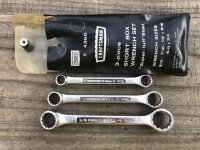
The “A”s on the Crown -v- DBE set look identical to the “A”s on these =v= doe wrenches. I’m not sure that we can draw any conclusions yet.
-Don
 

Attachments

  • 8FE90CC2-3E55-4971-8C97-CD69863F1A18.jpg
    8FE90CC2-3E55-4971-8C97-CD69863F1A18.jpg
    152.3 KB · Views: 38
  • 0D907093-F8A7-4644-A4B1-5B77B10A0A3A.jpg
    0D907093-F8A7-4644-A4B1-5B77B10A0A3A.jpg
    150.5 KB · Views: 30

DadsTools

Well-known member
Joined
Jul 27, 2017
Messages
1,852
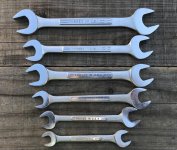
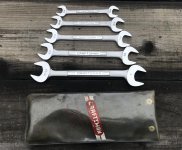
Yes. The 3-pc short box end set is problematic for our purposes because by their nature they are short, so even if they were made during the model number era, the numbers would probably have not been put on them because there was simply no room for them. We can kind of narrow down the years of their manufacture by the dual logos on the pouch and and no zip code in the address, which makes them post 1963 (the year when both the zip codes were implemented AND the year this Sears logo was introduced), but I can't say when the zip code was added. I have a very similar pouch with the zip code, so I would expect your set to be 1963-64. Which would make this VERY interesting since that's supposed to be solidly in the =v= years!!!

Your 6-pc DOE set is a good example of what I'm suggesting. Because of the flats on the heads, the sizes could be stamped there instead of the panel. Since there is no model number, there's plenty of space to draw the full double-line logo, providing just a short break to insert the v. They have a pointed A but can't tell if they're skinny, fat, or somewhere in between?
 

Jim C.

Well-known member
Joined
Jan 8, 2010
Messages
2,598
The “A”s on the Crown -v- DBE set look identical to the “A”s on these =v= doe wrenches. I’m not sure that we can draw any conclusions yet.
-Don

Don,

I think your DBE set depicted above is a middle to later version from the =V= era. While the "A" is pointed and there's no part number, the shanks are not skinny.

Jim C.
 

Jim C.

Well-known member
Joined
Jan 8, 2010
Messages
2,598
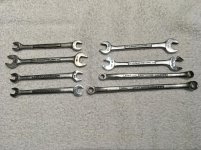
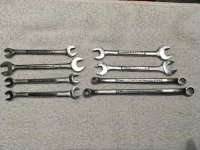
Okay, here's my contribution to the mix. I pulled a few small size wrenches from my collection. They include, SAE, metric and Whitworth. The Whitworth and metric wrenches are from Sears/Craftsman's earliest sets first offered right around 1960. The SAE wrenches are from the same time period. Notice they all have skinny shanks, a pointed "A" in the word Craftsman, no part number and a single line V. These were likely manufactured earlier in the =V= era.

Jim C.
 

Attachments

  • IMG_5213.jpg
    IMG_5213.jpg
    155.2 KB · Views: 28
  • IMG_5214.jpg
    IMG_5214.jpg
    154.7 KB · Views: 29
Last edited:

Jim C.

Well-known member
Joined
Jan 8, 2010
Messages
2,598
OK. Attached are photos of the fronts and backs of 5 smaller size wrenches, all -v-. From top to bottom:

#1. 1/4 x 5/16 DOE
#2. 3/8 x 7/16 DOE skinny
#3. 3/8 x 7/16 DOE fat
#4. 3/8 x 7/16 DBE
#5. 7mm x 9mm DBE

#1 seems to confirm that a single logo line was used on both sides because of the difficulty in properly centering the characters on the small size panels. Note how low on the panel the USA side is stamped. If this had been a double line, it would have been a mess. This also re-enforces Jim C.'s suggestion that these are still double-line era wrenches, since it's obvious why the double line could not have been used here.

#2 and #3 are the same size wrench, both -v-, but #2 is a skinny. Note also that the #2 has a pointed top A whereas the #3 has a flat top A. It suggests that the pointed A corresponds to the earlier skinny style with the flat A being the later fat. However, this alone may not be able to distinguish between what is normally considered =v= and -v-. Many more examples would need to be examined. But it appears that pointed A vs flat A and skinny vs. fat may actually be more accurate in dating a wrench than considering =v= or -v-.

#4 is pre-model number. Smaller size, so we'd expect the single line. However, it's also apparent that because it's a DBE, there was no end flat on which to stamp the sizes, so they had to go on the panel. In this instance, there is no attempt to express either a single or a double line as a detail of the logo design because there was simply no room. The line is then relegated to a little dash to the left and right of the v, serving here more as a delineater between adjacent characters than actually being intended as part of the mfr code. This has a flat A.

#5 is a long pattern DBE, so the panel has enough room for lines, but because it is a small size only a single line is used, and appears to be used as part of the logo design. On both sides the lines extend from the center Craftsman and USA out to the sizes, just like a logo, but with only a small break in which to insert the v. this one also has a flat A.

I do not have enough examples to determine whether or not #4 and #5 are skinny or fat, so this is a detail that needs to be confirmed by someone else's examples. But if the supposition is correct that the pointed A is skinny and the flat A is fat, then both these should be fat examples. If they are not, then this is not a solid correlation either.

Interestingly enough, of all the combo Cman v wrenches I have that are 5/8 or larger, the only =v= I can find are those with no model numbers. All the -v- I have all have model numbers. This also suggests that the double dash or single dash has more to do with the size of the wrench and the available space on the panel than if it were made during a specific set of years. It suggests that in reality there is only a v code that covers all the Moore/Easco years--there is no =v= or -v-.

I easily have close to 200 wrenches that are -v- marked. When I went back over them now, I was surprised to find out that every larger wrench 9/16 and up that has a -v- either has the model number also on the panel or the wrench sizes on the panel. If there is no such thing as a -v- mark on a 9/16 or larger wrench without model or size numbers on the panel, then we have for years been looking at this v code business all wrong. The difference between =v= and -v- may then have nothing to do with the year it was made, but only with the available space on the raised panel.

This mioght also explain why so many members have reported having sets that were bought whole having a mix of -v- and =v= wrenches.

Another correlation that apparently needs to be tied down is if there is a hard relationship between pointed A /skinny and flat A/fat. If there is, we may be able to tie down an aspect of dating these wrenches.

Am I on to something here?

Please look at your collection and see if you can find a larger size -v- without sizes or model numbers on the panel!

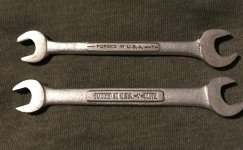
Dad,

The =V= and -V- manufacturer's marks are only one thing to look at and not enough alone to make a conclusion as to a wrench's approximate age. The pointed "A" is very important as is the thickness of a particular wrench's shank. The really skinny ones are definitely earlier =V= era and they'll all have a pointed "A" and no part number. Depending on the size of the wrench, they may have either a =V= or a -V- mark.

Jim C.
 
Last edited:

rickhigginshtbr

Well-known member
Joined
Aug 7, 2012
Messages
1,551
Location
Lower Bucks, PA
Another correlation that apparently needs to be tied down is if there is a hard relationship between pointed A /skinny and flat A/fat. If there is, we may be able to tie down an aspect of dating these wrenches.

Am I on to something here?

Please look at your collection and see if you can find a larger size -v- without sizes or model numbers on the panel!

From my understanding, the pointed A was roughly used from 1948-1955. Forget where I found that, and I could be off a year or two, but thats the general rule of thumb I use. The pointed A ones also tend to be the skinny models.
 

Jim C.

Well-known member
Joined
Jan 8, 2010
Messages
2,598
From my understanding, the pointed A was roughly used from 1948-1955. Forget where I found that, and I could be off a year or two, but thats the general rule of thumb I use. The pointed A ones also tend to be the skinny models.

Rick,

It think the pointed “A” was in production a little longer than 1955. In one of my earlier posts, I added a couple pictures that included a Whitworth sized wrench. Sears/Craftsman offered Whitworth sized tools between about 1960 and 1962. Every Craftsman Whitworth DBE and DOE wrench I’ve seen has a skinny shank, pointed “A,” and no part number. I do agree with you that skinny shank wrenches will typically have a pointed “A.”

Jim C.
 

Jim C.

Well-known member
Joined
Jan 8, 2010
Messages
2,598
Here's a pretty good depiction between earlier =V= era, skinny shank wrenches and later =V= era, wide shank wrenches. The set on the left is the older, skinny shank set. See the difference between the two sets? All the wrenches in both sets have a =V= manufacturer's mark and none of the wrenches in either set have a part number. However, the set on the left, the skinny shank, older wrenches all have a pointed letter "A" in the word CR"A"FTSM"A"N, while the set on the right, the wide shank, newer wrenches all have a flat top letter "A." It's my belief that skinny shank wrenches will typically have a pointed letter "A" and are older than the wider shank wrenches that typically have a flat top letter "A."

Jim C.
 

Attachments

  • IMG_5216.jpg
    IMG_5216.jpg
    151.7 KB · Views: 43
Last edited:

d42jeep

Well-known member
Joined
Oct 22, 2014
Messages
16,537
Location
Northern California
Here's a pretty good depiction between earlier =V= era, skinny shank wrenches and later =V= era, wide shank wrenches. The set on the left is the older, skinny shank set. See the difference between the two sets? All the wrenches in both sets have a =V= manufacturer's mark and none of the wrenches in either set have a part number. However, the set on the left, the skinny shank, older wrenches all have a pointed letter "A" in the word CR"A"FTSM"A"N, while the set on the right, the wide shank, newer wrenches all have a flat top letter "A." It's my belief that skinny shank wrenches will typically have a pointed letter "A" and are older than the wider shank wrenches that typically have a flat top letter "A."

Jim C.

Even these two wrenches which are both =v= and have the pointed A have slightly different shank sizes. There must have been small changes from year to year even though the markings didn’t necessarily change.
-Don
 

Attachments

  • 21AA4490-7F3E-48DB-91C7-31171742BF54.jpg
    21AA4490-7F3E-48DB-91C7-31171742BF54.jpg
    148.1 KB · Views: 31
  • 963DFF36-EB29-4F06-841D-FF687A99C37D.jpg
    963DFF36-EB29-4F06-841D-FF687A99C37D.jpg
    148 KB · Views: 25

d42jeep

Well-known member
Joined
Oct 22, 2014
Messages
16,537
Location
Northern California
These are my smallest wrenches with the =v= and the pointed A. All of my larger -v- wrenches have part numbers.
-Don
 

Attachments

  • F8E30D2D-94BE-423E-A6F8-8C5885E45F82.jpg
    F8E30D2D-94BE-423E-A6F8-8C5885E45F82.jpg
    150.8 KB · Views: 21
  • 786B1FE9-5D2E-4CD9-875D-ABB273486C63.jpg
    786B1FE9-5D2E-4CD9-875D-ABB273486C63.jpg
    151.3 KB · Views: 17
  • 02A23BA4-8347-4D1B-96FC-635B8E950B5C.jpg
    02A23BA4-8347-4D1B-96FC-635B8E950B5C.jpg
    148.3 KB · Views: 26
Last edited:

DadsTools

Well-known member
Joined
Jul 27, 2017
Messages
1,852
It's beginning to look like there is some variation with the width of the shank on these wrenches, so that it may be difficult to pin down a specific style of marks to a specific width, and hence a specific date. Seems the best we can do right now is to form a general conclusion that the fatter the shank is, the later its mfg date. It must have something to do with changing the metallurgy to reduce cost but adding more metal to maintain the strength as has been suggested.

In looking at my later USA examples, it seems like the -VV- codes are pretty consistent in width to the -V- codes with the model numbers on the panel. However, it appears from the specimens I have that starting with the -VΛ- code, they increased the metal volume again, noty so much in width, but thickened the shanks so that the edges are almost squared off instead of being beveled, and the chrome is darker. I'm not alone in observing that the quality seems to have taken a noticeable hit with this -VΛ-series.

As for the distinction between between =v= and -v-, it's starting to jell for me that a single or double line has nothing to do with the mfr code itself, but only if the panel had sufficient vertical and horizontal space on the code or reverse side to carryover the double line of the logo. On the very small panels, the size was insufficient for a double line, so a single line was used, but still of a relative length to hint at the double line logo. It appears that once model numbers appear, the idea of making longer lines on the reverse side to mimic the logo was dropped because of space restrictions and replaced with a small dash on either side of the code. So that a ----v---- in the middle of a long single line is not a -v- code. This is as Jim C. suggests. d42jeep's short DBE set on post #17 seems to show that a -v- code with no single or double long lines was used as early as perhaps 1963-64 (I believe that's the date on this set) and was used as the result of a space issue and nothing more.

So it appears that relying on =v= or -v- marks to determine dates or even Moore vs Easco is unworkable. We may have to rely more on the following factors for relative age from earlier to later:

1. V forged into the shank
2. V stamped into the panel
3. Pointed A / skinnier shank
3. Flat A / wider shank
4. Addition of model numbers

A study of the type of the A shape relative to shank width might yield some specific date info, if such a study might even be possible after all these years. All I can say right now is that it seems the wider the shank, the later the wrench, and that the width variation probably began sometime in the 1960s and culminated with the model number versions.
 

rickhigginshtbr

Well-known member
Joined
Aug 7, 2012
Messages
1,551
Location
Lower Bucks, PA
Rick,

It think the pointed “A” was in production a little longer than 1955. In one of my earlier posts, I added a couple pictures that included a Whitworth sized wrench. Sears/Craftsman offered Whitworth sized tools between about 1960 and 1962. Every Craftsman Whitworth DBE and DOE wrench I’ve seen has a skinny shank, pointed “A,” and no part number. I do agree with you that skinny shank wrenches will typically have a pointed “A.”

Jim C.

Maybe, maybe not. We all know how Sears historically never rotates stock. With WW sized, I can totally see them ordering 10K sets in 1954, and still be sitting on a few of those into the early 60's.

Just like the power tool colors. 1957 is supposed to be the year everything was Power Bronze. I have motors dated 8/56 in power bronze (early for the color), and I have a bandsaw dated 1958 that's still gray.

When I was a manager for the hardware stores a decade ago, it was common to see packaging from the 80's on a couple select SKU's. Everything date wise with Sears is an approximation.
 

Jim C.

Well-known member
Joined
Jan 8, 2010
Messages
2,598
Maybe, maybe not. We all know how Sears historically never rotates stock. With WW sized, I can totally see them ordering 10K sets in 1954, and still be sitting on a few of those into the early 60's.

Just like the power tool colors. 1957 is supposed to be the year everything was Power Bronze. I have motors dated 8/56 in power bronze (early for the color), and I have a bandsaw dated 1958 that's still gray.

When I was a manager for the hardware stores a decade ago, it was common to see packaging from the 80's on a couple select SKU's. Everything date wise with Sears is an approximation.

Hey Rick,

I think what you’re saying has merit, particularly since you worked there. I’m relying mostly on Sears/Craftsman catalogs for my information. I know that’s not totally accurate either. I’m sure stock sat around for years in some instances. As for the Craftsman Whitworth tools, well, based on looking at the catalogs, they were only offered between 1960 and 1962. I didn’t see any catalog offerings for Whitworth tools prior to 1960. If Sears had them say, prior to 1959, wouldn’t Sears advertise them in earlier catalogs? Even though the Whitworth tools did not appear in catalogs after 1962, I could definitely see them in physical stock for several years after 1962. While we might not know for sure, but I still think pointed “A” tools were in production (not just stock) well into the 1960s.

Jim C.
 
Last edited:

Jim C.

Well-known member
Joined
Jan 8, 2010
Messages
2,598
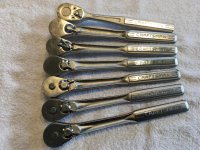
In an effort to shed a little more light on the pointed "A" aspect of this conversation and how it may correspond to the =V= era, rather than looking at wrenches, I thought coming from a different angle might help. There's been a lot of work done in recent years by a few members on this site dealing with Sears/Craftsman ratchets. While one can't pinpoint the exact dates the ratchets were manufactured, I think the most recent information does allow us to confidently approximate them within a couple years. Take a look at the series of ratchets depicted below. The oldest of the group is at the top of both photos and the most recent is at the bottom. All the ratchets have a pointed letter "A" in the word CR"A"FTSM"A"N and all of them, with the exception of the most recent one (on the bottom), have a double line (=V=) manufacturer's mark. Again, relying on research and Sears/Craftsman catalogs, the ratchets depicted below can be sorted by the years they were manufactured. Looking at the ratchets from oldest to newest and for purposes of this conversation, labelling them 1 through 7 respectively, their approximate years of manufacture are:

1: 1948 - 1956
2: 1956 - 1959
3: 1959 - 1966
4: 1967 - 1969
5: 1967
6: 1967 - 1968
7: 1968 - 1970

If the ratchets are indicative of other tools, like wrenches, then the pointed letter "A" and =V= manufacturer's mark were likely still in production well into the 1960s.

Jim C.
 

Attachments

  • IMG_5222.jpg
    IMG_5222.jpg
    158.6 KB · Views: 35
  • IMG_5221.jpg
    IMG_5221.jpg
    163.8 KB · Views: 38

rickhigginshtbr

Well-known member
Joined
Aug 7, 2012
Messages
1,551
Location
Lower Bucks, PA
I would think the wrenches were earlier, just because you see so many more "round A" versus "pointed A" available. But, yet again, with sears, consistency among product lines doesn't always happen.
 

d42jeep

Well-known member
Joined
Oct 22, 2014
Messages
16,537
Location
Northern California
I would think the wrenches were earlier, just because you see so many more "round A" versus "pointed A" available. But, yet again, with sears, consistency among product lines doesn't always happen.

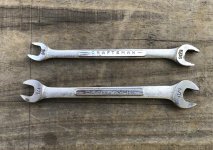
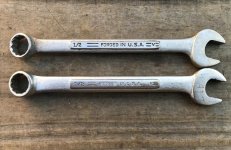
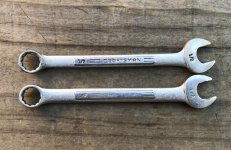
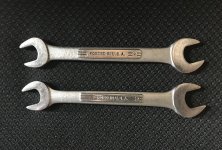
Here are some examples of what Rick is talking about. I found these first two wrenches at an estate sale on Friday. One has a pointed A the other a rounded A and that seems to be the only difference between the two wrenches. The shank size seems to be the same.
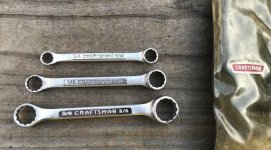
The third and fourth pictures are of a -v- marked shorty DBE wrench wth the =Craftsman= missing the = =. I guess there wasn’t room. It has a rounded A but no part number. Would this wrench be considered one from what was formerly thought of as the “=V=“ era? Other than the rounded “A” the wrench appears the same as the Crown set I posted upthread.
The fifth and sixth pictures are of a set that came with what I believe to be the original packaging. The wrenches are nice early consistent thin shank =v= DOEs all with the pointed “A” but the package they came in has the rounded “A” in the logo.
-Don
-Don20C1B60D-FD80-4972-8CB7-AEB8C5CB7EB9.jpg64D37D2F-E94D-4951-BEC3-3C559002B232.jpg48E10E07-3F5A-4A67-A58F-23885E05EC8B.jpgAAA0AAC9-0C5A-45EE-9C13-45FD97199695.jpg6D1E79A0-33EC-44E0-AE99-9E9AB364EEE5.jpg607A03CE-1919-4378-BB1B-87F7535ED47F.jpg
 
Last edited:

JoCoSawdust

Well-known member
Joined
Nov 19, 2018
Messages
2,416
Location
Eastern NC
I think a set I picked up yesterday can answer the question of whether or not the single line on smaller wrenches is just for lack space ie -v- vs =v=.

These wrenches are from a NOS basic mechanics set sold in November of 1964 (the hand written receipt was in the tool box) so these wrenches are obviously from the same era. Point A, no part number. The 3/8-7/16 wrench only has one horizontal line to the side of CRAFTSMAN on one panel, one horizontal line to the side of the V on the reverse.

IMG_3536.jpg

IMG_3537.jpg

IMG_3538.jpg
 

Jim C.

Well-known member
Joined
Jan 8, 2010
Messages
2,598
I think the smaller size wrenches from the =V= era had a single line. The key there is to look at the “A” in the word Craftsman. The pointed A is typically =V= era.

Jim C.
 

d42jeep

Well-known member
Joined
Oct 22, 2014
Messages
16,537
Location
Northern California
It’s good that JoCo’s set confirms the theory of the small wrenches not having the =v= markings. All of my smallest pointed A wrenches without part numbers have the -v- marking.
-Don
 

DadsTools

Well-known member
Joined
Jul 27, 2017
Messages
1,852
I think a set I picked up yesterday can answer the question of whether or not the single line on smaller wrenches is just for lack space ie -v- vs =v=.

These wrenches are from a NOS basic mechanics set sold in November of 1964 (the hand written receipt was in the tool box) so these wrenches are obviously from the same era. Point A, no part number. The 3/8-7/16 wrench only has one horizontal line to the side of CRAFTSMAN on one panel, one horizontal line to the side of the V on the reverse.

IMG_3536.jpg

IMG_3537.jpg

IMG_3538.jpg
This is the kind of artifact evidence we need. Thanks for posting it. Also, these end wrenches all appear to have 'skinny' shanks.

For me, the evidence is sufficient to definitively conclude that the smaller size end wrenches from this era bear a single line merely because their panels were too narrow to consistently fit a double line onto them while maintaining a relatively balanced look though variations in centering the stamp without the risk of having one of the double lines miss the panel altogether. These look to be identified by a "v" embedded in the middle of a long single line -----v-----. The Craftsman name on the other side will also be bordered by a long single line.

Wherever we see a v with just a short dash on either side--the supposed -v- code--it seems always to correspond with a panel that is too short (like with stubby end wrenches) or bearing too much information (like when model numbers were added) to fit any longer lines on the sides of the mfr code. Once model numbers were added, it appears all mfr codes thereafter were rendered with just the short dashes to the side.

I could be wrong, but it's my understanding that all the Moore wrenches, and later the Easco wrenches, were all made out of the single original Moore facility. If this is the case, I find it unlikely that it would have been producing different shank thicknesses and "A" styles all at the same time as an intentional goal, though we might expect some crossover as newer dies were introduced in the production line. While artifacts with sales receipts may sometimes throw us off because they were NOS, I think it is logical to assume that there was indeed some distinct date ranges associated with the gradual widening of the shank and the change to the "A" style.

If we were to tentatively accept this set posted by JoCoSawdust as a sort of 'contol' set (with the assumption that this was not NOS), then we could look for the gradual variations in shank thickness and "A" post-1964 leading up to the addition of the model numbers when the size and A style appears to have stabilized at least until the end of he single V code era. The examples I have bearing model numbers seem to show that those marked with a V or a VV are consistent in shank size and A style, only becoming even thicker still (and darker chrome) with the advent of the VΛ code.

Some external evidence supports the notion that the thickening shanks began after this 1964 set. One had to do with rising costs of alloys which was suggested earlier. Another, which can't be discounted, is the proliferation at this time of competition from cheaper Japanese tools. Even Craftsman itself started using the BF JAPAN mfr with greater frequency after its first introduction following the discontinuation of the budget Lectrolite wrenches by SK Wayne around 1963-64 that it had been previously furnishing to Sears. This same year saw a major change in the Sears company logo, that along with other changes reflected a shift in corporate marketing strategy at this time. Stable prices in the early 1960s was followed by a period of relatively rapid inflation starting around 1965 and leading up to the failed attempt to stabilize this by Nixon's 1970 price and wage freeze.

All this suggests a period between about 1965 and the introduction of model numbers (1975ish?) as the target years where the incremental changes in shank thickness and "A" style took place.
 
Last edited:
To avoid these ads, REGISTER NOW!
Top Bottom