To avoid these ads, REGISTER NOW!

Craftsman Drill Press

Outlawmws

Well-known member
Joined
Aug 9, 2011
Messages
39,096
Location
The Badlands
Also does the spindle spin freely? if not that may be part of the motors prob. if it's just a start up issue is there a capacitor in the base? If so that is now ancient and needs replaced.
 
To avoid these ads, REGISTER NOW!

Warped5

Well-known member
Joined
Feb 12, 2015
Messages
103
Location
Northwest Indiana
Mercman, keep an eye on eBay and CL. Every once in awhile, a real clean motor will show up at an affordable price. On CL, don't be afraid to grab a table saw or band saw just to rob the motor off it.
 
OP
F

FrankLee

Well-known member
Joined
Sep 13, 2010
Messages
3,547
Location
seMI, 48317
Re: The Classic Craftsman 100/150 Drill Press

A buddy's Father passed away, and he had some tools in his garage he was looking to sell. He had this drill press, and I said I would buy it from him...we loaded it up in my car and he said once I checked it out to let him know if I still wanted to give $100 for it. After getting it home, I see it's more rough than I thought. With the belt on, the motor hums, then trips the breaker. It spins ok with the belt off, but seems "tired". I wanted to do a cosmetic resto on this so it fit in with the rest of my vintage Craftsman woodshop tools...but how easy is it to rebuild the stock motor? I really don't want to invest in a modern motor for it. The model number badge is gone, so I'm not even sure what it is.

I had the same symptoms on the motor from dp#29... hum, no start. I removed it from the mount and tried again. This time I spun the pulley by hand while it was humming and it slowly accelerated up to speed after a few seconds. I believe this is a classic symptom of a bad start capacitor.

The capacitors on these motors are sardine-can shaped and mounted in the base. They are no longer available. You can get a cylindrical capacitor replacement and rig it somehow. I believe they are fairly inexpensive. I've never done it, but others have. Where in MI are you located? There are motor repair shops around. The specs may be printed on the old capacitor.

The bench model numbers of that era are either 103.23130 or 23131. The "2313" is the catalog number. I'm not sure what the last digit means.
 
Last edited:

bubinga

Well-known member
Joined
Jul 26, 2014
Messages
12,744
Location
Bridgeport Ohio. (Across River From Wheeling WV)
Mercman, keep an eye on eBay and CL. Every once in awhile, a real clean motor will show up at an affordable price. On CL, don't be afraid to grab a table saw or band saw just to rob the motor off it.
True, I've paid as little as $15.00 for an old table saw.
Just make sure it's an 1725, not 3450 RPM.
Most table saws are 3450.
 

mercman1951

Well-known member
Joined
Apr 28, 2006
Messages
47
Location
Michigan
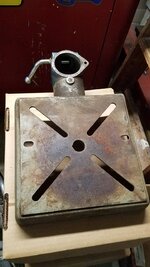
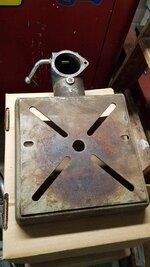
Well the motor has a date code for 1948. I suspect the DP is a model 100, likely of the same vintage as the motor. What is the diameter of the column? And can you shoot a pic of the table?
I noticed the "48". Figured that, thanks. Here is the table. It needs some work too.b8807013c08f430fa49d0d9a79a9dc13.jpg

Sent from my SM-G930P using Tapatalk
 

Attachments

  • b8807013c08f430fa49d0d9a79a9dc13.jpg
    b8807013c08f430fa49d0d9a79a9dc13.jpg
    111.4 KB · Views: 1

mercman1951

Well-known member
Joined
Apr 28, 2006
Messages
47
Location
Michigan
Mercman, keep an eye on eBay and CL. Every once in awhile, a real clean motor will show up at an affordable price. On CL, don't be afraid to grab a table saw or band saw just to rob the motor off it.
I do that. I even have email alerts set up, lol.

Sent from my SM-G930P using Tapatalk
 

mercman1951

Well-known member
Joined
Apr 28, 2006
Messages
47
Location
Michigan
Re: The Classic Craftsman 100/150 Drill Press

I had the same symptoms on the motor from DP #29... hum, no start. I removed it from the mount and tried again. This time I spun the pulley by hand while it was humming and it slowly accelerated up to speed after a few seconds. I believe this is a classic symptom of a bad start capacitor.

The capacitors on these motors are sardine-can shaped and mounted in the base. They are no longer available. You can get a cylindrical capacitor replacement and rig it somehow. I believe they are fairly inexpensive. I've never done it, but others have. Where in MI are you located? There are motor repair shops around. The specs may be printed on the old capacitor.

The bench model numbers of that era are either 103.23130 or 23131. The "2313" is the catalog number. I'm not sure what the last digit means.

Yes, even with the belt off, I have to give it a little nudge to spin. I guess I didn't even think of this little motor having a start capacitor (even though it says so on the badge!) Figured that was for bigger motors, but that makes sense. I also assumed it was a 23130, but I was bummed when I saw all of the original badging removed/missing, esp. the headband. It appears to have been repainted at some point in it's life; looks like primer overspray under the base, and as seen in the pics it's this weird bluish color... I'm in Hartland, but I work in Dearborn. Originally from Canton.

Sent from my SM-G930P using Tapatalk
 
Last edited:

mercman1951

Well-known member
Joined
Apr 28, 2006
Messages
47
Location
Michigan
Also does the spindle spin freely? if not that may be part of the motors prob. if it's just a start up issue is there a capacitor in the base? If so that is now ancient and needs replaced.

Yes, it turns free. When I got it running, I put the belt on the smallest pulley. It actually ran pretty quietly. It wouldn't turn with the belt slipped onto a larger pully though. I was expecting bearing noises but it was not bad.

Sent from my SM-G930P using Tapatalk
 

Locker537

Well-known member
Joined
Sep 25, 2016
Messages
488
Location
Massachusetts
DOH! Sorry. I always scored poorly on reading comprehension. LoL!


What did you find out?

I was able to snap a picture yesterday.

attachment.php


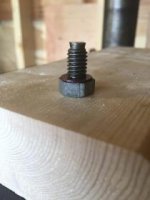
There is some interesting wear. It looks like someone must have put some force on it when it was unaligned, causing it to deform and mushroom a bit. I didn't try to reshape it with a file.

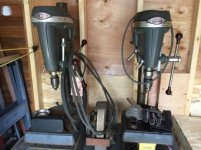
Even though FrankLee is on his 30th+ machine, no one warned me these awesome vintage machines like to multiply like Gremlins in the night...

attachment.php


The smaller machine is the one I bought from a member here. I've taken it apart and cleaned it using ample penetrating oil and WD-40 as a degreaser. I re-assembled and greased with Super Lube Synthetic grease as recommended here. The first issue discovered is the retaining screw above. The second issue, which may be a result of occasional misalignment is that the quill and pinion like to bind up during first use. After the quill spins a bit, everything starts to function as expected with a nice steady quill return tension and very very little vibration.

The larger machine was my uncle's father's machine. I'm fortunate that my uncle's family has very little interest in these old machines and he gracious gave it to me along with a few others similar era machines. I haven't done anything but take the motor off and lower the head frame to make moving it easier. Note the rust on the ring that the feed stop attaches to. That ring is very loose. I'm not sure what is going on there since I haven't taken it apart yet.
 

Attachments

  • IMG_1426.jpg
    IMG_1426.jpg
    7.9 KB · Views: 906
  • IMG_1416.jpg
    IMG_1416.jpg
    20 KB · Views: 904

droptical

Member
Joined
Apr 27, 2017
Messages
22
Location
Stillwater, Ok
Re: Bearings

Hello Frank. I'm a new member and have been gleaning quite a bit of useful information from this thread over the last few weeks. I very much appreciate the detail included in your posts and of course your willingness to share your experience.

I have a question about the process of installing new bearings for the spindle/quill assembly of the Craftsman 150 drill press (103.24511.) I'm finding that maybe the best technique for assembling the bearings to the spindle would be to freeze the spindle and warm the bearings. What I'm not finding is the order or necessity of heating or cooling the quill in this process. Should I freeze both the spindle and quill while heating the bearings or should I assemble the bearings into the quill and then heat that assembly to install onto the spindle from the freezer? Or maybe something in between?

I'll be sharing more after I get this thing back together. In the meantime, here's what I started with.

https://www.dropbox.com/sh/lv0q6ioikavym0g/AAD645Ya0YsiJd4jj_fe0DGWa?dl=0

Thanks to anyone who might have experience to share.

Andy
 
Last edited:
OP
F

FrankLee

Well-known member
Joined
Sep 13, 2010
Messages
3,547
Location
seMI, 48317
Re: Bearings

Hello Frank. I'm a new member and have been gleaning quite a bit of useful information from this thread over the last few weeks. I very much appreciate the detail included in your posts and of course your willingness to share your experience.

I have a question about the process of installing new bearings for the spindle/quill assembly of the Craftsman 150 drill press (103.24511.) I'm finding that maybe the best technique for assembling the bearings to the spindle would be to freeze the spindle and warm the bearings. What I'm not finding is the order or necessity of heating or cooling the quill in this process. Should I freeze both the spindle and quill while heating the bearings or should I assemble the bearings into the quill and then heat that assembly to install onto the spindle from the freezer? Or maybe something in between?

I'll be sharing more after I get this thing back together. In the meantime, here's what I started with.

https://www.dropbox.com/sh/lv0q6ioikavym0g/AAD645Ya0YsiJd4jj_fe0DGWa?dl=0

Thanks to anyone who might have experience to share.

Andy

Hello Andy,

Thanks and welcome! That's a very nice machine... another diamond in the rough.

IIRC, here's what I did (or would do):
  • freeze the spindle, heat and install the lower bearing
  • freeze the spindle and lower bearing, heat and install the lower end of the quill
  • freeze spindle, lower bearing and quill, heat and install the upper bearing
  • be prepared to press on the upper until fully seated into the quill
 

droptical

Member
Joined
Apr 27, 2017
Messages
22
Location
Stillwater, Ok
Re: Bearings

IIRC, here's what I did (or would do):
  • freeze the spindle, heat and install the lower bearing
  • freeze the spindle and lower bearing, heat and install the lower end of the quill
  • freeze spindle, lower bearing and quill, heat and install the upper bearing
  • be prepared to press on the upper until fully seated into the quill

Thanks Frank. That's just what I was looking for. I'll let you know how it works out.

Andy
 

ckadams00

Well-known member
Joined
Sep 12, 2011
Messages
1,273
Location
Seattle, WA
As others have said these machines do seem to breed when left alone, I am just starting a teardown of three floor models that have spent the winter in my garage. (Pics will be coming - yesterday I took about 20 before I realized I didn't have a memory card in my camera:eyecrazy:).

Frank - wanted to thank you for your patented method of removing the bases. I had one that was really rusty. Soaked them with PB Blaster all morning and then used your BFH and 2x4 trick and it worked like a charm on all of them!
 

ckadams00

Well-known member
Joined
Sep 12, 2011
Messages
1,273
Location
Seattle, WA
Frank - two questions as I revisit this whole thread prior to tearing into my three DPs. One - I never thought to ask this before - what are the T-slots on the base useful for? :dunno:

Second - you have a DP table in post #130 - do you know where that came from? One of the DPs I picked up had an extra table and it is the exact same one. . . .wondering if these had anything to do with these presses or if it's just a coincidence since it fits the column.
 
OP
F

FrankLee

Well-known member
Joined
Sep 13, 2010
Messages
3,547
Location
seMI, 48317
As others have said these machines do seem to breed when left alone, I am just starting a teardown of three floor models that have spent the winter in my garage. (Pics will be coming - yesterday I took about 20 before I realized I didn't have a memory card in my camera:eyecrazy:).

Frank - wanted to thank you for your patented method of removing the bases. I had one that was really rusty. Soaked them with PB Blaster all morning and then used your BFH and 2x4 trick and it worked like a charm on all of them!

You're very welcome. Yes, a BFH is a very versatile tool.

Frank - two questions as I revisit this whole thread prior to tearing into my three DPs. One - I never thought to ask this before - what are the T-slots on the base useful for? :dunno:

Second - you have a DP table in post #130 - do you know where that came from? One of the DPs I picked up had an extra table and it is the exact same one. . . .wondering if these had anything to do with these presses or if it's just a coincidence since it fits the column.

I'm not real sure what the t-slots were designed for, but they could hold a vise or other clamping device for larger/taller work.

That table is from the second generation of Emerson Craftsman machines. I like that it's all one plane.


Fourth(?) generation Emerson tables (below) first appear in the 1974/75 catalog. They are similar, but have a raised plateau and a thicker under-frame. Outlawmws posted the photo below in an earlier post.

attachment.php
 
Last edited:

droptical

Member
Joined
Apr 27, 2017
Messages
22
Location
Stillwater, Ok
Re: Bearings

  • freeze the spindle, heat and install the lower bearing
  • freeze the spindle and lower bearing, heat and install the lower end of the quill
  • freeze spindle, lower bearing and quill, heat and install the upper bearing
  • be prepared to press on the upper until fully seated into the quill

Well, my first attempt has failed -

I left the spindle in the freezer overnight at 0 degrees and heated the bearing on a 150 watt bulb for 30 minutes. With that, the bearing would barely start over the splines :dunno: I've turned the freezer down to -6 now (as low as it will go) and will try again in a couple of hours. Any recommendations on how to go about heating the bearing?

At room temperature the bearing ID is .622 and the spindle OD is .625. I had also checked for burrs on the spindle before putting it in the freezer last night.

Andy
 
OP
F

FrankLee

Well-known member
Joined
Sep 13, 2010
Messages
3,547
Location
seMI, 48317
Re: Bearings

Well, my first attempt has failed -

I left the spindle in the freezer overnight at 0 degrees and heated the bearing on a 150 watt bulb for 30 minutes. With that, the bearing would barely start over the splines :dunno: I've turned the freezer down to -6 now (as low as it will go) and will try again in a couple of hours. Any recommendations on how to go about heating the bearing?

At room temperature the bearing ID is .622 and the spindle OD is .625. I had also checked for burrs on the spindle before putting it in the freezer last night.

Andy

Hmmm. Where did you order bearings? What bearing number? What were the specs? What do the old bearings measure?

I don't think any lower freezer temp or time is going to help. Ten minutes of heating the bearing should be plenty.

Maybe measure the very end of the spindle on each spline pair.
 
Last edited:

Outlawmws

Well-known member
Joined
Aug 9, 2011
Messages
39,096
Location
The Badlands
Agree.

That is pretty much a good solid press fit. Even if you manage 300" F difference, it will still probably be an interference fit. A light bulb's surface is about 400 degrees but you will lose a lot by the time you get it onto the spindle, and the spindle will start cooling it immediately...
 

droptical

Member
Joined
Apr 27, 2017
Messages
22
Location
Stillwater, Ok
Re: Bearings

Hmmm. Where did you order bearings? What bearing number? What were the specs? What do the old bearings measure?

I don't think any lower freezer temp or time is going to help. Ten minutes of heating the bearing should be plenty.

Maybe measure the very end of the spindle on each spline pair.

New bearings are NSK 6202-10ZZ .6225 ID 1.377 OD

Old bearings are Nachi 620251ZZ .622 ID 1.377 OD

The spline pairs do vary to over .625 frozen. I'll thaw it out and take a closer look at the variances.

Thanks for the suggestions!
 
Last edited:
To avoid these ads, REGISTER NOW!

ckadams00

Well-known member
Joined
Sep 12, 2011
Messages
1,273
Location
Seattle, WA
Frank, I can't keep up with you but here are presses 3, 4, and 5 for me.

L-R are 103.23141 "100", 103.24511 "150" with original 1/2 HP motor, Emmerson "150" 113.24511

At this stage I am going over them and trying to determine a plan of attack. Your thread helps tremendously and I have learned a lot. I would love to keep one for wood and one for metal but I don't have the room . . .so two of them will get sold.


Last edited:

ckadams00

Well-known member
Joined
Sep 12, 2011
Messages
1,273
Location
Seattle, WA
Frank I had started a thread of my own on these presses last summer and got sidetracked - but I'm at it again. I don't want to hijack yours!
 
OP
F

FrankLee

Well-known member
Joined
Sep 13, 2010
Messages
3,547
Location
seMI, 48317
Frank, I can't keep up with you but here are presses 3, 4, and 5 for me.

L-R are 103.23141 "100", 103.24511 "150" with original 1/2 HP motor, Emmerson "150" 113.24511

At this stage I am going over them and trying to determine a plan of attack. Your thread helps tremendously and I have learned a lot. I would love to keep one for wood and one for metal but I don't have the room . . .so two of them will get sold.

It's not a competition, but an equally shared enthusiasm for old well-built machines.

Those first two look especially clean.

I'm contemplating selling my wood machine (#3) as I don't use it that much. I may have an interested party through my brother, but haven't heard from him yet.

I've got dp#30 torn down, mostly cleaned and started reassembly. I think I have a buyer for this one too... the same guy that has dp#23 and dp#25.


So with 5 machines, have you started to notice a pattern of issues? Any unique problems on any?


Frank I had started a thread of my own on these presses last summer and got sidetracked - but I'm at it again. I don't want to hijack yours!

I don't mind any Craftsman drill press related posts in this thread, but by having your own thread, you may get a wider variety of comments and participation. I have been following your thread with much interest.
 
Last edited:
OP
F

FrankLee

Well-known member
Joined
Sep 13, 2010
Messages
3,547
Location
seMI, 48317
I received the following question in a PM and thought it might be of general interest, so I'm answering here.

On the 150 that I have had forever, the head is larger and dimension from the column centerline to the quill centerline is bigger than the head that I found on CL (withOUT) the rapid-adjust. I thought that all of these were what is called “15 inch” drill presses. So, I now realize that I do not understand how the “15 inch” designation is measured. Can you explain this to me and tell me the CL distances on the different sizes?


The size of a drill press is determined by the center of the largest piece of material that will fit between the column and the center of the bit. So, a 15” drill press will drill the center of a 15” diameter piece of material, that is, the distance from the center of the bit to the column is 7½”.
 
Last edited:

Indexmill

Well-known member
Joined
Apr 12, 2013
Messages
1,413
Location
Central NC
I was the guy that asked Franklee the size question.

Thank you very much for the awesome answer!

One more question: Are all parts interchangeable between the 15 1/2 and the 13 1/2?

Indexmill.
 
Last edited:
OP
F

FrankLee

Well-known member
Joined
Sep 13, 2010
Messages
3,547
Location
seMI, 48317
Parts Swapping Between Craftsman 80s and 100s/early 150s

I was the guy that asked Franklee the size question.

Thank you very much for the awesome answer!

One more question: Are all parts interchangeable between the 15 1/2 and the 13 1/2?

Indexmill.

You're welcome and thanks for the question.

Actually, only a handful of the smaller parts are directly interchangeable between the 80s and 100s/early 150s.
 
Last edited:

bubinga

Well-known member
Joined
Jul 26, 2014
Messages
12,744
Location
Bridgeport Ohio. (Across River From Wheeling WV)
here is the 150 with the center pulley I did, and the treadmill motor.
Just a single speed on the motor. Not a step pulley.
My thinking was/is higher RPM at motor, for more torque, But still slow(er) speed at spindle.
Something to fool around with.
Sound and video is a little choppy.

<iframe width="640" height="360" src="https://www.youtube.com/embed/XYtWwAqu7Zo" frameborder="0" allowfullscreen></iframe>
 

ckadams00

Well-known member
Joined
Sep 12, 2011
Messages
1,273
Location
Seattle, WA
Frank picking up #6 in the am this one is a 150 with a slow speed pulley. Question for you as I break four machines down: what is the easiest way to check the spindle runout?
 
OP
F

FrankLee

Well-known member
Joined
Sep 13, 2010
Messages
3,547
Location
seMI, 48317
Frank picking up #6 in the am this one is a 150 with a slow speed pulley. Question for you as I break four machines down: what is the easiest way to check the spindle runout?

Congrats on #6!

Firstly, I am not an expert. My opinion on run-out regarding these Craftsman drill presses is that these machines sold at Sears were marketed for homeowner use in home shops. They are not ultra-precision machines... some run-out is inevitable. Acceptable run-out may depend on the material. Run-out when boring wood may be more tolerable than boring metal.

The easiest way to check for excessive run-out is to look and feel for a wobble. When I'm inspecting a drill press for purchase, that's all I check regarding run-out. I turn the motor pulley by hand and look for wobble in the chuck. I also bring a hardened machined steel dowel, tighten it in the chuck, run the machine and feel for wobble. I have a dial indicator, but usually don't bring it with me.
 
Last edited:

Outlawmws

Well-known member
Joined
Aug 9, 2011
Messages
39,096
Location
The Badlands
To look for run-out without a dial indicator, (while on a buying run) you can:

  • find or bring some straight drillrod stock (maybe keep on in your rig?) and chuck it. (if nothing else use a straight drill upside down?)
  • use a block of wood and something as a pointer and get it close to the rod
  • turn the top pulley by hand (maybe loosen the belt?)
  • Watch for apparent wobble as you turn the pulley

It is amazing how good the naked eye is at spotting a wobble with a point of reference. While its not measured, you can get a quick idea and feel for how bad it is..

If the rod wobbles, try again on the round parts of the chuck and upwards if possible to try to pin down if it's a bad chuck or if its the spindle.
 
OP
F

FrankLee

Well-known member
Joined
Sep 13, 2010
Messages
3,547
Location
seMI, 48317
To look for run-out without a dial indicator, (while on a buying run) you can:

  • find or bring some straight drillrod stock (maybe keep on in your rig?) and chuck it. (if nothing else use a straight drill upside down?)
  • use a block of wood and something as a pointer and get it close to the rod
  • turn the top pulley by hand (maybe loosen the belt?)
  • Watch for apparent wobble as you turn the pulley

It is amazing how good the naked eye is at spotting a wobble with a point of reference. While its not measured, you can get a quick idea and feel for how bad it is..

If the rod wobbles, try again on the round parts of the chuck and upwards if possible to try to pin down if it's a bad chuck or if its the spindle.

Excellent tips, Outlaw! Thanks!
 
OP
F

FrankLee

Well-known member
Joined
Sep 13, 2010
Messages
3,547
Location
seMI, 48317
Re: Bearings

The very ends of the spline were the culprit. Once I got them honed back into shape the warmed bearing just fell onto the frozen spindle. :rocker:

Thanks for everyone's input!

Andy

Good news!

I can't say I've seen it all, but I've run across a lot of fup'd parts. I always wonder what previous owners do to mess up these machines.
 

Jeep Monkey RTR

Well-known member
Joined
Oct 15, 2012
Messages
169
Location
Birmingham, AL
Re: The Classic Craftsman 100/150 Drill Press

Good morning, based on the size of this thread, I am sure this has been discussed but I am a little pressed for time and hoping for a little help. I happened upon a Craftsman 150 that I am going to look at during lunch today.

It appears to be in great shape but I'm curious to know what I should be looking for prior to purchase.

I see the discussion about checking for excessive Run Out (a few posts ago). Are there any other big things to look for?

I am hoping this one is a good buy because they aren't for sale often in my Neck of the woods.

Thanks.


Sent from my iPhone using Tapatalk
 
OP
F

FrankLee

Well-known member
Joined
Sep 13, 2010
Messages
3,547
Location
seMI, 48317
Re: The Classic Craftsman 100/150 Drill Press

Good morning, based on the size of this thread, I am sure this has been discussed but I am a little pressed for time and hoping for a little help. I happened upon a Craftsman 150 that I am going to look at during lunch today.

It appears to be in great shape but I'm curious to know what I should be looking for prior to purchase.

I see the discussion about checking for excessive Run Out (a few posts ago). Are there any other big things to look for?

I am hoping this one is a good buy because they aren't for sale often in my Neck of the woods.

Thanks.


Sent from my iPhone using Tapatalk

I think the over-all condition tells a lot about a used machine. If it's relatively clean, it was probably taken care of. A neglected machine is likely ok too... some rust is ok. Look for signs of abuse such as broken or missing parts, many holes in the table.
Regardless of the appearance, a quick check for run-out is very important. Even the nicest looking machine can have a bent spindle.
The sound of the motor, quill and spindle pulley is a tell-tale sign. If loud, bearings need attention.

Check this post for how I move a drill press:
http://www.garagejournal.com/forum/showthread.php?p=5362688&post5362688
 
Last edited:

Jeep Monkey RTR

Well-known member
Joined
Oct 15, 2012
Messages
169
Location
Birmingham, AL
Re: The Classic Craftsman 100/150 Drill Press

I think the over-all condition tells a lot about a used machine. If it's relatively clean, it was probably taken care of. A neglected machine is likely ok too... some rust is ok. Look for signs of abuse such as broken or missing parts, many holes in the table.
Regardless of the appearance, a quick check for run-out is very important. Even the nicest looking machine can have a bent spindle.
The sound of the motor, quill and spindle pulley is a tell-tale sign. If loud, bearings need attention.

Check this post for how I move a drill press:
http://www.garagejournal.com/forum/showthread.php?p=5362688&post5362688

Frank,
Thank you for the response. I will check all those things today when I see it and will likely post up a picture, if I buy it.
 

Jeep Monkey RTR

Well-known member
Joined
Oct 15, 2012
Messages
169
Location
Birmingham, AL
Re: The Classic Craftsman 100/150 Drill Press

So . . .? Buy it?:dunno:


Yes I did buy and yes, I probably overpaid. Unfortunately for me I have not had time to mess around with it since I unloaded from my trailer.

Right now we are in the middle of All Star baseball with our son and, for anyone who's is or has been there, the schedule is daunting to say the least. I spent about 6 hours awake at my house last week and was at the ball field all weekend.

This weekend is a NO BASEBALL weekend and I will get pictures up... I promise.


Sent from my iPhone using Tapatalk
 
To avoid these ads, REGISTER NOW!
Top Bottom