To avoid these ads, REGISTER NOW!

Craftsman Drill Press

exmaxima1

Well-known member
Joined
Jun 25, 2011
Messages
6,339
Location
Midwest
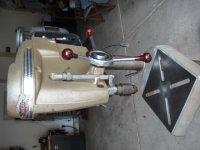
It's my belief that the hinged motor mount was introduced with the Craftsman 150 drill press in 1958. So that mm would be correct.


My Anniversary model DP (which I thought was a 1957) has the hinged mount.

Sorry, but I don't know how to rotate those images.
 

Attachments

  • cmdp1.JPG
    cmdp1.JPG
    135.4 KB · Views: 70
  • cmdp8.JPG
    cmdp8.JPG
    138.2 KB · Views: 67
To avoid these ads, REGISTER NOW!
OP
F

FrankLee

Well-known member
Joined
Sep 13, 2010
Messages
3,547
Location
seMI, 48317

SAA44-40

Well-known member
Joined
Jan 20, 2017
Messages
199
Location
West Texas
Almost done, adjusted the return and it snaps right back.
 

Attachments

  • 5B78FA65-C74F-4B74-92B9-86627F4CB3AA.jpg
    5B78FA65-C74F-4B74-92B9-86627F4CB3AA.jpg
    11.7 KB · Views: 88

SAA44-40

Well-known member
Joined
Jan 20, 2017
Messages
199
Location
West Texas
Okay. All buttoned up. Motor is now split phase-runs great. A couple of things I learned during this process, hopefully it will help others:
Do not use mothers mag polish on the machine turned accent
Meguires cleaner wax yields excellent results
Do not use nevr dull on the chromed knobs
Link belts are legit
And finally, when your youngster takes a hacksaw to your freshly sanded and waxed column...It’ll make me think of him and smile every time I use it
 
OP
F

FrankLee

Well-known member
Joined
Sep 13, 2010
Messages
3,547
Location
seMI, 48317
Okay. All buttoned up. Motor is now split phase-runs great. A couple of things I learned during this process, hopefully it will help others:
Do not use mothers mag polish on the machine turned accent
Meguires cleaner wax yields excellent results
Do not use nevr dull on the chromed knobs
Link belts are legit
And finally, when your youngster takes a hacksaw to your freshly sanded and waxed column...It’ll make me think of him and smile every time I use it

Hmm, here is the picture

Looks great! I like it!

What will you be using it for? Wood or metal? I ask because I see that your belt is in the fastest position. That is pdq.
 

sheltonfilms

Well-known member
Joined
May 28, 2014
Messages
157
Here's a question: When painting the headstock (especially a different color than original) what do you do with the inside cavities? Not much room to work with.
 

sheltonfilms

Well-known member
Joined
May 28, 2014
Messages
157
Got some of my motor pieces painted. I primed them and used a latex enamel paint. I'm thinking I should have used oil based. Everything I read online is conflicting about if latex is ok or not. Thoughts?
 

Attachments

  • IMG_1607.jpg
    IMG_1607.jpg
    143 KB · Views: 38

sheltonfilms

Well-known member
Joined
May 28, 2014
Messages
157
Frank which paint did you use on DP# 3 (your personal 150)?

13831278873_d7301c9bd1_b.jpg
 
OP
F

FrankLee

Well-known member
Joined
Sep 13, 2010
Messages
3,547
Location
seMI, 48317
Got some of my motor pieces painted. I primed them and used a latex enamel paint. I'm thinking I should have used oil based. Everything I read online is conflicting about if latex is ok or not. Thoughts?

Frank which paint did you use on DP# 3 (your personal 150)?

That was Rustoleum Dark Machine Gray in a spray can. I don't have any experience with latex paint for this type of application.
 

sheltonfilms

Well-known member
Joined
May 28, 2014
Messages
157
That was Rustoleum Dark Machine Gray in a spray can. I don't have any experience with latex paint for this type of application.

Thanks for the quick response.

I think I may switch it to the Rustoleum because the it looks very close to the color I want and I know in my personal experience rustoleum is usually tough as nails.

Doing some reading and I think you stated that the floor model base changed the mounting holes to a non-recessed style on the 150s in (IIRC) 59/60.

The 100 I picked up (non-tilt table/power bronze, either 56 or 57) has the non-recessed holes like your #3. Maybe tool catalogs are wrong on this? :dunno:
 
OP
F

FrankLee

Well-known member
Joined
Sep 13, 2010
Messages
3,547
Location
seMI, 48317
Thanks for the quick response.

I think I may switch it to the Rustoleum because the it looks very close to the color I want and I know in my personal experience rustoleum is usually tough as nails.

Doing some reading and I think you stated that the floor model base changed the mounting holes to a non-recessed style on the 150s in (IIRC) 59/60.

The 100 I picked up (non-tilt table/power bronze, either 56 or 57) has the non-recessed holes like your #3. Maybe tool catalogs are wrong on this? :dunno:

Yeah. Some of my observations were based on illustrations in the catalogs. Those smaller detail changes may not have been updated in catalogs in a timely manner. Can you verify whether the casting number has a 103 on the underside of the base?

Dupli-Color makes a Machinery Gray DA1612 that is just a bit darker than Rustoleum's.
Check this post: https://www.garagejournal.com/forum/showthread.php?p=5760584#post5760584
 
Last edited:

cseymour10

Member
Joined
Mar 13, 2016
Messages
6
Location
Santa Cruz, Ca
Hi Frank,
been browsing your thread and love the work you've been doing,
I've just started buying a few craftsman machines myself, little harder to find what I'm looking for on the west coast it seems.

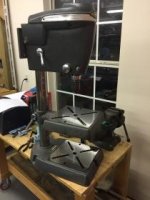
Found and picked up this Drill press for i think a decent price, has just a quick bad paint job that will need to be redone, but some how i didn't notice it was missing the Quill lock.

also need to figure out how the front piece of the vari-slo mounts, i think its all there but not attached.
 

Attachments

  • craftsman drill press.jpg
    craftsman drill press.jpg
    88.6 KB · Views: 85
OP
F

FrankLee

Well-known member
Joined
Sep 13, 2010
Messages
3,547
Location
seMI, 48317
Hi Frank,
been browsing your thread and love the work you've been doing,
I've just started buying a few craftsman machines myself, little harder to find what I'm looking for on the west coast it seems.

Found and picked up this Drill press for i think a decent price, has just a quick bad paint job that will need to be redone, but some how i didn't notice it was missing the Quill lock.

also need to figure out how the front piece of the vari-slo mounts, i think its all there but not attached.

Nice find!

Quill locks show up on ebay quite frequently. If you go the ebay route, and are looking for just the functionality, you don't necessarily need to find a Craftsman part.

Here is a Walker-Turner quill lock that will fit... and it's a great price! (not mine)
https://www.ebay.com/itm/Walker-Tur...774419?hash=item466df97013:g:ZL4AAOSw4PxZ52NS

I have this same quill lock and just test fitted it into a Craftsman 150 head frame. It works perfectly!

The differences between the W-T and Craftsman quill lock:
  • the bolt and lock cylinder are threaded 5/16-24 vs 5/6-18
  • the sleeve cylinder is longer; 1-5/16" vs 1"
  • the lock cylinder is longer; 1-1/8" vs 1"
  • the lock cylinder has a blind hole vs a through hole


If you are a purist and insist on a Craftsman part, look for one that has steel cylinders. IMO, the steel cylinders are superior to the cast cylinders.

You can always replace the bolt and use a Craftsman lever handle on the W-T lock.


More information on Craftsman drill press locks.
Craftsman drill press quill lock modifications.


There is a head casting piece of the Vari-Slo that I don't see. It has the red speed scale attached.

There are several scanned documents for your drill press and the Vari-Slo on that vintage machines website.

And here is the patent for the VS:
https://www.google.com/patents/US26...ved=0ahUKEwilv9-amtbOAhXClx4KHZqtBeUQ6AEIHDAA
 
Last edited:
To avoid these ads, REGISTER NOW!

RHJO51

Well-known member
Joined
Feb 27, 2015
Messages
242
Location
Red Hook, NY 12571
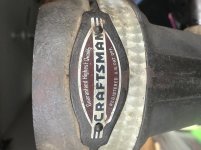
Hey guys, I didn't mean too but I stumbled across a 60s 150 floor model DP for $40. Couldn't pass it by. All there, dirty and a bit rusty. Looking forward to working on it. My question - the PO painted the head blue including painting over the big craftsman badge. Any suggestion on removing paint (no idea what kind of paint) without ruining the badge? No idea if it's in good shape or not but I want to see. Thank you - Jim
 

Outlawmws

Well-known member
Joined
Aug 9, 2011
Messages
39,107
Location
The Badlands
What I have done in the past for painted emblems Jim, is to lay some paper towel soaked with full strength Simple Green, Leave it for say 1/2 hour and see if the rattle can (I assume) paint is softening.

Repeat as needed. Go slow, as you don't want the SG to start in on the emblem paint. For more stubborn bits I used toothpicks to work at the paint. If it is rattle can paint it usually lifts off pretty easily. the original paint is tougher and stays longer as the surface was prepared, well before paint was applied.

The rattle can is generally sitting on top of whatever was over the paint (nicotine tar from smokers, dust, other light gunge...)
 

Trey T

Well-known member
Joined
Aug 3, 2011
Messages
3,749
Location
Houston, TX
That's a very nice bench-top DP w/ vari-slow ... I haven't seen that many of that model w/ vari-slow. How much, cseymour?
 

RHJO51

Well-known member
Joined
Feb 27, 2015
Messages
242
Location
Red Hook, NY 12571
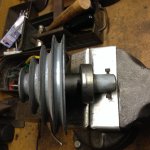
Hello Outlaw, thanks for the info on paint removal, I'll give it a try. But first an update. I started to pull this 150 apart, Seemed to run OK. I pulled out the spindle pulley and WTF, the spline inside this one are also shot - just gone, same as the other one I picked up. Good thing they were cheap. Interestingly the PO on this one tapped two screws through the pulley shaft to engage the spindle groves. Clever and it worked, but not good enough for me. Unfortunately I couldn't see the problem until I took it apart. Anyone have a good used spindle pulley? Thanks - Jim
 

Attachments

  • IMG_6979.jpg
    IMG_6979.jpg
    131.4 KB · Views: 58

michaelwolson

Well-known member
Joined
Mar 20, 2017
Messages
163
Location
San Jose, CA
Hello Outlaw, thanks for the info on paint removal, I'll give it a try. But first an update. I started to pull this 150 apart, Seemed to run OK. I pulled out the spindle pulley and WTF, the spline inside this one are also shot - just gone, same as the other one I picked up. Good thing they were cheap. Interestingly the PO on this one tapped two screws through the pulley shaft to engage the spindle groves. Clever and it worked, but not good enough for me. Unfortunately I couldn't see the problem until I took it apart. Anyone have a good used spindle pulley? Thanks - Jim

Looking at the current costs on ebay I wonder if it wouldn't be more cost effective to just have one machined?

No idea how much that would cost though.
 

Outlawmws

Well-known member
Joined
Aug 9, 2011
Messages
39,107
Location
The Badlands
It might be cheaper to get a splined sleeve that fits the spindle, then bore the worn pulleys for that, and light pres/epoxy them in...
 

sheltonfilms

Well-known member
Joined
May 28, 2014
Messages
157
Here is what I would almost do. Find a dowel the same size as the round bore near the top of the spindle pulley aka the max diameter of the splines. Place the rod/dowel into the pulley from the top until it is 5/8" away from the end. Then mix up some JB weld or other metal infused epoxy and spread it where the internal splines used to be. Then take the quill spline with some release agent sprayed on the tip and insert it into the bottom of the spindle pulley to mold the internal splines. The dowel rod will give a "bottom" to this process. Let it sit for a good 24 hours. Maybe able to remove the splines around hour 2 or 3. After 24 hours you can use a fine file to smooth the material a little bit.

Only issue i see is if you have nothing at all it maybe hard to center the quill shaft into the board. Maybe a dimple can be placed into the dowel rod to center it.
 

Slednut

Well-known member
Joined
Dec 20, 2012
Messages
2,550
Location
Washington state
First time I've seen this thread, I just purchased this a few weeks ago off CL for $75. Came with an extra belt and vise.

The protector plastic was still on the side panels, they look like new.
 

Attachments

  • P82A1302.jpg
    P82A1302.jpg
    133.9 KB · Views: 80
  • P82A1301.jpg
    P82A1301.jpg
    128.1 KB · Views: 113

RHJO51

Well-known member
Joined
Feb 27, 2015
Messages
242
Location
Red Hook, NY 12571
Hello Guys, your ideas on fixing the spindle pulley are good - keep them coming. Rather fix this one then turn it into a parts machine. Thanks again
 

RHJO51

Well-known member
Joined
Feb 27, 2015
Messages
242
Location
Red Hook, NY 12571
Any thoughts on using JB Weld to Make splines in my spindle pulley? There's not a lot of meat there for a spline bushing even if I could find the right one. Would the JB weld be tough enough for the torque of the 1/2 hp motor? spindle and original splines are just pot metal. Probably not much to lose but just wondering what y'all think. Thanks - Jim
 
OP
F

FrankLee

Well-known member
Joined
Sep 13, 2010
Messages
3,547
Location
seMI, 48317
Any thoughts on using JB Weld to Make splines in my spindle pulley? There's not a lot of meat there for a spline bushing even if I could find the right one. Would the JB weld be tough enough for the torque of the 1/2 hp motor? spindle and original splines are just pot metal. Probably not much to lose but just wondering what y'all think. Thanks - Jim

I've never had to deal with that situation, but I agree with your thoughts on using JB Weld.

JZiggy posted photos of a splined bushing in a pulley up in post 180, but the photos are now being held hostage by botophucket. If he's watching maybe he'll repost those photos.

IIRC, some other manufacturers use a separate pulley installed onto a splined sleeve. Atlas perhaps. Craftsman did too on later machines with 8-step pulleys, but that sleeve does not fit older spindles.

If that were my machine, it would likely be parted out.
 
Last edited:

sheltonfilms

Well-known member
Joined
May 28, 2014
Messages
157
Any thoughts on using JB Weld to Make splines in my spindle pulley? There's not a lot of meat there for a spline bushing even if I could find the right one. Would the JB weld be tough enough for the torque of the 1/2 hp motor? spindle and original splines are just pot metal. Probably not much to lose but just wondering what y'all think. Thanks - Jim

I think if you file grooves into where the new "male" teeth will be it would add more strength, think of the JB weld acting like keystock. Instead of it breaking the adhesion of the JB weld to the metal it would have to shear it.

Another idea is to cut the grooves and actually add steel "keystocks" to it and then use JB weld to make the final shape.
 

sheltonfilms

Well-known member
Joined
May 28, 2014
Messages
157
Well I picked up my 2nd drill press yesterday. Set an alert on FB market place and pulled the trigger as soon as I got the alert. Person was an hour 1/2 away but was on the way to my in laws house for Thanksgiving. Perfect Luck.

I'm trying to figure out the year on this one, but I'm confused on some of the characteristics:

It has a 6 3/4 throat (13 1/2).
Has machine screws on the engine turned band.
Has the nut/alloy locks.
Closed loop depth stop collar (bore isn't all the way through and has shoulder for quill to stop in).
Has threaded lock collar chuck.
Doesn't have rib on motor mount.
Model number 103.23640.


Table was in perfect shape (no holes or dimples).
Splines of spindle pulley were great with no radial slop between quill splines and pulley.

I personally like the straight handle better than the 3 handle version.
 

Attachments

  • IMG_1747.jpg
    IMG_1747.jpg
    8.7 KB · Views: 33
  • IMG_1771.jpg
    IMG_1771.jpg
    143.8 KB · Views: 54
  • IMG_1772.jpg
    IMG_1772.jpg
    144.8 KB · Views: 62
  • IMG_1776.jpg
    IMG_1776.jpg
    137.7 KB · Views: 62
  • IMG_1774.jpg
    IMG_1774.jpg
    129.1 KB · Views: 60
  • IMG_1777.jpg
    IMG_1777.jpg
    142.9 KB · Views: 57
  • IMG_1762.jpg
    IMG_1762.jpg
    113.5 KB · Views: 78
Last edited:
OP
F

FrankLee

Well-known member
Joined
Sep 13, 2010
Messages
3,547
Location
seMI, 48317
Well I picked up my 2nd drill press yesterday. Set an alert on FB market place and pulled the trigger as soon as I got the alert. Person was an hour 1/2 away but was on the way to my in laws house for Thanksgiving. Perfect Luck.

I'm trying to figure out the year on this one, but I'm confused on some of the characteristics:

It has a 6 3/4 throat (13 1/2).
Has machine screws on the engine turned band.
Has the nut/alloy locks.
Closed loop depth stop collar (bore isn't all the way through and has shoulder for quill to stop in).
Has threaded lock collar chuck.
Doesn't have rib on motor mount.
Model number 103.23640.


Table was in perfect shape (no holes or dimples).
Splines of spindle pulley were great with no radial slop between quill splines and pulley.

I personally like the straight handle better than the 3 handle version.

That is a very nice drill press and every bit as capable as it's 15-1/2" big brother.
  • The spindle and quill are the same diameters as 100/150 only shorter.
  • The spindle pulley bearings and the quill bearings are identical to the 100/150.
  • The spindle pulley is the same diameter as the 100/150 only the shaft is shorter.
  • The castings are just as heavy duty as the 100/150 only smaller.


That two-knob handle and pinion assembly will transfer to your 100.


Determining the model year

It's often very difficult to pin-point a specific year on these machines. Using the owners manuals, I've been able to identify when a change was made. However, there are a couple problems relying on the owners manuals. First, not all owners manuals were dated, and second, the date on those that are dated is likely a publication or copyright date, which may or may not correspond to the model year or catalog date.

I've also had to make the assumption that changes across the 80 and 100 model lines occurred in the same year.
For example, this owners manual for a 13-1/2" machine dated October, 1946, has all the features you listed above.

This owners manual for a 15-1/2" machine is dated December 1947. It MAY have all the features you listed above, but the scan is somewhat blurry.

I did not find any scans from 1948 or 1949.
This owners manual for a 15-1/2" machine is dated January 1950 . It also may have all the featuresyou listed above.

This owners manual for a 15-1/2" machine is dated January 1951. It has only two features you listedabove; the bracket and the locks.

This owners manual for a 13-1/2" machine has only two features you listed above; the bracket andthe locks.

There is no copyright date on this manual. Whoever scanned and submitted this decided it was from1952. So the 1952 date can be discounted.

Therefore, I think it can only be determined that your machine was made between 1946 and 1950.And that is using the publication dates. The actual model year could be later.

Using catalogs to date machines is likely more difficult. Catalogs of the time used illustrations and notphotographs.

10/1/2018

In conjunction with owners manuals and catalogs, advertising can sometimes be used to date feature upgrades. For instance, the
1952 Craftsman Power Tool Catalog is the first catalog to tout the new Jacob's Safe-Lock chuck. This advertisement from the May 1951 edition of Popular Mechanics publicized the new design.

2/6/2020

More About Determining the Model Year


There are several things that can be used to estimate model years. Most of these are guesstimates. It is very difficult to be absolutely precise.

catalogs
Catalogs are a great research resource for determining when items were available.
A couple problems though... items were illustrated, not photographed. Illustrations were not always updated, so subtle exterior changes were not always documented.

There are several years where catalogs were not produced.

There were several years where catalogs spanned two years.


FrankLee
3/20/2015:
Links to Drill Press Pages in Craftsman Catalogs
I often refer to the old Craftsman Power Tool catalogs to check or verify drill press information. It's a pita, though, toscroll through each one to find the drill press page time after time.
So, here are links I created to Craftsman Power Tool Catalogs with the #page= parameter to go directly to the drillpress page in each catalog. The #page= parameter may or may not work depending on your browser. It works fine in Chrome.
1937 - http://vintagemachinery.org/pubs/222/4459.pdf#page=25
1938 - http://vintagemachinery.org/pubs/222/4462.pdf#page=33
1939 - http://vintagemachinery.org/pubs/222/4464.pdf#page=31
1940 - http://vintagemachinery.org/pubs/222/2954.pdf#page=33
1941 - http://vintagemachinery.org/pubs/222/4393.pdf#page=35
1942 - http://vintagemachinery.org/pubs/222/2961.pdf#page=35
1943 - http://vintagemachinery.org/pubs/222/2697.pdf#page=25
1948 - http://vintagemachinery.org/pubs/222/4391.pdf#page=30
1949 - http://vintagemachinery.org/pubs/222/4460.pdf#page=22
1950 - http://vintagemachinery.org/pubs/222/2958.pdf#page=28
1951 - http://vintagemachinery.org/pubs/222/2960.pdf#page=34
1952 - http://vintagemachinery.org/pubs/222/5285.pdf#page=30
1953 - http://vintagemachinery.org/pubs/222/2698.pdf#page=36
1954 - http://vintagemachinery.org/pubs/222/1759.pdf#page=32
1955 - http://vintagemachinery.org/pubs/222/2699.pdf#page=30
1956 - http://vintagemachinery.org/pubs/222/2122.pdf#page=30
1957 - http://vintagemachinery.org/pubs/222/4403.pdf#page=30
1959/60 - http://vintagemachinery.org/pubs/222/2876.pdf#page=21
1960/61 - http://vintagemachinery.org/pubs/222/4563.pdf#page=31
1963 - http://vintagemachinery.org/pubs/222/4409.pdf#page=35
1964 - http://vintagemachinery.org/pubs/222/2874.pdf#page=35
1966 - http://vintagemachinery.org/pubs/222/4428.pdf#page=18
1968 - http://vintagemachinery.org/pubs/222/6895.pdf#page=18
1969 - http://vintagemachinery.org/pubs/222/4562.pdf#page=36
1970 - http://vintagemachinery.org/pubs/222/17198.pdf#page=38
1971 - http://vintagemachinery.org/pubs/222/9490.pdf#page=18
1972/73 - http://vintagemachinery.org/pubs/222/6894.pdf#page=34
1973/74 - http://vintagemachinery.org/pubs/222/17449.pdf#page=78
1974/75 - http://vintagemachinery.org/pubs/222/13749.pdf#page=74
1976/77 - http://vintagemachinery.org/pubs/222/12723.pdf#page=126
1977/78 - http://vintagemachinery.org/pubs/222/16306.pdf#page=14
1978/79 - http://vintagemachinery.org/pubs/222/16540.pdf#page=12

owners manuals
It seems that not all owners manuals were date stamped and not all years are represented on VM. Even if they were dated, what does the date mean? Copyright date? Publication date? Catalog date? Model year date? Comparing manuals with different dates can help identify when changes were introduced.

There are four unique early Craftsman 100 owners manuals on VM that have dates printed:
1946
1947
1950
1951

I could not tell any differences between the '46, '47 and '50 versions. The '51 version has changes from the earlier versions. There is also another early Craftsman 100 owners manual on VM that was rubber-stamped with a 1955 date. Because the date was rubber-stamped, it may or may not be reliable. This one has more changes from previous versions.

motor tags
Motor information tags often have a date code stamped onto them. I believe this is the date of manufacture. This can be a good clue to the model year of the drill press, but it's only circumstantial. Motors were optional, so they may not have been bought with the machine.

advertising
Advertisements are a very good resource to help date machines. In conjunction with owners manuals and catalogs, advertising can sometimes be used to date feature upgrades. For instance, the 1952 Craftsman Power Tool Catalog is the first catalog to tout the new Jacob's Safe-Lock chuck. This advertisement from the March 1951 edition of Popular Mechanics publicized the new design.
Unfortunately, there's not a lot of advertising specific to drill presses.

receipts
Original dated receipts are gold. However, there are rarely found or included with machines.

patents
Patents are not too much help in dating machines, but they are interesting to peruse when found.


So, using owners manuals and catalogs, I believe Craftsman 100 drill presses can be fairly easily categorized into one of the following time period windows. Motor tags may also suggest a mores specific date.
'46-'50
'51
'52-'53
'54
'56
'57
 
Last edited:

sheltonfilms

Well-known member
Joined
May 28, 2014
Messages
157
Ok looks like it is a 1947 model (if the motor is correct). Motor was a Dunlap 1/3 HP and i looked at the wrong number on the stamping.

I think the chuck messed me up:

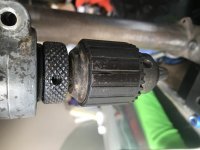
"In 1952, the Jacobs Safe-Lock chuck with a swiveling threaded lock collar (right) was introduced as a standard feature. "

So after 1952 is the collar directly attached to the chuck? This press seems to have a similar collar to the '56 I have.
 
OP
F

FrankLee

Well-known member
Joined
Sep 13, 2010
Messages
3,547
Location
seMI, 48317
Ok looks like it is a 1947 model (if the motor is correct). Motor was a Dunlap 1/3 HP and i looked at the wrong number on the stamping.

I think the chuck messed me up:

"In 1952, the Jacobs Safe-Lock chuck with a swiveling threaded lock collar (right) was introduced as a standard feature. "

So after 1952 is the collar directly attached to the chuck? This press seems to have a similar collar to the '56 I have.

Yes, attached collar is the safety chuck. If this is your '56, it does have the safety collar.


If your 13-1/2" drill press was a '40s model, it is actually a 100.
 

Cruzan80

Well-known member
Joined
Jul 22, 2015
Messages
4,168
Location
Denver, CO
Ok looks like it is a 1947 model (if the motor is correct). Motor was a Dunlap 1/3 HP and i looked at the wrong number on the stamping.

I think the chuck messed me up:

"In 1952, the Jacobs Safe-Lock chuck with a swiveling threaded lock collar (right) was introduced as a standard feature. "

So after 1952 is the collar directly attached to the chuck? This press seems to have a similar collar to the '56 I have.
What is the actual date code (month)? Trying to figure out when CM/Dunlap motors started post war

Sent from my Moto G (5) Plus using Tapatalk
 
To avoid these ads, REGISTER NOW!
Top Bottom