To avoid these ads, REGISTER NOW!

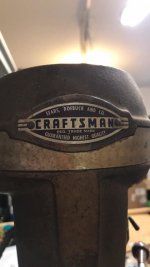
Craftsman Drill Press

To avoid these ads, REGISTER NOW!
OP
F

FrankLee

Well-known member
Joined
Sep 13, 2010
Messages
3,551
Location
seMI, 48317
Re: dp#66

Always nice to see one with a lift. Is that a rotary table with it too?

No rotary table. I did get all the Proto puller parts sitting on the base.

The seller had a poorly advertised garage sale yesterday and I didn't see the FB ad until today. I was still able to get a hold of him and luckily the drill press was still available. I picked some other things, but he said I missed a bunch of good stuff yesterday.
 

jkherd

Well-known member
Joined
Mar 22, 2009
Messages
564
Location
Southwest Missouri
Here is the one I use, according to the model # it is from 1937. It needed some work and new cord and switch.
 

Attachments

  • DSCN0078.jpg
    DSCN0078.jpg
    110.4 KB · Views: 60
  • DSCN0079.jpg
    DSCN0079.jpg
    102.3 KB · Views: 60

Junkman

Well-known member
Joined
Dec 18, 2006
Messages
6,607
Location
Northeastern CT
I am at the stage where I just don't know what way to go.. Do I use the head that is on my tall drill press (150) that was manufactured prior to 1967 when I originally purchased it used (painted grey from the factory), or the one that I just picked up, painted gold with the later improvements (???) to the head. Either way, both heads should be taken apart, cleaned and new bearings installed. I had disassembled and painted my original one about 10 years ago, but the information in this thread wasn't available, and I never took the quill apart. It had a wobble in it then, and after painting and reassembly, I haven't used it because of the wobble in the quill.
I was thinking that I could swap the heads, and keep them both, or sell the bench model (with either head) as is, and let the next buyer put new bearings into the quill.
My question is, which would be the better one to keep, the grey one (pre 1967) or the gold one, which I don't know its age. My tall press is missing its data plate. I removed it when I painted the base, and misplaced it. The numbers on the data plate (gold one) are 103.24521
 

Attachments

  • MVC-007S.jpg
    MVC-007S.jpg
    148.5 KB · Views: 24
OP
F

FrankLee

Well-known member
Joined
Sep 13, 2010
Messages
3,551
Location
seMI, 48317
I am at the stage where I just don't know what way to go.. Do I use the head that is on my tall drill press (150) that was manufactured prior to 1967 when I originally purchased it used (painted grey from the factory), or the one that I just picked up, painted gold with the later improvements (???) to the head. Either way, both heads should be taken apart, cleaned and new bearings installed. I had disassembled and painted my original one about 10 years ago, but the information in this thread wasn't available, and I never took the quill apart. It had a wobble in it then, and after painting and reassembly, I haven't used it because of the wobble in the quill.
I was thinking that I could swap the heads, and keep them both, or sell the bench model (with either head) as is, and let the next buyer put new bearings into the quill.
My question is, which would be the better one to keep, the grey one (pre 1967) or the gold one, which I don't know its age. My tall press is missing its data plate. I removed it when I painted the base, and misplaced it. The numbers on the data plate (gold one) are 103.24521

From what I can gather, the gold machine has the external spring tension knob and the grey one doesn't.(?)

My preference is the Craftsman 100 casting, but I upgraded every sub-assembly with later improved parts; quill with snap ring, feed handle hub with 1/2-13 threads, pivot motor mount, rapid adjust feed stop. I guess you could say it's a Craftsman 125.
:lol_hitti

I've also found that the King-Seeley castings seem to be better than the Emerson castings.
 

sheltonfilms

Well-known member
Joined
May 28, 2014
Messages
157
From what I can gather, the gold machine has the external spring tension knob and the grey one doesn't.(?)


My preference is the Craftsman 100 casting, but I upgraded every sub-assembly with later improved parts; quill with snap ring, feed handle hub with 1/2-13 threads, pivot motor mount, rapid adjust feed stop. I guess you could say it's a Craftsman 125.

:lol_hitti


I've also found that the King-Seeley castings seem to be better than the Emerson castings.


What differences have you seen in the castings? Is there some design changes or is it more in the quality of the cast?


Sent from my iPhone using Tapatalk
 
OP
F

FrankLee

Well-known member
Joined
Sep 13, 2010
Messages
3,551
Location
seMI, 48317
What differences have you seen in the castings? Is there some design changes or is it more in the quality of the cast?

Mostly quality. EEC castings seem to have more chips, voids, blemishes and flash. The finish sanding/grinding is not as tidy or carefully done either.
 
Last edited:

GreyEyes

Well-known member
Joined
Mar 25, 2019
Messages
54
Location
Florida
. It had a wobble in it then, and after painting and reassembly, I haven't used it because of the wobble in the quill.
.........
My question is, which would be the better one to keep

I would determine what is causing the wobble before deciding the course of action. Unless the bearings have gotten to the gritty, grinding, howling, balls ready to fall out of the races stage, they don't normally cause much runout. Remove the chuck and check the spindle runout. If it's okay, clean both spindle and chuck tapers really well, looking for any burrs or rust. Reassemble and check runout again. If the runout is from the chuck try the one from the other drill. If the spindle is bent either keep the other one or Frankenstein the two together using the best of both.
 

GreyEyes

Well-known member
Joined
Mar 25, 2019
Messages
54
Location
Florida
Re: DP#66 with Table Lift

These jam nuts normally carry the weight of the drill press table. The bottom surface of this nut is badly worn from wearing against the cast iron gear housing. This is why I strongly recommend moving the thrust bearing from inside of the housing to the outside.

For those without the slow speed or the vari-slo that find use in raising or lowering the head as well as the table you could use 2 thinner needle roller thrust bearings, one on the inside and one on the outside.

Personally I have not found a need to lower the head on a DP, but given the wide range of accessories that Craftsman marketed for these, some may have been easier to use with a lowered head.
 
OP
F

FrankLee

Well-known member
Joined
Sep 13, 2010
Messages
3,551
Location
seMI, 48317
dp#67, dp#68

My winter projects are reaching capacity. dp#67 is a Craftsman 12-1/4" model 103.23100. dp#68 is a Craftsman 150 model 113.24501. Neither motors are Craftsman.


10/1/2019

The column and cast iron on dp#68 cleaned up nicely.


10/09/2019

dp#66 and dp#68 cast iron is cleaned. Most internal parts are cleaned. Motors are cleaned with new cords.


10/12/2019

DP#68 is complete and is a beauty!

 
Last edited:

sunder

Well-known member
Joined
Aug 11, 2019
Messages
63
Location
IL
Re: The Classic Craftsman 100/150 Drill Press

This one looks really good.

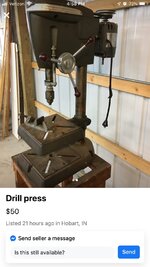
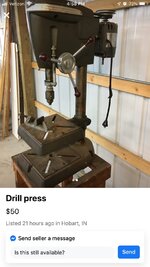
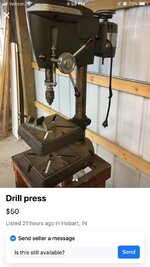
On facebook market place for $50

0f14a2214fb3b29cb748d11277f99cc5.jpg


Sent from my iPhone using Tapatalk Pro
 

Attachments

  • 0f14a2214fb3b29cb748d11277f99cc5.jpg
    0f14a2214fb3b29cb748d11277f99cc5.jpg
    314.4 KB · Views: 3

sheltonfilms

Well-known member
Joined
May 28, 2014
Messages
157
Saw this in another forum's classified section.

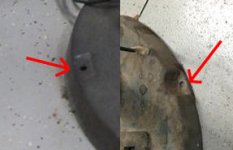
Flat cap went bad on motor so he made the base taller using 1/2" square tubing and rounded the corners. Gives more space for modern caps.

attachment.php


attachment.php
 

Attachments

  • motormount.jpg
    motormount.jpg
    112.6 KB · Views: 304
  • motormount1.jpg
    motormount1.jpg
    106.6 KB · Views: 309

bsorcs

Member
Joined
Jun 1, 2019
Messages
19
Location
New Orleans
On a piece of equipment that also has 120v for controls and such the high leg location matters, but on a simple motor it does not


Here is a very good decription of how to determine motor wiring, towards the bottom of the thread:

**I don't have enough posts here to share a link, I will PM it to you, will add it to this post when able**

This should be marked on your motor, but if it is missing this shows how to determine it.

So...I used the Practical Machinist guidance and deduced from the continuities that the motor is wired delta. The diagram on the inside of the wiring access plate of the motor directs me to supply power as though it is Wye wired...L1 to 1 and 7; L2 to 2 and 8; L3 to 3 and 9; and 4-6 together. Based on the continuities I wired for delta...L1 to 1,6,7; L2, 2,4,8; and L3 to 3,5,9. Next I revisited the switch diagram and got that straight, as per the pic previously posted. Result was that the motor ran like a top in both directions, sans smoke. Called it a day.

Subsequently, I ran the motor for a couple of minutes to ScotchBrite the chuck. On stopping the motor I noted that it was too hot to touch...sort of like bad bearings on an axle after a run. Only thing I can think of is to try re-wiring L1 - L3 in the wye configuration, now that I have the switch wiring straight. Any thought on this? More and more confused.
 

bsorcs

Member
Joined
Jun 1, 2019
Messages
19
Location
New Orleans
On a piece of equipment that also has 120v for controls and such the high leg location matters, but on a simple motor it does not


Here is a very good decription of how to determine motor wiring, towards the bottom of the thread:

**I don't have enough posts here to share a link, I will PM it to you, will add it to this post when able**

This should be marked on your motor, but if it is missing this shows how to determine it.

So...I used the Practical Machinist guidance and deduced from the continuities that the motor is wired delta. The diagram on the inside of the wiring access plate of the motor directs me to supply power as though it is Wye wired...L1 to 1 and 7; L2 to 2 and 8; L3 to 3 and 9; and 4,5 and 6 together. Based on the continuities I wired for delta...L1 to 1,6,7; L2 to 2,4,8; and L3 to 3,5,9. Next I revisited the switch diagram and got that straight, as per the pic previously posted. Result was that the motor ran like a top in both directions, sans smoke. Called it a day.

Subsequently, I ran the motor for a couple of minutes to ScotchBrite the chuck. On stopping the motor I noted that it was too hot to touch...sort of like bad bearings on an axle after a run. Only thing I can think of is to try re-wiring L1 - L3 in the wye configuration, now that I have the switch wiring straight. Any thought on this? More and more confused.
 

ClappedOutBport

Well-known member
Joined
Mar 30, 2016
Messages
998
So...I used the Practical Machinist guidance and deduced from the continuities that the motor is wired delta. The diagram on the inside of the wiring access plate of the motor directs me to supply power as though it is Wye wired...L1 to 1 and 7; L2 to 2 and 8; L3 to 3 and 9; and 4,5 and 6 together. Based on the continuities I wired for delta...L1 to 1,6,7; L2 to 2,4,8; and L3 to 3,5,9. Next I revisited the switch diagram and got that straight, as per the pic previously posted. Result was that the motor ran like a top in both directions, sans smoke. Called it a day.

Subsequently, I ran the motor for a couple of minutes to ScotchBrite the chuck. On stopping the motor I noted that it was too hot to touch...sort of like bad bearings on an axle after a run. Only thing I can think of is to try re-wiring L1 - L3 in the wye configuration, now that I have the switch wiring straight. Any thought on this? More and more confused.

Uh, maybe a dumb question, but: are the bearings good? Otherwise, I dunno.
 
To avoid these ads, REGISTER NOW!

GreyEyes

Well-known member
Joined
Mar 25, 2019
Messages
54
Location
Florida
So...I used the Practical Machinist guidance and deduced from the continuities that the motor is wired delta. The diagram on the inside of the wiring access plate of the motor directs me to supply power as though it is Wye wired...L1 to 1 and 7; L2 to 2 and 8; L3 to 3 and 9; and 4,5 and 6 together. Based on the continuities I wired for delta...L1 to 1,6,7; L2 to 2,4,8; and L3 to 3,5,9. Next I revisited the switch diagram and got that straight, as per the pic previously posted. Result was that the motor ran like a top in both directions, sans smoke. Called it a day.

Subsequently, I ran the motor for a couple of minutes to ScotchBrite the chuck. On stopping the motor I noted that it was too hot to touch...sort of like bad bearings on an axle after a run. Only thing I can think of is to try re-wiring L1 - L3 in the wye configuration, now that I have the switch wiring straight. Any thought on this? More and more confused.

Doesn't make a whole lot of sense. I would wire as the diagram on the access plate. If you discovered you had an error in the switch wiring that could have been the issue. I would also try running it with the belt disconnected to remove any other possible causes for overheating (belt alignment, spindle bearings)
 

bsorcs

Member
Joined
Jun 1, 2019
Messages
19
Location
New Orleans
Doesn't make a whole lot of sense. I would wire as the diagram on the access plate. If you discovered you had an error in the switch wiring that could have been the issue. I would also try running it with the belt disconnected to remove any other possible causes for overheating (belt alignment, spindle bearings)

The motor is a new, 1/2 hp, Lincoln 3-phase, so I am assuming that the bearings therein are good. As I noted earlier, wired delta it ran well in both directions but heated up, excessively to my mind. Today I changed the wiring to match the wye diagram provided: L1 to 1-7; L2 to 2-8; and L3 to 3-9. It started and ran very slowly without load, and soon gave off a bit of smoke. This suggests to me a couple of things.

1-That the provided diagram is incorrect and that, based on the check of engine-lead continuities, the motor is indeed wired delta.

2-There is a problem in how I wired the switch. The wiring diagram therein does not label the leads, so I assumed that I could start at one side of the three leads and call that one L1, then proceed through the other two, with L2 being the 240-volt leg. I'll revisit the diagram yet again tomorrow and check continuities and potentials coming out of the switch.

Beyond the above, I am at a loss as to why the motor seems to be running hot. I'll try to get in touch with the manufacturer to see if they can elucidate a solution.
 

GreyEyes

Well-known member
Joined
Mar 25, 2019
Messages
54
Location
Florida
The motor is a new, 1/2 hp, Lincoln 3-phase, so I am assuming that the bearings therein are good. As I noted earlier, wired delta it ran well in both directions but heated up, excessively to my mind. Today I changed the wiring to match the wye diagram provided: L1 to 1-7; L2 to 2-8; and L3 to 3-9. It started and ran very slowly without load, and soon gave off a bit of smoke. This suggests to me a couple of things.

1-That the provided diagram is incorrect and that, based on the check of engine-lead continuities, the motor is indeed wired delta.

2-There is a problem in how I wired the switch. The wiring diagram therein does not label the leads, so I assumed that I could start at one side of the three leads and call that one L1, then proceed through the other two, with L2 being the 240-volt leg. I'll revisit the diagram yet again tomorrow and check continuities and potentials coming out of the switch.

Beyond the above, I am at a loss as to why the motor seems to be running hot. I'll try to get in touch with the manufacturer to see if they can elucidate a solution.

If you can post a picture of your switch it would help.

You could also remove the switch from the equation. Wire the motor direct to test. That will show if it is a switch or motor wiring issue.
 

bsorcs

Member
Joined
Jun 1, 2019
Messages
19
Location
New Orleans
Finally photos. Mea Culpa.

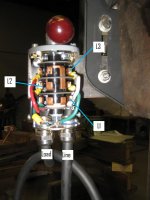
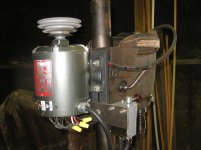
Re-visited the dp once again. Cords, switch, and delta connections in order; high leg [L2] connection in the switch was loose. Tightened the connection. Started and measured current in the 3 legs into the motor leads: L1[blk] 8.2a; L2[red] 9.5a; L3[wht] 9.8a. I have no idea how close currents in the individual legs should be.

Forward and reverse in order; quiet run; no smoke/spark/etc.

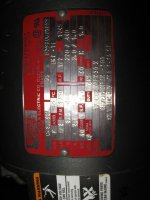
Per the photo, the motor is TE, not TEFC, unfortunately it seems. It got warm.

I put a call in to Leeson and will send motor tag photo. The motor is definitely NOS; could be 20+ years old. If Leeson cannot help, I'll take it to my favorite motor shop for a checkup.
 

Attachments

  • Labelled switch.jpg
    Labelled switch.jpg
    76.4 KB · Views: 57
  • Switch wiring diagram.jpg
    Switch wiring diagram.jpg
    91.6 KB · Views: 48
  • DP port side.jpg
    DP port side.jpg
    114.4 KB · Views: 56
  • Wired delta.jpg
    Wired delta.jpg
    116.4 KB · Views: 48
  • Motor tag 02.jpg
    Motor tag 02.jpg
    76.2 KB · Views: 45
Last edited:

GreyEyes

Well-known member
Joined
Mar 25, 2019
Messages
54
Location
Florida
Re-visited the dp once again. Cords, switch, and delta connections in order; high leg [L2] connection in the switch was loose. Tightened the connection. Started and measured current in the 3 legs into the motor leads: L1[blk] 8.2a; L2[red] 9.5a; L3[wht] 9.8a. I have no idea how close currents in the individual legs should be.

Your switch wiring appears correct, but your current readings are 4 times higher than they should be. Something is not right.
 
Last edited:

sunder

Well-known member
Joined
Aug 11, 2019
Messages
63
Location
IL
Re: The Classic Craftsman 100/150 Drill Press

And why isn't it in your shop/garage?

Sent from my SM-G930T using Tapatalk


I have a full size one i am restoring right now


Sent from my iPhone using Tapatalk Pro
 

bsorcs

Member
Joined
Jun 1, 2019
Messages
19
Location
New Orleans
Your switch wiring appears correct, but your current readings are 4 times higher than they should be. Something is not right.

Stellar observation. So, might there be an issue with the power coming out of the outlet? It's 120v, 240v, and 120v at a, b, and c...V = i x R. I'll check current entering the switch. Where else to look? Sounds kinda like a trip to the motor shop. I am still quite puzzled about the low-voltage wye wiring diagram on the inside of the wiring plate...L1 to 1,7 L2 to 2,8, L3 to 3,9. Maybe the Leeson folks can shed some light on that.

I'm just a simple geochemist, not a physics major.

Just had a thought: motor ambient temperature per the tag is 65 degrees Celsius. I don't think that I can hold my hand against that for more that few seconds based on time in a hot tub at 108 F. Might this be some sort of resolution [althought it does NOT explain the amperage issue]?
 
Last edited:

GreyEyes

Well-known member
Joined
Mar 25, 2019
Messages
54
Location
Florida
Stellar observation. So, might there be an issue with the power coming out of the outlet? It's 120v, 240v, and 120v at a, b, and c...V = i x R. I'll check current entering the switch. Where else to look? Sounds kinda like a trip to the motor shop. I am still quite puzzled about the low-voltage wye wiring diagram on the inside of the wiring plate...L1 to 1,7 L2 to 2,8, L3 to 3,9. Maybe the Leeson folks can shed some light on that.

I'm just a simple geochemist, not a physics major.

Just had a thought: motor ambient temperature per the tag is 65 degrees Celsius. I don't think that I can hold my hand against that for more that few seconds based on time in a hot tub at 108 F. Might this be some sort of resolution [althought it does NOT explain the amperage issue]?

Measure the voltages at the line terminals at the switch, you should have 240 between any two pairs.

That temperature rating is the max environmental temperature (the air surrounding the motor) that the motor can be operated in.
 

bsorcs

Member
Joined
Jun 1, 2019
Messages
19
Location
New Orleans
Measure the voltages at the line terminals at the switch, you should have 240 between any two pairs.

That temperature rating is the max environmental temperature (the air surrounding the motor) that the motor can be operated in.

240v present between all pairs. I'm going to take it to the shop.
 

GreyEyes

Well-known member
Joined
Mar 25, 2019
Messages
54
Location
Florida
240v present between all pairs. I'm going to take it to the shop.

Probably your best bet.

It really should be wired wye if that's what the data plate shows. Wiring delta instead could be the cause of the high current draw (and heat), but the question is why doesn't it run connected wye if that is its design? Bad winding? Mis-numbered winding wires? It is quite puzzling for sure.
 

gpw_42

Well-known member
Joined
Apr 24, 2017
Messages
717
Location
NC Sandhills, USA
Found this (late?) 150 for sale on the net; seller states it needs a new power cord (cracked) and belt. I've asked for pic of the table and the other side of the DP. Seller said it'd be tonight before he can send pics, which is reasonable. This might be my 1st DP. It's a 2 hour drive (in each direction).

Is there anything else I need to ask about before I go buy this thing? Any obvious warning signs in these pictures? Or should I just squat and hold till something closer comes along? Price is reasonable.

Thanks!

Update 10/9/19
The easy to remove parts are off the head.

To do:
- replace the electric cord
- remove the quill
- get an AutoZone belt
- get FrankLee's replacement washer & quill bumper set
- test runout
- disassemble chuck for cleaning. It opens/closes well.
Cosmetics:
- finish cleaning
- strip & paint (?)
- finish getting back to bare metal on table, column and base. Then coat all with paste wax.
 

Attachments

  • 70955954_10104686616689631_608771580817833984_n.jpg
    70955954_10104686616689631_608771580817833984_n.jpg
    28.7 KB · Views: 54
  • 71045848_10104686616485041_8990884671143280640_n.jpg
    71045848_10104686616485041_8990884671143280640_n.jpg
    43.6 KB · Views: 48
  • 69945963_10104686616505001_3037557603677765632_n.jpg
    69945963_10104686616505001_3037557603677765632_n.jpg
    47.2 KB · Views: 50
  • 70647443_10104686616480051_8761345280789446656_n.jpg
    70647443_10104686616480051_8761345280789446656_n.jpg
    43.8 KB · Views: 63
  • 69625445_10104686618446111_880842417396252672_n.jpg
    69625445_10104686618446111_880842417396252672_n.jpg
    30.3 KB · Views: 58
Last edited:
OP
F

FrankLee

Well-known member
Joined
Sep 13, 2010
Messages
3,551
Location
seMI, 48317
Found this (late?) 150 for sale on the net; seller states it needs a new power cord (cracked) and belt. I've asked for pic of the table and the other side of the DP. Seller said it'd be tonight before he can send pics, which is reasonable. This might be my 1st DP. It's a 2 hour drive (in each direction).

Is there anything else I need to ask about before I go buy this thing? Any obvious warning signs in these pictures? Or should I just squat and hold till something closer comes along? Price is reasonable.

Thanks!

It's actually a late 100, but that's good. It looks rough, but complete. If you're up to a complete refurb with re-painting, it will be a great machine.

If the motor runs, that's pretty much all the seller can say. Most issues are discovered upon personal inspection and tear-down.

I've done several two hour trips for these machines.
 

GreyEyes

Well-known member
Joined
Mar 25, 2019
Messages
54
Location
Florida
FrankLee do you know when the floor model base changed from the recessed to the through the base mounting holes?
 

Attachments

  • dpbase3.jpg
    dpbase3.jpg
    15.4 KB · Views: 43
OP
F

FrankLee

Well-known member
Joined
Sep 13, 2010
Messages
3,551
Location
seMI, 48317
Last edited:

Outlawmws

Well-known member
Joined
Aug 9, 2011
Messages
39,122
Location
The Badlands
On the recent Motor issue with 240. I haven't been looking closely but just has a random thought; are we talking 240 3 phase, or 220 (technically 240) single - (at either end...)
 

GreyEyes

Well-known member
Joined
Mar 25, 2019
Messages
54
Location
Florida
Unsure, but because the late 100 post above by gpw_42 has the newer base, I suspect the change occurred in the '56 or '57 model year. It first showed up in a 1960 catalog illustration.
https://www.garagejournal.com/forum/showthread.php?p=4325791&post4325791

Yeah, seems to be hard to pin down. 1957 catalog shows older style, but it was probably printed in 1956. Not sure, but I think that on occasion they just used the same artwork from a previous year if there were no major changes. Also possible older bases got broken and replaced with a newer one.
 
OP
F

FrankLee

Well-known member
Joined
Sep 13, 2010
Messages
3,551
Location
seMI, 48317
Yeah, seems to be hard to pin down. 1957 catalog shows older style, but it was probably printed in 1956. Not sure, but I think that on occasion they just used the same artwork from a previous year if there were no major changes. Also possible older bases got broken and replaced with a newer one.

I agree. Illustrations were not updated as quickly as the machines. This manual of a Craftsman 150 shows the older base: http://vintagemachinery.org/pubs/222/7332.pdf

The manual also shows the older ball-end headstock and table lock handles on the bench moel illustration. They would be the taper style. The headstock trim panel on the floor-standing illustration looks poorly "photoshopped".


Because the late 100 above has the new base, I believe all 150's would have had the newer base.
 
Last edited:

gpw_42

Well-known member
Joined
Apr 24, 2017
Messages
717
Location
NC Sandhills, USA
It's actually a late 100, but that's good. It looks rough, but complete. If you're up to a complete refurb with re-painting, it will be a great machine.

If the motor runs, that's pretty much all the seller can say. Most issues are discovered upon personal inspection and tear-down.

I've done several two hour trips for these machines.

FrankLee, thanks for the quick and informative follow-up. 24 hours later and seller still hasn't responded with the requested pic, so I guess he sold it otherwise. I'm not into the idea of a complete restoration project for $100 entry point, so it's probably just as well. Minor work (cord replacement) and rust removal, I'd probably have gone after it this morning.

There's a ton of detailed info on this thread, which I'm just starting to scratch the surface of.
 
OP
F

FrankLee

Well-known member
Joined
Sep 13, 2010
Messages
3,551
Location
seMI, 48317
FrankLee, thanks for the quick and informative follow-up. 24 hours later and seller still hasn't responded with the requested pic, so I guess he sold it otherwise. I'm not into the idea of a complete restoration project for $100 entry point, so it's probably just as well. Minor work (cord replacement) and rust removal, I'd probably have gone after it this morning.

There's a ton of detailed info on this thread, which I'm just starting to scratch the surface of.

Glad to help.

You'll find one. If you see one in that condition, at that price, at that distance with an optional feature, it's likely well worth the time and effort.
 

gpw_42

Well-known member
Joined
Apr 24, 2017
Messages
717
Location
NC Sandhills, USA
Glad to help.

You'll find one. If you see one in that condition, at that price, at that distance with an optional feature, it's likely well worth the time and effort.

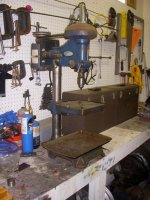
Well, I couldn't control myself...the seller responded a little later than I wanted, but with the requested extra pictures, plus I was able to set up a dinner with a buddy afterwards. So, I bought the Craftsman 100, model 103.24530. More project than I'd really intended, but it was the cheapest 100/150 I could find. Seller demonstrated that the motor spins freely, and quietly, even with the old dry rotted cord.

Started cleaning up the DP yesterday, with nothing significant to report. I'm amazed by how much better the table looks after a little soap and cold water. Working the column over with a grinder and a wire wheel sure left my hands tingling for a bit. Need to find some paste wax to protect the column (it's humid here), then clean the bare metal areas of the (non-angle adjustsable) table and stand. FrankLee was spot-on about the later model base on my DP. Sharp eyes...

The easy to remove parts are off the head.

To do:
- replace the electric cord
- remove the quill
- get an AutoZone belt
- get FrankLee's replacement washer & quill bumper set
- test runout
- disassemble chuck for cleaning. It opens/closes well.
Cosmetics:
- finish cleaning
- strip & paint (?)
- finish getting back to bare metal on table, column and base. Then coat all with paste wax.
 
To avoid these ads, REGISTER NOW!
Top Bottom