Indexmill
Well-known member
^^ Maybe his honey made him list it...


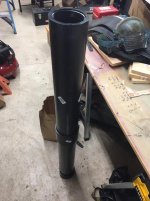
Glued together my evaporust tube tonight in preparation for an upcoming drill press refresh! Tube is 4’ long so it can accept a bench top column or other long metal!
Sent from my iPhone using The Garage Journal mobile app
If you get a #13 rubber stopper for the end of the 2-3/4” column, you can save a lot of evaporust.
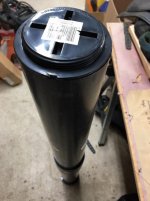
I have glued a threaded fitting onto the end so I can seal it and roll it around to keep the liquid moving and also to prevent evaporation !

My soaking chamber is a ~72" piece of 3" PVC . I originally had a domed cap glued on the bottom. It worked well, but was awkward since it couldn't stand or balance vertically.
When going to use it once, I accidentally punched a hole through the cap when I inserted a column. I wanted a replacement cap that was flat and ended up using threaded fittings similar to yours.
I used a thread sealer on the plug threads and tightened as much as I could. It was very difficult to tighten the plug on a relatively small section of loose pipe of that diameter.
I used it very successfully a couple times outdoors. When the weather cooled, I tried it indoors and discovered that even with the thread sealer, the plug leaked. Now I have a small rust stain from a puddle of citric acid solution on my basement floor. I now set the pipe in a small bucket to catch the leak.
So, my point of all this is to suggest that you test your pipe and procedure with water only for several hours before inserting the column and evaporust. I suspect that you may also have a very difficult time tightening the plug enough to prevent a leak and then removing the plug afterward.
Yep,It *****...happens more times than not. Don't get it...dont want to sell it, don't list it.
JG

That's a Good Idea!!Good point on the cap leaking. I glued a flat cap on the other end so it can stand up but I will most definitely stand it in a bucket just to be safe!
Sent from my iPhone using The Garage Journal mobile app

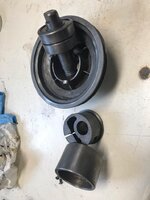


Picked this one up yesterday model 103.23140. It needs some TLC. It has the slow speed pulley. Looks like everything is original and nothing is missing except for the column shoe. I had both spindle pulley retaining screws snap when I tried to unscrew them. Once I get the correct drill bit size I can drill them out. The owner also had a 4 vices for sale at a good price so I came home with them all. From left to right: Columbian No. 63 Red Arrow, Craftsman 506.51800, Wilton 101020, and 4” Standard Vise. They are just as rusty as the drill press but will clean up nice!
Very nice haul... well worth the trip!
I'm thinking the dp is a '51 model. With no grooves in the sleeve for round rings, the msa is an early version.
Who is hiding behind the blanket?
It looks like the same model as mine.
Does it have the speckled paint?
Frank, what year would you say my DP is?
I am guessing 1948, but I may not always be right, but never wrong.
It looks like the same model as mine.
Does it have the speckled paint?
Frank, what year would you say my DP is?
I am guessing 1948, but I may not always be right, but never wrong.
My craftsman motor says “H3 47” .. 1947 I’m assuming
... I'm thinking the dp is a '51 model. With no grooves in the sleeve for round rings, the msa is an early version.
Yes, March '47.
I think I made a mistake earlier. I didn't notice the chuck. Unlike T.K.B.'s drill press, your chuck does not have the safety collar, so definitely pre-1951. I can't tell from the pictures, does yours have the machine screws on the trim panel?
I came across this when I was looking through the old Craftsman catalogs.
Has anyone seen it and is it available?
View media item 100770


The drill press hunt has been very slow for a couple months. Decent original drill presses are few and far between, too far away or far too expensive.
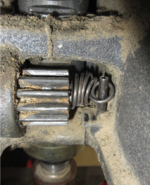
I'm always looking for any older Craftsman machine project. When this 115.6965, post-war, early pre-block grinder popped up yesterday, I had to go for it. The seller's pictures and description were not great, but it looked complete. The price-versus-distance risk seemed worth it.

I met the seller at his place of business. The grinder and pedestal stand were loaded in the back of his pickup. Besides the overall dirty condition and rust on the center band, the only problem I could see was that the glass in both eye shields is cracked. He said it ran and I was ok with his word. I paid the man and we loaded it into my car.
What I didn't expect was the size and weight of this thing!

My other cast iron pre-block is dwarfed by this beast.
The pedestal is homemade and massive... 37½" high, bottom diameter 16". The top mounting plate is 9½" x 10¼". I estimate that it weighs 200+ pounds!
555678


2/13/2020
I dismantled most of the grinder this morning.
Arbor Nuts
Removing the stones is sometimes a problem, but a right-hand threaded jam nut is an indispensable tool for this job. The threads on this machine is 1/2-24, so not very common except for grinder arbors.
Procedure:
- use a wrench on each arbor nut
- remove the left side nut first
- remove the outer flange and stone
- thread the jam nut and the original nut back onto the left side arbor and tighten them against each other
- use wrenches on the left side outer jam nut and on the right side nut
- remove the right side nut
- remove the outer flange and stone
- loosen and remove the jam nuts from the left side arbor
Inner Flanges
Removing the inner flanges on these pre-block grinder is often a problem and this machine was no exception. These flanges are a softer cast aluminum(?) and may deform when over-tightened.
In my case, the left inner flange would rotate on the arbor, but would not slide off. I applied Liquid Wrench several times and rotated the flange. Spinning the flange got easier, but the flange still would not slide off the arbor.
I then used my heat gun to warm the flange, turning the arbor shaft to evenly heat the flange. After a couple minutes of heat, I was able to pop the flange off by hand.


The right inner flange was a bit more challenging. I had to reinstall the jam nuts in order to get the flange to rotate on the arbor. No matter how much LW and heat I used, the flange was not coming off. Even judicious force with a puller didn't budge it.
I got it to the point where the flange would spin easily, so I grabbed the flange with my hand and turned the motor on. While the arbor was spinning, I gently pulled the flange. A couple times, the flange spun out of my grip. I could feel the flange heating up from the friction and eventually, it came free.
So, both flanges got removed without damage.


This afternoon, I started cleaning a couple parts.

I have been scouring CL and FB Marketplace to mount one of these next to my drill press. Always too far for me. I am very jealous.
Looking good! How crunchy are your lead wires?
They look pretty good in the pic but that can be deceiving.


