To avoid these ads, REGISTER NOW!

Craftsman Drill Press

Hoorn

Well-known member
Joined
May 19, 2020
Messages
1,140
Location
Glendora, CA
Howlr, is the top of your spindle pulley approx 3/4" below the cast iron head?

PXL_20211223_004243535.jpg

And yes, the spindle bearing retention screws that go in through the side of the head should easily ride above the bottom bearing.
 
To avoid these ads, REGISTER NOW!

Hoorn

Well-known member
Joined
May 19, 2020
Messages
1,140
Location
Glendora, CA
Howlr, in this cutaway diagram, you can get a great visual on those spindle pulley assembly retention screws. Note as they come in through the side of the head when fully seated they ride atop the lower spindle pulley bearing. If your spindle pulley is not seated deep enough or the screws cannot fully seat there is an issue.

KS47-52b.JPG
 

11b30b4

Well-known member
Joined
Jul 16, 2020
Messages
1,029
Location
GA
Howlr, Hoorn is correct. Place a straight edge across the top of the head, centered over the spindle and measure the distance. Chances are you are a bit high. You should measure ¾” to be fully seated. Also, yes, the side spindle bearing retention screws should rest on top of the outer race of the bottom spindle bearing like in the cutaway patent illustration.

As for the noise, if you have illuminated the motor then is most likely is the spindle assembly. Did the bearings slide on easily or did you need to press them on? Often the outside circumference of the spindle pully shaft is worn and there can be play between the bearing inner race and the shaft. If this is the case, try using some green Loctite (medium strength) between the bearing and the shaft. same goes if there is play between the outer care of the spindle bearings and the bore holes in the head.
 

howlr

Member
Joined
May 22, 2020
Messages
6
Location
NJ
Thank you @Hoorn and @11b30b4
My pulley is just about 3/4" down from the top of the casting and my retention screws seem to be in the correct place. I can feel vibration if I touch the top of the spindle shaft (above the pulley), and the noise changes if I push sideways on the top of the shaft. I'll try reassembling with some green Loctite between the bearings and shaft.
D7B450BB-1842-45BF-9A8E-1CDE99D38BE1.jpeg
 

howlr

Member
Joined
May 22, 2020
Messages
6
Location
NJ
I reassembled with green Loctite between the quill bearings and the shaft. It's an improvement but not 100%. Vibration is highest with the quill up and least with the quill extended all the way down. I should have checked if the shaft was bent before reassembling. 🤦‍♂️
 

11b30b4

Well-known member
Joined
Jul 16, 2020
Messages
1,029
Location
GA
Howlr, your spacing looks correct in the pic you posted. If you have an opportunity to disassemble the spindle pulley assembly, please take pics of the shaft. I would like to see just how worn the shaft is. Most likely, this is not a huge issue and please do not take it all apart just to take a pic, only if you have reason to do so.
 

howlr

Member
Joined
May 22, 2020
Messages
6
Location
NJ
If you have an opportunity to disassemble the spindle pulley assembly, please take pics of the shaft. I would like to see just how worn the shaft is.
I haven't pulled the shaft. I'll post photos if I end up taking it apart again.

I made a few other observations:
1. There's some play between the head casting and the quill. With the quill fully extended and unlocked, I can push it forward and back by 0.0030" and side to side by 0.0020". Photo attached of how I measured. Is this typical? I think the vibrations I'm getting may be motor vibrations amplified by the loose fit between quill and casting.
2. The shaft runout checked just above the chuck safety collar is 0.0020". It might be a bit better if cleaned up. Next I'll remove the chuck, clean up the taper and check the runout there.
3. The chuck runout is terrible: 0.0185" just below the jaws. So I also have some work to do to figure out what's going on with the chuck.

I've got a 3 phase motor + VFD waiting in the wings, so I'll rig that up to see if the original Craftsman motor is the source of the vibrations.
 

Attachments

  • 91D8D588-7D3A-4FCF-B7ED-1B1637089295.jpeg
    91D8D588-7D3A-4FCF-B7ED-1B1637089295.jpeg
    318 KB · Views: 42

howlr

Member
Joined
May 22, 2020
Messages
6
Location
NJ
Hmmm. Pulled the chuck. The taper runout is 0.0040 at the top (wide end) and 0.0070 at the bottom (narrow end) with the quill unlocked and 0.0025 and 0.0050, respectively, with the quill locked. Shaft runout just above the chuck threads is 0.0035 with the quill unlocked and 0.0015 with the quill locked. Not sure what, if anything, I can do to improve this.

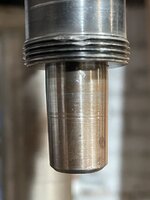
The chuck threads on the shaft are a bit mangled and the taper is scored. Photo attached. I wonder what happened to this press. Chuck appears to be original - a Jacobs 633C.

Vibration and noise are a bit improved with the chuck removed but I suspect that's because the untightened chuck jaws were vibrating along with everything else.
 

Attachments

  • 02CC97C2-3164-4E18-84CD-8FE8F94666CD.jpeg
    02CC97C2-3164-4E18-84CD-8FE8F94666CD.jpeg
    250 KB · Views: 41

11b30b4

Well-known member
Joined
Jul 16, 2020
Messages
1,029
Location
GA
Howlr, a runout of .002 -.003 is not bad. At this point I recommend you reach out to FrankLee and see if he has a suggestion. Just PM him here on the forum and he will respond to the PM.
 

tjpavlov

Well-known member
Joined
May 18, 2012
Messages
1,276
Location
Providence, RI
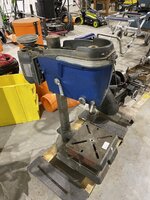
I was hoping to get everyone’s opinion on a craftsman drill press I saw today. It’s sitting at a local tool consignment shop with a price of $150. My guess is that I could get it for $100.
All that I know is that it came in as part of a big lot when someone died.
The motor looks brand new but for some unknown reason half of one side is painted blue. It does have the tilting table.
Everything feels like it moves smoothly but the little lever on the bottom left side spins freely and doesn’t feel connected to anything.
Does anyone have an opinion on this for me? I’d be up for repainting and cleaning it up but I’m not a mechanic or electrician. A20CEAB8-DA1B-4554-9D7C-40A40312C553.jpeg
 

Attachments

  • 4C6160EA-AB96-4F87-9F40-50FB18332D33.jpeg
    4C6160EA-AB96-4F87-9F40-50FB18332D33.jpeg
    390 KB · Views: 37
  • F32AD53C-9394-41AC-8CBB-C27F76609266.jpeg
    F32AD53C-9394-41AC-8CBB-C27F76609266.jpeg
    448 KB · Views: 37
  • 10AA1339-BAB0-4EA2-A259-C33FE7DFB3C6.jpeg
    10AA1339-BAB0-4EA2-A259-C33FE7DFB3C6.jpeg
    362.8 KB · Views: 35

Cruzan80

Well-known member
Joined
Jul 22, 2015
Messages
4,181
Location
Denver, CO
If you are referring to the handle in the front, bottom of the headstock, that is for locking the quill. The "knob" behind it holds the spring for auto-retracting the quill.
 

tjpavlov

Well-known member
Joined
May 18, 2012
Messages
1,276
Location
Providence, RI
If you are referring to the handle in the front, bottom of the headstock, that is for locking the quill. The "knob" behind it holds the spring for auto-retracting the quill.
Yes the quill lock lever doesn’t do anything. And the quill doesn’t seem to spring back up automatically.
 

Hoorn

Well-known member
Joined
May 19, 2020
Messages
1,140
Location
Glendora, CA
I'm sure you noted the feed stop collar and feed stop are missing also. The feed handles and hub are in remarkable condition in comparison to the rest of the drill press. I almost wonder if it came from a later model drill press, particularly because the head lock and table lock handle are the early model style, when you would typically see black knobs instead of maroon.
 

11b30b4

Well-known member
Joined
Jul 16, 2020
Messages
1,029
Location
GA
Tjpavlov, so no feed stop, collar, or rod. If the knob that you are talking about is the tension knob then the spring may be broken or missing. in my opinion, the spring is the hardest thing to find if its broken or missing since they are no longer made. The other parts you can find on ebay from time to time. I would not pay more than $50.00 for it in my neck of the woods but they may be less common where you are. If there is an issue with the spring expect to it to be some time before you would be able to have this press working.
 

Hoorn

Well-known member
Joined
May 19, 2020
Messages
1,140
Location
Glendora, CA
This topic is currently on Jtbinvalrico's thread "Atlas Craftsman table lift" in the general tools forum, but I will discuss it here as well as it's relevant.

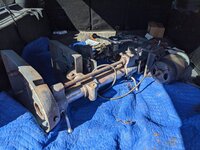
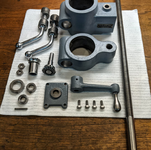
I purchased a Craftsman 100 in very good condition yesterday with an Atlas 7x7 cross slide vise attached to it and Atlas head and table lift #5. Here it is on the ride home.

PXL_20220126_202232377.jpg

The seller had an amazing array of 1930s roadsters in his garage and we couldn't stop talking about cars. Because of this, I stayed long, and I did not check the lift until I got home. When I got home and got it out of the back of my SUV I turned the handle and it spun freely with no resistance, and the long threaded shaft was not turning. Knowing this was not a good sign I opened up the gearbox.

PXL_20220126_203135187.jpg

The gear for the handle side is missing all together and the gear that rides over the shaft had sheared off and was crumbled within the gearbox. I reached out to FrankLee to see if he had run across a situation like this before and he directed me to a 10-year-old thread from Jtbinvalrico who had a similar situation. His thread has the details but I will recap here. Gears can be ordered from McMaster-Carr that will work as replacements. They have to be modified as the bushing below the gears are too long and the shaft mounted gear needs to be welded onto the keyed bushing that the top of the old gear sheared off from. It will be a tricky operation but will technically be stronger once it's in place as the replacement gears are made out of steel whereas the original gears were surprisingly made from pot metal.

I was upset at this discovery and didn't really take any pictures of the drill press. I immediately started to disassemble it to get the lift off the column. Of the last 30 drill presses that have been through my workshop of course THIS head, and the upper gearbox and the table were frozen solid on the column as if they were all one piece of solid granite. It was long, hard labor that eventually got them off.

I will post pictures and follow up in time.
On a positive note the atlas cross slide was in very good condition except the ball crank handles were broken (they almost always are). I've already ordered two replacements.

PXL_20220127_220547338.jpg

PXL_20220127_220949054.jpg
 

Hoorn

Well-known member
Joined
May 19, 2020
Messages
1,140
Location
Glendora, CA
This is what the gears "should" look like. The gear on the left with the long bushing rides over the top of the shaft. The gear to the right is actually pinned to the shaft that connects to the handle. You can see the hole where the pin is in. Just below that is the actual bottom of the gear. (Lift #4 pics)

Screenshot_20220127-221734~2.png

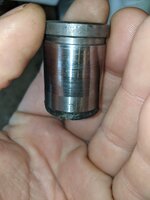
This is all I am left with. This is the bushing and right at the top edge the pot metal gear sheared right off. I need this bushing because it is keyed inside. At the bottom of this bushing you will note a scar from a set screw.

PXL_20220127_163329394.jpg

That scar is caused from the collar set screw that secures it under the gearbox. You can see the bushing extends from below the gearbox, and then that collar is raised up and screwed down onto it.

90989.jpg

The top of the gear should look like this.

Screenshot_20220127-221747~2.png

So the trick will be, trying to mesh the two gears perfectly otherwise they won't really turn.

Screenshot_20220127-221923~2.png
 
Last edited:

11b30b4

Well-known member
Joined
Jul 16, 2020
Messages
1,029
Location
GA
****, sorry to hear about the gears and other issues. That cross slide does look real clean. Keep at it brother, I still have not even seen a lift in person down here in GA.
 

Hoorn

Well-known member
Joined
May 19, 2020
Messages
1,140
Location
Glendora, CA
That really ***** that it was broken. I hope the seller didn't know. I have to say, that cross slide vise and table lift are drool worthy now. Nice job!
I take full responsibility as I did not check it in advance, but I am positive the previous owner did not know. He was old enough to be a WW2 veteran and he was fabulously wealthy. Because of the price asked for the drill press with a lift and cross slide vise attached, he had absolutely no idea of their real value or even how the lift worked; having it on a benchtop model is not very useful anyway. In the picture you can see the bottom lift collar is not even supporting the table where it should be. He got quite a kick out of it when I told him the real value and desirability of these.

It was his granddaughter who handled the sale on OfferUp and she had to sift through many offers. She told me she went with mine because I was honest about the atlas lift. I just happened to be the interested buyer she texted back and asked what is all the commotion about regarding this thing? The other four Atlas lifts I bought I got in first, not this one. The response was apparently so overwhelming she had to consider what to do, she went with me for the reason I described despite others offering twice as much.

Because of how hard it was to get everything off, literally a nightmare with blocks of wood, big hammers and lots of time and WD-40, nothing had been moved for a very long time. I'm sure it was in that condition when he bought it himself. Here is a picture from the ad. The picture is heavily cropped and I blacked out any clue or reference to the seller to respect his privacy. It was not painted black it's just dark. The paint is actually in good condition and it's the original blue-gray. Yes as a bonus it had the Craftsman articulating lamp as well.

Screenshot_20220125-230321~4.png
 
Last edited:

Smokeshow69

Well-known member
Joined
Dec 7, 2012
Messages
8,366
Location
Pacific Northwest
I take full responsibility as I did not check it in advance, but I am positive the previous owner did not know. He was old enough to be a WW2 veteran and he was fabulously wealthy. Because of the price asked for the drill press with a lift and cross slide vise attached, he had absolutely no idea of their real value or even how the lift worked; having it on a benchtop is not very useful anyway. In the picture you can see the bottom lift collar is not even supporting the table where it should be. He got quite a kick out of it when I told him the real value and desirability of these.

It was his granddaughter who handled the sale on OfferUp and she had to sift through many offers. She told me she went with mine because I was honest about the atlas lift. I just happened to be the interested buyer she texted back and asked what is all the commotion about regarding this thing? The other four Atlas lifts I bought I got in first, not this one. The response was apparently so overwhelming she had to consider what to do, she went with me for the reason I described despite others offering twice as much.

Because of how hard it was to get everything off, literally a nightmare with blocks of wood, big hammers and lots of time and WD-40, nothing had been moved for a very long time. I'm sure it was in that condition when he bought it himself. Here is a picture from the ad. The picture is heavily cropped and I blacked out any clue or reference to the seller to respect his privacy. It was not painted black it's just dark. The paint is actually in good condition and it's the original blue-gray. Yes as a bonus it had the Craftsman articulating lamp as well.

Screenshot_20220125-230321~4.png
Sorry to hear about the broken gears Hoon! That’s really disappointing but at least you can fix them. You didn’t say what you paid but I think a you **** is in order! I have only seen one floor model with a lift and I sent it to a local friend and he bought it! Not a common find anywhere
 
To avoid these ads, REGISTER NOW!

Hoorn

Well-known member
Joined
May 19, 2020
Messages
1,140
Location
Glendora, CA
I finished repairing the gears for the Atlas head and table lift. A thread was started some 10 years ago by Jtbinvalrico, as he documented his repair procedure for the same problem. For whatever reason Atlas elected to make the gear teeth out of pot metal. Jtbinvalrico indicated his teeth had literally crumbled away and this lift had essentially the same problem. One gear was missing all together and the other sheared off the shaft bushing and as I was pulling the pieces out, it literally crumbled away. After ordering the gears from McMaster-Carr I got underway.

The first gear repair was easy enough.

PXL_20220129_183122775.jpg

I had to cut roughly half an inch off the gear body. I started with a very fine Dremel cut off wheel to get it started and then went slowly but surely with a hacksaw. Once I had it flat I drilled through and through and used the same sized taper pin that Atlas used.

PXL_20220129_191037152.jpg

Rides flat on the face of the gearbox cover.

PXL_20220129_193656848.jpg

Once that was done I moved on to the other gear. I had to cut a lot more material off on this one and then I had to hollow it out so the bushing could ride flat inside.

PXL_20220130_024749466.jpg

After cleaning out the material in the center I had to drill a 3/4" hole through the gear so it would accept the shaft.

PXL_20220201_224719338.jpg

I covered the entire bottom and sides of the gear void with JB weld, laid the bushing in it, clamped it up under my drill press and drilled both sides for expansion pins. Once these were knocked in I made sure there was no excess JB weld spilling into the inner bushing. I also had to use a very tiny half inch sized drum sander attached to my Dremel to grind off about 1/8" of the expansion pin that had protruded into the bushing and smooth it out.

The reason I opted not to go with welding is I am not a welder and I don't own any welding equipment. In addition the bushing is primarily pot metal with a very thin outer shield of metal so that it can ride smoothly in the lower gear box bore. Although Jtbinvalrico made his work well I wasn't sure where a weld would even hold. By pinning two sides and using steel epoxy, even inside the pins, it feels very secure and there is absolutely no play whatsoever.

PXL_20220202_001418466.jpg

PXL_20220202_001628966.jpg

It is exactly the same length, down to the millimeter of an original that I used to compare. I did put the entire gearbox together and the gears mesh well and it works. I will not attempt to put it under load until it's had a couple days to thoroughly harden.

PXL_20220202_001856305.jpg

Only because the gears were sheared off, in this picture you can clearly see that the material used is the same type as that for pulleys, most likely zamak, which is die cast and has a very low percentage of aluminum; 5% or less. You can also see that that cast iron table you are cranking up is dependent on that gear which is cast onto a 1/8" inner bushing pot metal wall. As unseemly as that is, most still work after all these years!

PXL_20220129_201342785.jpg

I have very little experience working with metal and probably for that reason this is a project I would not look forward to having to do again! I'm just glad it works and for all intents and purposes is stronger in every regard than the one I have on my drill press which uses pot metal gears.
 
Last edited:

Hoorn

Well-known member
Joined
May 19, 2020
Messages
1,140
Location
Glendora, CA
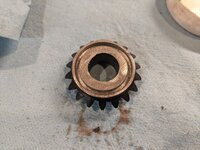
While comparing gears for sizing purposes, I ran across an anomaly. Of the five lifts I have found, four had a shaft gear exactly like this one.

91146~2.jpeg

Rather than show all of them, they all look like the one above. They have a "lip" at the bottom of the gear bushing. That lip, in conjunction with the overhanging tooth end, sandwich a thin layer of metal around the outer wall so that it can ride inside the gearbox bore without wearing.

In this picture you can visualize how the outer metal shield protects the pot metal from wear as it rides inside a fairly long cast iron bore.

Screenshot_20220127-221747_2.png

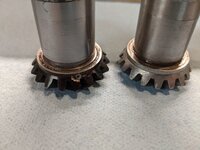
During my comparison I pulled the shaft gear out of a spare lift I have and noted it is one solid piece of metal that was machined.

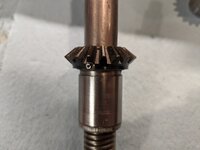
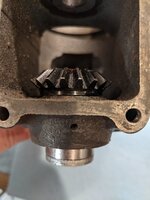
PXL_20220129_203858246.jpg

Here you see that pot metal lip with stress marks all over it next to the solid machined piece.

PXL_20220129_201646103.jpg

And flipping it over you can see the machine marks on this solid piece.
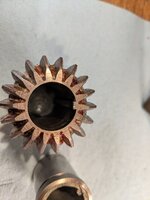
PXL_20220129_201335954.jpg

Since this was on my spare, I immediately swapped it out with the one on my drill press. It's anyone's guess how something like this could have happened. Maybe it was from a first year run and the bean counters decided it was too expensive to machine, or maybe after complaints of the gears breaking they came up with this as an improvement? We'll probably never know.
 

11b30b4

Well-known member
Joined
Jul 16, 2020
Messages
1,029
Location
GA
Hoorn, outstanding outline of how you modified and made the repairs. Thank you for the pics and commentary. I hope at some [point I can find one of these lifts down here in the deep south. I have never seen the lift system on any machines for sale since I started looking back in 2020.
 

Hoorn

Well-known member
Joined
May 19, 2020
Messages
1,140
Location
Glendora, CA
Hoorn, outstanding outline of how you modified and made the repairs. Thank you for the pics and commentary. I hope at some [point I can find one of these lifts down here in the deep south. I have never seen the lift system on any machines for sale since I started looking back in 2020.
Thank you.
Your day will come 11b regarding snagging a lift. They actually do work quite well lifting and lowering the table. I'm also sure yours will be a ridiculous "you ****" price as well.
 

Cruzan80

Well-known member
Joined
Jul 22, 2015
Messages
4,181
Location
Denver, CO
Is it possible someone machined a replacement, and rather than doing in two pieces, simply just stuck a piece of metal in the mill/lathe and went for it?
 

Hoorn

Well-known member
Joined
May 19, 2020
Messages
1,140
Location
Glendora, CA
Is it possible someone machined a replacement, and rather than doing in two pieces, simply just stuck a piece of metal in the mill/lathe and went for it?

Cruzan80, anything is possible regarding stuff like this I suppose.
I'm no machinist, but if someone did do that they had some pretty decent sized equipment to cut those teeth and blend those angles. Maybe someone can chime in on how that was done in one piece, specifically a smooth inner bore with a full length key.
 

Outlawmws

Well-known member
Joined
Aug 9, 2011
Messages
39,131
Location
The Badlands
A broach. Start with a hole the Dia needed for the height of the key, and the broach would be staged to make successive cuts until you finished with a round hole adn full key.
 

Cruzan80

Well-known member
Joined
Jul 22, 2015
Messages
4,181
Location
Denver, CO
Cruzan80, anything is possible regarding stuff like this I suppose.
I'm no machinist, but if someone did do that they had some pretty decent sized equipment to cut those teeth and blend those angles. Maybe someone can chime in on how that was done in one piece, specifically a smooth inner bore with a full length key.
Face off the front on a lathe, then transfer to a shaper or mill with an indexing head mounted at the right angle. Take two passes to get the right shape, and you are done. Here is a video from Keith Rucker showing him doing one (
). Actual cutting starts at about 20min in, and 25min in shows a mostly cut gear.
 

Indexmill

Well-known member
Joined
Apr 12, 2013
Messages
1,413
Location
Central NC
While comparing gears for sizing purposes, I ran across an anomaly. Of the five lifts I have found, four had a shaft gear exactly like this one.

91146~2.jpeg

Rather than show all of them, they all look like the one above. They have a "lip" at the bottom of the gear bushing. That lip, in conjunction with the overhanging tooth end, sandwich a thin layer of metal around the outer wall so that it can ride inside the gearbox bore without wearing.

In this picture you can visualize how the outer metal shield protects the pot metal from wear as it rides inside a fairly long cast iron bore.

Screenshot_20220127-221747_2.png

During my comparison I pulled the shaft gear out of a spare lift I have and noted it is one solid piece of metal that was machined.

PXL_20220129_203858246.jpg

Here you see that pot metal lip with stress marks all over it next to the solid machined piece.

PXL_20220129_201646103.jpg

And flipping it over you can see the machine marks on this solid piece.

PXL_20220129_201335954.jpg

Since this was on my spare, I immediately swapped it out with the one on my drill press. It's anyone's guess how something like this could have happened. Maybe it was from a first year run and the bean counters decided it was too expensive to machine, or maybe after complaints of the gears breaking they came up with this as an improvement? We'll probably never know.

I'm going with the bean counter theory.
 

Cruzan80

Well-known member
Joined
Jul 22, 2015
Messages
4,181
Location
Denver, CO
For some reason, I am thinking shaper with something akin to a boring bar for the inside shape. But I am having trouble nailing down how to do it, in my head. Easiest way would probably be to simply cut the slot and mount a key inside (obviously wasn't done that way in this case).
 

Smokeshow69

Well-known member
Joined
Dec 7, 2012
Messages
8,366
Location
Pacific Northwest
The stickies being destroyed by the new format makes me sad. Those were a huge resource 😠. Other than that I have no issues 👍

anyone know if the early 80 models(13.5) with ball bearings have the same column as a 100 model(15)?

i am wondering if I can find a 3rd pulley from a later 100/150 and put it in? I want to say no but can’t remember exactly
 

gatewaysysop

Well-known member
Joined
Nov 11, 2008
Messages
3,288
Location
Arizona
Smoke, the column size of an 80 is 2 1/4" vs 2 3/4" for a 100/150, too small for an MSA pulley.

I thought the MSA would fit the smaller column as well, if you omitted the sleeve that goes with it and installed by itself? I don't have a model 80 to confirm but I seem to recall reading that this was the case, possibly in the old scans of MSA instructions?
 
To avoid these ads, REGISTER NOW!
Top Bottom