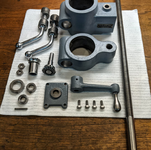
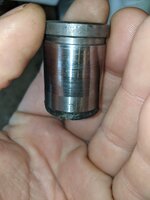
I haven't pulled the shaft. I'll post photos if I end up taking it apart again.If you have an opportunity to disassemble the spindle pulley assembly, please take pics of the shaft. I would like to see just how worn the shaft is.

Yes the quill lock lever doesn’t do anything. And the quill doesn’t seem to spring back up automatically.If you are referring to the handle in the front, bottom of the headstock, that is for locking the quill. The "knob" behind it holds the spring for auto-retracting the quill.


I take full responsibility as I did not check it in advance, but I am positive the previous owner did not know. He was old enough to be a WW2 veteran and he was fabulously wealthy. Because of the price asked for the drill press with a lift and cross slide vise attached, he had absolutely no idea of their real value or even how the lift worked; having it on a benchtop model is not very useful anyway. In the picture you can see the bottom lift collar is not even supporting the table where it should be. He got quite a kick out of it when I told him the real value and desirability of these.That really ***** that it was broken. I hope the seller didn't know. I have to say, that cross slide vise and table lift are drool worthy now. Nice job!

Sorry to hear about the broken gears Hoon! That’s really disappointing but at least you can fix them. You didn’t say what you paid but I think a you **** is in order! I have only seen one floor model with a lift and I sent it to a local friend and he bought it! Not a common find anywhereI take full responsibility as I did not check it in advance, but I am positive the previous owner did not know. He was old enough to be a WW2 veteran and he was fabulously wealthy. Because of the price asked for the drill press with a lift and cross slide vise attached, he had absolutely no idea of their real value or even how the lift worked; having it on a benchtop is not very useful anyway. In the picture you can see the bottom lift collar is not even supporting the table where it should be. He got quite a kick out of it when I told him the real value and desirability of these.
It was his granddaughter who handled the sale on OfferUp and she had to sift through many offers. She told me she went with mine because I was honest about the atlas lift. I just happened to be the interested buyer she texted back and asked what is all the commotion about regarding this thing? The other four Atlas lifts I bought I got in first, not this one. The response was apparently so overwhelming she had to consider what to do, she went with me for the reason I described despite others offering twice as much.
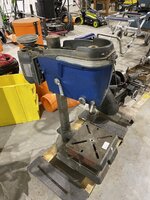
Because of how hard it was to get everything off, literally a nightmare with blocks of wood, big hammers and lots of time and WD-40, nothing had been moved for a very long time. I'm sure it was in that condition when he bought it himself. Here is a picture from the ad. The picture is heavily cropped and I blacked out any clue or reference to the seller to respect his privacy. It was not painted black it's just dark. The paint is actually in good condition and it's the original blue-gray. Yes as a bonus it had the Craftsman articulating lamp as well.
![]()
I believe that Hoorn said that he was going to have to machine on the new gears to adapt them to fit.The good news is you were able to find gears that fit. Seems pretty amazing to me.


Thank you.Hoorn, outstanding outline of how you modified and made the repairs. Thank you for the pics and commentary. I hope at some [point I can find one of these lifts down here in the deep south. I have never seen the lift system on any machines for sale since I started looking back in 2020.
Is it possible someone machined a replacement, and rather than doing in two pieces, simply just stuck a piece of metal in the mill/lathe and went for it?
I agree! Great pictures and write up as well!Nice work!![]()
Face off the front on a lathe, then transfer to a shaper or mill with an indexing head mounted at the right angle. Take two passes to get the right shape, and you are done. Here is a video from Keith Rucker showing him doing one (Cruzan80, anything is possible regarding stuff like this I suppose.
I'm no machinist, but if someone did do that they had some pretty decent sized equipment to cut those teeth and blend those angles. Maybe someone can chime in on how that was done in one piece, specifically a smooth inner bore with a full length key.
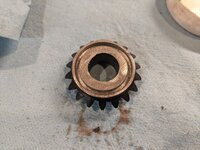
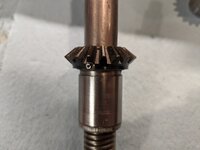
I'm going with the bean counter theory.While comparing gears for sizing purposes, I ran across an anomaly. Of the five lifts I have found, four had a shaft gear exactly like this one.
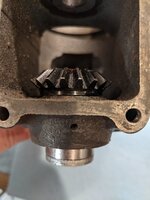
Rather than show all of them, they all look like the one above. They have a "lip" at the bottom of the gear bushing. That lip, in conjunction with the overhanging tooth end, sandwich a thin layer of metal around the outer wall so that it can ride inside the gearbox bore without wearing.
In this picture you can visualize how the outer metal shield protects the pot metal from wear as it rides inside a fairly long cast iron bore.
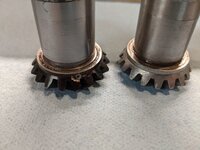
During my comparison I pulled the shaft gear out of a spare lift I have and noted it is one solid piece of metal that was machined.
Here you see that pot metal lip with stress marks all over it next to the solid machined piece.
And flipping it over you can see the machine marks on this solid piece.
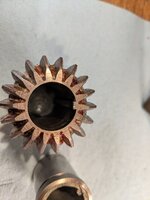
Since this was on my spare, I immediately swapped it out with the one on my drill press. It's anyone's guess how something like this could have happened. Maybe it was from a first year run and the bean counters decided it was too expensive to machine, or maybe after complaints of the gears breaking they came up with this as an improvement? We'll probably never know.
Very, very 'spensive.A broach. Start with a hole the Dia needed for the height of the key, and the broach would be staged to make successive cuts until you finished with a round hole adn full key.
My thought as well!I'm going with the bean counter theory.
Smoke, the column size of an 80 is 2 1/4" vs 2 3/4" for a 100/150, too small for an MSA pulley.