To avoid these ads, REGISTER NOW!

Craftsman =v= question...

Private Lugnutz

Well-known member
Joined
Mar 30, 2012
Messages
30,477
Location
The Authentic Jersey Shore
That partial underline C on that adjustable in the background is interesting because it also has the VANADIUM mark. What do you think the date on that one is, Lugz?
May 1942. Those were made by J.P. Danielson, and, like most J.P. Danielson tools, they were date-coded. That particular adjustable has an L-5-2 forged-in on the handle near the hanging hole, which is broached with a 9/16" double-hex box end. Very late for a VANADIUM marking, but not unheard of.

DadsTools said:
BTW, can't even imagine what YOUR garage looks like with all those tools!
That workbench in most of my photos is in the basement, actually, where most of my tools are. I had just gathered up a small lot of CRAFTSMAN orphans for a trade, and grabbed that adjustable to balance the pliers for the gripping pattern photo.

I am a very selective picker with a modest collection.
 
To avoid these ads, REGISTER NOW!
OP
2

240SX

Well-known member
Joined
Apr 20, 2010
Messages
77
Thanks, 240. Glad I asked. It has what I would call a transitional marking, falling between the so-called long- or short-underline C logo and the CRAFTSMAN logo, and I would date them to 1946-1949.

Rationale: The so-called "nested diamonds" gripping pattern on the handles was in use from at least 1938 through the 50's, so we have to look at the other features. No "Vanadium" marking dates them to no earlier than 1942, when that marking was dropped due to wartime alloy restrictions. It gets trickier after that.

If the logo was an underline C, I would say surely wartime. If it was a C that was identical to the other letters in the logo, surely 1949 or early 50's. Pliers in the 1949 and 1954 catalogs have both CRAFTSMAN and =CRAFTSMAN= logos.

Yours has that slightly open geometric 'C' in front of the rest of the identical 'RAFTSMAN' letters. AA is vague and also inconsistent on this marking. As I said up top, I think it's transitional, after the long or short underline C, and before the CRAFTSMAN or =CRAFTSMAN=. Either way, they stopped playing around with that C in 1949. After that, it was all CRAFTSMAN or =CRAFTSMAN=. So your lineman's pliers are either wartime or immediate post-war.

Nice!

I have a pair of uncommonly seen assembly or chain nose pliers (often mistaken as duckbills) with the 1949-and-later CRAFTSMAN logo. You can compare the C on it to the C on your lineman's pliers to see what I am referring to above.

View media item 75462
View media item 75644

Thanks so much! I think they're amazing and love the style and work of the engraving in the handles. I love hearing the history on the different tools, especially during war eras when certain materials were limited.
 

DadsTools

Well-known member
Joined
Jul 27, 2017
Messages
1,852
May 1942. Those were made by J.P. Danielson, and, like most J.P. Danielson tools, they were date-coded. That particular adjustable has an L-5-2 forged-in on the handle near the hanging hole, which is broached with a 9/16" double-hex box end. Very late for a VANADIUM marking, but not unheard of.


That workbench in most of my photos is in the basement, actually, where most of my tools are. I had just gathered up a small lot of CRAFTSMAN orphans for a trade, and grabbed that adjustable to balance the pliers for the gripping pattern photo.

I am a very selective picker with a modest collection.
Thanks for the date. I just picked up a Danielson in bronze or copper, I'll have to look for a date code.

Ah, yes.....BASEMENTS! I remember now! After you've lived in Florida for awhile, you tend to forget that houses have such things in other parts of the country.
 

scottybk

Well-known member
Joined
Oct 30, 2015
Messages
187
Location
frenchtown nj
Really enjoying this thread and the comments, stories and photos. I'm a yard/garage sale hound here in northwest NJ and often come across old tools, most of which I buy lol.

I generally avoid "estate sales" like the plague. In this area, a 3rd party estate seller comes in and prices everything at full botique retail/crazy ebay "dream" prices. I'm an attorney, and most of my estate clients are generally very disappointed from their estate sale income, as the company takes a fat cut and then they usually need a dumpster to get rid of whatever didn't sell. I always advise families to get an appraiser to do a walk thru, and if nothing is terribly valuable to just have their own garage sale.

For example, there was an estate sale recently I stopped at (broke my own "no estate sale rule lol) and there was a 3/4 inch drive old Craftsmen V set priced at a jaw dropping $350. And no ratchet included, just the T breaker bar! I have no problem telling these clowns how insane their prices are. I ended up buying an old, relatively common Bakelite tube radio for $40 after tons of haggling and a test plug-in. It was still a bit high for this radio.

Anyway, I'd also picked up a common corn-broom style little whisk-broom at this sale, and told them I wanted that along with the radio. It had no price tag on it. I told her how about you just throw this little broom into the radio deal as a bonus ? She then picks up her phone and is calling the other lady outside to find out the whisk broom price. Unreal. She can't get the other lady since cell service is bad, so I just told her straight out 'I'm taking this whisk broom as part of the deal, OK?" And I did. God what a freaking crapshow at these sales.
 

Jim C.

Well-known member
Joined
Jan 8, 2010
Messages
2,598
Really enjoying this thread and the comments, stories and photos. I'm a yard/garage sale hound here in northwest NJ and often come across old tools, most of which I buy lol.

I generally avoid "estate sales" like the plague. In this area, a 3rd party estate seller comes in and prices everything at full botique retail/crazy ebay "dream" prices. I'm an attorney, and most of my estate clients are generally very disappointed from their estate sale income, as the company takes a fat cut and then they usually need a dumpster to get rid of whatever didn't sell. I always advise families to get an appraiser to do a walk thru, and if nothing is terribly valuable to just have their own garage sale.

For example, there was an estate sale recently I stopped at (broke my own "no estate sale rule lol) and there was a 3/4 inch drive old Craftsmen V set priced at a jaw dropping $350. And no ratchet included, just the T breaker bar! I have no problem telling these clowns how insane their prices are. I ended up buying an old, relatively common Bakelite tube radio for $40 after tons of haggling and a test plug-in. It was still a bit high for this radio.

Anyway, I'd also picked up a common corn-broom style little whisk-broom at this sale, and told them I wanted that along with the radio. It had no price tag on it. I told her how about you just throw this little broom into the radio deal as a bonus ? She then picks up her phone and is calling the other lady outside to find out the whisk broom price. Unreal. She can't get the other lady since cell service is bad, so I just told her straight out 'I'm taking this whisk broom as part of the deal, OK?" And I did. God what a freaking crapshow at these sales.

Kind of an interesting story about the broom.....🤔
 

DadsTools

Well-known member
Joined
Jul 27, 2017
Messages
1,852
Really enjoying this thread and the comments, stories and photos. I'm a yard/garage sale hound here in northwest NJ and often come across old tools, most of which I buy lol.

I generally avoid "estate sales" like the plague. In this area, a 3rd party estate seller comes in and prices everything at full botique retail/crazy ebay "dream" prices. I'm an attorney, and most of my estate clients are generally very disappointed from their estate sale income, as the company takes a fat cut and then they usually need a dumpster to get rid of whatever didn't sell. I always advise families to get an appraiser to do a walk thru, and if nothing is terribly valuable to just have their own garage sale.

For example, there was an estate sale recently I stopped at (broke my own "no estate sale rule lol) and there was a 3/4 inch drive old Craftsmen V set priced at a jaw dropping $350. And no ratchet included, just the T breaker bar! I have no problem telling these clowns how insane their prices are. I ended up buying an old, relatively common Bakelite tube radio for $40 after tons of haggling and a test plug-in. It was still a bit high for this radio.

Anyway, I'd also picked up a common corn-broom style little whisk-broom at this sale, and told them I wanted that along with the radio. It had no price tag on it. I told her how about you just throw this little broom into the radio deal as a bonus ? She then picks up her phone and is calling the other lady outside to find out the whisk broom price. Unreal. She can't get the other lady since cell service is bad, so I just told her straight out 'I'm taking this whisk broom as part of the deal, OK?" And I did. God what a freaking crapshow at these sales.
We have one estate sales company down here in North Central Florida who has a fellow I call ManStuff. Anything that's man stuff, this guy researches it down to the molecular structure. It's ridiculous. I have caught him at times, though, since no one can know everything about everything and they spread him kind of thin sometimes. Best ones were the art plate he sold for $2 (worth $225), and four rolls from a box of wrapping paper he had priced at $2 a roll (can you imagine, same stuff at the dollar store) that turned out to be 1930s wallpaper!!! There have been times I've 're-assembled' some sets and asked for a price, got the deal. Oh, then there was the time recently where I bought boxes of Shiny Brite 1960s ornaments at .50 a box because the cashier thought that price was for the whole box! I call it Picker's Revenge.

I come from NJ. Unfortunately down here, you don't have the luxury of picking and choosing where you search. There's so many more people up there and so much more old stuff that you have far more opportunities per square mile than down here--some apartment complexes back home have more people than entire cities down here. Plus other factors like very few people until the late 1950s when AC became widely available, no real attics (just crawl spaces), no basements, heat and humidity roaches everything including old plastics, all the retired people who sold everything off before coming down, etc, etc. You learn to deal with the estate people because you have to. Fortunately, the IQ per capita is a little lower down here too, so it gives you an edge.

You don't know how good you have it up there. Picker heaven. I see the posts all the time "look what I found", and I know instantly they're not down this way!

Yeah, kudos on the broom. Get 'em when you can. Damned vultures!
 

Private Lugnutz

Well-known member
Joined
Mar 30, 2012
Messages
30,477
Location
The Authentic Jersey Shore
I just picked up a Danielson in bronze or copper, I'll have to look for a date code.

Let's see a pic! Maybe it is beryllium-copper?
I'll second that request for a pic, and a report on the date code if it has one. If it's a Danielson BeCu tool, or any bronze/brass/copper composition, it would be the first I have ever seen or heard of.
 

DadsTools

Well-known member
Joined
Jul 27, 2017
Messages
1,852
I'll second that request for a pic, and a report on the date code if it has one. If it's a Danielson BeCu tool, or any bronze/brass/copper composition, it would be the first I have ever seen or heard of.

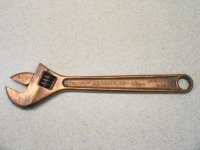
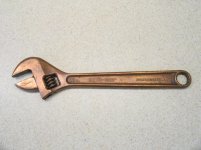
Here's what I got. Hope we can ID it. I was told it was used on a ship.
 

Attachments

  • IMG_8772.jpg
    IMG_8772.jpg
    141 KB · Views: 60
  • IMG_8773.jpg
    IMG_8773.jpg
    142.2 KB · Views: 54
  • IMG_8775.jpg
    IMG_8775.jpg
    139.4 KB · Views: 53

tym

Well-known member
Joined
Mar 5, 2016
Messages
2,429
Location
MA
Hmm...looks like someone copper-plated a forged steel tool?
 

DadsTools

Well-known member
Joined
Jul 27, 2017
Messages
1,852
Hmm...looks like someone copper-plated a forged steel tool?
Possible, but everything is copper colored, including the nut and the nut axle. It's also clear to see that the wrench has had some use and wear in the copper finish, so it must have been this way when put into service. If it's a plating, it must be very heavy or else the soft copper would have worn through on the handle with the amount of usage on it. Who would go through the trouble of copper-plating such a tool before putting it to use, and why?. Is it a factory job? The Navy?

BTW, this has NOTHING to do with Craftsman =v=.:dunno:
 

Rileysan

Well-known member
Joined
Sep 11, 2015
Messages
4,298
Location
Milwaukie, Oregon
Possible, but everything is copper colored, including the nut and the nut axle. It's also clear to see that the wrench has had some use and wear in the copper finish, so it must have been this way when put into service. If it's a plating, it must be very heavy or else the soft copper would have worn through on the handle with the amount of usage on it. Who would go through the trouble of copper-plating such a tool before putting it to use, and why?. Is it a factory job? The Navy?

BTW, this has NOTHING to do with Craftsman =v=.:dunno:
I've never seen a copper plated steel tool. Copper alloy, yes, but not copper plated.

Yours is the result of a chemical reaction. If it had a special plating, it would be labeled as such

Sent from my LGL41C using Tapatalk
 

DadsTools

Well-known member
Joined
Jul 27, 2017
Messages
1,852
I've never seen a copper plated steel tool. Copper alloy, yes, but not copper plated.

Yours is the result of a chemical reaction. If it had a special plating, it would be labeled as such

Sent from my LGL41C using Tapatalk
What chemical reaction do you speak of?
 

Private Lugnutz

Well-known member
Joined
Mar 30, 2012
Messages
30,477
Location
The Authentic Jersey Shore
Hmm. That is a very interesting wrench, Dads.

Some very early steel tools were copper-plated. I have a couple Bethlehem Spark Plug Company socket sets. Everything is copper-plated. Ratchets, handles, extensions, and sockets. I think Bog may have been copper-plating early on, too. But that was the 1920's.

Can you ascertain if it's plated or not by gouging it? Or by more closely inspecting with a magnifying glass the areas that sure do look from a distance like bare steel underneath plating? Namely, that chip on the tip of the static jaw, the area on the paneled handle where it meets the reinforced hanging hole, and the rim of the reinforced hanging hole itself, just under the forged-in date code. Bronze or BeCu will look like bronze or BeCu where it chips or wears in the same way that steel looks like steel underneath. If it's bronze or BeCu it's bronze or BeCu through and through.

As far as I know, nobody was copper plating anything when this wrench was made, which is without a doubt August 1944. Almost all copper was allocated for brass production (i.e., artillery and small arms shell casings).

Non-sparking bronze, brass, and BeCu tools weren't plated. They had a natural bronze, brass, and BeCu finish. I don't think that copper-plating a steel wrench will turn it into a non-sparking tool. Less risky trying that on a wrench than a striking tool, obviously, but still, not truly considered non-sparking as far as I know.

I have seen some of my steel tools take on a coppery hue or patina with age, and sometimes with exposure to certain fumes, such as muriatic acid. But the coppery finish on this adjustable crescent type wrench looks too uniform for that. Unless it was dipped in something inadvertently. Or on purpose. Speaking of which, it may have been dipped or sprayed with something later, as a rust-prevention on a bare steel tool. Although I think that (cold steel sprays and reagents) is relatively recent technology, and I agree with you that whatever this is, it looks, if not original, almost as old.

I notice that it doesn't have the size of the 12-point broached opening inside the hanging hole forged-in to the end of the handle, the way some are marked. It should be an 11/16". It went in /16ths like this: 1/2" (6"), 9/16" (8"), 5/8" (10"), and 11/16" (12").

You know what the model name refers to, right?
 
Last edited:

DadsTools

Well-known member
Joined
Jul 27, 2017
Messages
1,852
Hmm. That is a very interesting wrench, Dads.

Some very early steel tools were copper-plated. I have a couple Bethlehem Spark Plug Company socket sets. Everything is copper-plated. Ratchets, handles, extensions, and sockets. I think Bog may have been copper-plating early on, too. But that was the 1920's.

Can you ascertain if it's plated or not by gouging it? Or by more closely inspecting with a magnifying glass the areas that sure do look from a distance like bare steel underneath plating? Namely, that chip on the tip of the static jaw, the area on the paneled handle where it meets the reinforced hanging hole, and the rim of the reinforced hanging hole itself, just under the forged-in date code. Bronze or BeCu will look like bronze or BeCu where it chips or wears in the same way that steel looks like steel underneath. If it's bronze or BeCu it's bronze or BeCu through and through.

As far as I know, nobody was copper plating anything when this wrench was made, which is without a doubt August 1944. Almost all copper was allocated for brass production (i.e., artillery and small arms shell casings).

Non-sparking bronze, brass, and BeCu tools weren't plated. They had a natural bronze, brass, and BeCu finish. I don't think that copper-plating a steel wrench will turn it into a non-sparking tool. Less risky trying that on a wrench than a striking tool, obviously, but still, not truly considered non-sparking as far as I know.

I have seen some of my steel tools take on a coppery hue or patina with age, and sometimes with exposure to certain fumes, such as muriatic acid. But the coppery finish on this adjustable crescent type wrench looks too uniform for that. Unless it was dipped in something inadvertently. Or on purpose. Speaking of which, it may have been dipped or sprayed with something later, as a rust-prevention on a bare steel tool. Although I think that (cold steel sprays and reagents) is relatively recent technology, and I agree with you that whatever this is, it looks, if not original, almost as old.

I notice that it doesn't have the size of the 12-point broached opening inside the hanging hole forged-in to the end of the handle, the way some are marked. It should be an 11/16". It went in /16ths like this: 1/2" (6"), 9/16" (8"), 5/8" (10"), and 11/16" (12").

You know what the model name refers to, right?
No. Lugz, I'm not familiar with the model name.

I didn't pay too much attention to the tool when I acquired it at a yard sale along with an old V 1/2" CM breaker. The fellow only had a few tools for sale, so I don't think anyone was trying to pull a fast one, especially a $6.

Examining it close now, the steel colored spots around the tips of the jaws does look like tool steel. There's a distinct ridge between the steel and copper color, so it's definitely plated, and appears to be about the thickness of a heavily-plated chrome tool. The tool has definitely seen average use, but not real heavy use. The 12-point box shows dirt and oxidation inside, but is also definitely copper colored in there too. The finish has largely worn away from the inside jaw faces, but there's enough finish remaining to show it was plated in there too. The nut and axle screw also appear to have been plated before the tool was assembled for use. From everything that I can observe, it was indeed either made this way, or it was disassembled and plated before being reassembled and placed into use.

Funny it's a wartime date, Lugz!

I'm as interested in learning more about this as everyone. I also know it's important to throw as many stones as you can at something like this to expose anything illegitimate. But I also think it's important to keep a few things in mind:

1. No one tried to defraud me for big bucks when I bought it. The seller seemed to think it was a common tool in ships of the time. He seemed quite happy to get $12 total for this wrench and the CM =V= (guess this qualifies this post for the thread!).

2. I was initially only asking in here about the date code on it. I didn't think much of it at first because of what the seller told me, I just bought it because I thought it looked cool. I only posted the photos when folks started asking me to. I didn't start a thread flashing this with, "Look what I got!"

3. Throw REAL stones, not just vague speculations spawned by the prejudicial disbelief that it can't possibly be real just because you've never seen one, as if ANY reason, no matter how groundless, is preferred over possibly having to accept this artifact as legit. It might just be.
 
Last edited:

DadsTools

Well-known member
Joined
Jul 27, 2017
Messages
1,852
Closeup of the wear at tip showing the plating edge.
 

Attachments

  • IMG_8776.jpg
    IMG_8776.jpg
    139.6 KB · Views: 32

Private Lugnutz

Well-known member
Joined
Mar 30, 2012
Messages
30,477
Location
The Authentic Jersey Shore
No. Lugz, I'm not familiar with the model name.
BET'R GRIP is a reference to the square throat when the moving jaw is opened, which allows it to seat better/deeper on square fasteners. Only J.P. Danielson and Utica (and Utica customers, such as Herbrand, Bonney, pre-1945 Plomb) did that as far as I know. Crescent and most of the other knock-offs (Diamond, etc) have a hex throat.

Closeup of the wear at tip showing the plating edge.
Clearly plated! And definitely a conundrum given the mfgring date.

The only thing I can think of is the military customer getting a waiver on the plating, either because I am wrong about copper-plating not qualifying it as a non-sparking tool, or certain tools (Navy shipboard, for example, to go with the tool's acquisition story) being copper-plated, perhaps later in the war, as a corrosive resistant, instead of being painted Navy grey, which is what I have predominantly seen. Either way, it's the first one I have ever seen. I have seen lots of wartime bronze and BeCu. Never copper-plating.

Or, it was copper-plated for whatever reason after the war, perhaps because it was a more feasible solution before chrome and nickel came back around.

EDIT: Thanks for mentioning it and showing it.
 
Last edited:

DadsTools

Well-known member
Joined
Jul 27, 2017
Messages
1,852
BET'R GRIP is a reference to the square throat when the moving jaw is opened, which allows it to seat better/deeper on square fasteners. Only J.P. Danielson and Utica (and Utica customers, such as Herbrand, Bonney, pre-1945 Plomb) did that as far as I know. Crescent and most of the other knock-offs (Diamond, etc) have a hex throat.


Clearly plated! And definitely a conundrum given the mfgring date.

The only thing I can think of is the military customer getting a waiver on the plating, either because I am wrong about copper-plating not qualifying it as a non-sparking tool, or certain tools (Navy shipboard, for example, to go with the tool's acquisition story) being copper-plated, perhaps later in the war, as a corrosive resistant, instead of being painted Navy grey, which is what I have predominantly seen. Either way, it's the first one I have ever seen. I have seen lots of wartime bronze and BeCu. Never copper-plating.

Or, it was copper-plated for whatever reason after the war, perhaps because it was a more feasible solution before chrome and nickel came back around.

EDIT: Thanks for mentioning it and showing it.
I never thought I would find anything, let alone wartime, that would stump the band! Especially in Florida! It was always my aspiration just to find something on your wish-list. I didn't think much of it when I bought it with the =V= breaker for $12. Figured with the brand, thought it was older, in good mechanical condition, and with the copper color, plus the =V= breaker, the combo would be good for $35-$40. For a $12 investment, that's a good day!

I think it's legit all the way. The government wouldn't have plated it themselves. Unfathomable that a private individual would have gone through the time and expense plating it or sending it out the be plated just the then beat it up in use. That's irrational. Fellow told me it was a non-sparking wrench. It made sense to me, but at the time I thought it was solid, not plated.

Next, considering the date, can we imagine this being made for anyone using copper except for the government? This fits with the Navy story, although he didn't mention anything about it being a wartime tool. Certainly not for the private sector, unless it was for a contractor critical to the war effort.

Perhaps another consideration was that a solid BeCu may have been too cost prohibitive, and the plating was a compromise to meet budget. Not sure how that kind of bidding or gov. requirements worked back then. Or...heaven forbid...Danielson won the bid by pitching this wrench as non-sparking even though it was only plated? After all, as presented brand new, it WAS non-sparking. Companies have done worse things to Uncle Sam.

I want to thank you for your honest assessment, Lugz. The comment I made earlier about wild speculations just to discredit the tool was not meant toward you (as you probably know).

OK, I'm going to say it...it's obviously a rare tool. Do you believe a member PM'd me a few days ago giving me a hard time about using that word, and suggested I should just fabricate a story about something being commonly available simply to avoid saying that word in here for fear of unscrupulous people trying to fake one? And that for something selling on eBay for $10 lousy dollars? I smacked my forehead like any good Philly Dego would!

Thanks again. Then comes the million-dollar inevitable question--wonder what it's worth?
 
Last edited:

Rileysan

Well-known member
Joined
Sep 11, 2015
Messages
4,298
Location
Milwaukie, Oregon
What chemical reaction do you speak of?

Sulfur Dioxide is a common pollutant that is know to react with ferrous metals. It's what produced the infamous acid rain in the Rust Belt during the 70s and 80s. In the stamp collecting world, Sulfur Dioxide is responsible for turning postage stamps printed in orange and red ink (they used red iron oxide in the pigment) to very dark red, or even black.

The wrench could have also been cleaned with chemicals that caused a reaction. White vinegar, Hydrofluoric acid (used to be considered a "weak" acid and was often used for the cleaning of tools), or perhaps used in a plating environment.


Clearly plated! And definitely a conundrum given the mfgring date.

The only thing I can think of is the military customer getting a waiver on the plating, either because I am wrong about copper-plating not qualifying it as a non-sparking tool, or certain tools (Navy shipboard, for example, to go with the tool's acquisition story) being copper-plated, perhaps later in the war, as a corrosive resistant, instead of being painted Navy grey, which is what I have predominantly seen. Either way, it's the first one I have ever seen. I have seen lots of wartime bronze and BeCu. Never copper-plating.

Or, it was copper-plated for whatever reason after the war, perhaps because it was a more feasible solution before chrome and nickel came back around.

EDIT: Thanks for mentioning it and showing it.

I'm trying to keep an open mind here, so I'll ask the obvious.

1) Who makes, or who has made copper plated tools and for what purpose? BeCu is the standard for a non-sparking environment going way back before the war. Copper plating is used on cooking utensils to prevent certain chemical reactions with food, but I have not heard of such a use on mechanic's tools.

Edit: I missed your comments about early copper plated tools. Any idea why they did it and why they stopped?

2) Are there any markings on the wrench indicating a special plating? If not, why go through the trouble of making a specialty tool and not mark it?

3) What are the chances this wrench exists in that state because someone working for a plating company was playing with, or testing chemicals?

All things being equal, the simplest answer is usually the right one ...

Brian
 
Last edited:
To avoid these ads, REGISTER NOW!

Gmonkee

Well-known member
Joined
May 9, 2010
Messages
2,724
Nickel plated tools when they are nickel plate over copper will go to all copper with wear or extreme heat.

I use CM sockets to make socket wrenches. The heat from the weld area leaves the adjacent area in copper plate. Fires will do the same. I cannot guess the war year mfg'd date with the plating however.

I might suggest that the 1946 cars looked just like 1941 cars for the most part as they resumed civvie production with the old design. Did this wrench maker do the same after the end of wartime limits using old dies?
 

DadsTools

Well-known member
Joined
Jul 27, 2017
Messages
1,852
First, we must admit that this artifact actually exists. It's not hearsay. Nor are the dating marks in dispute. Nor is the fact that one has never seen such an example before is any compelling reason to dismiss it as bogus. No one has seen it all, and no one knows it all. I just recently produced a couple of artifacts that, while references and comparables could be found with some research, no one here had ever actually seen these tools first-hand. That being said, let's try to look at these thoughts objectively:

Sulfur Dioxide is a common pollutant that is know to react with ferrous metals. It's what produced the infamous acid rain in the Rust Belt during the 70s and 80s. In the stamp collecting world, Sulfur Dioxide is responsible for turning postage stamps printed in orange and red ink (they used red iron oxide in the pigment) to very dark red, or even black.

The wrench could have also been cleaned with chemicals that caused a reaction. White vinegar, Hydrofluoric acid (used to be considered a "weak" acid and was often used for the cleaning of tools), or perhaps used in a plating environment.

These effects could only at best leave a light coating almost like a patina, and likely not a surface that would be so uniform over the entire tool. The photo of the jaws shows this is indeed some sort of plating, and a substantial plating at that. One would have to completely ignore a significant portion of the physical evidence to accept any of these solutions as the best or even probable answer.

[/QUOTE]1) Who makes, or who has made copper plated tools and for what purpose? BeCu is the standard for a non-sparking environment going way back before the war. Copper plating is used on cooking utensils to prevent certain chemical reactions with food, but I have not heard of such a use on mechanic's tools.

Edit: I missed your comments about early copper plated tools. Any idea why they did it and why they stopped?[/QUOTE]

Again, the very fact that one has not heard of this before cannot be used as an argument that such a thing cannot exist. By your own words, you were unaware that some tools were copper plated back in the 20s--doesn't mean they don't exist. We are speaking of "copper" plating only because of its appearance and color--it is likely of a copper alloy, since we have a very good idea what this would look like were it pure copper. It's apparent durability and appearance indicates that it may well be BeCu.

[/QUOTE]2) Are there any markings on the wrench indicating a special plating? If not, why go through the trouble of making a specialty tool and not mark it?[/QUOTE]

There are numerous examples of variations in tools not having special markings to indicate it. Just recently, a vintage Williams B-52 ratchet was posted having a glove lever, and another reported with cushioned grips as well. Catalog references show that Williams assigned these special model numbers, but the tools themselves show the standard B-52 mark with no other special designation. I recall seeing some wartime tools of a certain maker with some being cadmium plated and some being plain steel, but no special markings to indicate either variety. I'm sure there are many examples, as you can well imagine (just take a walk down the schizophrenic Duro-Indestro lane) . So just because you personally cannot imagine why anyone would make such a tool without markings is almost moot--available artifacts show that the very manufacturers themselves at times saw a good reason to do this. So this too does not in itself pose a compelling argument that the wrench could not have been manufactured this way. In fact, the wrench itself--not an idea or notion, but the hard physical evidence itself--indicates more strongly that it was indeed made this way than it does for any other possibility.

And if you think about it, why NOT use the same forging dies for this? Wouldn't that be the most competitive in bidding? And don't you think that the copper plating itself SCREAMS special tool more than any small marking? In this case, a special marking is not reasonably necessary.

[/QUOTE]3) What are the chances this wrench exists in that state because someone working for a plating company was playing with, or testing chemicals?[/QUOTE]


I think reason and common sense can tell you this is a highly unlikely scenario that would have resulted in this tool. So I think the chances of that are very slim. Plus, you cannot discount the seller's reference to it being used in Navy vessels when coupled with the wartime date code on it. He also referred to it as a non-sparking wrench, and i can tell you this fellow was no tool expert himself, especially since he saw no significance to the =v= mark on the breaker, or even cared if it were a CM. If you're looking for a statistical probability, the connection of these facts creates a probability far beyond any imagined speculative ideas--it is the scenario that best fits the evidence of the artifact itself.

Again, it also seems highly improbable that some private individual would have invested the time and expense to have this plated with a copper alloy only to then beat it up in use. It just doesn't make sense. To wonder why someone allegedly playing with a plating would choose an adjustable wrench over any other item--especially something that would have to be disassembled so the parts could be plated separately--only adds more remote speculation on top of an already speculative notion.

[/QUOTE]All things being equal, the simplest answer is usually the right one ...

Brian[/QUOTE]


IF you take the artifact itself as the best witness, it's physical characteristics as the most solid, hard-reality testimony, and couple this with the corroborating provenance handed down with the tool to the seller, the simplest answer is....the wrench was actually manufactured this way at the time of the date code by Danielson. Any other possibility is more remote, less probable, and requires convolutions in speculation for which there is not a shred of physical evidence other than the notion that one just simply can't believe it's legit.

Of course, if one is going to double down on the path of denial, than any speculation, no matter how absurd or groundless, would be to him the preferable solution.
 
Last edited:

Private Lugnutz

Well-known member
Joined
Mar 30, 2012
Messages
30,477
Location
The Authentic Jersey Shore
Dads,

I don't think anyone was trying to intentionally discredit or de-legitimize the wrench, then or now. I'm not sure how that's even possible when you weren't sure what it was yourself.

Frankly, I didn't pay too much attention to its provenance, because you didn't really share much of that upfront, except for the Navy bit. I was the one who brought up non-sparking, before you revealed that the seller mentioned it. I still don't think we know exactly what it is, other than the fact that it was assuredly manufactured by J.P. Danielson in 1944, as I said upfront.

tym thought it looked copper-plated, and so did I. After seeing the close-up, it's unmistakably plated with something, and something probably containing copper. Rileysan said he's never seen a copper-plated tool, and obviously didn't know they existed. Honestly, I found his statement about a chemical reaction to be hasty, and a lot more declarative than I ever like to be, especially before exploring other possibilities, and not having all the facts (like the precedence for copper plating in the tool industry), but even then I don't think he was trying to intentionally discredit the wrench.

Not playing moderator here, but I have no desire to continue a conversation if the insinuations and unnecessary tension persist.

As for the value, it's rare, but rare does not always equal valuable. The value to me, like so many other tools, is in the questions it poses, as a prompt for more research.

BeCu is the standard for a non-sparking environment going way back before the war.
Agreed, as I discussed in my initial responses. But I am not as quick as you are to dismiss other possibilities, such as steel tools being plated with copper or perhaps even some kind of beryllium copper as an alternative or supplement in a non-sparking environment, that may be part of a historical record I am not aware of. Especially since that thing is clearly plated, not the result of some accidental exposure.

Rileysan said:
Edit: I missed your comments about early copper plated tools. Any idea why they did it and why they stopped?
No, but I would suspect that purveyors found it either less effective or more expensive compared to nickel and chrome.

Are there any markings on the wrench indicating a special plating? If not, why go through the trouble of making a specialty tool and not mark it?
Why would it be marked? Have you ever seen a tool marked with its plating compound or other chemical finish compound, whether chrome, nickel, cadmium, zinc, phosphorous, or black oxide? I don't know why copper should be looked at any differently or why you would expect a special marking. If you're referring to its potential toxicity, wartime BeCu tools were not marked BeCu, either, as far as I know. I think that came much later when they were found to be harmful.

What are the chances this wrench exists in that state because someone working for a plating company was playing with, or testing chemicals?
It's possible. It's a notion that I would consider less likely than the other possibilities I have mentioned, but I wouldn't rule it out.
 
Last edited:

Private Lugnutz

Well-known member
Joined
Mar 30, 2012
Messages
30,477
Location
The Authentic Jersey Shore
Nickel plated tools when they are nickel plate over copper will go to all copper with wear or extreme heat.
That's a good point, Gmonkee. But it doesn't get us out of the wartime dilemma. Nickel was one of the first elements to be allocated (in mid 1941), restricted from use in plating (late 1941) and ultimately restricted to < 0.06% in steel. In other words, it wouldn't make any more sense for it to be nickel-plated in 1944 either.
 

Rileysan

Well-known member
Joined
Sep 11, 2015
Messages
4,298
Location
Milwaukie, Oregon
Why would it be marked? Have you ever seen a tool marked with its plating compound or other chemical finish compound, whether chrome, nickel, cadmium, zinc, phosphorous, or black oxide? I don't know why copper should be looked at any differently or why you would expect a special marking. If you're referring to its potential toxicity, wartime BeCu tools were not marked BeCu, either, as far as I know. I think that came much later when they were found to be harmful.

Toxicity is not the issue with copper (it's still used in kitchen utensils), reactivity is. If it was copper plated for a special purpose, I would expect that to be noted in some way. However, there's nothing to differentiate this wrench from every other Danielson adjustable wrench from that era. No part or model number difference, special numbers, or marketing name - it's the same as all the rest of the wrenches.

Brian
 

Ole Slewfoot

Well-known member
Joined
Feb 22, 2016
Messages
5,098
Location
Freedom, CA
It happens

attachment.php


I cold see a wrench used in a high fuel environment possibly being copper plated in the field in an effort to improve safety. If I was in a closed room working on fuel fittings all day, I'd certainly grab a copper plated wrench before the one that wasn't.

I accidentally bronzed a bare steel husky ratchet brass wire brushing it after a vinegar bath That wrench is definitely plated much thicker.
 
Last edited:

notlob

Well-known member
Joined
Aug 19, 2013
Messages
1,384
Location
norcal
A. Is it copper plated? It may have been coated with something (e.g. blo mixture that has now aged to resemble copper) in order to prevent corrosion. blo coating of tools was very common in earlier times.

B. Many welding clamps have copper plated screws to prevent welding spatter from ruining the threads. Maybe this was plated for use in a welding shop.

C. Crude copper plating can be done in a manner similar to electrolysis rust removal in reverse. If it is copper plated, it may not have been plated by the manufacturer.

D. Page 46, Plomb catalog 18A
attachment.php
 

Attachments

  • Plomb copper clad cat 18a.jpg
    Plomb copper clad cat 18a.jpg
    146.6 KB · Views: 1,363
Last edited:

notlob

Well-known member
Joined
Aug 19, 2013
Messages
1,384
Location
norcal
First, we must admit that this artifact actually exists. It's not hearsay.
...
Of course, if one is going to double down on the path of denial, than any speculation, no matter how absurd or groundless, would be to him the preferable solution.

Please counselor, lighten up. No one has alleged you are in error. This discussion relates to probabilities. Experts have yet to opine that the coating is what it purports to be.

"[Dadstools] doth protest too much, methinks."

:beer:
 

tym

Well-known member
Joined
Mar 5, 2016
Messages
2,429
Location
MA
I too am unsure why there is suddenly tension in this thread.

Regarding electroplating, I've done that for giggles in the past (copper plated a nickel, actually), but I would expect some holldays if that was done here.

Some other possibilities
-Factory experiment/prototype that did not go into wide production
-Factory one-off as a gift/prize/giveaway (especially as wartime gold and silver would have been restricted)
 

Private Lugnutz

Well-known member
Joined
Mar 30, 2012
Messages
30,477
Location
The Authentic Jersey Shore
Toxicity is not the issue with copper (it's still used in kitchen utensils), reactivity is.
I was referring to BeCu, Brian, since I wasn't sure what you were referring to.

Rileysan said:
there's nothing to differentiate this wrench from every other Danielson adjustable wrench from that era. No part or model number difference, special numbers, or marketing name - it's the same as all the rest of the wrenches.
Again, there's no precedence for the differentiation. I have owned dozens of J.P. Danielson adjustable crescent-type wrenches, made for themselves, or for others (e.g., Craftsman, PENENS, and Plomb), in multiple finishes: plain steel, cadmium plated, chrome-plated, and even black oxide. They are all marked the same with the same model number regardless of the finish. Few tools are marked differently due to finish in my experience. Even if economy line tools with economy line finishes have a different model number in a catalog or brochure for ordering purposes, in most cases they are marked the same, in my experience.
 

Private Lugnutz

Well-known member
Joined
Mar 30, 2012
Messages
30,477
Location
The Authentic Jersey Shore
D. Page 46, Plomb catalog 18A
attachment.php
As if on cue!

Private Lugnutz said:
But I am not as quick as you are to dismiss other possibilities, such as steel tools being plated with copper or perhaps even some kind of beryllium copper as an alternative or supplement in a non-sparking environment, that may be part of a historical record I am not aware of.

Many thanks for that, notlob.
 

Private Lugnutz

Well-known member
Joined
Mar 30, 2012
Messages
30,477
Location
The Authentic Jersey Shore
And to further break my own arm vigorously patting myself on the back..., note how the Plomb catalog says, "We do not claim these wrenches to be non-sparking... These wrenches must not be hammered upon."
:lol_hitti

Private Lugnutz said:
I don't think that copper-plating a steel wrench will turn it into a non-sparking tool. Less risky trying that on a wrench than a striking tool, obviously, but still, not truly considered non-sparking as far as I know.

I wish we had an example of a KOP-R-KLAD wrench. It may be thick enough to resemble plating, whereas, in my experience, other period coatings do not.
 

Private Lugnutz

Well-known member
Joined
Mar 30, 2012
Messages
30,477
Location
The Authentic Jersey Shore
A qualification/correction:

While many mfgrs were using a copper plating early on as a base for the final chrome or nickel plating, and some (Williams and Herbrand, to name two) were doing so as late as 1950, I'm not so sure that the antique socket sets I have are copper-plated. I just checked the Bethlehem period documents I have gathered for the set, and none of the ads use that terminology explicitly. They don't use any other terminology for the finish, either. It could be done with the same copper plating others were later using as an underplating, or they could be coated, similar to what Plomb was doing to affect near non-sparking qualities in 1940. Whatever it is, it's very thin.

For comparison purposes, I just pulled some pieces out of the set for a quick photo (see Thumbnail below), with those pieces exhibiting the most wear on the left to those exhibiting the most copper-coating/plating remaining on the right. And the L-handle shows areas of both wear and retention.
 

Attachments

  • 20171019_210826.jpg
    20171019_210826.jpg
    62.6 KB · Views: 21
Last edited:

Rileysan

Well-known member
Joined
Sep 11, 2015
Messages
4,298
Location
Milwaukie, Oregon
I too am unsure why there is suddenly tension in this thread.

Unfortunately internet anonymity has largely turned polite discourse into dispute, which has a negative feel to it. However, at no point has anyone made derogatory comments or been reduced to calling names so I don't feel any tension. But in all fairness to the OP, this probably should have its own thread :)
 

DadsTools

Well-known member
Joined
Jul 27, 2017
Messages
1,852
I appreciate the continuing conversation on what is apparently an unusual item. Rather than answer any post specifically, let me make some comments.

I really am a no-BS kind of guy. I am not politically correct, nor am I socially shy or sensitive. I calls 'em as I sees 'em, and let the chips fall where they may.

Rileysan, my exception to some of your speculations stems from where I perceived you coming from by your words. They strongly indicated in several places (yes, I can go back and quote all this if you wish) that you questioned the authenticity of this item based primarily on the fact that a., you yourself have never seen such a wrench and, b., you yourself could not imagine such a wrench to be legitimate. Operating from that position, you speculated on possible alternatives, some that simply did not take into consideration the physical evidence on the wrench itself. It seemed if you were grasping at any straw, however remote, to argue for it being illegit, not from the physical evidence, but from a prejudicial position. So that's why I feel you were trying to discredit it. This is how deniers typically argue a point--been there many times. I wrote a published thesis on theoretical cosmology that turned some long-established beliefs in physics on their heads, and had to confront such denial-arguments during conferences I spoke at. Perhaps I'm overly sensitive to it because of this, but I've learned to detect it quickly. In my world, that's intellectually dishonest. And I will flag people for that.

Lugz, I do so much appreciate your expertise, and even more so, your objectivity. Moreover, I have gained an even greater respect here for you, because, instead of addressing my attitude or approach, you stuck to the facts and the evidence and defended some of my conclusions. I'm SO used to people trying to 'poison the well', attacking the person instead of addressing the evidence. God, man, you don't know how rare that is! Or perhaps you do. What a breath of fresh air! I really don't even know you, but I already know now I could call you friend. After all, it is about the truth, isn't it?

Lugz, I didn't talk up front about the entire provenance the seller gave me because I really didn't think much of it at first. I only had mentioned the wrench in passing because of the possible date code one of your posts clued me in on. As I said, I didn't start a thread on this with proclamations, it just kind of unfolded as we went along. But you obviously gathered a strong sense of its legitimacy in short order, even without the whole provenance.

notlob, you rode in like the Calvary with that Plomb catalog! That gave us the industry precedent and verification we so much needed to understand precisely what this wrench might be and why it was made so. While we as yet don't have a physical specimen of one of these Kop-R-Klad safety wrenches, the Danielson adjustable appears to be a living example of such a tool. Fits it like a glove,and draws many loose strings together. Thank you!

So here's what it looks like:

This wrench is legit, was made this way as a 'safety' wrench. The provenance the seller told me about the Navy and non-sparking all fit together. One could forgive a layman for not knowing the distinction between 'non-sparking' and 'safety' wrench, but it's in the same category. There even could be a finish protection factor to it based on all your statements that would tie it in with the Navy too. However, I don't fully buy into the Plomb tale that seems to indicate the plating was actually pure copper, I think it's presented that way to emphasize the color and make it less technical and so more digestible for the reader. I deal in a lot of different types of vintage items, not just tools, and I see what copper looks like over time, especially if it's exposed to a salt environment!!! So I think we are looking at a copper alloy for sure. The wrench could never look so good if it were pure copper. And I don't think it was cleaned because of the presence and appearance of the patinas in the recesses. Could an expert clean it to make it look that way? For pity sake, for a $6 wrench???? I think this item is precisely what all the evidence and provenance indicates it to be.
 

Rileysan

Well-known member
Joined
Sep 11, 2015
Messages
4,298
Location
Milwaukie, Oregon
Rileysan, my exception to some of your speculations stems from where I perceived you coming from by your words. They strongly indicated in several places (yes, I can go back and quote all this if you wish) that you questioned the authenticity of this item based primarily on the fact that a., you yourself have never seen such a wrench and, b., you yourself could not imagine such a wrench to be legitimate. Operating from that position, you speculated on possible alternatives, some that simply did not take into consideration the physical evidence on the wrench itself. It seemed if you were grasping at any straw, however remote, to argue for it being illegit, not from the physical evidence, but from a prejudicial position. So that's why I feel you were trying to discredit it. This is how deniers typically argue a point--been there many times. I wrote a published thesis on theoretical cosmology that turned some long-established beliefs in physics on their heads, and had to confront such denial-arguments during conferences I spoke at. Perhaps I'm overly sensitive to it because of this, but I've learned to detect it quickly. In my world, that's intellectually dishonest. And I will flag people for that.

If you come from such a background, then you know full well what a peer review is - and this is no different. If you feel tense or upset, I'll tone it down a bit but I won't stop being the devil's advocate. I live and breathe metal casting, metallurgy, and chemistry. I have written several papers on the reactivity of sand and binder systems with metal alloys for the foundry industry. I have even presented my work for peer review before the metal casting conference hosted by the American Foundry Society. See? I can sound smart too.

No one questions that your wrench is plated, nor that it is copper colored. However a scratch test will tell you nothing. If you want to verify its authenticity, remove a flake and have it analyzed with a spectrometer.

And quit being so thin skinned.

Brian
 

DadsTools

Well-known member
Joined
Jul 27, 2017
Messages
1,852
OK guys, just for the record....

"If you come from such a background, then you know full well what a peer review is...."

There's the bait and switch. This wasn't a peer review. I was asked to post a photo of a wrench and I did. That's not a peer review of anybody's work. Nice try though.

"If you feel tense or upset, I'll tone it down..."

There it is. The personal attack, the poisoning of the well. It's not about the evidence or the subject matter, it's about the person and discrediting him. It's been made to be about my feelings--yeah, that's the real issue here. Now he's going to be so magnanimous in accommodating poor little DadsTools. Rubbish.

"See? I can sound smart too."

There it is again. personal attack. Of course, he IS smart, but I'm only trying to 'sound' smart. And subtly makes it look like I made up the cosmology reference with absolutely no evidence to that effect, just like the prior wrench arguments. Again, nice try, but your colors are showing.

"And quit being so thin skinned."

Again, it's not about the merits of the argument, it's about me being flawed somehow, and if he can successfully paint me that way in other's eyes, he can discredit any position I take without ever addressing the evidence at hand. Also makes him look superior too. Now he's going to discipline me.

And his solution? Take a chip and have it analyzed, which he already knows no one's going to do that for an old wrench. It all sounds all very impressive, but actually says nothing. The main theme, however--the demeaning and discrediting--is quite thoroughly covered.

Learned all about this in college debates. But I did mention this approach in my previous post, and he's now giving us a live example of what I had outlined. He just did exactly what I described. Thanks for illustrating it so perfectly.
 
Last edited:

jakemac

Well-known member
Joined
May 21, 2013
Messages
9,035
Location
New England
Well, apparently this thread decided to travel to Halifax by way of Tijuana.
It was an interesting side topic, but it's getting dangerously close to becoming testy.

Let me try something .......

I like Craftman =V= series tools.
......... Discuss ..........
 

DadsTools

Well-known member
Joined
Jul 27, 2017
Messages
1,852
Well, apparently this thread decided to travel to Halifax by way of Tijuana.
It was an interesting side topic, but it's getting dangerously close to becoming testy.

Let me try something .......

I like Craftman =V= series tools.
......... Discuss ..........
I think I mentioned this once before in another thread:

"Blessed are the peacemakers...."

The =v= certainly seem better made than that which came later. I don't use their hardline tools primarily because of my Dad's dislike of them. Since I buy and sell, and since people like to buy the =v= tools, I'd have to say they're my favorite Craftsman.:thumbup:
 
To avoid these ads, REGISTER NOW!
Top Bottom