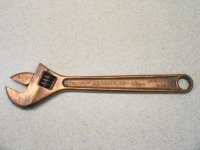
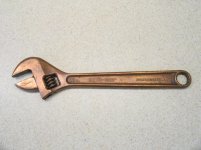
First, we must admit that this artifact actually exists. It's not hearsay. Nor are the dating marks in dispute. Nor is the fact that one has never seen such an example before is any compelling reason to dismiss it as bogus. No one has seen it all, and no one knows it all. I just recently produced a couple of artifacts that, while references and comparables could be found with some research, no one here had ever actually seen these tools first-hand. That being said, let's try to look at these thoughts objectively:
Sulfur Dioxide is a common pollutant that is know to react with ferrous metals. It's what produced the infamous acid rain in the Rust Belt during the 70s and 80s. In the stamp collecting world, Sulfur Dioxide is responsible for turning postage stamps printed in orange and red ink (they used red iron oxide in the pigment) to very dark red, or even black.
The wrench could have also been cleaned with chemicals that caused a reaction. White vinegar, Hydrofluoric acid (used to be considered a "weak" acid and was often used for the cleaning of tools), or perhaps used in a plating environment.
These effects could only at best leave a light coating almost like a patina, and likely not a surface that would be so uniform over the entire tool. The photo of the jaws shows this is indeed some sort of plating, and a substantial plating at that. One would have to completely ignore a significant portion of the physical evidence to accept any of these solutions as the best or even probable answer.
[/QUOTE]1) Who makes, or who has made copper plated tools and for what purpose? BeCu is the standard for a non-sparking environment going way back before the war. Copper plating is used on cooking utensils to prevent certain chemical reactions with food, but I have not heard of such a use on mechanic's tools.
Edit: I missed your comments about early copper plated tools. Any idea why they did it and why they stopped?[/QUOTE]
Again, the very fact that one has not heard of this before cannot be used as an argument that such a thing cannot exist. By your own words, you were unaware that some tools were copper plated back in the 20s--doesn't mean they don't exist. We are speaking of "copper" plating only because of its appearance and color--it is likely of a copper alloy, since we have a very good idea what this would look like were it pure copper. It's apparent durability and appearance indicates that it may well be BeCu.
[/QUOTE]2) Are there any markings on the wrench indicating a special plating? If not, why go through the trouble of making a specialty tool and not mark it?[/QUOTE]
There are numerous examples of variations in tools not having special markings to indicate it. Just recently, a vintage Williams B-52 ratchet was posted having a glove lever, and another reported with cushioned grips as well. Catalog references show that Williams assigned these special model numbers, but the tools themselves show the standard B-52 mark with no other special designation. I recall seeing some wartime tools of a certain maker with some being cadmium plated and some being plain steel, but no special markings to indicate either variety. I'm sure there are many examples, as you can well imagine (just take a walk down the schizophrenic Duro-Indestro lane) . So just because you personally cannot imagine why anyone would make such a tool without markings is almost moot--available artifacts show that the very manufacturers themselves at times saw a good reason to do this. So this too does not in itself pose a compelling argument that the wrench could not have been manufactured this way. In fact, the wrench itself--not an idea or notion, but the hard physical evidence itself--indicates more strongly that it was indeed made this way than it does for any other possibility.
And if you think about it, why NOT use the same forging dies for this? Wouldn't that be the most competitive in bidding? And don't you think that the copper plating itself SCREAMS special tool more than any small marking? In this case, a special marking is not reasonably necessary.
[/QUOTE]3) What are the chances this wrench exists in that state because someone working for a plating company was playing with, or testing chemicals?[/QUOTE]
I think reason and common sense can tell you this is a highly unlikely scenario that would have resulted in this tool. So I think the chances of that are very slim. Plus, you cannot discount the seller's reference to it being used in Navy vessels when coupled with the wartime date code on it. He also referred to it as a non-sparking wrench, and i can tell you this fellow was no tool expert himself, especially since he saw no significance to the =v= mark on the breaker, or even cared if it were a CM. If you're looking for a statistical probability, the connection of these facts creates a probability far beyond any imagined speculative ideas--it is the scenario that best fits the evidence of the artifact itself.
Again, it also seems highly improbable that some private individual would have invested the time and expense to have this plated with a copper alloy only to then beat it up in use. It just doesn't make sense. To wonder why someone allegedly playing with a plating would choose an adjustable wrench over any other item--especially something that would have to be disassembled so the parts could be plated separately--only adds more remote speculation on top of an already speculative notion.
[/QUOTE]All things being equal, the simplest answer is usually the right one ...
Brian[/QUOTE]
IF you take the artifact itself as the best witness, it's physical characteristics as the most solid, hard-reality testimony, and couple this with the corroborating provenance handed down with the tool to the seller, the simplest answer is....the wrench was actually manufactured this way at the time of the date code by Danielson. Any other possibility is more remote, less probable, and requires convolutions in speculation for which there is not a shred of physical evidence other than the notion that one just simply can't believe it's legit.
Of course, if one is going to double down on the path of denial, than any speculation, no matter how absurd or groundless, would be to him the preferable solution.