To avoid these ads, REGISTER NOW!

Craftsman =V= series

To avoid these ads, REGISTER NOW!

Empty Pockets

Well-known member
Joined
Sep 21, 2015
Messages
4,942
Location
Rural New York
I have a large number of =V=, =VA=, -V- and V sockets, drive tools and wrenches.

The near new tools don't get used, in favour of tools that show their age

The older USA Craftsman stuff has an obvious quality difference over the newer USA stuff and the imports
 

PCustoms

Well-known member
Joined
Jul 23, 2011
Messages
22,388
Location
VT
I've got a 3/8" breaker, need to look tomorrow to see if it's V or -V- or =V=
 

jakemac

Well-known member
Joined
May 21, 2013
Messages
9,035
Location
New England
Most of the wrenches and sockets in my main box are =V='s (with a few -V-, V/\, and VV to fill in). All my SnapOn, Williams, SK, and other "good" brands are in another box and rarely get touched.

I grew up using my Grandfather's Craftsman tools from the early 60's. So, not only is there an emotional connection, but I've been conditioned to the feel of those tools. Everything else, no matter how great, just feels wrong in my hand.

I've spent years, and probably more money than I should have, to complete my set. And that doesn't even count the stoopid crazy money I paid for my first Speeder Ratchet (fortunately the second one was only 50¢, making the offset a mear manic $75.25).

The heart wants what the heart wants. :lol_hitti
 

Jason280

Well-known member
Joined
Mar 4, 2012
Messages
3,157
Makes me want to go home and start checking all my extra Craftsman tools...
 

gdocktor3

Well-known member
Joined
Apr 18, 2015
Messages
5,419
Location
Connecticut
Craftsman tools are the king of all tools. Realistically, there are probably more vintage or USA made Craftsman tools in one town than there are Snap On or Matco in the whole state. Every mechanic in America has Craftsman stuff in their garage/boxes. Every DIYer, weekend warrior has Craftsman in their garage/house. Every grandfather, father, uncle, brother, son has Craftsman. They're everywhere. Even Joe Blow has a 50 piece Craftsman set and some screwdrivers from the time he bought a new washer/dryer. But Joe Blow doesn't have Snap On or Matco because he doesn't need them. Now, add all the Taiwan, Chinese, Japanese made Craftsman to the USA stuff, dump it in the ocean and you can walk across to Europe.
 
Last edited:

Jim C.

Well-known member
Joined
Jan 8, 2010
Messages
2,598
Most of the wrenches and sockets in my main box are =V='s (with a few -V-, V/\, and VV to fill in). All my SnapOn, Williams, SK, and other "good" brands are in another box and rarely get touched.

I grew up using my Grandfather's Craftsman tools from the early 60's. So, not only is there an emotional connection, but I've been conditioned to the feel of those tools. Everything else, no matter how great, just feels wrong in my hand.

I've spent years, and probably more money than I should have, to complete my set. And that doesn't even count the stoopid crazy money I paid for my first Speeder Ratchet (fortunately the second one was only 50¢, making the offset a mear manic $75.25).

The heart wants what the heart wants. :lol_hitti

Yeah Jake, that's kind of my story too. My dad had them, my uncles had them, and out of habit, I have them. Growing up, it was just a simple fact that if you needed a tool, you went to Sears and bought it. Add in the fact that my dad was a Sears employee in the 1970s and 80s, and got a 10% discount on all purchases, made the choice of tools (and everything else) pretty easy. We got everything at Sears. I know some will complain about hand fatigue/pain using RP wrenches, etc., but I never got that. Now maybe that's because I didn't use them all day every day. I don't know. Cman =v= and -v- tools are still my most used (and most collected) brand. If it makes you feel any better, you did okay paying $75 for your speeder ratchet.....I paid a little north of that for mine!!!!

Jim C.


Craftsman tools are the king of all tools. Realistically, there are probably more vintage or USA made Craftsman tools in one town than there are Snap On or Matco in the whole state. Every mechanic in America has Craftsman stuff in their garage/boxes. Every DIYer, weekend warrior has Craftsman in their garage/house. Every grandfather, father, uncle, brother, son has Craftsman. They're everywhere. Even Joe Blow has a 50 piece Craftsman set and some screwdrivers from the time he bought a new washer/dryer. But Joe Blow doesn't have Snap On or Matco because he doesn't need them........

I think anyone would be hard pressed to argue with this.^^^^^
 

jakemac

Well-known member
Joined
May 21, 2013
Messages
9,035
Location
New England
If it makes you feel any better, you did okay paying $75 for your speeder ratchet.....I paid a little north of that for mine!!!!

Jim C.

That was the offset price (to soothe myself) after I found a rusted lump in the bottom of a wet bucket at a yard sale, long after I had succumbed to eBay urges on the first one. It took me months to turn that lump into a speeder ratchet. North was in the rearview mirror when I pressed the pay now button. If I had to actually sign a check and put it in the mailbox I might have defaulted on the deal. :lol_hitti

Just shows you how far we're willing to go to feed our compulsions. :lol:
 
Last edited:

Mechanical Noise

Well-known member
Joined
Apr 25, 2014
Messages
2,635
Location
Southeast of O'Hare
^ let me add to that:
What really makes no sense to me is that a Craftsman =V= set on Ebay will command a much higher selling price than a comparable set made by another manufacturer that would unquestionably be far more rare, as well as (in some cases) being of better quality - i.e., Indestro, Duro Chrome, S-K, Walden, Herbrand, Giller, Thorsen, etc..
There's absolutely no making sense of it. But then, there's no making sense of Ebay buyers, either. :eyecrazy:

It's an afterglow from the Sears Catalog. People would leaf back and forth through the book, dreaming of all the wonderful things they could do with those shiny tools. The catalog made Craftsman more than tools.
 

Wakefield

Well-known member
Joined
Aug 26, 2010
Messages
5,132
Location
Arlington VA (but would like to get out to country
It's an afterglow from the Sears Catalog. People would leaf back and forth through the book, dreaming of all the wonderful things they could do with those shiny tools. The catalog made Craftsman more than tools.

Remember the tents (Ted Williams?) As much as 18 toot long,screen windows and gray floor,must have weighed over 80 lbs. without the aluminum pipes and stakes to hold it up. And it had its own special fragrance too. Must have been the waterproofing.
There was even a J.C. Higgins gun! .22 rifle with tubular magazine
 

four.cycle

Well-known member
Joined
Oct 19, 2015
Messages
28,586
Location
Tacoma, Washington
gdoktor3 said:
Craftsman tools are the king of all tools. Realistically, there are probably more vintage or USA made Craftsman tools in one town than there are Snap On or Matco in the whole state. Every mechanic in America has Craftsman stuff in their garage/boxes. Every DIYer, weekend warrior has Craftsman in their garage/house. Every grandfather, father, uncle, brother, son has Craftsman. They're everywhere. Even Joe Blow has a 50 piece Craftsman set and some screwdrivers from the time he bought a new washer/dryer. But Joe Blow doesn't have Snap On or Matco because he doesn't need them. Now, add all the Taiwan, Chinese, Japanese made Craftsman to the USA stuff, dump it in the ocean and you can walk across to Europe.

^ Interesting observation, and I think you're 99.9% correct. The other .01% would have been my father, who hated Sears. We had NO Craftsman in our house - or anything else sold by Sears. I have no idea on the "why" part.
He refused to pay good money for any tool, because they always got "borrowed" by some relative or left out in the rain. So I grew up in a house with virtually no hand tools at all other than an oddball pair of Globemaster pliers or some Roscoe screwdrivers.
 

Rileysan

Well-known member
Joined
Sep 11, 2015
Messages
4,298
Location
Milwaukie, Oregon
^ Interesting observation, and I think you're 99.9% correct. The other .01% would have been my father, who hated Sears. We had NO Craftsman in our house - or anything else sold by Sears. I have no idea on the "why" part.
He refused to pay good money for any tool, because they always got "borrowed" by some relative or left out in the rain. So I grew up in a house with virtually no hand tools at all other than an oddball pair of Globemaster pliers or some Roscoe screwdrivers.

That might be the saddest story I have every heard!

I grew up in a single parent home. In the early days of working on my bicycles, I borrowed tools from a neighbor who owned nothing but Craftsman (early 1980s). Once I started working on cars, it became my mission to fill my coffers with Craftsman tools. I would order sets from the catalogue and have them shipped to my local Sears store to avoid s&h charges up until ~1990. Most were US made -v- or -G- tools, but there were a couple of random "forged in Japan" combo wrenches in one of the sets.

Over the past couple of years, I've been on a mission to understand all the different codes (which has led me to this thread). I have accumulated -v-, -vv-, =v=, -G-, along with a handful of earlier "circle U" and H sockets.

If you are comparing Moore Drop Forge to Easco, I could see why there was a difference. But if you are comparing like-marked sockets, the differences are confusing.

What I find most interesting is the differences in wall thickness in the sockets. You'd expect to find minor differences in the sharpness of the points due to wear in the hard tooling used to make them, but not the thickness of the walls.

Has anyone determined what codes represent the thickest socket walls?

Brian
 
Last edited:

gdocktor3

Well-known member
Joined
Apr 18, 2015
Messages
5,419
Location
Connecticut
Has anyone determined what codes represent the thickest socket walls?

Brian

If you look back to post #35 I took some pictures of 3 sockets I have. You can see the G series sockets have thicker walls. However, that is not always a good thing. In most cases, people want the thin wall sockets for clearance purposes. Much like the thin wall impact sockets they sell. And as you can see, the thin wall V series have stood the test of time and seem to be more popular these days. Here are two links from this thread that may help answer more of you questions. Check them out. Alloy artifacts is an awesome site for all vintage USA tools.
http://www.thegaragegazette.com/index.php?topic=867.0
http://alloy-artifacts.org/craftsman-maker-v.html
 

four.cycle

Well-known member
Joined
Oct 19, 2015
Messages
28,586
Location
Tacoma, Washington
re: "Has anyone determined what codes represent the thickest socket walls?"

^ the only way that's going to happen is when all the holes are filled on ToolArchives.com in the "sockets" section, which displays photos and sizes of sockets by height, OD at drive end, and OD at broach end (which I did above on the little 11/32" socket photos.)
Alloy-Artifacts.org doesn't show that sort of information.

Offhand, I would guess that the older =V= sockets have thinner walls, but then (again), almost all of my Craftsman stuff is 1/4" drive; I don't have enough in 1/2" drive to make any comparison, and the only 3/8" drive Craftsman I own is a pear-head ratchet.
 
To avoid these ads, REGISTER NOW!

littleponderosa

Well-known member
Joined
Sep 27, 2014
Messages
864
Location
MONTANA
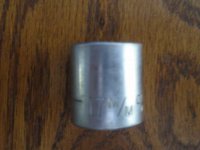
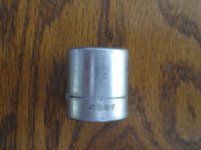
My odd addition to the thread.

3/8" drive 17M/M, no knurling, appears to have only a V.

Bill
 

Attachments

  • 005.jpg
    005.jpg
    147.6 KB · Views: 76
  • 009.jpg
    009.jpg
    145.5 KB · Views: 82

jakemac

Well-known member
Joined
May 21, 2013
Messages
9,035
Location
New England
The early metric didn't have the knurling. I'm not sure when the knurling started, late 70's or 80's maybe. :dunno:
 

Wakefield

Well-known member
Joined
Aug 26, 2010
Messages
5,132
Location
Arlington VA (but would like to get out to country
At the top of page 8 of the 1960 Craftsman Hand Tool catalog there is an explanation about why/how the =V= sockets are thin walled.

http://www.blackburntools.com/articles/rose-tools-catalog-archives/sears/pdfs/sears-craftsman-1960-hand.pdf

I see they sold the crossbar separately from the hinge handle (breaker bar)
so the 1960 bar is similar to mine a little too late for me to get the crossbar!

some of the older combination wrenches were thinner in the body/handle than the ones made more recently-like 30 years ago
 

gdocktor3

Well-known member
Joined
Apr 18, 2015
Messages
5,419
Location
Connecticut
Has anyone determined what codes represent the thickest socket walls?

Brian

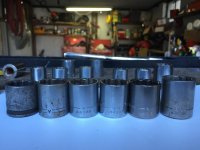
Well, I found as many USA made 12 point 11/16" sockets as I could, 3/8" drive, with different markings. Here's what I was able to find. From left to right is circle with H, double line V, single line V, single line VV, single line G, single line EE. You can be the judge, but looks to me the EE has thickest walls. Not sure that means much though considering I have the H series from the 30's-40's that I still use regularly because of the low profile.

I couldn't find an explanation for the single or double line sockets, but here is the list of symbols and what they mean.

H-circle = New Britain, ca. 1931 - 1947
E/EE = National Hand Tools/Stanley Works ca. 1982 - 1991
G = Easco, ca. 1979 - 1989 the Gastonia plant.
G continued = Danaher, ca. 1990 - 2011
V = Moore Drop Forge, ca. 1946 - 1967
V (continued) = Easco, ca. 1968 - 1986
VV = Easco, ca. 1974 - 1989
VV continued = Danaher, ca. 1990 - 2011


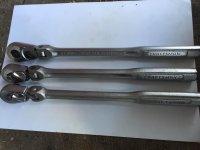
Then I found a few other random sockets with different codes (G1, G2, G2D) and 3 of the same ratchets I have with different markings and design.
G1 = Danaher, ca. 2000 - 2004
G2 = Danaher, ca. 2004 - 2008
G2D = Danaher, ca. 2008 - 2011 - This socket also has the laser etching

Hope this helps a little.
 

Attachments

  • IMG_2030.jpg
    IMG_2030.jpg
    129.7 KB · Views: 65
  • IMG_2031.jpg
    IMG_2031.jpg
    147.4 KB · Views: 55
  • IMG_2032.jpg
    IMG_2032.jpg
    133.9 KB · Views: 46
  • IMG_2029.jpg
    IMG_2029.jpg
    130.8 KB · Views: 55
  • IMG_2035.jpg
    IMG_2035.jpg
    135.9 KB · Views: 75
  • IMG_2034.jpg
    IMG_2034.jpg
    137.2 KB · Views: 70

four.cycle

Well-known member
Joined
Oct 19, 2015
Messages
28,586
Location
Tacoma, Washington
Wakefield said:
some of the older combination wrenches were thinner in the body/handle than the ones made more recently-like 30 years ago

^ the earlier CM =V= open-end wrenches have much narrower shanks than the more recently produced equivalents. "skinny" would be a good descriptor.

a buddy of mine was here a few days ago and remarked that he would love to have an older set of the CM " =V= " box wrenches, noting that they had much slimmer shanks than those more recently produced.
 

jakemac

Well-known member
Joined
May 21, 2013
Messages
9,035
Location
New England
I couldn't find an explanation for the single or double line sockets, but here is the list of symbols and what they mean.

Speculation has been that the switch from double line to single line signified the change when Danaher absorbed Moore Drop Forge around '67/'68. But noone has been able to prove that. It still remains a mystery.
 

Rileysan

Well-known member
Joined
Sep 11, 2015
Messages
4,298
Location
Milwaukie, Oregon
Well, I found as many USA made 12 point 11/16" sockets as I could, 3/8" drive, with different markings. Here's what I was able to find. From left to right is circle with H, double line V, single line V, single line VV, single line G, single line EE. You can be the judge, but looks to me the EE has thickest walls. Not sure that means much though considering I have the H series from the 30's-40's that I still use regularly because of the low profile.

-cut-

Hope this helps a little.
Thank you for taking the time to look these over! I intend to do the same with some of my sockets in the very near future. Until then, please accept my weak attempt at explaining my question. I was sorting my Craftsman socket sets last week into sets by code (-v-, and so on). In my 1/2" drive, 12pt metric sockets, I encountered one socket (12 or 13mm I think) that was so obviously different from the others that I had to do a double-take. The wall thickness was probably twice as thick as the others. I set it aside to look at it more closely, but haven't had the time to re-examine it.

If I can find the time this week, I will try to get back to this thread with pictures.

G = Easco, ca. 1979 - 1989 the Gastonia plant.
G continued = Danaher, ca. 1990 - 2011
V = Moore Drop Forge, ca. 1946 - 1967
V (continued) = Easco, ca. 1968 - 1986
VV = Easco, ca. 1974 - 1989
VV continued = Danaher, ca. 1990 - 2011

A little history lesson ...

I'm also a stamp collector. Prior to the creation of the US Bureau of Engraving and Printing in 1890, the US contracted with at least 5 different companies from 1847 to 1891 to print postage and revenue stamps.

Under the contract agreements with the US, all plates, dies, and remaining stock were the property of the US Post Office Department. When a contract ended, all the tooling was either forwarded on to the next contractor or destroyed. During the 1870s, a series of stamps known as the "Banknotes" were created by the National Banknote Company. When the contract ended, the tooling went to the Continental Banknote Company who were allowed to add "secret marks" to the dies in order to identify their work. When their contract ended, the tooling was sent to the American Banknote Company who were allowed to slightly modify the colors, paper, and/or dies in order to identify their work.

All of this to make this point: I believe there must be a way to identify who made Craftsman tools with similar markings (-V-, -G-, etc). I would like to think the toolmaker would like to identify their work!

Brian
 

gdocktor3

Well-known member
Joined
Apr 18, 2015
Messages
5,419
Location
Connecticut
All of this to make this point: I believe there must be a way to identify who made Craftsman tools with similar markings (-V-, -G-, etc). I would like to think the toolmaker would like to identify their work!

Brian

I'm not sure if this is a question or a statement, but that's exactly what these markings represent. Read the introduction section of this page. http://alloy-artifacts.org/craftsman-maker-v.html#intro
 

Rileysan

Well-known member
Joined
Sep 11, 2015
Messages
4,298
Location
Milwaukie, Oregon
I'm not sure if this is a question or a statement, but that's exactly what these markings represent. Read the introduction section of this page. http://alloy-artifacts.org/craftsman-maker-v.html#intro

That's what I thought, but if I read your previous post correctly, you showed that the markings remained the same as they transitioned from one manufacturer to another. -G- could be Easco or Danaher. -V- could be Moore Drop Forge or Easco, and so on.

It appears they eventually changed codes, but when and why?

In the big scheme of things, it's not important. From a collecting standpoint, it's interesting and therefore worthy of the question ...


G = Easco, ca. 1979 - 1989 the Gastonia plant.
G continued = Danaher, ca. 1990 - 2011
V = Moore Drop Forge, ca. 1946 - 1967
V (continued) = Easco, ca. 1968 - 1986
VV = Easco, ca. 1974 - 1989
VV continued = Danaher, ca. 1990 - 2011

Brian
 
Last edited:

jakemac

Well-known member
Joined
May 21, 2013
Messages
9,035
Location
New England
You need to read the history of the companies.
Moore Drop Forge was absorbed into Danaher, which was absorbed into Easco, which was absorbed into Apex. Meanwhile, the manufacturing was done at the same facilities. At some point recently, I think MDF was sold off to the Ideal Tool group, but I'm a little scetchy on that right now. It's all a shell game played by the investment groups to take money out of the companies and put it in the investors pockets.
 

gdocktor3

Well-known member
Joined
Apr 18, 2015
Messages
5,419
Location
Connecticut
Im guessing the markings stayed the same as they transitioned because it was still the same exact design and same specs. If it was a new design created by that new company, I'd imagine the symbol would change. So many of those were being pumped out at the time that Easco, for instance, probably didn't even bother as they already had their own line of hand tools and sockets.
 

jakemac

Well-known member
Joined
May 21, 2013
Messages
9,035
Location
New England
The date codes on Craftsman tools aren't like those on SnapOn, where the code is specific to a year. Instead, the Craftsman codes signify an era. Over the years the code has changed for any number of reasons. A change in manufacturers (SnapOn, SK, MDF, etc), perhaps a change in manufacturing ownership (MDF/Danaher/Easco/Apex), a change in factory location (US or Asia), a change in design specifications (shape, wall thickness, steel composition, chrome formula), or an executive's whim. Noone really knows because Sears/Craftsman remains tight lipped about the history of its products (they may not have even documented the information).

What we know about the history of Craftsman tools has been compiled by dedicated enthusiasts (like lauver, lbgradwell, and others) with little to no help from Sears. Most of this info comes from observation, antidotal conversations with purchasers from memory, and a lot of supposition.

This is why ongoing conversations like this one are important to unraveling the mysteries, and to preserve the information for those who come latter.
 
Last edited:

KEH

Well-known member
Joined
Jan 31, 2010
Messages
5,142
Little ponderosa's socket is the early metric, design, late 60s -early 70s. I bought a set of 1/2 drive metric sockets about then and that was the design.

KEH
 

jakemac

Well-known member
Joined
May 21, 2013
Messages
9,035
Location
New England
Little ponderosa's socket is the early metric, design, late 60s -early 70s. I bought a set of 1/2 drive metric sockets about then and that was the design.

KEH

Model numbers didn't appear stamped on the tools until 1974, so those sockets are from the mid-70's.
 

Farmall450

Well-known member
Joined
Dec 23, 2011
Messages
13,355
Location
Marengo, Illinois
The ratchets are much nicer.

The few V series sockets I have left are losing their chrome but still functional.

Ebay people are crazy though. A 3/8" rhft flex handle V series ratchet went for $120+shipping a couple days ago on ebay, more than a new dual 80.

Picked up the 1/2 flex head RHFT and was surprised by this.
Well worth it for the cost of a rebuild kit :D
 
To avoid these ads, REGISTER NOW!
Top Bottom