I'm building rails for a server rack (19-inch rack) and would appreciate critique and feedback on my plan before I get too far into this process. I have almost no experience doing these types of things and would like to be saved from making stupid mistakes and wasting money and time. I've attached a picture of roughly what this rail will look like in a rack. The purpose of these rails is to provide vertical support for heavy electronic equipment (up to about 110lb but typically closer to 30lb). The equipment will also be fastened to the front mounting holes and therefore needs to be vertically-aligned correctly.
I'll be using 19.5" lengths of 2.5x1.5", 3/16" thick steel angle. I cut this from 20' lengths at the supplier. I haven't been able to find stainless steel or galvanized steel in the 2.5x1.5", 3/16" thick dimensions, so I have to use regular steel. The long leg can be longer than 2.5", but the short leg must be less than 1.75". It's critical that these rails be rust-free (and remain that way), so I'm planning to have the steel galvanized at a local galvanizer after performing all cutting operations on it. This will be used in an indoor, temperature-controlled environment.
The fasteners are M6 (0.236in OD). I saw that 6.3-6.6mm (0.248-0.260") clearance holes are typical. Additionally, the galvanizer told me the process typically adds between 3 and 10mil of thickness. Therefore, the hole diameter should be reduced between 6 and 20mil. If I use a 17/64" drill bit for the hole, the resulting hole diameter after galvanziation should be 0.246-0.260", which seems just about right.
Are my calculations for the pre-galvanization hole diameter reasonable? Is my overall procedure for creating rack rails like this sound? Or, are there better/easier ways?
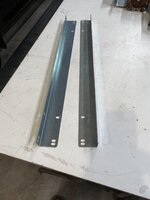
I've tested the rack rail before galvanization (shown in the picture) and the fit and dimensions work well.
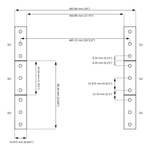
I do realize that the vertical load-bearing capability of these rails would be improved if I could have a 2nd set of screws directly above the first set. Unfortunately, that's not possible as this edge of the rail needs to be less than 1 rack unit (1.75"). The 2nd picture shows 19-inch rack dimensions. Still, I've tested this with some heavy equipment and it seems to be really solid.
I can go into more detail about the dimensions for the rail, including the vertical position of the holes, etc. but that part I think I got right, so I haven't included it.
I'll be using 19.5" lengths of 2.5x1.5", 3/16" thick steel angle. I cut this from 20' lengths at the supplier. I haven't been able to find stainless steel or galvanized steel in the 2.5x1.5", 3/16" thick dimensions, so I have to use regular steel. The long leg can be longer than 2.5", but the short leg must be less than 1.75". It's critical that these rails be rust-free (and remain that way), so I'm planning to have the steel galvanized at a local galvanizer after performing all cutting operations on it. This will be used in an indoor, temperature-controlled environment.
The fasteners are M6 (0.236in OD). I saw that 6.3-6.6mm (0.248-0.260") clearance holes are typical. Additionally, the galvanizer told me the process typically adds between 3 and 10mil of thickness. Therefore, the hole diameter should be reduced between 6 and 20mil. If I use a 17/64" drill bit for the hole, the resulting hole diameter after galvanziation should be 0.246-0.260", which seems just about right.
Are my calculations for the pre-galvanization hole diameter reasonable? Is my overall procedure for creating rack rails like this sound? Or, are there better/easier ways?
I've tested the rack rail before galvanization (shown in the picture) and the fit and dimensions work well.
I do realize that the vertical load-bearing capability of these rails would be improved if I could have a 2nd set of screws directly above the first set. Unfortunately, that's not possible as this edge of the rail needs to be less than 1 rack unit (1.75"). The 2nd picture shows 19-inch rack dimensions. Still, I've tested this with some heavy equipment and it seems to be really solid.
I can go into more detail about the dimensions for the rail, including the vertical position of the holes, etc. but that part I think I got right, so I haven't included it.