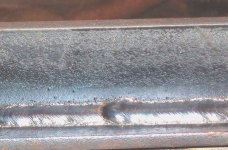
Can't see the pics here John, cause you didn't 'upload' them to the forum but have them going/coming from an off-site image hosting place. Which doesn't get through the corp firewall here. grrr.
Anyway, to me California and welding and structural raises some questions about meeting building/fabrication codes for structural welding and seismic structural welding codes. Don't know if that applies in your case or not.
Welding 101 - you weld "metal", not rust or millscale or paint or whatnot. So clean the metal of all 'stuff' that is not clean shiny metal. No oil or grease or paint, no rust or millscale (a wire wheel typically doesn't remove most millscale, it just shines it up so you need to grind or otherwise remove the millscale first). Some welding processes can 'tolerate' a bit of 'not-metal' (SMAW or other flux processes can typically 'tolerate' the most amount of 'non-metal') and GTAW can typically have almost no 'non-metal', but for the 'best' welding results always clean your metal to clean-n-shiny metal before welding.
And unless you posted a pic (see above comment about non-forum pics not always getting through corp firewall) of your welder, just saying "Miller wire-feed welder" isn't quite enough to go on.
As Miller (and Lincoln and most other manufacturers) make wire-feed welders from little 120V machines that output about 100 'real' amps or so (recent marketing-speak has them called 130-140 amp units, but that is really-really pushing it IMNSHO) that usually do not have enough real 'snot' to weld 3/8 inch thick steel with GMAW but may have enough power to do so with multi-pass using (some) FCAW wires (check to see if the FCAW wire in question is 'rated' for the material thickness and for possible seismic/structural welding before using such wires/machines) all the way up to some big machines that can run spray-mode GMAW (not vertical, as spray-mode weld puddles are too hot and fluid for vertical welding) that could melt through 3/8 - 1/2 inch thick steel in a single pass.
Welding using short-circuit transfer mode and 0.023/0.025 wire with C25 shielding gas is NOT going to get you anywhere near enough heat/penetration into some 3/8 inch thick steel. Some 0.035 solid ER70S-6 wire and C25 in short-circuit transfer mode with a big enough machine -may- enable you to weld that 3/8 inch thick steel (typically a 200+ 'class' machine, as the 175/180-class usually top-out around 3/16 to 1/4 inch or so using solid wire and GMAW).
Zeke/Milt, yes vertical welding is position 3F (for fillet welds) or 3G (for groove welds).
Vertical-up is usually used for 'structural' thickness welds if doing vertical welds, because vertical-down makes you run downhill faster (as gravity is pulling the weld puddle down ahead of you and you have to keep the arc on the base/parent metal to fuse into that and not just pile up a big puddle of filler that then doesn't fuse/penetrate). Vertical-down is useful for welding 'thinner' materials where you are trying to limit the heat/penetration into the base/parent material.
YMMV, etc, etc, etc.


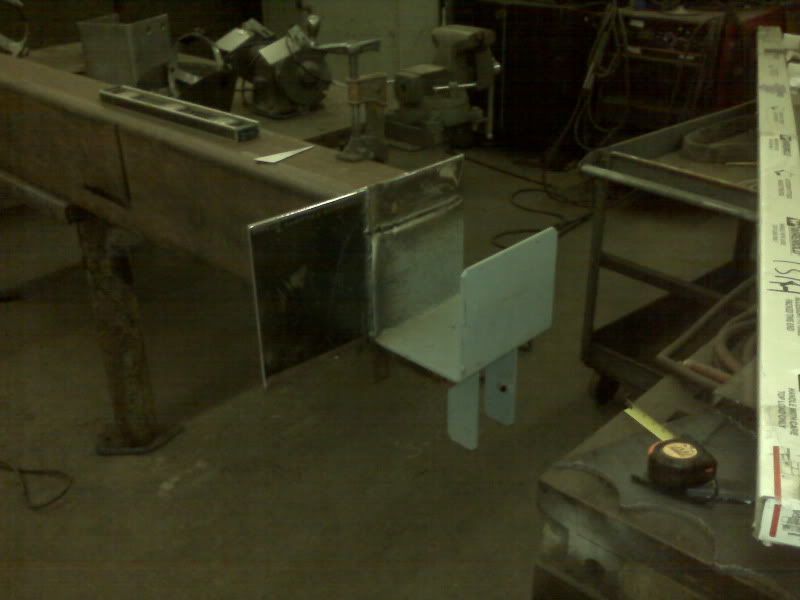


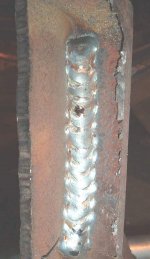
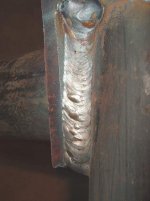
 You might want to champer the 3/8 tube where you have a **** joint as in your first pic. and crank up the heat a little.Grinding the scale a touch more can't hurt ether...