To avoid these ads, REGISTER NOW!

Curing new concrete

FlameOut

Well-known member
Joined
Jan 12, 2008
Messages
428
Location
Pittsburgh, Pennsylvania
I was curious as to what is the best way to go about curing my new floor. I asked the guy that poured it about hosing it down, and he said if I can't keep it continually wet to not do it at all or it could develop glazing cracks.

I'd like to clean it off, as there's dust everywhere from doing the control cuts, but I don't want to hose if off it will do more harm than good.

He did say not to park on it for AT LEAST a week, preferably longer
 
To avoid these ads, REGISTER NOW!

nate379

Banned
Joined
Feb 2, 2009
Messages
7,279
Location
Palmer, AK
Put a yard sprinkler on it and turn it on every day morning and night. Do that for a week or so.... longer the better.
 

Chris Adams

Well-known member
Joined
Oct 21, 2007
Messages
2,117
Temps here in the low 100's, they told me to wet it carefully (spray into the air, not at it) while it was still soft, keep it wet for three or four days.

I did that, but stopped 'watering it' after the frame went up.
Googling found most people recommend watering it.
 
OP
F

FlameOut

Well-known member
Joined
Jan 12, 2008
Messages
428
Location
Pittsburgh, Pennsylvania
I guess the best thing for me to do is not wet it at all. From what I found from google, it says if you wet it, you need to NOT let it dry out during this process
 

bimmer1980

Well-known member
Joined
Feb 5, 2009
Messages
2,105
Location
York, PA
concrete cures, it does not "dry". Therefore in order to facilitate the curing process, it needs to be wet for an extented period of time. Ideally, 28 days. When I poured some slabs for a project at my other garage, I covered it with plastic to keep it wet. We left it that way for a month. For a slab that was only 4 inches thick, it developed tremendous strength. For a later project, we had 6 concrete trucks back over it fully loaded and it did not crack.
 

brownbagg

Well-known member
Joined
Mar 20, 2006
Messages
5,208
put a soaker hose under the plastic, turn the hose on everyday for thirty minutes, keep it cover at least 14 days
 

aleccolin

Well-known member
Joined
Jul 12, 2009
Messages
101
For wet cure call around to some construction supply companies and buy a product called burlene. It's a poly backed burlap that you soak and it stays moist. Very often spec'd for wet cure of slabs.

Concrete is batched with the appropriate amount of water for the quantity of cement. Or at least it should be, which is why you always have cylinders taken for testing. You also NEED to know the air content, which for slabs should NEVER exceed 3% per ACI. Finishing to a dense hard-troweled finish works some of the water out, as well as some being lost through evaporation (more on sunny, breezy days which is why you sometimes need evaporation reducer during finishing). If you have good (taped) poly down under the slab the water can't go down, so it has to come out the top. For this reason the most common method for curing concrete BY FAR is curing compound. Spray it on and it forms a layer that prevents this water from escaping the fresh concrete until it has a chance to fully hydrate. Most break down over time and are compatible with most floor finishes.

Concrete cure is exponential, with the concrete developing more than 2/3 its design strength in the first 7 days with just the water in the mix. You can wet cure for 3 to 7 days, or just spray it with curing compound and stay off of it for a week. I work for a large concrete contractor building everything from sound walls to 30+ story high-rises and for every job that specifies wet cure with burlene or something similar, there are 20 that use curing compound.

FYI - Slow and thorough hydration can help prevent shinkage cracking, but the concrete will not develop more strength than the mix will allow. You can't make a 6000psi slab out of 3000psi design strength concrete, no matter how long you keep it wet. For distributed loads like cars and even concrete trucks, the capacity of the subbase is more critical than the compressive strength of the concrete.
 
Last edited:

nate379

Banned
Joined
Feb 2, 2009
Messages
7,279
Location
Palmer, AK
Do they even use 3000psi for garages? Around here they seem to use 4 or 5k. My slab has some kind of fiberglass hairs in it, was told it makes it stronger?
 
To avoid these ads, REGISTER NOW!
OP
F

FlameOut

Well-known member
Joined
Jan 12, 2008
Messages
428
Location
Pittsburgh, Pennsylvania
I ended up not wetting it at all, since it would have been impossible for me to keep it continuously wet. I know it was 4000 psi mix, but I do recall him telling the driver of the concrete truck to mix it with 5% air? Does that sound right? I see in above post that the 5% would be high. Not even sure what that means.

Tomorrow will be a week, so I guess it is now ok to park on? It's an average of 7" thick with rebar about every 18"
 

Mike83

Well-known member
Joined
Jan 24, 2008
Messages
2,156
Location
Wisconsin
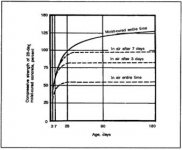
Concrete cure is exponential, with the concrete developing more than 2/3 its design strength in the first 7 days with just the water in the mix. You can wet cure for 3 to 7 days, or just spray it with curing compound and stay off of it for a week.

I disagree with the bolded statement. See below. I agree with the rest of your comments. Curing compound is a convenient way to cure concrete. The OP should note that curing compound is NOT used to cure bridge decks. Rather, burlap and soaker hoses and also poly sheeting to prevent evaporation are used.
 

Attachments

  • concrete cure.jpg
    concrete cure.jpg
    15.2 KB · Views: 53

Mike83

Well-known member
Joined
Jan 24, 2008
Messages
2,156
Location
Wisconsin
I ended up not wetting it at all, since it would have been impossible for me to keep it continuously wet. I know it was 4000 psi mix, but I do recall him telling the driver of the concrete truck to mix it with 5% air? Does that sound right? I see in above post that the 5% would be high. Not even sure what that means.

Tomorrow will be a week, so I guess it is now ok to park on? It's an average of 7" thick with rebar about every 18"

The "air" is air entrainment which is microscopic air bubbles in the concrete. 5% of your mix volume will contain tiny voids and these voids aid in the ability of the concrete to withstand freeze thaw cycles since the water in the concrete has room to expand. 5% air is nothing to be concerned about. That is in spec for DOT projects anyway.
 

ddawg16

Well-known member
Joined
Jul 11, 2008
Messages
21,005
Location
S. California
I watered mine down 2-3 times a day.....it's been about 8 months and not even a hairline.....

The water keeps the top layer from shrinking down as fast as it dries....it's when the top layer dries and the bottom is not that cracks start to happen....

Another option is to put plastic over it...this will help keep the water in...
 

rieferman

Well-known member
Joined
May 18, 2009
Messages
2,586
Location
Collegeville PA (30 min west of Philly)
My guy also had me water twice per day - before work and when I got home. But my pour was in an enclosed space (barn) during humid period (raining every day) so I'm not 100% sure if his advice for curing would be different during hot summer, or a slab open to the elements. In my case, the water from the morning watering wouldn't even evaporate by the time I got back home from work. So far no hairlines or anything. (we used 4000 with fibers.. no rebar.. 4 inches on 4 inches of gravel)
 

aleccolin

Well-known member
Joined
Jul 12, 2009
Messages
101
I disagree with the bolded statement. See below. I agree with the rest of your comments. Curing compound is a convenient way to cure concrete. The OP should note that curing compound is NOT used to cure bridge decks. Rather, burlap and soaker hoses and also poly sheeting to prevent evaporation are used.

I'm not sure why you disagree. The chart you posted confirms my statement. I didn't say that strength INCREASED exponentially, only that the curve was exponential...which it is. The chart you posted shows several strenth-maturity curves, each following a different exponentially decreasing function based on method of cure. The rate of cure (slope of the curve) is high on the front end and decreases at an increasing rate over time; as the concrete strength approaches its limit the slope of the curve approaches zero. The rate of change is different depending on temperature, cementitious content (cement, fly ash, slag) method of cure, etc. It takes a very long time to reach absolute 100% complete hydration and maximum strength, which is why we use the 28 day cure design strength standard. We've poured 5000psi mixes that would give us 2500psi in two days depending on the admixtures and W/C ratio. Very high early strength for formwork stripping to meet schedule, and slower cure on the back end. The function is different for every mix, but they all follow the same pattern.
 
Last edited:

Mike83

Well-known member
Joined
Jan 24, 2008
Messages
2,156
Location
Wisconsin
I'm not sure why you disagree. The chart you posted confirms my statement. I didn't say that strength INCREASED exponentially, only that the curve was exponential...which it is. The chart you posted shows several strenth-maturity curves, each following a different exponentially decreasing function based on method of cure. The rate of cure (slope of the curve) is high on the front end and decreases at an increasing rate over time; as the concrete strength approaches its limit the slope of the curve approaches zero. The rate of change is different depending on temperature, cementitious content (cement, fly ash, slag) method of cure, etc. It takes a very long time to reach absolute 100% complete hydration and maximum strength, which is why we use the 28 day cure design strength standard. We've poured 5000psi mixes that would give us 2500psi in two days depending on the admixtures and W/C ratio. Very high early strength for formwork stripping to meet schedule, and slower cure on the back end. The function is different for every mix, but they all follow the same pattern.


Sorry, I missed that you did not say "increased". No need for the math or concrete lesson.
 
To avoid these ads, REGISTER NOW!
Top Bottom