For wet cure call around to some construction supply companies and buy a product called burlene. It's a poly backed burlap that you soak and it stays moist. Very often spec'd for wet cure of slabs.
Concrete is batched with the appropriate amount of water for the quantity of cement. Or at least it should be, which is why you always have cylinders taken for testing. You also NEED to know the air content, which for slabs should NEVER exceed 3% per ACI. Finishing to a dense hard-troweled finish works some of the water out, as well as some being lost through evaporation (more on sunny, breezy days which is why you sometimes need evaporation reducer during finishing). If you have good (taped) poly down under the slab the water can't go down, so it has to come out the top. For this reason the most common method for curing concrete BY FAR is curing compound. Spray it on and it forms a layer that prevents this water from escaping the fresh concrete until it has a chance to fully hydrate. Most break down over time and are compatible with most floor finishes.
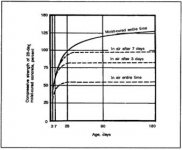
Concrete cure is exponential, with the concrete developing more than 2/3 its design strength in the first 7 days with just the water in the mix. You can wet cure for 3 to 7 days, or just spray it with curing compound and stay off of it for a week. I work for a large concrete contractor building everything from sound walls to 30+ story high-rises and for every job that specifies wet cure with burlene or something similar, there are 20 that use curing compound.
FYI - Slow and thorough hydration can help prevent shinkage cracking, but the concrete will not develop more strength than the mix will allow. You can't make a 6000psi slab out of 3000psi design strength concrete, no matter how long you keep it wet. For distributed loads like cars and even concrete trucks, the capacity of the subbase is more critical than the compressive strength of the concrete.