To avoid these ads, REGISTER NOW!

Cutting drywall in a finished space

branimal

Well-known member
Joined
May 31, 2016
Messages
1,938
I've got to cut 2 slots (each 12-18" tall ) in the drywall so I can snake up hvac lineset and a pvc condensate pipe from below. One slot to let me drill out the baseplate, and the other to hook up the lineset to the mini split unit.

The plan is to use a drywall blade on my oscillating tool to make the cut. Shop vac in the other hand to keep the dust down.

Is it worth trying to split the stud when cutting the drywall? That way - I can screw the drywall right back on the studs. The studs are metal, so that might prematurely dull the blade. Or should I shoot for inside the stud, and make the repair with scrap wood.
 
To avoid these ads, REGISTER NOW!

HoosierMark

Well-known member
Joined
Jan 31, 2013
Messages
1,442
Location
Southeast IN
i simply cut between the studs then screw a short piece of wood to the sides of the stud. I slide the wood up or down in the hole so it goes past the edge. This gives me an easy place to screw the piece I removed back to. I was also taught to lightly bruise the edge of the drywall with a hammer to give the mud a little deeper place to adhere too. Probably extra work but hey I am a lousy drywall guy and worse repair person.
 

bwringer

Well-known member
Joined
Jan 1, 2013
Messages
10,270
Location
Indianapolis
If you make the cuts by hand (utility knife and/or stab saw) rather than using a power tool, you'll generate one hell of a lot less dust, and it won't take long at all. Might even be quicker than using the guybrator.

Also, when making the repair afterwards, use the "dust free" or "dust control" joint compound. That stuff is amazing; when you sand it, the dust just falls straight down instead of making a cloud and heading for your lungs.
 

gizardlizard

Well-known member
Joined
Aug 29, 2019
Messages
726
Location
Madison, WI
i simply cut between the studs then screw a short piece of wood to the sides of the stud. I slide the wood up or down in the hole so it goes past the edge. This gives me an easy place to screw the piece I removed back to. I was also taught to lightly bruise the edge of the drywall with a hammer to give the mud a little deeper place to adhere too. Probably extra work but hey I am a lousy drywall guy and worse repair person.
This is how I have been doing it for years. It’s the fastest and easiest.
 
OP
B

branimal

Well-known member
Joined
May 31, 2016
Messages
1,938
Thanks guys .... I'll give the utility knife and stab saw a shot. Good call on the dust control compound.

Guybrator..... :ROFLMAO:.
 

CoronadoBruin

Well-known member
Joined
Jun 24, 2023
Messages
49
Location
SoCal Mountains & Desert
Retired carpenter here, and a fairly good hanger/taper/patcher as well, though the real pros are amazing to watch when they patch. Anywho, post #6 is correct when he says posts ##2-4 get it right. I'll add a bit more:

Find a small saw with small teeth and as little set as possible (drywall stab saws have large teeth and a significant set, and will tear the paper backing. Fine for hanging rock but not good for repairs by homeowners). Don't tell your wife but a sharp serrated bread knife works well, or use a good utility knife. Cut on the inward (push) stroke, not the outward to avoid damaging the paper. Don't use power tools as you will make a mess, even with a vacuum hose (it can work well if you have some experience). Cut the horizontals first so you can find the stud edges. Take care in avoiding electrical wires (don't be aggressive and take small strokes). Post #3 hits it with cut a longer board than the opening, and slide up and down so the ends are past the opening, otherwise you'll NEVER have the new nailers perfectly flush with existing studs, and your patch will look like hell. Use, say, a 1x2 or 1x3 with the flat side facing out, using one screw at each end into the remaining drywall. Use the same piece of drywall to patch, particularly if there is texture. Screw it back on, don't nail it. Do not use a lot of screws, and do not countersink them where they break the paper. Dimpling is a skill beyond a homeowner so don't do that. Take a sharp utility knife and ease all the edges about 1/8" so your four edges have a v-groove. Use some fast-drying Alex caulking and work it in, and wipe off the excess quickly with a wet cloth, and to a point where the caulking is just a hair below the surface. Let it dry completely before you mud, and consider using hot mud that dries quickly but is also is a bear to sand. If you have access to the mud that does not cause a dust storm, that's great as well but hot mud rarely cracks. Another option is wet-sanding (sponge) but you can't feather edges with that process. Alex caulking and hot mud will not crack on a repair if done correctly. If you have taped before, and it is a smooth wall, or you can match the texture, by all means do it that way. If you tape, do not use mesh tape unless you use hot mud. Mesh joints with regular topping or all-purpose mud will crack 70-90% of the time.


Last edited:

CraigStu

Well-known member
Joined
May 22, 2014
Messages
4,027
Location
Blacksburg, Va
The other thing I have found w/ the mesh tape (like HoosierMark I am not a good mud person) is that, if I sand a little to deep and expose a tiny bit of the mesh, it is a bear to get rid of that filament that is now sticking up.
 

CoronadoBruin

Well-known member
Joined
Jun 24, 2023
Messages
49
Location
SoCal Mountains & Desert
The other thing I have found w/ the mesh tape (like HoosierMark I am not a good mud person) is that, if I sand a little to deep and expose a tiny bit of the mesh, it is a bear to get rid of that filament that is now sticking up.
It's like an internal suture working its way out. You don't know what to do, but if you pull on it, it causes even more problems. :eek:
 
To avoid these ads, REGISTER NOW!

cgrutt

Well-known member
Joined
Mar 4, 2016
Messages
8,250
All good advise haven't used Alex caulking for that before but learn something new everyday. Few more comments.

I cut drywall all the time with oscillating tool because it's so fast but sharp razor blade will keep dust down. If you do use the tool make sure to use a dust bag in vac or you may blow dust throughout the house with the exhaust from shop vac. I have a really good vac for this and it's rarely a problem but have also used my Rigid with HEPA and/or drywall bags and it works fine.

They sell drywall repair clips at most big box stores that will make short work of putting cut piece back in place. A piece of pine 1x2 or other scrap wood also works fine. The clips leave a small piece of metal on outside that has to be taped afterwards.
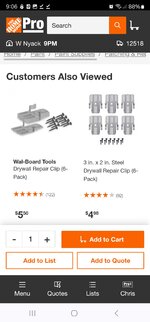
Screenshot_20231216_090640_Chrome.jpg

Not sure how large a hole you're making but you could also use a drywall patch, which is metal backed adhesive mesh to make repair. You could put this directly over small hole or over the reinstalled piece. I generally install over the cut piece it fills over any gaps left by cutting and leaves a nice smooth surface for the compound. By no means needed but just another option.

Screenshot_20231216_090752_Chrome.jpg

I've talked about this before but here's one of my "secrets" for great drywall repairs. Buy yourself a roll of Adfors Fibafuse and use instead of mesh or paper tape. Put a good coat of mud over seam, apply the fibafuse and embed it heavily into the compound. Scrape away all of the excess and let it dry. Another thin coat or two of compound, some very light sanding and patch will be nearly invisible. This is great stuff.

Screenshot_20231216_090917_Chrome.jpg

As for as hot mix or general purpose compound I use both. There's a little bit of a learning curve with hot mix you have to get consistency right and work fast but you can get job done in a day with it. It comes in various set times 5 min, 20min, 45 min, 90min, etc. I would use either 20 or 45 depending on how fast you work. 5 min is great for small repairs but you have to work FAST. There's a difference between cured and dry with hot mix the great thing about it is you can recoat when still wet as long as you waited long enough for the cure time to allow product to fully set. The downside is you can make as much dust as cutting just pouring it out of bag, you have to work fast and dispose of any excess before it hardens up and you have to keep all of your tools clean multiple times during repair. It doesn't shrink or crack, at least as much as General (or light weight/low dust) compound. I tend to use either hot or general purpose (standard weight) for repairs. Shrinking and dust are not an issue if you use thin coats and avoid putting anything on that will need to come off. Keep it thin and feathered and you won't really need to do much sanding at all.

Good luck.
 

Rusted Nut

Well-known member
Joined
Dec 11, 2022
Messages
1,809
Location
PNW
We do this all time at work. Cut between studs and patch as others have said. Use these Milwaukee saws-all blades with a slow speed, with a shop vac, you will virtually no additional clean up.


CoronadoBruin

Well-known member
Joined
Jun 24, 2023
Messages
49
Location
SoCal Mountains & Desert
I've got to cut 2 slots (each 12-18" tall ) in the drywall so I can snake up hvac lineset and a pvc condensate pipe from below. One slot to let me drill out the baseplate, and the other to hook up the lineset to the mini split unit.

The plan is to use a drywall blade on my oscillating tool to make the cut. Shop vac in the other hand to keep the dust down.

Is it worth trying to split the stud when cutting the drywall? That way - I can screw the drywall right back on the studs. The studs are metal, so that might prematurely dull the blade. Or should I shoot for inside the stud, and make the repair with scrap wood.
Found an appropriate jab saw for you:


That way you can use the very thin small set or no-set metal-cutting sawzall blades out there.

Contrary to what a few others have said, I would still cut by hand and NOT use power tools as it is a little trickier than it seems for a homeowner to hold a power tool (albeit small) in one hand and the vacuum hose in the other. It's one thing for those of us who have done it for 25, 35, or 45 years and another for a non-carpenter or non-drywaller homeowner. Play it safe, do it the simple way.
 

Zeke

Well-known member
Joined
Aug 13, 2009
Messages
17,176
Location
Long Beach CA, the sewer by the sea.
Cutting down the face of the stud is tedious because you constantly have to avoid original nails and screws which won't be hold much when you cut right next them. I've never seen anyone try an do that. Drywall patching is one of the most fundamental of all repairs but it's no wonder the GL would spend 2 pages of posts on it.

However, texturing is more difficult if called for. That can take some practice. I have found those pressurized cans found at the store to be OK, but not as good as a real texture hopper. Unless you are a master at this the repair will be noticable.

While it was not my main trade I had the advantage and pleasure to live 2 doors down from a retired plasterer who taught me interior and exterior plastering techniques, scratch, brown and finish with stucco or lime putty. He of course was not a fan of drywall but he could do that just fine. Under his tutelage I did coved ceilings and cast moldings. Like painting, it's fun when you know how and it's not your day to day job.
 

bwringer

Well-known member
Joined
Jan 1, 2013
Messages
10,270
Location
Indianapolis
I wouldn't call drywall repair "fun" by any stretch... out of necessity I've learned to make immaculate, invisible drywall repairs at least on smooth walls, but I'm very, very slow at it. Like, a week or more of coating, drying, sanding, repeat, repeat, repeat, paint... Pros are amazing, and fast.
 

Hank11

Well-known member
Joined
Aug 19, 2019
Messages
1,151
Location
Tennessee
It might be easier to cut the while bay open along the middle of the studs. Trying to work through small openings is silly. When you hit a screw, try to unscrew it. Other cut around it. When done, screw and glue (plain old wood glue) strips of 1/4” plywood inside the top and bottom of your hole. Let that sit a few minutes then replace the cut out drywall and screw it to the studs. Dab a little glue on the cut out where it lays on the 1/4 plywood backers you put in the hole. Be neat and careful and it all lays together again like nothing happened. A couple coats of 5 minute mud and its time for primer.
 

Zeke

Well-known member
Joined
Aug 13, 2009
Messages
17,176
Location
Long Beach CA, the sewer by the sea.
I wouldn't call drywall repair "fun" by any stretch... out of necessity I've learned to make immaculate, invisible drywall repairs at least on smooth walls, but I'm very, very slow at it. Like, a week or more of coating, drying, sanding, repeat, repeat, repeat, paint... Pros are amazing, and fast.
That's because you take a week to do a 2 hour job.
 

Leaflessshadetree

Well-known member
Joined
Aug 1, 2013
Messages
7,152
Location
Don't ask.
Utility knife, cut the outer layer of paper then switch to a disposable breakable blade and cut through at a bevel. Use the piece you cut out as the patch.
 

The Cobbler

Super Moderator
Staff member
Joined
Oct 24, 2013
Messages
25,879
Location
Niagara Region, Ontario, Canada
I usually cut the drywall slightly past center of the studs . use sharp blades in a utility knife and cut slightly angles so the finished side of the drywall is a bit smaller than the unfinished side. seldom was I cutting for access but for hole repairs. cut the patch on the "tight side" set it in place & cut it to fit . screw it in place and finish it. I did use oscilating tools, but frankly, a good knife & blade is probably faster & less dust. in some of the projects , the drywall contained asbestos so we would keep the cut line wet with a spray bottle of water as we cut and power tools were forbiden .
 

Mandres

Well-known member
Joined
Jun 22, 2006
Messages
1,153
I wouldn't go anywhere near the studs unless you absolutely have to. You don't want to deal with existing screws, taped joints or electrical wiring. Cut the access slots in the bays, then use scrap 1x2 as backer boards for the patch. If you want the repair to disappear plan to mud a much wider area than you'd think. Probably a foot wider on each side. Matching any texture can be a challenge, the harbor freight hopper works pretty well in my experience.
 
To avoid these ads, REGISTER NOW!
Top Bottom