

pcmeiners
Well-known member
My static well water level has recent lowered due to the lack of rain in the last couple months, almost at pump level, sucking air at times. The casing is down 260 feet, pump is only down 85 feet. Decided to replace the 40 year old, ½ hp 7 gallon per minute pump, under sized 1”polypropylene pipe, plus the electric line and send a new ¾ hp Gould pump which will produce >10 gpm pump at 140 feet .
Biggest issues are getting the correct poly pipe and the correct fittings. The poly pipe suppliers are not adhering to any standard so ordering the pipe was loads of fun. Some supplier go with IPS (nominal inside pipe size, like NPT pipe size) and some go CTS (copper tube size). Many retailers do not specify what type they are selling and most retailers are not showing the inside and outside dimensions. If you buy 1-1/4 poly in IPS, inside dimensions are nominally 1.25 inches up to approximately 1.40”, which is fine. CTS dimension use the outside dimension and the wall thickness which can vary quite a bit; CTS wall thickness makes a big difference in CTS pipe water flow volume. Now if water flows from a 1-1/4”pipe and you get 20 gallons per minute with CTS dimensions ( at a given pressure) with an IPS dimensions of 1-1/4” you get more than 30 gallons per minute, >1/3 more flow just because of a 1/4”.
Why would anyone want CTS sized pipe for a well or any other water supply use? Make no sense.
The other main issue with poly pipe is the pressure rating, most deep wells are going to need a higher rating then 100 psi, even 160 psi, so higher pressure IPS rated pipe is more difficult to obtain and higher priced. Lastly, it better to have a single length of poly in a well rather than 2 piece with a coupling, which can makes more difficult to obtain and generally incurs a higher price.
Barb fitting….. Seems ALL barbed fitting are CTS sized. So if you get IPS pipe, you need to purchase barbed fittings one size larger to fit IPS pipe without causing unnecessary restrictions in the fittings and possible sealing issues using a smaller CTS size with smaller inside dimensions. So for a 1-1/4 IPS pipe you need a CTS barb size of 1-1/2. Good luck is if you need a barb fitting with a smaller NPT size on a pipe thread end, hard to find and forget about getting it in 304 stainless unless you shell out extra bucks. Supplyhouse.com had such a fitting in brass (1-1/2 barb to 1” NPT). The needed 1-1/2” to 1” NPT fitting was due to my old 1” NPT pitless adapter; no way I am digging down 6 feet to change to a 1-1/4” NPT pitless….I will live with the small restriction..
Hose bands…. For years well installer have used cheap stainless hose bands on well connections, they are OK for car radiator but not good for poly water pipe connections, especially since most are third world produced, and they ****. It is not a fun thing when a poly pipe decides to slip off a barb fittings causing an unnecessary pump/pipe extraction or worse and goes to the bottom of a well if the pump has no safety line causing a really expensive extraction. Best to us 304 or 316 Marine Stainless Steel T-Bolt Hose Clamps.
As long as the pressure is the same during measuring the differences in pipe flow, the proportion of flow is roughly > 1/3 more between 1” and 1-1/4” ( goes for any psi pressure used)
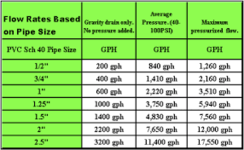
Years back I thought (2) or (3) 1" pipes would give more flow than a pipe of 2", I was wrong as the chart above shows.
Biggest issues are getting the correct poly pipe and the correct fittings. The poly pipe suppliers are not adhering to any standard so ordering the pipe was loads of fun. Some supplier go with IPS (nominal inside pipe size, like NPT pipe size) and some go CTS (copper tube size). Many retailers do not specify what type they are selling and most retailers are not showing the inside and outside dimensions. If you buy 1-1/4 poly in IPS, inside dimensions are nominally 1.25 inches up to approximately 1.40”, which is fine. CTS dimension use the outside dimension and the wall thickness which can vary quite a bit; CTS wall thickness makes a big difference in CTS pipe water flow volume. Now if water flows from a 1-1/4”pipe and you get 20 gallons per minute with CTS dimensions ( at a given pressure) with an IPS dimensions of 1-1/4” you get more than 30 gallons per minute, >1/3 more flow just because of a 1/4”.
Why would anyone want CTS sized pipe for a well or any other water supply use? Make no sense.
The other main issue with poly pipe is the pressure rating, most deep wells are going to need a higher rating then 100 psi, even 160 psi, so higher pressure IPS rated pipe is more difficult to obtain and higher priced. Lastly, it better to have a single length of poly in a well rather than 2 piece with a coupling, which can makes more difficult to obtain and generally incurs a higher price.
Barb fitting….. Seems ALL barbed fitting are CTS sized. So if you get IPS pipe, you need to purchase barbed fittings one size larger to fit IPS pipe without causing unnecessary restrictions in the fittings and possible sealing issues using a smaller CTS size with smaller inside dimensions. So for a 1-1/4 IPS pipe you need a CTS barb size of 1-1/2. Good luck is if you need a barb fitting with a smaller NPT size on a pipe thread end, hard to find and forget about getting it in 304 stainless unless you shell out extra bucks. Supplyhouse.com had such a fitting in brass (1-1/2 barb to 1” NPT). The needed 1-1/2” to 1” NPT fitting was due to my old 1” NPT pitless adapter; no way I am digging down 6 feet to change to a 1-1/4” NPT pitless….I will live with the small restriction..
Hose bands…. For years well installer have used cheap stainless hose bands on well connections, they are OK for car radiator but not good for poly water pipe connections, especially since most are third world produced, and they ****. It is not a fun thing when a poly pipe decides to slip off a barb fittings causing an unnecessary pump/pipe extraction or worse and goes to the bottom of a well if the pump has no safety line causing a really expensive extraction. Best to us 304 or 316 Marine Stainless Steel T-Bolt Hose Clamps.
As long as the pressure is the same during measuring the differences in pipe flow, the proportion of flow is roughly > 1/3 more between 1” and 1-1/4” ( goes for any psi pressure used)
Years back I thought (2) or (3) 1" pipes would give more flow than a pipe of 2", I was wrong as the chart above shows.
Last edited:


 As a teenager I drilled wells for a couple years, interesting job.