To avoid these ads, REGISTER NOW!

Deep well pump replacement

pcmeiners

Well-known member
Joined
Aug 13, 2009
Messages
7,846
Location
In the only town in Pennsylvania, Bloomsburg.
My static well water level has recent lowered due to the lack of rain in the last couple months, almost at pump level, sucking air at times. The casing is down 260 feet, pump is only down 85 feet. Decided to replace the 40 year old, ½ hp 7 gallon per minute pump, under sized 1”polypropylene pipe, plus the electric line and send a new ¾ hp Gould pump which will produce >10 gpm pump at 140 feet .

Biggest issues are getting the correct poly pipe and the correct fittings. The poly pipe suppliers are not adhering to any standard so ordering the pipe was loads of fun. Some supplier go with IPS (nominal inside pipe size, like NPT pipe size) and some go CTS (copper tube size). Many retailers do not specify what type they are selling and most retailers are not showing the inside and outside dimensions. If you buy 1-1/4 poly in IPS, inside dimensions are nominally 1.25 inches up to approximately 1.40”, which is fine. CTS dimension use the outside dimension and the wall thickness which can vary quite a bit; CTS wall thickness makes a big difference in CTS pipe water flow volume. Now if water flows from a 1-1/4”pipe and you get 20 gallons per minute with CTS dimensions ( at a given pressure) with an IPS dimensions of 1-1/4” you get more than 30 gallons per minute, >1/3 more flow just because of a 1/4”.

Why would anyone want CTS sized pipe for a well or any other water supply use? Make no sense.

The other main issue with poly pipe is the pressure rating, most deep wells are going to need a higher rating then 100 psi, even 160 psi, so higher pressure IPS rated pipe is more difficult to obtain and higher priced. Lastly, it better to have a single length of poly in a well rather than 2 piece with a coupling, which can makes more difficult to obtain and generally incurs a higher price.

Barb fitting….. Seems ALL barbed fitting are CTS sized. So if you get IPS pipe, you need to purchase barbed fittings one size larger to fit IPS pipe without causing unnecessary restrictions in the fittings and possible sealing issues using a smaller CTS size with smaller inside dimensions. So for a 1-1/4 IPS pipe you need a CTS barb size of 1-1/2. Good luck is if you need a barb fitting with a smaller NPT size on a pipe thread end, hard to find and forget about getting it in 304 stainless unless you shell out extra bucks. Supplyhouse.com had such a fitting in brass (1-1/2 barb to 1” NPT). The needed 1-1/2” to 1” NPT fitting was due to my old 1” NPT pitless adapter; no way I am digging down 6 feet to change to a 1-1/4” NPT pitless….I will live with the small restriction..

Hose bands…. For years well installer have used cheap stainless hose bands on well connections, they are OK for car radiator but not good for poly water pipe connections, especially since most are third world produced, and they ****. It is not a fun thing when a poly pipe decides to slip off a barb fittings causing an unnecessary pump/pipe extraction or worse and goes to the bottom of a well if the pump has no safety line causing a really expensive extraction. Best to us 304 or 316 Marine Stainless Steel T-Bolt Hose Clamps.


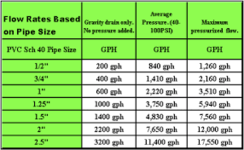
As long as the pressure is the same during measuring the differences in pipe flow, the proportion of flow is roughly > 1/3 more between 1” and 1-1/4” ( goes for any psi pressure used)
1728227889717.png

Years back I thought (2) or (3) 1" pipes would give more flow than a pipe of 2", I was wrong as the chart above shows.
 
Last edited:
To avoid these ads, REGISTER NOW!

Norcal

Well-known member
Joined
Mar 16, 2008
Messages
13,752
I am glad I live in a area where pitless adapter are unnecessary, the well is only 185' or so, hung on PVC pipe, replacing the original 1 1/2" galvanized pipe.
 

PCustoms

Well-known member
Joined
Jul 23, 2011
Messages
22,351
Location
VT
@pcmeiners skimmed the post and am a bit confused....

  1. Why does CTS or IPS measurement affect the flow? 30gpm is a flow rate, not a size..
  2. Why do you need such a high pressure rating on a deeper well, aren't these just running at sub 80psi anyway?
 

micromind

Well-known member
Joined
Sep 24, 2023
Messages
3,012
Location
Fernley, Nevada, about 30 miles east of Reno.
@pcmeiners skimmed the post and am a bit confused....

  1. Why does CTS or IPS measurement affect the flow? 30gpm is a flow rate, not a size..
  2. Why do you need such a high pressure rating on a deeper well, aren't these just running at sub 80psi anyway?

Water is 2.31' per PSI. If the pump is 115' down the well and the static water lever goes that low, you'll have 100 PSI at the pump. If the pressure switch is set at 40 - 60, the pressure will be 160 at the pump.
 
OP
P

pcmeiners

Well-known member
Joined
Aug 13, 2009
Messages
7,846
Location
In the only town in Pennsylvania, Bloomsburg.
"Why does CTS or IPS measurement affect the flow? 30gpm is a flow rate, not a size."

IPS 1-1/4" pipe or tubing is manufactured in a nominal pipe size, so the inside of a 1-1/.4" pipe is 1-1/4"
CTS is manufactured to a size measured to the outside of the pipe or tubing surface, so CTS 1-1/4" tubing's inside circumference is 1-1/4" (OD) minus the wall thickness twice, so if the wall thickness is 1/8" then the inside measurement is 1"(ID)

Now the difference between 1-1/4" IPS and CTS is roughly 1/4" ( there can be variances in tubing wall thicknesses) which does not sound like a lot but in pipe flow it make a big difference. For every increment in all pipe sizes,there is a large difference in pipe flow due to friction, flow characteristics, and turbulence.

This effect gases also as in compressor piping. If you have a 3/4" pipe system on a compressor capable of producing 40cfm, and the measured flow output at a device is 20 cfm, if re-piped using 1" (at the same compressor output pressure) you would get a little more than 30 cfm.

"Water is 2.31' per PSI. If the pump is 115' down the well and the static water lever goes that low, you'll have 100 PSI at the pump. If the pressure switch is set at 40 - 60, the pressure will be 160 at the pump." :thumbup:

To add.... well tubing (generally) goes up to 250psi strength. Drill a well deep enough and you have to use steel pipe to the pump because the pressure at the pump could exceed 250psi.
 
Last edited:

W-Cummins

Well-known member
Joined
Jan 9, 2006
Messages
1,639
Location
Iowa
Why don't you use sch 80 drop pipe? I don't think I would use poly pipe if it was free! My pump is in the hole @ 260' I put it in twice the first pump lasted about 20 years. I got the sec 80 1.250 pipe in 20' lengths and threaded it saved TONS over buying ready made drop pipe and the plastic cuts like butter, it didn't take me 2 hours to thread it all.
 

racecougar

Well-known member
Joined
Jan 26, 2021
Messages
4,981
Location
Missouri
To add.... well tubing (generally) goes up to 250psi strength. Drill a well deep enough and you have to use steel pipe to the pump because the pressure at the pump could exceed 250psi.
That's how it is around here. IIRC, when we put in the new well in '17, we set the pump at 465' down.
 
OP
P

pcmeiners

Well-known member
Joined
Aug 13, 2009
Messages
7,846
Location
In the only town in Pennsylvania, Bloomsburg.
"Why don't you use sch 80 drop pipe?"

Because I do not have a setup to pull the pipe very fast, thinking winter issues.
The check valve is at the Gould pump, all the water weight is more difficult to manage with pipe.
Pulled pipe in the winter, you get wet every time with pipe.
That said, pipe is quite usable.
 

djbmw

Well-known member
Joined
Jun 20, 2013
Messages
1,120
Location
Ottawa, Ontario, Canada
The luxury of poly pipe is that you can heat it up a bit and get it to fit if there's a bit of slop, or if its a bit too tight.

Pull the pump, see what you're working with, and replace.... or just redo the whole thing (pump, torque arrester, check valve, poly pipe, wires, clamps).. and then you only have to worry about the size of the pitless adapter.
 
OP
P

pcmeiners

Well-known member
Joined
Aug 13, 2009
Messages
7,846
Location
In the only town in Pennsylvania, Bloomsburg.
The luxury of poly pipe is that you can heat it up a bit and get it to fit if there's a bit of slop, or if its a bit too tight.
Getting adapters to fit is secondary to my concerns. Losing >1/3 capacity if I were to use CTS is a major issue, and should be for anyone running water pipe, be it a well, geothermal or any other use of poly tubing.
 

djbmw

Well-known member
Joined
Jun 20, 2013
Messages
1,120
Location
Ottawa, Ontario, Canada
Getting adapters to fit is secondary to my concerns. Losing >1/3 capacity if I were to use CTS is a major issue, and should be for anyone running water pipe, be it a well, geothermal or any other use of poly tubing.
But the bottle neck is not the well pipe. The bottle neck is all of the interior plumbing in your house. As soon as the 1.5 or 1.25 pipe (or whatever you buy) enters your home its reduced to 3/4" to fit the pressure tank/valve....

Its great to have a million gallons per hour when the pipe enters the home but it quickly becomes irrelevant. The only time that it truly matters in a residential setting... is if that single well is feeding multiple drops, prior to being reduced.
 

mikedodge

Well-known member
Joined
Jun 27, 2017
Messages
2,756
For the fittings get everything from the same supplier or if you're picking up in store check it before buying. If never had a problem with the correct style fittings fitting properly, the diameters have always matched properly.
It would **** if one manufacturer is measuring different then others. If that's the case I'd avoid them and find the products from one that does it the more common way or at least matches what I already have.
 

dcg9381

Well-known member
Joined
Jun 20, 2018
Messages
11,627
Location
Austin, TX
Because I do not have a setup to pull the pipe very fast, thinking winter issues.
Why do have to pull it in winter? We've got shallow wells in Michigan.. They have a schrader valve on them that is used to winterize if we're gone the way they are setup is they can function all winter (plumbing itself is below the frost line). I get if you've got water coming out of the cap area that isn't heated.

In Tx the shallowest well in my neighborhood is 475'. They use schedule 80 PVC, but pulling these is a huge pain in the ***, you need a crane / lift system.
 
OP
P

pcmeiners

Well-known member
Joined
Aug 13, 2009
Messages
7,846
Location
In the only town in Pennsylvania, Bloomsburg.
It is not irrelevant, yes the internal house pipe reduces the flow, but you are still getting more volume than if you have less volume due to the well pipe restriction. Friction loss (thus volume loss) is cumulative. Does it matter?, granted much of the time not really, but it depends on how much water is used at the same time, also lower friction loss uses less pump electric.

"Why do have to pull it in winter?"

If a pump dies in the winter or the well dries up in the winter... I worked a few wells in sub zero weather.... loads of fun. Point being I can pull poly up a well very fast in cold weather, pipe without a pipe pulling setup is very time consuming.

"For the fittings get everything from the same supplier or if you're picking up in store check it before buying. If never had a problem with the correct style fittings fitting properly, the diameters have always matched properly."

If you read my posts this is already explained, and remedied, and it is not as simple as you would like to believe.
 
Last edited:

dcg9381

Well-known member
Joined
Jun 20, 2018
Messages
11,627
Location
Austin, TX
As soon as the 1.5 or 1.25 pipe (or whatever you buy) enters your home its reduced to 3/4" to fit the pressure tank/valve....
I've got a 20 gallon pressure tank, it's got a 1" inlet. It's also "partial flow" - it's supplemented by the pump itself and is on a branch.

The 3/4" PEX typically in a home is a "branch". Given you can't flow more than branch diameter supports at pressure, but 3/4" is more than enough flow for several residential plumbing valves and 1/2" lines to be branched out from 3/4.
 

W-Cummins

Well-known member
Joined
Jan 9, 2006
Messages
1,639
Location
Iowa
My static well water level has recent lowered due to the lack of rain in the last couple months, almost at pump level, sucking air at times. The casing is down 260 feet, pump is only down 85 feet. Decided to replace the 40 year old, ½ hp 7 gallon per minute pump, under sized 1”polypropylene pipe, plus the electric line and send a new ¾ hp 12 gpm pump down to 180 feet (or more).

Now if water flows from a 1-1/4”pipe and you get 20 gallons per minute with CTS dimensions ( at a given pressure) with an IPS dimensions of 1-1/4” you get more than 30 gallons per minute, >1/3 more flow just because of a 1/4”.
Seems that this is a moot point! Your putting in a 12 gpm pump and both poly pipes will do 20 gpm. Seems like the new 3/4hp pump must be amazing given it can pump 12 gpm at more than 2x the depth and only 1/4hp more. BTW how much can your well pump, can it even pump 30 gpm??
 
To avoid these ads, REGISTER NOW!
OP
P

pcmeiners

Well-known member
Joined
Aug 13, 2009
Messages
7,846
Location
In the only town in Pennsylvania, Bloomsburg.
I not arguing with you or anyone else or explaining every last detail. I am tired of it.

"Seems like the new 3/4hp pump must be amazing given it can pump 12 gpm at more than 2x the depth and only 1/4hp more. BTW how much can your well pump, can it even pump 30 gpm?"

The pump that was installed 40 years ago was about the cheapest the driller could put down the well, just about pumps at 85 feet. The new Gould pump cost $1100 has 14 stages and can pump 10 gpm at 140 feet. I do not see the aquifer lowing from 80 to anywhere near 140 feet in my lifetime .
 
Last edited:

dcg9381

Well-known member
Joined
Jun 20, 2018
Messages
11,627
Location
Austin, TX
I do not see the aquifer lowing from 80 to anywhere near 140 feet in my lifetime .
Why the heck would they drill a 260 foot well and place the pump at 85' down? Perhaps because they're drilling by the foot?

You might be "ground water level" safe in PA... But around here, swings of 60 feet are pretty common within 5 year periods.

Sorry you're getting some grief here, as usual I think people are trying to provide good info so you only have to do the job once.

This is one of the "better" looking well water graphs in my area. There are quite a few that are "trending down" over decades.


1728334015542.png
 
Last edited:
OP
P

pcmeiners

Well-known member
Joined
Aug 13, 2009
Messages
7,846
Location
In the only town in Pennsylvania, Bloomsburg.
"Why the heck would they drill a 260 foot well and place the pump at 85' down?"

Driller may not have hit a good bearing water strata until 260, then the 260 strata must be feed from a high point to have the the static level I have, (I live in mountain area). On the other hand he may have drilled for extra profit. :) As a teenager I drilled wells for a couple years, interesting job.

Static water level I assume was <70ft on the install date; pretty high for a 260 ft well, almost artesian ( only lived here since 2021). I talked to the driller/installer before deciding to do the new install myself trying to get information, he had no documentation. Sounded like all he is interested in is the most profit he can make. So I guess when he installed the pump (his father did it), putting the pump down deeper cut into the companies profit margin.

In my area I looked for the governments well info, nothing for a couple miles in all directions, all my neighbors are at 250-300ft. Interesting area for water, many streams, springs, ponds.. the original farmers knew what good farm land needed.

Glad I do not need to go >450, I would have to have a mortgage just for the well. Water here is really good, high in iron/manganese but easy to remedy.
 

30-30remchester

Well-known member
Joined
Aug 20, 2011
Messages
250
Spent 50 + years in the industry and owned and operate well and pump business. I always like reading these responses. I seldom agree with them, but most replies will and do work. I am not a fan of poly pipe but there are many well pumps hung on that type of pipe. I would and have never used any as drop pipe and extremely seldom as line pipe. There could be a valid reason that a 7 gpm pump was selected and a higher capacity pump than the well is capable of sustaining is a sure way to get dirty water and short pump life.
 

mikedodge

Well-known member
Joined
Jun 27, 2017
Messages
2,756
"For the fittings get everything from the same supplier or if you're picking up in store check it before buying. If never had a problem with the correct style fittings fitting properly, the diameters have always matched properly."

If you read my posts this is already explained, and remedied, and it is not as simple as you would like to believe.

I read your posts and thats why I said that. It's not what I would like to believe, it's how it usually works. If a single supplier can't get you the piping and proper sized fittings that work with it its a ****** supplier.
 

sizem

Active member
Joined
Jan 20, 2021
Messages
29
Location
kentucky
For my well (100ft deep, 85 ft deep pump, 1/2 mile run n addtl 300ft rise), I switched to a product called WellHose which has better pressure capacity than poly, tends to minimize internal buildups, very non-reactive with typical well water and easy to lower w/ pump and pull out. I used a simple 4 inch dia PVC pipe as a roller. used as a replacement for galv steel pipe. Product has a 50 year life expectancy/10yr warranty. I've been very pleased. www.hosesolutions.com
 
OP
P

pcmeiners

Well-known member
Joined
Aug 13, 2009
Messages
7,846
Location
In the only town in Pennsylvania, Bloomsburg.
For my well (100ft deep, 85 ft deep pump, 1/2 mile run n addtl 300ft rise), I switched to a product called WellHose which has better pressure capacity than poly, tends to minimize internal buildups, very non-reactive with typical well water and easy to lower w/ pump and pull out.
Interesting product. Using the linked device to simplify the pump pull and install


"There could be a valid reason that a 7 gpm pump was selected and a higher capacity pump than the well is capable of sustaining is a sure way to get dirty water and short pump life."

Possibly the original owner would not go for anymore money for a deeper pump install. With a static level of 70 ft in a 260 foot well, the pressure pushing water up is tremendous. With a 6" casing causing approximately 2184 lbs of water pushing up to 70ft it is very difficult believing a higher capacity pump would not have been an option if dropped down deeper. Water is clean, other than a some iron/manganese
 
Last edited:

larry4406

Well-known member
Joined
Jan 27, 2006
Messages
19,059
Location
Northern Virginia
For my well (100ft deep, 85 ft deep pump, 1/2 mile run n addtl 300ft rise), I switched to a product called WellHose which has better pressure capacity than poly, tends to minimize internal buildups, very non-reactive with typical well water and easy to lower w/ pump and pull out. I used a simple 4 inch dia PVC pipe as a roller. used as a replacement for galv steel pipe. Product has a 50 year life expectancy/10yr warranty. I've been very pleased. www.hosesolutions.com
Interesting system.

The FAQ page on their site says the hose is affected by chlorine and to contact them. Anytime well work is done, you are supposed to chlorinate the well. This negative would turn me off to this product.
 

30-30remchester

Well-known member
Joined
Aug 20, 2011
Messages
250
What is curios to me about these threads and people's experiences is the number of times people have worked on their pumps. A properly installed pump of good quality and should not have to be replaced or worked on for 15 years at a minimum. I pulled several pumps per year that were in use for over 30 years.
 

djbmw

Well-known member
Joined
Jun 20, 2013
Messages
1,120
Location
Ottawa, Ontario, Canada
What is curios to me about these threads and people's experiences is the number of times people have worked on their pumps. A properly installed pump of good quality and should not have to be replaced or worked on for 15 years at a minimum. I pulled several pumps per year that were in use for over 30 years.
Pumps made in the 70's and 80's were built to last.
Unfortunately pumps today, even from good brands/manufacturers, see roughly half of the life when compared to pumps of yester-year.

Gotta love profiteering and cost savings.
 

racecougar

Well-known member
Joined
Jan 26, 2021
Messages
4,981
Location
Missouri
What is curios to me about these threads and people's experiences is the number of times people have worked on their pumps. A properly installed pump of good quality and should not have to be replaced or worked on for 15 years at a minimum. I pulled several pumps per year that were in use for over 30 years.
The setup we replaced in '17 had been in use since the '80's.
 

Bert_

Well-known member
Joined
Dec 24, 2016
Messages
9,699
Location
NW Iowa
Lots of variations of poly pipe. I always use iron pipe size with a 250psi rating.
 
OP
P

pcmeiners

Well-known member
Joined
Aug 13, 2009
Messages
7,846
Location
In the only town in Pennsylvania, Bloomsburg.
" A properly installed pump of good quality and should not have to be replaced or worked on for 15 years at a minimum."

Pump I am getting is a Gould (10)GS series, Reviewed it carefully before selecting, they tout how good the internal plastic parts are, even plastic bearing. I even checked out the next better series pump they make, made for industrial pumping, basically the same pump. Guess the days of all metal pumps are gone. Sure hope this lasts >15 years.


gba2331

Well-known member
Joined
Sep 22, 2021
Messages
760
Interesting system.

The FAQ page on their site says the hose is affected by chlorine and to contact them. Anytime well work is done, you are supposed to chlorinate the well. This negative would turn me off to this product.
Agreed but maybe brief or low-level sanitization is okay.

They have an install in Manassas…field trip, @larry4406 ?
 

30-30remchester

Well-known member
Joined
Aug 20, 2011
Messages
250
I installed several truckloads of GOULD pumps. They were and still could be (I retired several years ago). I also installed many all stainless steel pumps. The thermal plastic impellers work far better in a sediment well as stainless will gall easier. I think GOULD still build stainless pumps. They have many different models.
 

sizem

Active member
Joined
Jan 20, 2021
Messages
29
Location
kentucky
Just to follow up re: concerns of chlorine degradation. If shocking for bacteria is req'd for initial install, chlorine shock the well and after the appropriate exposure time, drop the pump and operate. If one were to create long term exposure of the hose then the inner & outer liner of polyurethane would degrade, while the internal substrate of polyester (which provides the mechanical strength would not). If multiple chlorine shocks are req'd then the install has other issues. Then the hose would not hold pressure, but pump can still be removed.

In my case, I did not have a bacteria issue both before & after install, and the hose sees approx 170 PSIG. in operation.
Anyway, just sharing...not advocating.
 

dcg9381

Well-known member
Joined
Jun 20, 2018
Messages
11,627
Location
Austin, TX
If multiple chlorine shocks are req'd then the install has other issues.
Well, it might not be the install. It could be the water itself.
Here an initial "shock" was recommended. The driller just said "dump 1-2 gallons of bleach down there". They call that good enough.

We had successive coliform issues, which may be the nature of the beast depending on the water source. I shocked the well every 18 months or so. Chlorine is never good for any pump, but it's also not necessarily the end of the world for short term exposure. Well would stop producing chlorine water in a day or two... Or you could pump it out until you couldn't smell it.

Water quality varies wildly depending on where you are. YMMV. Just my experience owning a well. And part of why I switched to rain collection.
 

larry4406

Well-known member
Joined
Jan 27, 2006
Messages
19,059
Location
Northern Virginia
Just to follow up re: concerns of chlorine degradation. If shocking for bacteria is req'd for initial install, chlorine shock the well and after the appropriate exposure time, drop the pump and operate. If one were to create long term exposure of the hose then the inner & outer liner of polyurethane would degrade, while the internal substrate of polyester (which provides the mechanical strength would not). If multiple chlorine shocks are req'd then the install has other issues. Then the hose would not hold pressure, but pump can still be removed.

In my case, I did not have a bacteria issue both before & after install, and the hose sees approx 170 PSIG. in operation.
Anyway, just sharing...not advocating.
Here, when a pump and riser pipe is installed (poly, metal, whatever), the well is schocked immediately with chlorine. They have a chart - diameter, depth, thus X amount of chlorine bleach at Y% or granules.

Shocking is done AFTER installation. Your pipe, hose, etc, drags across the lawn and picks up animal feces as you install and your hands are far from sterile nor is the pump and piping sterile.

Once chlorinated, you use a hose and discharge the hose back into the well. You continued to do this while wetting the interior of the well pipe. This continues until you are recirculating chlorinated water all along the interior of well casing and the down pipe. Post chlorine smell, you continue this for about 15 minutes or so.

When this is done, then you admit chlorinated water into the home and run till you have chlorine (via smell) at each fixture).

Then, the chlorinated water is left alone to burn out and cleanse the piping for 24-48 hours; ie you don't run any water.

After that, the system is run non-stop, typically thru a hose bib to purge the well and house till testing proves absence of chlorine. This can take 5-10 hours depending on well.

Only then is it tested for potability.

That's a lot of chlorine exposure I am thinking.

Above is new construction process here in VA.

Hence my concern with this hose.
 

30-30remchester

Well-known member
Joined
Aug 20, 2011
Messages
250
Larry you are spot on. However, I have never had to pump the well more than a couple hours after Contact time has expired. However, there is a lingering oder, but not harmful though I told the customers to not drink or cook with the water for 48 hours.
 

larry4406

Well-known member
Joined
Jan 27, 2006
Messages
19,059
Location
Northern Virginia
Larry you are spot on. However, I have never had to pump the well more than a couple hours after Contact time has expired. However, there is a lingering oder, but not harmful though I told the customers to not drink or cook with the water for 48 hours.
Health Department here, as well as private labs, have a test powder that they use to test for presence of chlorine (water turns pink if chlorine is present). Water has to test negative for chlorine before a sample is taken for potability testing.
 
To avoid these ads, REGISTER NOW!
Top Bottom