eborcim
Well-known member
wow....that's terrible....not much else to say  glad they got out safely.
glad they got out safely. glad they got out safely.
Being in the design stage of my own shop I would like to know how the interior of the walls and ceiling were finished? OSB? Sheetrock? Exposed studs? Reducing the spread of fire is one of my worries.
I guess if you think about it, its not much more than some black iron pipe and sprinkler heads...
And a pump and a storage tank if your water main is too small? And a monitored fire alarm system that signals the fire department to come down should a sprinkler head go off. And of course the 300 dollar per year monitoring fee and the 300 dollars per year for the quarterly sprinkler system inspection. Not that this is not worth it for peace of mind. It probably is but my concern is that a residential sprinkler system is not going to be able to tackle a garage fire with all those combustibles. I honestly don't know enough about sprinkler systems but I do wonder what kind of system would be adequate for a shop/garage.
A sprinler system must be designed for the potential fire load. More combustables means more heads and more gpm flow. Even if they do not extinguish a fire, they can do a huge amount to keep it contained untill the fire department can get there. There's really no downside to having a sprinkler system. But it can get a little more tricky if the building is not heated all winter....then you need a dry system.
 Structure would have probably been saved if sheetrock was used... It would have fought back fire for at least 15-20 minutes(deducting a little for intense heat source) instead of immediately helping to spread the flames like OSB would do...
Did I read that right? painted OSB interior sheeting???? Nobody reading this should consider flammable sheeting in thier garage anymore
Certainly is sad. Hope your friend gets it rebuilt in a timely fashion.
Unfortunately NFPA 13D, the residential standard does require sprinklers in attached garages much less detached garages.
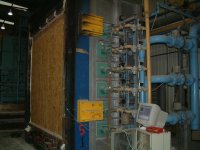
Fuel load can overload even commercial sprinkler systems. This concrete and metal sprinkled building was brought down by wood pallets. You can see the 6” sprinkler pipes that have fallen down.
And a pump and a storage tank if your water main is too small? And a monitored fire alarm system that signals the fire department to come down should a sprinkler head go off. And of course the 300 dollar per year monitoring fee and the 300 dollars per year for the quarterly sprinkler system inspection. Not that this is not worth it for peace of mind. It probably is but my concern is that a residential sprinkler system is not going to be able to tackle a garage fire with all those combustibles. I honestly don't know enough about sprinkler systems but I do wonder what kind of system would be adequate for a shop/garage.
I have a buddy who always says the only thing better than burning a pallet is burning 10 pallets ... I can only image an entire building of them.Pallet fires are HOT. We had a pallet company catch on fire a few years ago. Total loss. I had the road blocked redirecting traffic about 500 yards away and could really feel the heat off of it...
Being in the design stage of my own shop I would like to know how the interior of the walls and ceiling were finished? OSB? Sheetrock? Exposed studs? Reducing the spread of fire is one of my worries.
Honestly, no, I don't think it would have. Your forgetting that an 'unfinished' wall still has OSB typically on the outside, so potato, potatoe is what I say.I can't help but wonder though if the fact it was lined with OSB inside didn't make it substantially worse than if it had been either unfinished or sheetrocked.
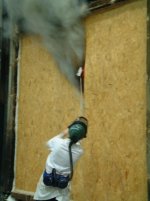
The answer to any fire barrier is a material like sheetrock. A single 1/2" sheet on a stud or solid OSB sheathed wall, will give you a 30 minute wall, for fire purposes. Time at the very least, to get out. A double slabbed wall would give you 60. But, if you use something like LaFarge Echek board, 15mm (Blue paper), double-slabbed,we've tested OSB faced SIP panels in a furnace, and took 94 minutes to breach. This far exceeds any code for compartment wall that I know of.Did I read that right? painted OSB interior sheeting???? Nobody reading this should consider flammable sheeting in thier garage anymore
Good point, with the 'right' fuel - gas in this case, it's a bit moot - this place is coming down, End Of Story. But something more important, 'cos another poster mentioned it - a steel sheet will do zip for you - in fact, in commercial buildings around here, which are commonly steel framed, the columns/beams need to be specifically fire-proofed themselves as, unlike timber, which chars, beams heat, twist, etc and you'll get Disproportionate Collapse - have a look at that pic and even the sprinkler pipes, despite carrying a coolant, are toast........funnily enough, in a fire, timber can be your friend, as something like a Glulam beam is inherently safer, fire-wise, than steel beam, as the natural charring that occurs helps mitigate flame spread and burn of the beam. The longer, the better ! Why do you think they make charcoal from timber ? Exactly, because of the slow burn characteristics.Fuel load can overload even commercial sprinkler systems. This concrete and metal sprinkled building was brought down by wood pallets. You can see the 6” sprinkler pipes that have fallen down.

I hope he was well insured.
The good thing nobody was hurt.
things can be replace.
If he has good insurance he gets to rebuild and start buying new stuff.
Looks like Norwalk firedepartment was there.
They havn't lost a foundation yet.
Then you would end up with half burned shed, half burned tools, half burned car, etc.
How do you end up ahead in that case?
Get everyone out. Call the fire dept. Call the insurance guy. Start over fresh.
Last thing I want to do is dig around in a fire damaged, water damaged, smoke damaged garage trying to find something to salvage. You have sheetrock?? So what. By the time the fire is put out it's either singed, burned, or crumbling from the water the firefighters use. Then you have to tear it off, decide whether or not the wiring can be saved, on and on and on....
Talking about sprinklers and stuff, has anyone ever thought about a Halon system? In a confined space like a garage it would be very effective and it wouldn't have to be large either as you only need a 4% concentration of Halon in the air to effectively quench a fire and not having it relight.
We used them all the time at telecom exchanges and other places with sensitive electronics.
Best thing with it is that it's completely unintrusive and leaves no residue at all. It's not harmful to breathe in the concentrations needed, but you do get a change of pitch in your voice like with helium while breathing it.
FYI halon has been banned (since the mid 1990s I believe) and has generally been replaced with FM-200. This is a very expensive type of system...

Or antifreeze.

Yeah,spraying a flammable liquid like antifreeze out of the sprinkler heads should help.
That's how it's done in unheated spaces. Either a dry system or an antifreeze loop.
Well then, why don't you go join up and straighten them out? I'm sure they could use an expert like yourself and will benefit greatly from your years of experience and know-how.
Ok I may be a dummy but how does spraying a flammable liquid on a fire extinguish it?If you look at section 5 of this MSDS for antifreeze it shows it has a fairly high flashpoint at 254*f but still the stuff in the pipes should get heated up pretty quick I would think.
http://www.enterpriseoil.ca/i/pdf/msd/Antifreeze-PrestoneAdvancedFormula.pdf