

designer485
Well-known member
Preview - Before and After:
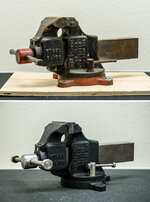
About this project:
With Christmas approaching, I decided to restore a vise for my Dad as he doesn't currently have one in his workshop. I searched Craigslist and eBay for a few weeks until I stumbled upon this Desmond Stephan 33s is seemingly great condition. I overpaid a bit, but it was worth it in the end as the vise was in excellent condition and disassembled with ease.
Inspiration came from my previous vise restoration (Desmond Stephan 41p Restoration) as well as @cavemanwelder on Instagram. The main goals were to clean up the casting marks, install new custom jaws, replace the handles and provide a tough, durable and good looking coat of paint.
My current vise:

Before Images:
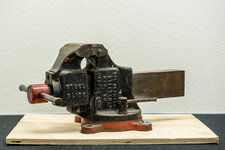


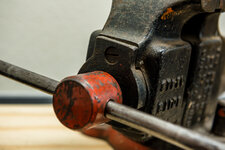

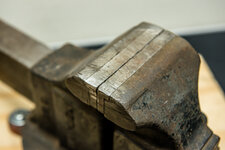

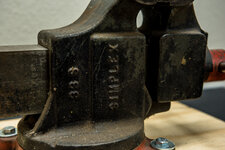

Time to take it apart (everything came apart very easy which was awesome):

The lead screw was in great shape with little to no visible wear.


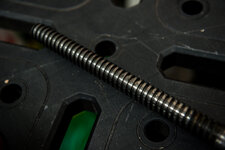
Other than some dirt, old paint and surface rust, things looked good.

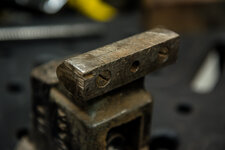
The factory jaws have definitely had some use, but the bolts broke free without much force.

More disassembly:


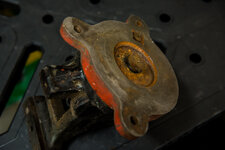
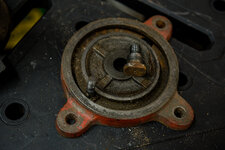
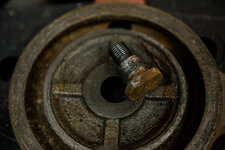


The swivel lock bolt had some significant wear so that was replaced.


The lead screw nut and retaining pin came out easily.


Out came the wire wheel to clean up most of the parts:


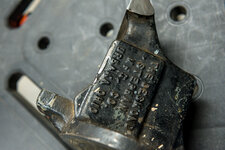
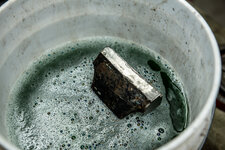
Next, I turned my attention to the castings. I like the look of cast iron so I wasn't trying to smooth everything out, but I like to remove the casting parting lines and clean up any major signs of use. I also gave the cast parts a dunk in simple green overnight to loosen up the old paint and crusty dirt.
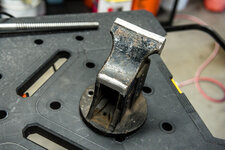

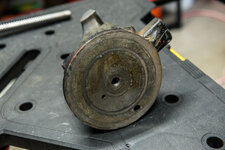

I went around all of the edges and got rid of any sharp spots or burrs.


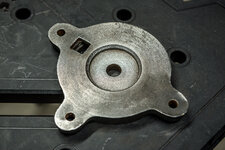
After the wire wheel and some file work:



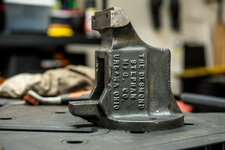

There was some pretty significant casting marks near the logo:

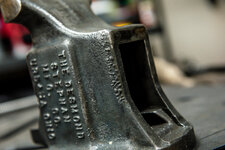
Parting line - before and after:


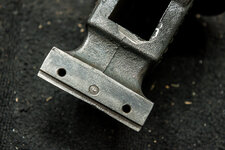




Time to tape / mask the parts for paint. I chose VHT wrinkle black. It goes on easy and seems to be pretty tough on some other parts I have painted with it in the past.


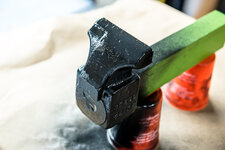
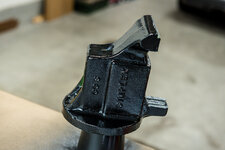

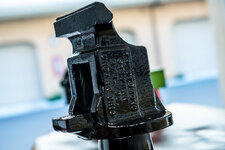
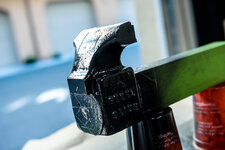

I almost forgot to paint the front collar.

I chose to cold blue the nut and some of the machined surfaces. I used a combination of Super Blue and OxphoBlue (the OxphoBlue gets much darker).


New swivel lock bolt (ordered from McMaster)


I know some folks don't like cutting off a perfectly usable handle, but two things really stand out on a vise restoration and that is the handle and the jaws. Both of which are getting replaced, especially as this one is a gift.
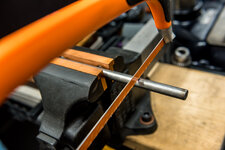
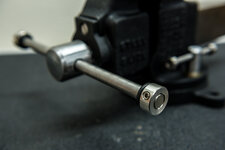
My handle solution is a bar of 17-4 PH stainless rod, two 303 stainless shaft collars and 2 large diameter O-rings. I used the same combination on my vise and love the result. The best part is that everything is an off the shelf item at McMaster. I did have to cut the main handle rod from 12" to 10" and the swivel lock handle rod from 6" to 4". I also put a slight chamfer on the edge of each rod with a file in the drill press.




Painted parts:


I did not want raw casting showing up behind the lead screw collar so that got a coat of cold blue as well. The OxphoBlue gets really dark.


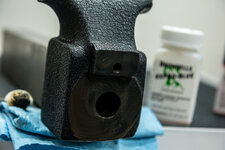
I cleaned up the inside edges of the lead screw handle hole after cutting off the stock handle.


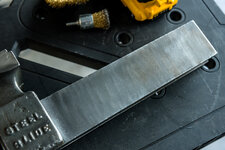
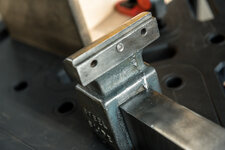
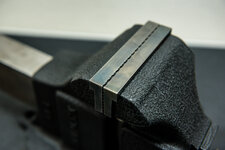
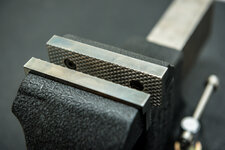
I stumbled across AntiqueVises.com and a guy named Logan Kendrick. I cannot say enough good things about my experience ordering custom jaws from him. I sent over a CAD file of what I was looking for and a few weeks later a beautiful set of hardened A2 serrated jaws were on my doorstep. I am thrilled with how these fit and function. There is a slight miss with the serrations which I was made fully aware of prior to receiving the jaws and he offered to remake them if I wanted. I kind of like the fact you can tell a human made them and it adds to the story without hurting the function, so I took them as is. His communication was great and it came with great integrity.
The stock jaws are 3.75" wide. I upped the dimension to a full 4" and also made them a bit taller / thicker. Overall, I think the change really works well.


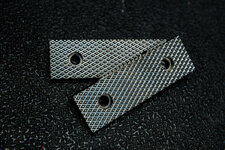
A2 looking amazing after being hardened.
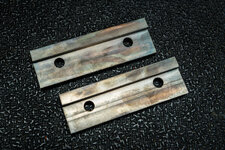
The finished parts:


Reassembly:


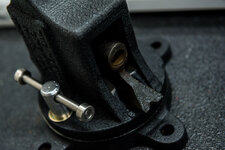


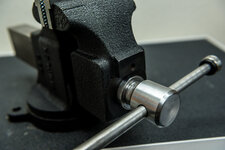
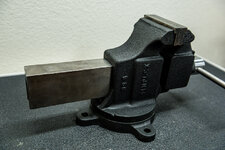
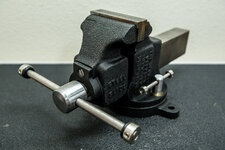
Finished product:


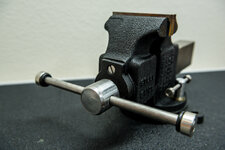
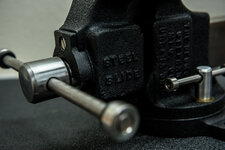









About this project:
With Christmas approaching, I decided to restore a vise for my Dad as he doesn't currently have one in his workshop. I searched Craigslist and eBay for a few weeks until I stumbled upon this Desmond Stephan 33s is seemingly great condition. I overpaid a bit, but it was worth it in the end as the vise was in excellent condition and disassembled with ease.
Inspiration came from my previous vise restoration (Desmond Stephan 41p Restoration) as well as @cavemanwelder on Instagram. The main goals were to clean up the casting marks, install new custom jaws, replace the handles and provide a tough, durable and good looking coat of paint.
My current vise:
Before Images:
Time to take it apart (everything came apart very easy which was awesome):
The lead screw was in great shape with little to no visible wear.
Other than some dirt, old paint and surface rust, things looked good.
The factory jaws have definitely had some use, but the bolts broke free without much force.
More disassembly:
The swivel lock bolt had some significant wear so that was replaced.
The lead screw nut and retaining pin came out easily.
Out came the wire wheel to clean up most of the parts:
Next, I turned my attention to the castings. I like the look of cast iron so I wasn't trying to smooth everything out, but I like to remove the casting parting lines and clean up any major signs of use. I also gave the cast parts a dunk in simple green overnight to loosen up the old paint and crusty dirt.
I went around all of the edges and got rid of any sharp spots or burrs.
After the wire wheel and some file work:
There was some pretty significant casting marks near the logo:
Parting line - before and after:
Time to tape / mask the parts for paint. I chose VHT wrinkle black. It goes on easy and seems to be pretty tough on some other parts I have painted with it in the past.
I almost forgot to paint the front collar.
I chose to cold blue the nut and some of the machined surfaces. I used a combination of Super Blue and OxphoBlue (the OxphoBlue gets much darker).
New swivel lock bolt (ordered from McMaster)
I know some folks don't like cutting off a perfectly usable handle, but two things really stand out on a vise restoration and that is the handle and the jaws. Both of which are getting replaced, especially as this one is a gift.
My handle solution is a bar of 17-4 PH stainless rod, two 303 stainless shaft collars and 2 large diameter O-rings. I used the same combination on my vise and love the result. The best part is that everything is an off the shelf item at McMaster. I did have to cut the main handle rod from 12" to 10" and the swivel lock handle rod from 6" to 4". I also put a slight chamfer on the edge of each rod with a file in the drill press.
Painted parts:
I did not want raw casting showing up behind the lead screw collar so that got a coat of cold blue as well. The OxphoBlue gets really dark.
I cleaned up the inside edges of the lead screw handle hole after cutting off the stock handle.
I stumbled across AntiqueVises.com and a guy named Logan Kendrick. I cannot say enough good things about my experience ordering custom jaws from him. I sent over a CAD file of what I was looking for and a few weeks later a beautiful set of hardened A2 serrated jaws were on my doorstep. I am thrilled with how these fit and function. There is a slight miss with the serrations which I was made fully aware of prior to receiving the jaws and he offered to remake them if I wanted. I kind of like the fact you can tell a human made them and it adds to the story without hurting the function, so I took them as is. His communication was great and it came with great integrity.
The stock jaws are 3.75" wide. I upped the dimension to a full 4" and also made them a bit taller / thicker. Overall, I think the change really works well.
A2 looking amazing after being hardened.
The finished parts:
Reassembly:
Finished product:
