Gearing Up!
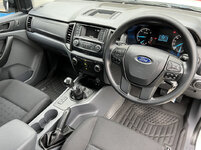
Previous to my S550, the only manual cars I had driven were basic work vehicles, think delivery vans and single-cab pickups trucks. In 2010, I took delivery of manual PK Ranger, which became my daily driver. That car was replaced in 2016 with a new PX MK II Ranger. In both cases, Ford did not even offer an automatic transmission, so I really didn’t have a choice. I would complain about the diesel-manual combo being a drag in daily driving, but both of those cars taught me how to heal-toe rev match and hone my shifting skills.


For any other car I have bought, I’d confidently say that a manual was never part of the equation, to the point where it wasn’t even considered for more than a second. Why? Because in most cases, the auto was faster or the better option, to the point where I truly doubted the whole point of a manual in modern motoring. Once upon a time, you bought the manual because it had more gears, was faster, more efficient and overall, the better driving experience. However, once automatics started to match and then exceed a manual in terms of gear count, the balance shifted. You know, a lot is said about “save the manual” or “you’re not a real car enthusiast if you don’t like or buy a manual”. Said people will almost always have an automatic in their daily driver, probably the “fun” car too. So, what is the hype about? If they are so good, why don’t car companies sell more of them…………….and that includes sports cars where both options are offered.
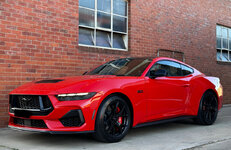
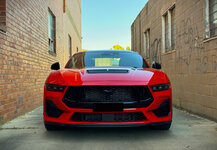
So, after all that……………………I’ve said this before, but it wasn’t until I bought a Mustang did I come to understand why so many people get hooked on the whole V8 manual thing. In complete contrast to what I said above, I didn’t even consider the auto when placing my order for the S550. Why? Because if I was jumping in the deep end, I wanted the full Mustang experience.
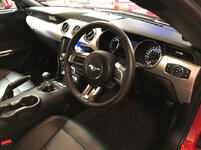

Very early on, I felt like I had made a mistake going for the Getrag MT-82 6-speed manual. The strange clutch action made it difficult to drive off the line, it was a case of stalling it or stuttering away from a set of lights. Not cool.

I was dialing up revs like I would normally, when in fact it was better to allow the car to it for you, as in, ease off the clutch and the computer responds with the correct amount of throttle. Obviously that changes when doing a hard launch, but it took me a while to get used to that arrangement. Once I did though, I began to really love that relationship between hands and feet.

Now, the elephant in the room……………..the Chinese made Getrag MT-82 and its reputation for poor reliability. The thing is, I think what ruins this transmissions reputation is a lack of build
consistency rather than
quality. Some of them are brilliant, some of them are grindy, some of them make a lot of noise, some of them break. Mine? Well, it was extremely noisy at low speed from brand new and had the very occasional gritty shift into third. The later 2018+ MT-82 D4 was stronger than before, but was way overgeared for the high revving Coyote, which sifted the balance toward the 10-speed auto. I have a personal belief that those who manage to blow up MT-82’s are shifting them in the most brutal of ways, then complaining when it breaks. There are plenty of videos on YouTube showing some tuff young lad powershifting his Mustang (or Camaro, Corvette……….) to prove this theory.

It wasn’t until I got to drive a few 6-speed auto Mustang GT’s did I fully appreciate the manual experience. The Ford-GM ZF 6-speed copy was ok, but nowhere near as good as the real ZF 6-speed, they just lacked the sharpness of the manual and felt like an old school slush box in comparison. With the MT-82 manual, I liked it more than the internet had me believing. The direct shift linkage made this version more precise compared to the MT-82 fitted to my Ranger and its horrible remote shifter linkage system. I especially loved the ultra-short gearing, which made the car feel more powerful than it was. I also liked the shift weight and crisp feel through the just-right shifter. Many owners swapped out the shifter knob, but I thought Ford got it right. I would have liked a better pedal placement to make heal-toe easier, many fitted aftermarket kids to remedy this.

So why, you may ask, did I go for the 10-speed automatic if I loved the manual V8 Mustang experience? Once again, I wanted to try something new. If Ford had put the Tremec in the GT as well as the Darkhorse, maybe that would have made the decision harder to make. I think its pretty obvious that the Tremec is what Ford
should be using instead of the MT-82, for both strength and the shorter gearing. So, choosing the 10-speed was for two reasons, the aforementioned “something new” and for the shorter gearing and how it better suits the high-revving Coyote V8.
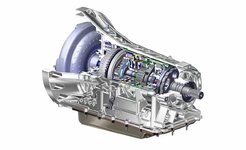
The 10-speed automatic was part of a co-development between Ford and General Motors, designed for use in rear-wheel-drive applications. Ford actually did the design work here, with GM taking lead on the 9-speed transverse gearbox. Both companies manufacture their own versions and it’s widely fitted to a range of models, on the Ford side that includes the F-150, Ranger, Bronco, Explorer/Aviator, Expedition, Mustang and even the RWD Transit. While there are five different torque ratings for this gearbox, the Mustang uses the 10R80 version, which started production at Ford's Sharonville Transmission plant in 2018. The 10R80 is a conventional torque converter automatic, with the overall design layout based on the ZF 8-speed. It features a unique triple-clutch arrangement, all the while being the same physical size as the previous 6-speed auto.

I’ve driven plenty of 10-speed automatic Ford’s, both in Ranger and Mustang. Obviously, the diesel 10-speed experience is a world apart from a V8 Mustang, so comparisons and comments regarding those are not relevant here. I have driven S550’s with the 10-speed, and found them excellent when the hammer went down, but felt they were lost at low speed/normal driving conditions. Too many gears, too many choices. So, ordering a new S650 10-speed was a moment of blind faith.
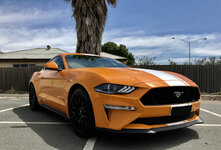

In the intervening years, Ford have worked hard on improving the calibration for the 10-speed auto, both in Ranger and Mustang. The most obvious change I have noticed is they do far less gear-skipping, so the upshifts are smoother and more natural feeling. In early examples, I found that the gear skip left the engine labouring after an upshift.
In this S650, so far I have been really liking this transmission. I think it goes without saying, I really dislike CVT autos, but then I also don’t really love DCT’s either. For me personally, a torque converter is the perfect compromise, especially since the advent of the ZF 6 and 8-speeds. The slushiness of a traditional torque converter is mostly gone, so you get a much more responsive feel and none of the abruptness that can come from a DCT. In the Mustang, the shift speeds both up and down are great, the rev-match down shifts are epic! The gearbox shift response and calibration can be altered via the drive mode, and manual shifts are available at any time via the paddles, reverting back to auto after afterwards. Manual control can also be locked by moving the shifter from D to M.
I will say though, manual inputs by the paddles are quite delayed. I went looking to see if the drive mode selection made a difference here, however there was no mention of improved response, just that the actual gear shifts were quicker in Sport/Drag/Track modes, not necessarily faster manual response. Those modes do provide more sensitivity to throttle inputs when left in drive, likewise holding gears for longer before upshifting.
In normal driving, the transmission is very smooth and natural feeling. Having said that, you do hear the car shifting a lot. In heavier acceleration, up to a point at the moment as the car is still too new for aggressive driving, the shifts are firm and quick in engagement. As mentioned, those rev matched down shifts are a delight, especially the 3rd to 2nd. I also love having paddle shifters on a performance car for the first time. At some point, I may look at extenders for the paddles, they are just a tad small, especially when cornering.


If I was to critique, it would be minor. The above-mentioned slow response to manual inputs being the main one. The second, I would still love to have manual function with the gear lever, something Ford themselves did so right with the BA through FGX Falcons, push forward to downshift, pull back to upshift. And lastly, with so many gears to account for, it can be hard to know what gear is being used unless in manual mode. On the Ranger, you can actually initiate a gear count in auto mode, which I find quite useful.

Overall, I’m happy I went automatic this time. I did think I would get bored without the manual transmission, but that hasn’t really played out so far. An automatic just suits my driving style more, and with a competent auto, it means I can set it to KILL and have some fun, then select D and enjoy the comfort at the end.