To avoid these ads, REGISTER NOW!

Did I screw up?

hydrogeoman

Member
Joined
Nov 4, 2023
Messages
10
Hello,

I am (was) planning on building a 16' x 28' gambrel roofed shed (with loft). I have already poured a mono slab that is 10 inches thick x 12 inches wide around the perimeter to support stick built walls. The floor between the perimeter is and approximately 5-6 inches thick. The perimeter "foundation" is reinforced with two vertical rows of #4 rebar and the slab is reinforced with #4 rebar in a 2ft x 2ft grid, wired together.

I am in CO, so we get freeze / thaw. The soil compacts well (silty, sandy, clay).

I am concerned that there may be too much movement for a building of this size and weight and I should have either drilled piers below frost line or a full perimeter foundation down below frost line (was trying to save money).

Do I risk building as planned or would that be a huge mistake? Any advice would be greatly appreciated!
 
To avoid these ads, REGISTER NOW!
OP
H

hydrogeoman

Member
Joined
Nov 4, 2023
Messages
10
did you follow any building dept requests or specs?
I spoke to the building permits office and the person I spoke to said that my proposed foundation would be fine. So I went ahead with the pour. Later, when I took my permit application in, I spoke to an inspector that was "concerned" about my plan.

I know I should have waited to pour the slab, but work, weather, and scheduling made me pull the trigger (perhaps too fast). The building permit approval is still pending, but I was hoping to get additional opinions here. (I have been a lurker here for at least 15 years, but this is my first post).
 

climb.on

Well-known member
Joined
Apr 13, 2015
Messages
501
Location
Minnesota
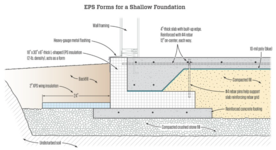
I think you are fine. You poured a thickened edge monolithic slab. Did say what he was concerned about? Did you insulate under the slab? If the building will be heated then you need to make this a Frost Protected Shallow Foundation (FPSF). You need 2"-4" of insulation on the perimeter of the slab and a 2' (preferably 4') wide perimeter insulation around the base of the foundation. FBSFs are in the building code, so if they give you are hard time, show them the code. I have a 36x48 shop and a 2300sq/ft ranch home built this way. I'm in MN. Built in 2017. It works! And we have a high water table. Lot's of guys on the job site, told me this won't work. Well I can tell you very confidently that it does.
 

Attachments

  • Screen Shot 2023-11-04 at 9.38.14 PM.png
    Screen Shot 2023-11-04 at 9.38.14 PM.png
    2.2 MB · Views: 138
OP
H

hydrogeoman

Member
Joined
Nov 4, 2023
Messages
10
Thank you climb.on! The second building inspector I talked to said that if there is much movement of the slab, there could be a lot of structural damage to the building. I did not insulate under the slab, but building is not going to be heated. Only going to be used to store garden equipment, machinery, tools, etc. Basically a large tufshd.

My slab is somewhat similar to what your figure shows, but the slab and thickened edges are resting on compacted soil native soil. No crushed stone, footing, or insulation That's it.
 

grant00

Well-known member
Joined
Feb 12, 2011
Messages
205
Location
Littleton, CO
For a building your size, the type of foundation is what I have seen recommended in Colorado also through my building department. I think drilling piers would be way overkill
 

Copymutt

Well-known member
Joined
Sep 3, 2016
Messages
3,386
Location
Colorado
Code here prohibits rebar contact with your compacted material. Concerned that rebar doesn’t appear to be continuous from slab down the vertical portion of the pour. Six years ago I removed & repoured the slab portion of our living room 16x 28 due to insufficient rebar and insufficient compaction under the monopour. Not a fun job.
 
OP
H

hydrogeoman

Member
Joined
Nov 4, 2023
Messages
10
grant00 - I had the ICC guidance sheet for a detached garage, which show that monoslab as an option, which is one of the reasons I went that route. The second inspector I talked to has me second guessing.

Copymutt - The rebar grid was set in "rebar chairs" which keeps it about 2 inches above the compacted soil.

Thanks for the replies
 

Copymutt

Well-known member
Joined
Sep 3, 2016
Messages
3,386
Location
Colorado
Maybe I’m misinterpreting the drawing. Ah, I see now that there is EPS where I expected a stem wall pour. Here’s the rebar backfill contact area not allowed in Co.

IMG_3649.jpeg
 

reader2580

Well-known member
Joined
Dec 31, 2014
Messages
14,516
Location
Minneapolis, MN
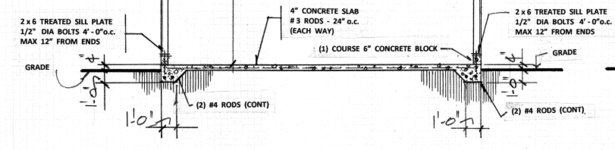
I am in Minnesota. Garages here are done all the time with a slab as you described. My local city approved the plans for my concrete slab. I included a section from my plans of the concrete slab that was poured for my 24'x60' building.

1699169022698.png
 
To avoid these ads, REGISTER NOW!

472scout

Well-known member
Joined
Sep 18, 2010
Messages
1,276
Location
back 40
If you want to eliminate risk hire a geotechnical engineer or simply switch to post frame.
 

billconner

Well-known member
Joined
Jul 20, 2021
Messages
6,950
Location
Thousand Islands NYS
The IRC, basis for most residential codes in US, does not require frost protection for buildings of this size. Specifically:

1. Protection of free-standing accessory structures with an area of 600 square feet (56 m2) or less, of light-frame construction, with an eave height of 10 feet (3048 mm) or less shall not be required.

If the ground was properly prepared, you'll be fine. And if you had footings below frost or went the FPSF route and the ground was not properly prepared, you'd have problems.
 

ConCretin

Well-known member
Joined
Jan 20, 2011
Messages
3,378
Location
Central Maine
As long as the soils under your mono-slab are reasonably free draining, you should be fine. In practical terms, this means you can dig down to the frost line without finding wet soil. Good surface drainage is also important to eliminate that as a source of moisture in the soils under your structure. If so, frost movement will be minimal and no danger to your structure.

I have a 32x28 garage with a later 14x36 addition on un-insulated mono-slab foundations very similar to yours. They've survived a decade or more of harsh Maine winters with no issues whatsoever.
 

grant00

Well-known member
Joined
Feb 12, 2011
Messages
205
Location
Littleton, CO
I can understand why you are second guessing off what the inspector told you. At least you can maybe take some peace of mind away knowing you built it typical for what our local colorado jurisdictions would require. There have likely been thousands built just like yours and I would be the local AHJ would have adjusted their building guidelines if this was a problem. From what I have seen the method you used, for the size of structure you have, is common all up and down the front range!

Wouldn’t be the first time I heard someone say an inspector said or asked for something strange ;)
 
Last edited:

Beemer

Well-known member
Joined
Jun 21, 2020
Messages
1,400
Location
Northeast
Wow, "silty, sandy clay".
Frost occurs in soil that retains moisture. Silt and clay are the worst in that regard being very fine grained soils.
If that really is your soil profile you should anticipate frost and movement.
Also, if you don't have a vapor barrier under the slab you might see periods where the slab seems damp depending on the weather; again it's about the fine drained soil that retains moisture.
 
Last edited:

nadogail

Well-known member
Joined
Jan 23, 2009
Messages
31,931
Location
Coronado, CA
I spoke to the building permits office and the person I spoke to said that my proposed foundation would be fine. So I went ahead with the pour. Later, when I took my permit application in, I spoke to an inspector that was "concerned" about my plan.

I know I should have waited to pour the slab, but work, weather, and scheduling made me pull the trigger (perhaps too fast). The building permit approval is still pending, but I was hoping to get additional opinions here. (I have been a lurker here for at least 15 years, but this is my first post).
WELCOME TO THE FORUM.
 

rerod

Well-known member
Joined
Jan 30, 2015
Messages
376
Location
North English Iowa
Six years ago I removed & repoured the slab portion of our living room 16x 28 due to insufficient rebar and insufficient compaction under the monopour. Not a fun job.


Holy cow.. You must be an expert on how to pour a mono, after doing it twice.

My take on any "monolithic slab" under a heated building is that even unthicked, they would survive freezing weather (pole barns) because the interior heat would prevent underslab freezing as long as the slab wasn't insulated..

For unheated, you would want a buried pitched 2' exterior perimeter insulation board skirt/wings which turns up the vertical edge of the slab. The unheated building being well insulated and air tight is still important to capture the constant 50 degree soil temperature and prevent heave.

IMO The thickened edge is important, but only a safe guard or insurance to strengthen the slab if it ever did heave or get washed out. But you could prevent freezing and heave on a 4" unthickened slab if you buried a good insulation apron, and had a tight insulated building to capture soil temperature and prevent freezing.
 

Copymutt

Well-known member
Joined
Sep 3, 2016
Messages
3,386
Location
Colorado
Never poured the original!
I would never pour any slab sans rebar. Worse the original homeowner poured it over expansive clay. Thus my delightful project removed & repoured through a window. In retrospect it was easier to bust up w/o rebar.
 

dcg9381

Well-known member
Joined
Jun 20, 2018
Messages
11,660
Location
Austin, TX
IMHO, the best guys in the world sitting in their chairs cannot answer this for you. You need a soils test.. Without that everyone is just guessing at what type of design you need for a foundation.

That being said, if your foundation design mimics that or is better than foundations in your same area (I'm assuming that you've got the same soil type) - that'd be the 2nd best indicator of "might be good to go".

I have poured one foundation without a soils test and foundation engineering. It worked out OK, but I also did that pour after talking to the guys that installed the underground utilities in the immediate area (we sit on top of limestone and flint). Typical construction here is rebar and concrete beams, so that's what we did.

I see non-rebar foundations all the time up north (fiber), even on really sandy soil.
 

MikeOxard

Member
Joined
Jun 9, 2024
Messages
10
If the rebar is the concern just dip them in creosote to prevent the rust, then you're good to go.


Wouldn’t be the first time I heard someone say an inspector said or asked for something strange ;)
 
To avoid these ads, REGISTER NOW!
Top Bottom