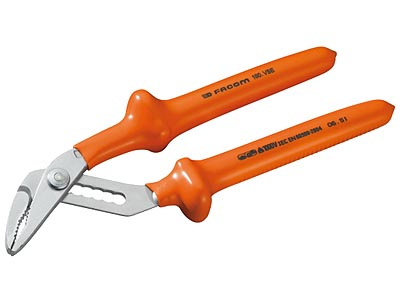
The main difference between “insulated” tools, such as the ones usually seen that say inulated to 1000v, is that the tools are actually tested at high voltage, usually with a tank full of conductive liquid, to verify that the insulative handles and other surfaces, are actually insulated and safe. This ads an extra step to the production process, which costs more money, which is the reason the insulated versions of tools usually cost more.
In some cases the insulated grips look practically the same, between insulated and non-insulated tools from the same manufacturer, such as the bimaterial molded grips found on pliers from companies such as Knopex and Facom.
There are some differences between the pliers grips though. The insulated pliers have larger guards to prevent a users hand from slipping up the grip onto the uninsulated portion of the pliers.
Spring loaded pliers seem to be less common, I’m not sure whether this is a code requirement anywhere for safety reasons, although a loose spring could fall and cause safety issues so this might be the reason. Facom has spring loaded insulated pliers, but their pliers use a plastic spring, so this might be the reason they manufacture spring loaded pliers and other companies don’t.
I’m not sure if there’s any difference between the material, or material thickness of the insulated and ininsulated grips.
Different countries and regions seem to have different standards for their insulated tools.
In Europe, a number of the insulated tools manufacturers produce tools that are almost fully insulated. Not only are the grips insulated and tested, but the heads of the tools are coated as well on tools such as pliers, so the only areas not insulated might be the actual plier jaw gripping surfaces. There are also pliers made from non-conductive materials like plastics, with inset jaws made from steel or possibly ceramic.
Some manufacturers produce more than one type of insulated tool grip. Knipex and Facom for instance both produce two different series if insulated tools. One type has injection molded grips, whereas the other type, has grips that dipped in a thick insulated coating. The dip insulated tools are almost always more expensive, sometimes significantly. I read somewhere that the dip insulated tools where manufactuered for workers who need to work on live electrical circuits, whereas the molded grip tools where meant for people who had to service lines where they might accidentally encounter live electrical circuits. I’m not sure how accurate this is though.
The dip insulated tools have some more especifics as far as manufacturing goes. If the insulation is applied in more than one ayer, the different layers have to be color coated, so that damage can be spotted. If the outer layer is broken and an inner layer is visible, use of the tools should be discontinued. I believe most of the dip insulated tools used to have two layers. Now some newer versions, such as Irega insulated wrenches, mention three differently colored layers for the insulation.
Some of the dip insulated tools seem to have a textured grip surface, whereas other manufacturers leave the surface smooth. I’m not sure if this is a requirement for some countries or not. Facom, Sibille, and older klein tools were made with insulated grips that had “treads” molded into them. Facom and Sibille are French or at least produce items for the French markets so maybe France has some sort of requirement for this. There was another French insulated tool supplier who also used textured dip insulated grips. All the grips including the Klein pliers were also orange.
There is a British manufacturer of insulated tools that uses nylon 11, and directly molds the grips onto the tool handle surface. Their claim for this being better us that the nylon is more impact resistant, and because it’s molded directly onto the tool, the handle surface won’t dislodge, and slip from the tool, which is shown to happen to grips that are pushed on, like the lower cost molded Knipex insulated plier grips.
Another thing that should be noted about insulated pliers, is that unless the manufacturer is actually also a tool maker, such as Knipex, Klein, Facom, etc., most insulated tool “manufacturers” buy tools from other manufactuers, then apply the appropriate insulation, and do the safety testing.