To avoid these ads, REGISTER NOW!

Dimmers and CFLs

tjpavlov

Well-known member
Joined
May 18, 2012
Messages
1,280
Location
Providence, RI
So I have a quick series of questions to ask. I have put a few Dimmer switches in my house. I used the Pass & Seymour/Legrand ones that Lowes sells for around $30. They are designed for CFL and LED lights:

link

I have paired these with CFL flood lights from Costco, 65W replacement. They draw around 13 watts each. On the box, they are marked "dimmable". I think they are made by a company called "Feit".

The lights work and they dim..... just not that much. I can probably only dim them about 20% before one or more of the bulbs starts to blink. My old incandescents used to dim way more. In my living room, it would be nice to turn the lights down much more when watching tv. So here are my questions:

1. Have you had this problem with CFLs?
2. Is this always going to be a problem, or should I change either the switch or the bulbs? Could the problem be the switch?
3. Is there a better brand/quality CFL that would work better?
4. Would I get better performance out of LED bulbs?

Thanks for any and all input!

EDIT---Can't get the link to work. Item # 355647 at Lowes.com.
 
Last edited:
To avoid these ads, REGISTER NOW!

Zeke

Well-known member
Joined
Aug 13, 2009
Messages
17,176
Location
Long Beach CA, the sewer by the sea.
When you dim the lights you are using less electricity so for my money I use incandescent dimmed 50% or more. Bulbs last years and for the time they are on they aren't changing the climate. Even though they have 'dimmable' CFL's they aren't designed necessarily for the purpose. Let's just say they are designed to accommodate it. LED's dimmed sure don't give off that warm glow but they do go down to less light which is one goal.

If you're trying to score they might not be as romantic as candles (or dimmed incandescents).
 

2ManyProjects

Well-known member
Joined
Jul 18, 2013
Messages
757
So I have a quick series of questions to ask. I have put a few Dimmer switches in my house. I used the Pass & Seymour/Legrand ones that Lowes sells for around $30. They are designed for CFL and LED lights:

link

I have paired these with CFL flood lights from Costco, 65W replacement. They draw around 13 watts each. On the box, they are marked "dimmable". I think they are made by a company called "Feit".

The lights work and they dim..... just not that much. I can probably only dim them about 20% before one or more of the bulbs starts to blink.

'Tis the nature of the beast. NO fluorescent light, be it linear or CFL, is really all that "dimmable", no matter what the claims made.

My old incandescents used to dim way more. In my living room, it would be nice to turn the lights down much more when watching tv.

Your best option will likely be to use FEWER lights, which are of very limited brightness to begin with, rather than attempt to drastically dim lights which are actually designed and intended to be rather bright.

4. Would I get better performance out of LED bulbs?

Maybe.

While LEDs are potentially dimmable, you have to take into consideration the underlying technology. LEDs are, fundamentally, DC devices which are sensitive to current, not voltage. Further, unlike a resistor (or an incandescent light bulb), the current flowing through an LED is NOT even roughly proportional to the voltage developed across its terminals (which remains more-or-less constant, typically at about 1.5-4.0V depending on the particular type of LED, regardless of current flow; this compares to about 0.5-0.7V for a "normal" non-LED diode). In fact, once switched "On", the current flow through a diode is more-or-less unlimited, and must be externally controlled in order to avoid destroying the device. Notably, this is precisely the opposite scenario of a normal incandescent light bulb, where current (and therefore brightness) tracks voltage almost exactly.

Further, an LED is basically a solid-state "switch" (a diode is, after all, two-thirds of a transistor), which more-or-less instantly goes from "Full Off" to "Full On" when the current flow reaches a certain threshold. While it is theoretically possible to operate a diode in its "linear" area (much like a transistor in an audio amplifier), it would take some REALLY sophisticated (read: "expensive") control electronics to accomplish this. So as a practical matter, it just isn't done.

So, in order to get "dimmability" in such applications as the backlights for (newer) LCD computer monitors and TVs, the LEDs are actually powered from a fairly sophisticated "driver" circuit, which works a lot like a switching power supply: The (still DC) power is first turned into a series of pulses (basically an offset square wave), at a VERY high frequency (could be 50 kHz or more). Then those pulses are fed to the LEDs, which in turn actually switch on and off at that same very high rate. This "flashing" is far too rapid for us to detect, visually; so it seems like the light is simply "On". At "full" output, the "On" periods VASTLY exceed the "Off" periods (which, at least in theory, could be zero). Then, in order to vary the perceived brightness, the "duty cycle" of the pulses is changed, with ever-longer "Off" periods between each "On" period, producing what appears to be "dimmer" light. Note that throughout all this, the voltage actually applied to the LED (when it is applied at all) remains constant, regardless of the "dimming" setting of the moment. Basically, it is a crude form of Pulse Code Modulation ("PCM"; cf. http://en.wikipedia.org/wiki/Pulse-code_modulation).

Now let's look at a typical LED-based "replacement" light bulb... As can be gleaned from the above, the 120V 60 Hz AC found in household electrical systems is far from suitable for operating LEDs directly. Therefore, a complete "power supply" circuit must be built into each bulb, in order to generate the low-voltage DC actually needed by the LEDs. These power supplies are typically rather inefficient, in part because they simply MUST be made cheaply, in order for the product to be commercially viable. Further, as part of the "cost control" used in the design, it is generally assumed that the input voltage (to the "bulb" -- i.e., the power supply) will be more-or-less constant at normal "line" voltage, and also be a more-or-less steady 60 Hz sine wave.

In order to "accommodate" a typical wall-mounted "universal" dimmer switch requires still more complication in the power supply, which of course leads to more cost. But beyond the cost issue, the already-marginal efficiency also goes further to Hell, because IF the power supply can operate satisfactorily at either a vastly reduced input voltage OR off the very "mangled" waveform produced by a typical SCR-based "dimmer switch", then it must near-necessarily "throw away" (usually in the form of heat) a lot of the input power it "normally" sees when the dimmer is not turned down (or when a dimmer is not used at all).

Bottom Line: LED lighting systems which are designed from the get-go as LED lighting systems, including a properly designed DEDICATED control system, can be both completely "dimmable" AND reasonably efficient. But it sure as Hell won't sell for $30! The current state of affairs with these half-assed LED-based "bulbs" designed to directly replace standard incandescent bulbs, and operate in the same lamps and fixtures, off the same (highly inappropriate) voltages and waveforms, is already a HUGE "kludge" to begin with. Throw in a dimmer control which was fundamentally designed for an ENTIRELY different technology, and you make a bad situation worse. To the extent that they (sometimes) work at all, it is reminiscent of the old quote (from Mark Twain, I think; but not sure):

"The wonder is not that the bear dances poorly, but that it dances at all."

 
Last edited:

Kevin C

Well-known member
Joined
Aug 4, 2011
Messages
1,653
Location
Portland OR
the current flowing through an LED is NOT even roughly proportional to the voltage developed across its terminals (which remains more-or-less constant, typically at about 1.5-4.0V depending on the particular type of LED, regardless of current flow; this compares to about 0.5-0.7V for a "normal" non-LED diode). ... In fact, once switched "On", the current flow through a diode is more-or-less unlimited, and must be externally controlled in order to avoid destroying the device.


A bit better description would be that voltage vs current curve is somewhat steep and, so the some type if current control is needed (still, its a curve. See attachment, but for a particular technology the curve is very predicable). For many applications, a resistor in series is enough. That flattens out the voltage VS current curve (combo of the two components).

With a simple dropping resistor, brightness / current is easily maintained (assuming a fixed voltage). Brightness is easy to vary by adjusting the voltage since voltage vs current is a lot more linear with the added resistor. Current control is a step up in circuit design and some LED systems even used a photo diode to monitor the output (closed loop control).
 

Attachments

  • led_i_v_curve.jpg
    led_i_v_curve.jpg
    43.8 KB · Views: 3
Last edited:
To avoid these ads, REGISTER NOW!

rlitman

Well-known member
Joined
Oct 18, 2010
Messages
24,679
Location
Long Island
When you dim the lights you are using less electricity so for my money I use incandescent dimmed 50% or more.

If you like a dim room, but sometimes have the need to turn the lights up, then that's fine.
If you're always dimming a 100W bulb to the light output of a 60W bulb, you should know that while you're getting a 60W bulb's output of light, but burning more like 85W. The hotter an incandescent bulb's filament, the more efficient and shorter lived it is. By dimming an incandescent bulb you are getting much longer life, but if you always want the dimmer light, it would be far cheaper to buy dimmer bulbs and run them at full brightness.

LEDs are, fundamentally, DC devices which are sensitive to current, not voltage. Further, unlike a resistor (or an incandescent light bulb), the current flowing through an LED is NOT even roughly proportional to the voltage developed across its terminals (which remains more-or-less constant, typically at about 1.5-4.0V depending on the particular type of LED, regardless of current flow; this compares to about 0.5-0.7V for a "normal" non-LED diode). In fact, once switched "On", the current flow through a diode is more-or-less unlimited, and must be externally controlled in order to avoid destroying the device. Notably, this is precisely the opposite scenario of a normal incandescent light bulb, where current (and therefore brightness) tracks voltage almost exactly.

Further, an LED is basically a solid-state "switch" (a diode is, after all, two-thirds of a transistor), which more-or-less instantly goes from "Full Off" to "Full On" when the current flow reaches a certain threshold. While it is theoretically possible to operate a diode in its "linear" area (much like a transistor in an audio amplifier), it would take some REALLY sophisticated (read: "expensive") control electronics to accomplish this. So as a practical matter, it just isn't done.

So, in order to get "dimmability" in such applications as the backlights for (newer) LCD computer monitors and TVs, the LEDs are actually powered from a fairly sophisticated "driver" circuit, which works a lot like a switching power supply: The (still DC) power is first turned into a series of pulses (basically a square wave), at a VERY high frequency (could be 50 kHz or more). Then those pulses are fed to the LEDs, which in turn actually switch on and off at that same very high rate. This "flashing" is far too rapid for us to detect, visually; so it seems like the light is simply "On". At "full" output, the "On" periods VASTLY exceed the "Off" periods (which, at least in theory, could be zero). Then, in order to vary the perceived brightness, the "duty cycle" of the pulses is changed, with ever-longer "Off" periods between each "On" period, producing what appears to be "dimmer" light. Note that throughout all this, the voltage actually applied to the LED (when it is applied at all) remains constant, regardless of the "dimming" setting of the moment. Basically, it is a crude form of Pulse Code Modulation ("PCM"; cf. http://en.wikipedia.org/wiki/Pulse-code_modulation).

If you're thinking DC as in one side is always positive and one is always negative, then yes. Some people would read DC as the constant voltage that comes from a battery, and LED's work best when pulsed (not only for the purposes of dimming, but also you can get a higher maximum output out of an LED with pulsed current rather than steady state).

Also, you are thinking PWM, not PCM.
 

Kevin C

Well-known member
Joined
Aug 4, 2011
Messages
1,653
Location
Portland OR
I have five Cree $10, 60 watt equivalent LED's in my dining room on a dimmer. They are design to be dimmed. I also have a $20 dimmer from Homers thats designed to work with them.

The Cree bulbs put out 800 Lumens each at 9.5 Watts to put out a respectable 84 Lumens per watt.

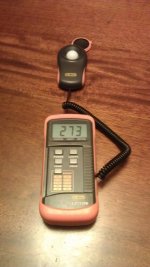
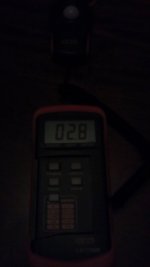
Up full I get about 273 lux on our dining room table. All the way down, about 28 lux, low enough that its hard to take a photo of my meter.

Despite "expert" claims that this is an issue, it works really, really well.

The only thing you don't get is a color shift with the intensity change to get that warm romantical feeling at dinner. For that we have candles.

Fun discussion. I used to design LED and laser drive circuits for industrial applications as well as LED light sources. The state of the art has changed quite a bit, but the basics have not. The first PCB I ever designed modulated a solid state LASER at a 100 MHZ. AC modulation imposed on a base DC current.

Even then we had dedicated IC's that did most of the work.

Building LED's was kind of fun too. Basically, we would source the LED die from a foundry and build up custom light sources.

http://www.ti.com/lit/an/snva605/snva605.pdf TI info covering LED drive options that interface with standard Triac dimmers.
 

Attachments

  • IMAG2036.jpg
    IMAG2036.jpg
    144 KB · Views: 6
  • IMAG2037.jpg
    IMAG2037.jpg
    120.7 KB · Views: 3
  • IMAG2038.jpg
    IMAG2038.jpg
    126.7 KB · Views: 2
Last edited:

Kevin C

Well-known member
Joined
Aug 4, 2011
Messages
1,653
Location
Portland OR
The current state of affairs with these half-assed LED-based "bulbs" designed to directly replace standard incandescent bulbs, and operate in the same lamps and fixtures, off the same (highly inappropriate) voltages and waveforms, is already a HUGE "kludge" to begin with. Throw in a dimmer control which was fundamentally designed for an ENTIRELY different technology, and you make a bad situation worse.

Some people say something should not be done, others say it cant be done... Then there are those that figure out how it can be done.

My most pressing questions were about the electronic circuit design – how the heck was Cree able to build an LED driver that dimmed so well, with such an excellent power factor (.98), all the while driving an array of 80 LEDs so effectively that it is able to warranty the bulb for 10 years of heavy use?

This is the same LED lamp that I showed as having a great dimming range with a low cost Home Depot Dimmer.

The most common way for LED bulbs to handle triac dimmer switches is to decode the power from the triac through a high-frequency pulse-width modulation circuit. Says Mike: “We don’t use that approach in this particular bulb. We have a very proprietary type of RMS process that involves our IP [intellectual property] and phase dimming.” Hmmm. Not very informative, but Cree’s reticence is understandable: Why make it easy for your competition to copy you?
As we saw in the tear down, the bulb’s only power management IC is the STMicroelectronics 6561D transition mode power factor corrector. So back to the ST website. Here’s app note AN2711 (a pdf) 120Vac input Triac dimmable LED driver for the L6562A, a chip in the same family as the 6561, that explains the use of the 656X Chip to handle triac dimming as well as PFC in a flyback power converter topology. Granted, it’s for an isolated LED driver, but its detailed explanation of using the chip for dimming is still valid as an insight into how the Cree driver may work.
The 80 LEDs (4 LEDs per individual LED component; 20 individual LED components) are arranged in an array of two parallel strings each with 10 individual LED components, making 40 LEDs per string. I asked Mike about the long series strings of LEDs: One LED failing open would take out an entire LED string, causing half the bulb to go dark. He said the PPM (parts/million) failure for an LED in the field – especially one that would fail open — is almost vanishingly low, which gives Cree the confidence to warranty these bulbs for 10 years.

http://www.designingwithleds.com/qa-with-cree-about-60w-replacement-led-bulb/

http://www.designingwithleds.com/cree-60w-led-replacement-bulb-review-and-tear-down/
 

2ManyProjects

Well-known member
Joined
Jul 18, 2013
Messages
757
A bit better description would be that voltage vs current curve is somewhat steep and, so the some type if current control is needed (still, its a curve. See attachment, but for a particular technology the curve is very predicable).

I did perhaps oversimplify, in an attempt to both make it understandable and to highlight some of the fundamental differences between an LED (or other diode) and an resistor or light bulb. That "curve" is what I referred to as the diode's linear area; and damn straight, it's "steep" -- operating exclusively in that region is somewhat akin to balancing on a knife-edge; hence my comment about needing sophisticated control circuits to do so. I could be wrong; but I believe that at least in MOST "inexpensive" applications, the LEDs are simply either driven into saturation, or off, at any given moment, using the pulsed current approach I already described.

For many applications, a resistor in series is enough. That flattens out the voltage VS current curve (combo of the two components).

With a simple dropping resistor, brightness / current is easily maintained (assuming a fixed voltage). Brightness is easy to vary by adjusting the voltage since voltage vs current is a lot more linear with the added resistor.

True. But at that point, the overall circuit behavior is being dominated by the resistor, not the diode. So it doesn't really illustrate very well how the LED itself operates. And besides, added series resistance is the LAST thing we want if we care about overall efficiency. Sweeping generalizations get really risky here, in part because there has been so much development in this field over the past few years and there are now MANY variations of the theme. But it's still not unreasonable to figure that far more power could/would go up as heat in the dropping resistor than that which is actually consumed by the LED. For small indicators on a control panel, that's not a problem; for lighting up a room, it is.

Current control is a step up in circuit design and some LED systems even used a photo diode to monitor the output (closed loop control).

All well and good -- but obviously a LOT more complicated (hence, expensive) than a simple resistor.

If you like a dim room, but sometimes have the need to turn the lights up, then that's fine.
If you're always dimming a 100W bulb to the light output of a 60W bulb, you should know that while you're getting a 60W bulb's output of light, but burning more like 85W. The hotter an incandescent bulb's filament, the more efficient and shorter lived it is. By dimming an incandescent bulb you are getting much longer life, but if you always want the dimmer light, it would be far cheaper to buy dimmer bulbs and run them at full brightness.

Absolutely correct.

If you're thinking DC as in one side is always positive and one is always negative, then yes. Some people would read DC as the constant voltage that comes from a battery, and LED's work best when pulsed (not only for the purposes of dimming, but also you can get a higher maximum output out of an LED with pulsed current rather than steady state).

As I used the term above, I primarily meant that the current never reverses direction, such as routinely happens with household AC. Think of it as that battery current run through a switch which is rapidly making/breaking contact. I've since slightly edited my post (referring to "an offset square wave") to make this somewhat more clear.

Also, you are thinking PWM, not PCM.

Yes, that's the better term. Tho' I suppose that in a least some sense, PWM is itself "a crude form of PCM".

I have five Cree $10, 60 watt equivalent LED's in my dining room on a dimmer. They are design to be dimmed. I also have a $20 dimmer from Homers thats designed to work with them.

The Cree bulbs put out 800 Lumens each at 9.5 Watts to put out a respectable 84 Lumens per watt.

That sounds pretty decent, for a cheap off-the-shelf retail product. But it still pales by comparison to the efficiency that raw LEDs themselves can produce, when driven from an ideal source.


Kevin C

Well-known member
Joined
Aug 4, 2011
Messages
1,653
Location
Portland OR
operating exclusively in that region is somewhat akin to balancing on a knife-edge; hence my comment about needing sophisticated control circuits to do so.


The knife edge analogy is a bit "dramatic". Millions upon millions of LED light sources just use a simple dropping resistor.

True. But at that point, the overall circuit behavior is being dominated by the resistor, not the diode. So it doesn't really illustrate very well how the LED itself operates. And besides, added series resistance is the LAST thing we want if we care about overall efficiency.


A few points here;

The idea of using a resistor is to make it the dominant component of the circuit. This comes up if you have packaging constraints. Product design is a balancing act of multiple factors. In many cases, for a simple light circuit the added expense of anything past a resistor is not worth it.

This is why you will see resistors in a lot of designs low cost LED light source designs. Optical encoders, cheap LED flashlights, indicator lights, low cost LED strip lights etc...

All well and good -- but obviously a LOT more complicated (hence, expensive) than a simple resistor.


You make claims that are black or white, good or bad. In the real world its a bit more complicated. In this case a LOT more complicated and therefore expensive. What does that mean?

A Simple Example: Say you want to produce 800 lumens of light from LED's. At the same time, you would like to insure the components last a long, long time.

You have the option of using a simple drive circuit and requiring more chips (since you cant drive them as hard) or, you can reduce the number of LED's and add to your BOM a control circuit that allows you to get more light with less LED's. The cost of using less light sources can easily offset the added cost of a driver IC. The control circuit requires a whopping 8 components.

In the second case, the added circuitry reduces the overall cost. A LM3401 is about $0.65 ( low volumes). In volume the cost for the entire drive circuit is less than a dollar, but you saved three dollars in LED light sources.

Yes, that's the better term. Tho' I suppose that in a least some sense, PWM is itself "a crude form of PCM"


That is pretty funny stuff. :rocker:


That sounds pretty decent, for a cheap off-the-shelf retail product. But it still pales by comparison to the efficiency that raw LEDs themselves can produce, when driven from an ideal source.


Can you provide a link to a system that us mortals can purchase that has an ideal source and minimizes optical losses from the LED to make the Cree system look so bad (or as you so nicely phrased it "cheap")?

That would be the point of making the comment right? Further the discussion of what options are available to install VS a bit of internet grandstanding just to be right?
 

frankush

Well-known member
Joined
Oct 23, 2011
Messages
1,156
Location
IL
Another option would be to call the tech support line for P&S. They can tell you which bulb manufacturers products have been tested for use with your dimmer. You can also find out if they are full dim-to-off. I would try using one of the big 3 lamp manufacturers, Phillips, GE or Sylvania.
 

Kevin C

Well-known member
Joined
Aug 4, 2011
Messages
1,653
Location
Portland OR
Looking at some reviews it seems like others have not been impressed with the dim-ability of the bulb you have. CFL's can work, but in my experience, the LEDs work a lot better.

It looks like that CFL might have an issue when dimmed, and other CFL's seem to dim down a lot more.
Assuming that its this CFL: http://www.homedepot.com/p/Feit-Electric-65W-Equivalent-Soft-White-2700K-BR30-Dimmable-CFL-Light-Bulb-12-Pack-BPESL15R30-DM-12/100653113?N=1z0u4xv%2FNtk-Extended%2FNtt-Feit%252BElectric%252B65W%252BEquivalent%3FNtx%3Dmode%2Bmatchpartialmax%26NCNI-5#customer_reviews

I have 8 65W BR-30's in my basement, so switching to CFLs would have given me substantial savings. I tried one of these bulbs, and will not be switching. It dimmed to about 50%, and then turned off. It also turned pinker when dimming, and looked terrible when compared to the rest of the incandecents. Two stars only because it was fine at full brightness.

These Feit dimmable CFLs seem like a good bargain, but you get what you pay for. About 20% of them failed in the first couple of weeks. They don't dim anywhere near as much as the Philips dimmable CFLs and the point where they dim to off is not uniform so you may have some on while others are out. Don't buy these - buy the Philips. The Philips can dim more, they do so uniformly, and they all go out at the same time.

Short Story... Its probably the bulb.
 
To avoid these ads, REGISTER NOW!
Top Bottom