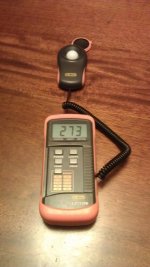
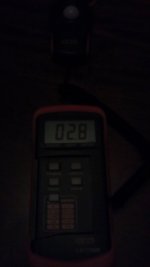
So I have a quick series of questions to ask. I have put a few Dimmer switches in my house. I used the Pass & Seymour/Legrand ones that Lowes sells for around $30. They are designed for CFL and LED lights:
link
I have paired these with CFL flood lights from Costco, 65W replacement. They draw around 13 watts each. On the box, they are marked "dimmable". I think they are made by a company called "Feit".
The lights work and they dim..... just not that much. I can probably only dim them about 20% before one or more of the bulbs starts to blink.
'Tis the nature of the beast.
NO fluorescent light, be it linear or CFL, is really all that "dimmable", no matter what the claims made.
My old incandescents used to dim way more. In my living room, it would be nice to turn the lights down much more when watching tv.
Your best option will likely be to use FEWER lights, which are of very limited brightness to begin with, rather than attempt to drastically dim lights which are actually designed and intended to be rather bright.
4. Would I get better performance out of LED bulbs?
Maybe.
While LEDs are
potentially dimmable, you have to take into consideration the underlying technology. LEDs are, fundamentally, DC devices which are sensitive to current, not voltage. Further, unlike a resistor (or an incandescent light bulb), the current flowing through an LED is
NOT even roughly proportional to the voltage developed across its terminals (which remains more-or-less constant, typically at about 1.5-4.0V depending on the particular type of LED, regardless of current flow; this compares to about 0.5-0.7V for a "normal" non-LED diode). In fact, once switched "On", the current flow through a diode is more-or-less unlimited, and must be externally controlled in order to avoid destroying the device. Notably, this is precisely the opposite scenario of a normal incandescent light bulb, where current (and therefore brightness) tracks voltage almost exactly.
Further, an LED is basically a solid-state "switch" (a diode is, after all, two-thirds of a transistor), which more-or-less instantly goes from "Full Off" to "Full On" when the current flow reaches a certain threshold. While it is theoretically possible to operate a diode in its "linear" area (much like a transistor in an audio amplifier), it would take some REALLY sophisticated (read: "expensive") control electronics to accomplish this. So as a practical matter, it just isn't done.
So, in order to get "dimmability" in such applications as the backlights for (newer) LCD computer monitors and TVs, the LEDs are actually powered from a fairly sophisticated "driver" circuit, which works a lot like a switching power supply: The (still DC) power is first turned into a series of pulses (basically an offset square wave), at a VERY high frequency (could be 50 kHz or more). Then those pulses are fed to the LEDs, which in turn actually switch on and off at that same very high rate. This "flashing" is far too rapid for us to detect, visually; so it
seems like the light is simply "On". At "full" output, the "On" periods VASTLY exceed the "Off" periods (which, at least in theory, could be zero). Then, in order to vary the
perceived brightness, the "duty cycle" of the pulses is changed, with ever-longer "Off" periods between each "On" period, producing what appears to be "dimmer" light. Note that throughout all this, the voltage actually applied to the LED (when it is applied at all) remains constant, regardless of the "dimming" setting of the moment. Basically, it is a crude form of Pulse Code Modulation ("PCM"; cf.
http://en.wikipedia.org/wiki/Pulse-code_modulation).
Now let's look at a typical LED-based "replacement" light bulb... As can be gleaned from the above, the 120V 60 Hz AC found in household electrical systems is far from suitable for operating LEDs directly. Therefore, a complete "power supply" circuit must be built into each bulb, in order to generate the low-voltage DC actually needed by the LEDs. These power supplies are typically rather inefficient, in part because they simply MUST be made cheaply, in order for the product to be commercially viable. Further, as part of the "cost control" used in the design, it is generally assumed that the input voltage (to the "bulb" -- i.e., the power supply) will be more-or-less constant at normal "line" voltage, and also be a more-or-less steady 60 Hz sine wave.
In order to "accommodate" a typical wall-mounted "universal" dimmer switch requires still more complication in the power supply, which of course leads to more cost. But beyond the cost issue, the already-marginal efficiency also goes further to Hell, because
IF the power supply can operate satisfactorily at either a vastly reduced input voltage OR off the very "mangled" waveform produced by a typical SCR-based "dimmer switch", then it must near-necessarily "throw away" (usually in the form of heat) a lot of the input power it "normally" sees when the dimmer is not turned down (or when a dimmer is not used at all).
Bottom Line: LED lighting systems which are designed
from the get-go as LED lighting systems,
including a properly designed DEDICATED control system, can be both completely "dimmable" AND reasonably efficient. But it sure as Hell won't sell for $30! The current state of affairs with these half-assed LED-based "bulbs" designed to directly replace standard incandescent bulbs, and operate in the same lamps and fixtures, off the same (highly inappropriate) voltages and waveforms, is already a HUGE "kludge" to begin with. Throw in a dimmer control which was fundamentally designed for an ENTIRELY different technology, and you make a bad situation worse. To the extent that they (sometimes) work at all, it is reminiscent of the old quote (from Mark Twain, I think; but not sure):
"The wonder is not that the bear dances poorly, but that it dances at all."