To avoid these ads, REGISTER NOW!

DIY heat pump install on house

OP
T

teknikfrog

Well-known member
Joined
Apr 29, 2023
Messages
216
Ok more updates. I have cool air blowing, with some interesting caveats.

First off here is the running pressure:

photo_2024-07-25_16-17-36.jpg

This looks low but I don't know.

The system is blowing cold like it always has and is not shutting off on low or high pressure. I'm not celebrating yet however, because I would not be surprised if this system ices up on me, because of what I did to make it work:

I noted that the EEV controller donut thinggy that goes onto the valve comes off. Light bulb moment. So I put the evap EEV into test mode OPEN, and then REMOVED the donut, thus removing control. System working great and my house is cooling.

Obviously it can't manage superheat like this so I need to continue to diagnose, but this is REALLY promising. The vacuum on suction issue is GONE.

So it's clear that (a) my indoor EEV valve is the issue and (b) it appears to be an electrical issue with the controls, not a mechanical issue.

Thoughts?

 
To avoid these ads, REGISTER NOW!

American Locomotive

Well-known member
Joined
Jan 8, 2017
Messages
11,014
Location
Rhode Island
It souds like the indoor eev controller is driving the valve fully closed. That might mean there is a problem with one of the temperature sensors on the evaporator making it think superheat is really low.

I would let the system be off for a while (like an hour) and check the resistance of each temperature sensor on the indoor unit. The resistances should all be the same.
 
OP
T

teknikfrog

Well-known member
Joined
Apr 29, 2023
Messages
216
It souds like the indoor eev controller is driving the valve fully closed. That might mean there is a problem with one of the temperature sensors on the evaporator making it think superheat is really low.

I would let the system be off for a while (like an hour) and check the resistance of each temperature sensor on the indoor unit. The resistances should all be the same.
K will do later. I'm gonna go ahead and let me house cool off a bit because this is the first time in like three weeks I've had air. Hopefully I'm not causing any damage, everything looks nominal, except refrigerant pressures seem low.
 

brewchief

Well-known member
Joined
Sep 20, 2008
Messages
2,371
Location
Michigan
Why is the high and low side pressures reading the same?

You will need an accurate way to measure the suction and lquid lines temperature at the outdoor unit to get a subcooling and superheat reading.
 
OP
T

teknikfrog

Well-known member
Joined
Apr 29, 2023
Messages
216
Why is the high and low side pressures reading the same?

You will need an accurate way to measure the suction and lquid lines temperature at the outdoor unit to get a subcooling and superheat reading.
Well I suppose if I opened the indoor EEV 100% it stands to reason that high pressure in the system would go way down.

My system is running 100% as expected and the compressor is purring like a kitten.

Am I causing damage by running it in this state or can I keep it online till the morning to resume diagnostics?
 

American Locomotive

Well-known member
Joined
Jan 8, 2017
Messages
11,014
Location
Rhode Island
Well I suppose if I opened the indoor EEV 100% it stands to reason that high pressure in the system would go way down.

My system is running 100% as expected and the compressor is purring like a kitten.

Am I causing damage by running it in this state or can I keep it online till the morning to resume diagnostics?
Well in theory you shouldn't get any cooling if both high and low side are the same pressure.
 

brewchief

Well-known member
Joined
Sep 20, 2008
Messages
2,371
Location
Michigan
Since heat pumps have a service port on the suction and liquid lines plus a true suction port thats on the compressor side of the reversing valve I hope you are simply reading the suction pressure in two spots.
 

bonneyman

Well-known member
Joined
Apr 22, 2010
Messages
8,857
Location
Desert SW
It's so hard to "diagnose from a distance". It's something I tried to avoid when in business.
There are just so many things for a tech to look at and consider, the feel of certain parts, temperature differences, what the conditions are and the chart readings. It's like a doctor with his patient - you really gotta be there!
But especially the new units crammed full of all that electronic sensors and controls. If it's working now I'd take a wait and see attitude. If there's a hiccup with the electronics you could do a "reboot" and see if that clears any bad codes. Turn off all power to the unit(s) and leave it for 30 minutes. Then power it back up and adjust the temps.
 
OP
T

teknikfrog

Well-known member
Joined
Apr 29, 2023
Messages
216
It's so hard to "diagnose from a distance". It's something I tried to avoid when in business.
There are just so many things for a tech to look at and consider, the feel of certain parts, temperature differences, what the conditions are and the chart readings. It's like a doctor with his patient - you really gotta be there!
But especially the new units crammed full of all that electronic sensors and controls. If it's working now I'd take a wait and see attitude. If there's a hiccup with the electronics you could do a "reboot" and see if that clears any bad codes. Turn off all power to the unit(s) and leave it for 30 minutes. Then power it back up and adjust the temps.
Okay boomer.
 
OP
T

teknikfrog

Well-known member
Joined
Apr 29, 2023
Messages
216
Good morning. New diagnostics:

- I checked the evamp temp sensor: 9660 ohms (78F) prognosis: GOOD!
- I checked the gas temp sensor: 9580 ohms (78F) prognosis: GOOD!

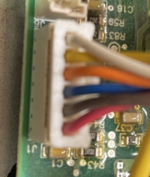
There are no other sensors, so this should be a piece of cake. The only thing left as far as I can tell is the EEV stepper motor. There I ran into a snag. The board connector looks like this:

Screen Shot 2024-07-26 at 7.14.11 AM.png

The motor itself looks like this:

Screen Shot 2024-07-26 at 7.14.45 AM.png

Uhhh okay why are my wire colors different?

Then, the documentation says the connector looks like this:

photo_2024-07-26_07-15-26.jpg

So uh yeah that makes no sense at all.

I did go ahead and ohm out what I could. If I go by color at the board connector and pretend I didn't just see all that, I show open circuits on 3 of the pairs. This would strongly imply a failed stepper motor but given none of this stuff matches up I can't trust that.

I might go ahead and just replace the motor but I can't find it to order.
 
OP
T

teknikfrog

Well-known member
Joined
Apr 29, 2023
Messages
216
DOH! Disregard that last bit I didn't realize it was referring to a sub-connector between the stepper and EEV board. The motor ohms out correctly.

That said, I literally can't get my multimeter pins into the FIG2 connector, I literally do not have the dexterity..
 
OP
T

teknikfrog

Well-known member
Joined
Apr 29, 2023
Messages
216

This thread might describe my issue to a T.

If the EEV is closing on shutdown and taking too long to reopen on startup, that would cause low pressure on suction and LPCO shutdown. In the thread a guy mentions the 2 sensors--evap and gas temp and says:

"Evaporator temp sensor is an early warning indicator to speed up the EEV control loop."

Well hot damn.

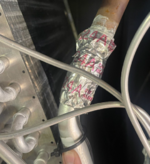
Screen Shot 2024-07-26 at 7.48.19 AM.png

THAT IS NOT FACTORY TAPE! This is a callback that the installer must have done years ago.

Now what are the odds I see signs of repair on a sensor that is allegedly responsible for helping regulate EEV position?

Of course I still can't explain the problem. Maybe the sensor has shifted away from the line?

Interesting...
 

American Locomotive

Well-known member
Joined
Jan 8, 2017
Messages
11,014
Location
Rhode Island
Honestly, if the system is providing an adequate temperature split (difference between incoming and outgoing air) and the coil isn't freezing, you could just leave the stepper coil off. It would essentially just function as a fixed orifice system. You'd loose some efficiency.

This thread might describe my issue to a T.

If the EEV is closing on shutdown and taking too long to reopen on startup, that would cause low pressure on suction and LPCO shutdown. In the thread a guy mentions the 2 sensors--evap and gas temp and says:

"Evaporator temp sensor is an early warning indicator to speed up the EEV control loop."
Well hot damn.
He's not correct. It has two sensors, because it needs to measure the superheat - how much temperature the gas has "gained". To do that, it needs to measure the temp right at the EEV, and then after the evap.

It seems like the main problem is the board is programmed to lock down the EEV at power off, and the system hits the LPCO before it can open back up. It seems like it's a common issue with this system, and it appears that it was marginal from the factory. As the system aged, it started cutting out.

They also suggested adding some kind of timer delay on the LPCO.
 
To avoid these ads, REGISTER NOW!
OP
T

teknikfrog

Well-known member
Joined
Apr 29, 2023
Messages
216
Honestly, if the system is providing an adequate temperature split (difference between incoming and outgoing air) and the coil isn't freezing, you could just leave the stepper coil off. It would essentially just function as a fixed orifice system. You'd loose some efficiency.
This is where I am at now. The system is running flawlessly with the stepper removed.
 

brewchief

Well-known member
Joined
Sep 20, 2008
Messages
2,371
Location
Michigan
Honestly, if the system is providing an adequate temperature split (difference between incoming and outgoing air) and the coil isn't freezing, you could just leave the stepper coil off. It would essentially just function as a fixed orifice system. You'd loose some efficiency.
He's not correct. It has two sensors, because it needs to measure the superheat - how much temperature the gas has "gained". To do that, it needs to measure the temp right at the EEV, and then after the evap.

It seems like the main problem is the board is programmed to lock down the EEV at power off, and the system hits the LPCO before it can open back up. It seems like it's a common issue with this system, and it appears that it was marginal from the factory. As the system aged, it started cutting out.

They also suggested adding some kind of timer delay on the LPCO.
Problem I see with that is what happens if the EEV can pass more refrigerant then an orifice? Will we lose all superheat and start flooding the compressor?

The 105/255 pressures make me think it's either under relatively low load right now, the EEV is too wide open or it's slightly undercharged. With the EEV not functioning you can't check the charge with any accuracy. If slightly undercharged that might make it hit the low pressure cutout before the EEV can start to control it.

I might consider hooking the EEV back up and put a jumper on the low pressure switch and watch it and see if the EEV starts to open, I wouldn't let it run below 25 psi on the low side if it doesn't start to open.
 
OP
T

teknikfrog

Well-known member
Joined
Apr 29, 2023
Messages
216
Problem I see with that is what happens if the EEV can pass more refrigerant then an orifice? Will we lose all superheat and start flooding the compressor?

I tried to measure superheat. I put a thermocouple on the suction line and it was showing like 65F and with a 105psi low side which equates to around 35 degrees of superheat.

So, if I measured right (a big IF) I'm running too much superheat. I guess by like 20* maybe? My uneducated opinion is that this is terrible for efficiency but isn't bad enough to nuke the compressor.

I also agree that this is WORSE than a fixed orifice because that would be (a) tuned for the overall system and (b) charged to fixed-orifice standards.


The 105/255 pressures make me think it's either under relatively low load right now,
Yeah, I think my saving grace is that I'm in a log home. It's a 4-bedroom but is extremely well insulated with a basement. The AC just doesn't have to work that hard. It's full cycling, and the compressor is spending plenty of time off.

Screen Shot 2024-07-26 at 5.23.25 PM.png

This is from my weather station. The system sat off all night. At 9:30 I started tinkering. I then buttoned everything up, cleaned the outdoor coils with a hose, and it's been running since. You can see how the temps stabilized and things are rock solid.

I might consider hooking the EEV back up and put a jumper on the low pressure switch and watch it and see if the EEV starts to open, I wouldn't let it run below 25 psi on the low side if it doesn't start to open.

I plan on doing this but I want to wait until springtime. Unless the system starts making weird noises, ices up, or quits, I'm just going to leave it for now. The last 2 weeks have been a deep dive into HVAC and it's been super fun but it's also caused me to stack up a huge backlog of chores.

I am planning on putting away about 7k in a rainy day fund with the expectation that I'll be installing a new system DIY in between 6 and 36 months. I hate this trane system, I hate how complicated it is, I hate that I have ZERO support from the manufacturer or installer. I might actually go to an AC system after this. I have a very efficient reburning wood stove that provides most of our heat in the winter, so strip heat isn't as scary to me as it is to some.
 
OP
T

teknikfrog

Well-known member
Joined
Apr 29, 2023
Messages
216
Just an update, I finished out the summer with the unit running in it's degraded state relatively okay. It froze up on me three times; twice on extremely hot days where I had it set to 72, and once when I was away from home and had bumped the temps up while we were gone and then cranked it back up upon return. Otherwise it ran fine.

No difference seen in power bill. I'll never buy a "high efficiency" unit again, seeing as it's basically running as a fixed orifice system with the wrong size orifice.

With the weather cooling I flipped on the heat. WOW. It heats far better than it ever did. I'm talking like 5* per hour. Previously I was getting a weird *psheewwwww* noise occasionally and it's not doing that anymore. I suspect having the evap EEV wide open at all times is better vs how it was before with it acting up.

So it looks to me like I can limp this system along indefinitely. In the spring I'm going to fiddle with the evap EEV with a magnet and see if I can find a better setting. I'll mess with the subcooling and superheat as well to see if I can get it setup a little better.

Long term I will need a new system and I'll definitely DIY the install.

What's the deal with ground source heat pumps? I've been wanting to get a water well drilled and if I could bundle a water well drilling into a ground source heat pump drilling that would probably save some cash, especially if I DIY the well drilling myself.
 

pcmeiners

Well-known member
Joined
Aug 13, 2009
Messages
7,961
Location
In the only town in Pennsylvania, Bloomsburg.
"I've been wanting to get a water well drilled and if I could bundle a water well drilling into a ground source heat pump drilling that would probably save some cash, especially if I DIY the well drilling myself."

Drilling a well is not that easy. Drilling a well for geothermal is more like drilling multiple wells, very deep, and expensive wells which is not DIY unless you can rent a drilling rig, and not the toy rigs they show on U-tube. If you have a large lot, your better off with ground loops, which is much easier then well loops but still requires a lot of digging.
 
OP
T

teknikfrog

Well-known member
Joined
Apr 29, 2023
Messages
216
"I've been wanting to get a water well drilled and if I could bundle a water well drilling into a ground source heat pump drilling that would probably save some cash, especially if I DIY the well drilling myself."

Drilling a well is not that easy. Drilling a well for geothermal is more like drilling multiple wells, very deep, and expensive wells which is not DIY unless you can rent a drilling rig, and not the toy rigs they show on U-tube. If you have a large lot, your better off with ground loops, which is much easier then well loops but still requires a lot of digging.
Go on...

I was looking at the DIY water well route where you buy the drilling heads and such and then rent the high-flow compressor that comes on a trailer. Would that not work for drilling a ground source heat pump?
 

pcmeiners

Well-known member
Joined
Aug 13, 2009
Messages
7,961
Location
In the only town in Pennsylvania, Bloomsburg.
Do you have access to something of the drill rig linked below, this is what you need to drill a well suitable for geo, along with the pipe casings and pumps. Basically you need a mortgage just for the wells. Personally I was on a rig drilling through rock 30 feet thick (basalt rock) and at other times drilling though multiple boulders, that is a possibility you could encounter. It not DIY

 
Last edited:
OP
T

teknikfrog

Well-known member
Joined
Apr 29, 2023
Messages
216
How is a ground source heat pump at all financially sensible if it requires a crew running a million dollar machine to install????
 
OP
T

teknikfrog

Well-known member
Joined
Apr 29, 2023
Messages
216
I do have plenty of land and plan on buying a mini-ex so that's no big deal. Guess ground loop is the way to go.
 
To avoid these ads, REGISTER NOW!
Top Bottom