To avoid these ads, REGISTER NOW!

DIY storage cabinet help...

Vicious Customs

Well-known member
Joined
Jan 3, 2012
Messages
66
Hey guys, I'm in need of some help. If this is in the wrong place, feel free to move it. Also, before I start let me apologize for the length of the post and the amount of questions I'm putting out there. I did a bunch of searching and am having difficulty finding the information put forth in a way I can understand.

I'm sure someone out there can help teach this dog some new tricks. My wife wants some new cabinets/closets and other built-ins, and I've convinced her that I need to build some garage cabinets to help obtain the necessary finish skills to accomplish the task. Win win? I think so.

Now, I have some basic fabrication skills when it comes to working with metal, and I've done a bit of rough carpentry over the years, but I haven't gotten into any finish work, and haven't done much beyond **** and miter joints, and this is where my troubles begin. I don't know what's necessary and it's my understanding that joinery can be the difference between a sturdy and aesthetically pleasing piece and a cobbled together POS. Now, I know I can achieve a cobbled together POS, and that's not what I want. :lol_hitti

I've been searching the interwebs and the plans I've found are lacking, and the material info isn't much better, so I figure what better place to ask.

On to the plan! :pimpflash

I will be creating base cabinets and tall rolling cabinets. The base cabinets will be varying widths, 36" tall, and 24" deep with either doors or drawers, and the tall cabinets will be approximately 72"Hx36"Wx18"D. I'm thinking that I will use 3/4 MDF or Plywood for the structure. I've used MDF for a benchtop before, and it's held up okay. I believe that painted it will last a good long while, but if plywood is a better option I'm not opposed. I intend on painting and not staining, if that makes a difference.

I'm not sure if an internal frame is necessary, if 3/4" is the right material, and what the best joints will be for durability and longevity for both cabinet and shelf mounting. From what I gather an internal frame isn't necessary if I use 3/4" material, and I've read where 1/2" might also suffice. I'd rather do it right the first time. Also, as I understand it, the floor of most cabinets are slid into a dado. Is this the correct? If I intend on putting casters under the tall cabinet, should the walls be **** jointed to the floor so they are resting on the floor? What is the best way to mount the back? **** joint between the walls, behind the walls, setup with a rabbet or double rabbet? Do I have my joints all screwed up? How about the top? Should it **** joint on top, sit down inside with **** joints, rabbets? Are face frames necessary with this type of construction? I intend on using European hinges for mounting the doors, and as I understand it they will work with faceless configurations, but again I'm a novice. Finally, what's the best way to connect the joints beyond glue? Nails, pocket screws, biscuits? :dunno:

So, there you have it, I think I've covered my basic questions. If you can offer any help, point me toward a detailed outline, or give me some constructive criticism I'd greatly appreciate it.
 
To avoid these ads, REGISTER NOW!

mds5951

Well-known member
Joined
Aug 15, 2010
Messages
322
I'm not saying it can't be done. But I'm not sure if its worth your time or money. I worked on/off for a guy while I was inbetween jobs that made and installed custom cabinets/vanities/pantries/etc. his work was top notch and he used different rough cut woods, hardwood plywoods, etc to do the job.

The amount of different tooling (not sure if right word) he used was impressive. The bare minimum I would say you'd need a table saw with a nice large "table" and fence, with probably another table build around it in order to handle the 4x8 sheets of ply, a wood shaper, a good router, a good dado set, a kreg jig, don't forget a nice Forstner bit for the hinges.

You have no small task ahead of you.
 
OP
V

Vicious Customs

Well-known member
Joined
Jan 3, 2012
Messages
66
I'm not saying it can't be done. But I'm not sure if its worth your time or money. I worked on/off for a guy while I was inbetween jobs that made and installed custom cabinets/vanities/pantries/etc. his work was top notch and he used different rough cut woods, hardwood plywoods, etc to do the job.

The amount of different tooling (not sure if right word) he used was impressive. The bare minimum I would say you'd need a table saw with a nice large "table" and fence, with probably another table build around it in order to handle the 4x8 sheets of ply, a wood shaper, a good router, a good dado set, a kreg jig, don't forget a nice Forstner bit for the hinges.

You have no small task ahead of you.

Thanks for the insight. You're not the first one to tell me it's no small task. I do understand that, but I definitely like the opportunity to learn new skills, especially ones that I'll be able to use now and in the future. It's an adventure, right? :thumbup:

I actually have most of the tooling, with the exception of the kreg jig, inherited from my wife's grandfather, so that portion of the expense should be manageable. On top of that any tool I need to buy is an investment :bounce:


Thanks for this. I like the setup.
 

wantedabiggergarage

Member Emeritus
Joined
Feb 25, 2006
Messages
3,897
Location
Independence, MO, USA.
The amount of different tooling (not sure if right word) he used was impressive. The bare minimum I would say you'd need a table saw with a nice large "table" and fence, with probably another table build around it in order to handle the 4x8 sheets of ply, a wood shaper, a good router, a good dado set, a kreg jig, don't forget a nice Forstner bit for the hinges.

You have no small task ahead of you.

I disagree with the tooling, as cabinets were built for years, with hand tools, before all that stuff was available. (people just have to use their brain more to figure out how to do something)
A circular saw, and router, with some sawboards and jigs. Kreg jig is nice and handy (I have one), but dowels could be done just as well. I personally, went the commercial track setup, and don't use a table saw. (but it can be done without the commercial stuff as well) Mainly a mater of time (to build your tool) verses money.
I would avoid MDF, personally, as well as Home cheapo type plywood.

Cabinet styles vary. Plywood has pretty much taken over, but look at some houses built before electricity, and you will find frame and panel construction, so that is an option as well.
 

buening

Well-known member
Joined
Dec 17, 2007
Messages
1,338
Location
Decatur, IL
I used 3/4" oak plywood (oak was on sale at the time, otherwise too expensive) for the shell of my cabinets in my garage, and I think 5/8" thick MDF for the doors. My tall cabinet is 4' wide x 8' tall x 2' deep. The cabinets above the bench are 40" tall x 4' wide x 12" deep and there are two end to end. I didn't use any fancy jointery, just glued and screwed the joints and its pretty solid. I used the same 3/4" plywood for the shelves, and due to the weight I was planning for the shelves and their spans I used 1"x1"x3/16" angle iron screwed to the front edges of the shelves. I recessed the shelf clip strips in the side walls and surface mounted the strips on the backwall of the large cabinet, and used the V-shaped clips to hold the shelves (see below for example). Hind sight, the shelf clips are the weak link of the cabinets. I could sit on the 48" span shelf and the angle iron would hold me perfectly, but the clips pull out of the strips. I need to take some pictures of my cabinets, as I'm sure it will help you picture it better

addsh5-3201.jpg


By the way, my cabinets were built using only a circular saw and a long pipe clamp as a guide. No table saw and no fancy Kreg system. The pipe clamp as a guide took longer since I had to measure more than with a table saw, but I used the tools I had in the limited space my garage allows. A dado blade would have made recessing the shelve strips easier, but a circular saw for each edge and a chisel removed the strip of plywood to recess it.

BTW, my cabinets are the frameless style and utilize Grass brand concealed self closing hinges.
 
Last edited:
OP
V

Vicious Customs

Well-known member
Joined
Jan 3, 2012
Messages
66
I disagree with the tooling, as cabinets were built for years, with hand tools, before all that stuff was available. (people just have to use their brain more to figure out how to do something)
A circular saw, and router, with some sawboards and jigs. Kreg jig is nice and handy (I have one), but dowels could be done just as well. I personally, went the commercial track setup, and don't use a table saw. (but it can be done without the commercial stuff as well) Mainly a mater of time (to build your tool) verses money.
I would avoid MDF, personally, as well as Home cheapo type plywood.

Cabinet styles vary. Plywood has pretty much taken over, but look at some houses built before electricity, and you will find frame and panel construction, so that is an option as well.

Thanks for this. I believe I'll steer clear of MDF in my adventure.

I used 3/4" oak plywood (oak was on sale at the time, otherwise too expensive) for the shell of my cabinets in my garage, and I think 5/8" thick MDF for the doors. My tall cabinet is 4' wide x 8' tall x 2' deep. The cabinets above the bench are 40" tall x 4' wide x 12" deep and there are two end to end. I didn't use any fancy jointery, just glued and screwed the joints and its pretty solid. I used the same 3/4" plywood for the shelves, and due to the weight I was planning for the shelves and their spans I used 1"x1"x3/16" angle iron screwed to the front edges of the shelves. I recessed the shelf clip strips in the side walls and surface mounted the strips on the backwall of the large cabinet, and used the V-shaped clips to hold the shelves (see below for example). Hind sight, the shelf clips are the weak link of the cabinets. I could sit on the 48" span shelf and the angle iron would hold me perfectly, but the clips pull out of the strips. I need to take some pictures of my cabinets, as I'm sure it will help you picture it better

addsh5-3201.jpg


By the way, my cabinets were built using only a circular saw and a long pipe clamp as a guide. No table saw and no fancy Kreg system. The pipe clamp as a guide took longer since I had to measure more than with a table saw, but I used the tools I had in the limited space my garage allows. A dado blade would have made recessing the shelve strips easier, but a circular saw for each edge and a chisel removed the strip of plywood to recess it.

BTW, my cabinets are the frameless style and utilize Grass brand concealed self closing hinges.

Sounds like 3/4 ply is the way to go. Not a big deal, and I want it to last!

I'd greatly appreciate some additional pictures if you have some time. If you don't mind getting some of the way the backs, sides, bottom and top are joined together, that'd be a huge help, too.
 

buening

Well-known member
Joined
Dec 17, 2007
Messages
1,338
Location
Decatur, IL
I will try to snap some pics. The cabinets are a dark gray, so pics may not show up well. Oh and I used 1/2" plywood for the backs of the cabinets. If you are screwing these to a wall then you don't need very thick backs.

I made my large cabinet to easily cut from 4x8 sheets. The back is a full 4x8 sheet, the sides are a 4x8 sheet cut in half, and the doors are a 4x8 sheet MDF cut in half and trimmed down very slightly for door gaps. Only the top, bottom, and shelves were not easily divided within a 4x8 sheet.

If you were to lay the cabinet on its face with the back facing up, the back would sit on top of the sides, top, and bottom panels. The screws go around the perimeter of the back and into the end grains of each side/top/bottom panel. I think I used screws every foot or so and applied glue to the back and ends of the panels prior to setting the back on them. I put a toe cutout on the bottom front of the cabinet (like kitchen cabinets have) and have the bottom of the inside of the cabinet at the top of the toe kick (again similar to kitchen cabinets). Below the bottom panel to the ground is just a void with some bracing to prevent the bottom panel from sagging from storage weight. Due to the proportions and the presence of the toe kick, the large cabinet wants to tip forward so I had to screw the back panel to the wall studs.

The small cabinets were constructed the same way, with the back sitting on top of the sides/top/bottom.
 
OP
V

Vicious Customs

Well-known member
Joined
Jan 3, 2012
Messages
66
I will try to snap some pics. The cabinets are a dark gray, so pics may not show up well. Oh and I used 1/2" plywood for the backs of the cabinets. If you are screwing these to a wall then you don't need very thick backs.

I made my large cabinet to easily cut from 4x8 sheets. The back is a full 4x8 sheet, the sides are a 4x8 sheet cut in half, and the doors are a 4x8 sheet MDF cut in half and trimmed down very slightly for door gaps. Only the top, bottom, and shelves were not easily divided within a 4x8 sheet.

If you were to lay the cabinet on its face with the back facing up, the back would sit on top of the sides, top, and bottom panels. The screws go around the perimeter of the back and into the end grains of each side/top/bottom panel. I think I used screws every foot or so and applied glue to the back and ends of the panels prior to setting the back on them. I put a toe cutout on the bottom front of the cabinet (like kitchen cabinets have) and have the bottom of the inside of the cabinet at the top of the toe kick (again similar to kitchen cabinets). Below the bottom panel to the ground is just a void with some bracing to prevent the bottom panel from sagging from storage weight. Due to the proportions and the presence of the toe kick, the large cabinet wants to tip forward so I had to screw the back panel to the wall studs.

The small cabinets were constructed the same way, with the back sitting on top of the sides/top/bottom.

This is extremely helpful. Thanks again!

If I'm understanding this correctly, the bottom mounts between the sides, and I assume the top does, too. Is this correct?

I'll be putting casters on the garage cabinets, so I'll probably go 3/4" for the back. In the house, I'll be mounting to the wall, so I'll go with the 1/2".


This is cool. I definitely think it will be nice to have on hand. Thanks!
 

shovel

Well-known member
Joined
Dec 26, 2008
Messages
477
Location
Port Neches, Texas
Vicious Customs, you can do this! You wont save any money doing it yourself, but you can learn some new skills and acquire some new tools that will pay for themselves this job and from now on. You have got great information and advise here. I too recommend a book that covers basic kitchen cabinet building. There are good reasons whey kitchen cabinets are a standard height, width and depth. These reasons apply to the shop too. I recommend 3/4" plywood also. There are imported plywoods they sell at the big box stores that are relatively inexpensive and are well made. Perfect for shop cabinets. You will need a good table saw. A good used contractors saw would be your best bet. The Kreg jig is excellent for face frames for your cabinets. Fast and easy once you get the hang of it. If there is a good hardwood lumberyard near you, the probably sell 2" wide face frame stock. The cheapest hardwood will do, if you are going to paint the cabinets. Buying 2" stock may be a little more expensive, but is a great time saver. Good luck and post up some pics.
 
To avoid these ads, REGISTER NOW!

rsanter

Well-known member
Joined
Dec 22, 2007
Messages
18,492
Location
visalia ca
First you need to know how a cabinet is put together. Go look at the ones in the house now and look at the ones in the big box store. Examine them for the mechanics of how they are put together.
Look for basic plans on the web, again look at the mechanics.

Tools
For cabinets I think you will need a decent table saw. Does not have to be a high end or expensive one but needs to be decent enough to make a reliable straight line.
For those that say you do not need one, true. But it will be faster, easier, and better to use one verses other methods.

Glue and nails
Learn the fact that the glue is stronger than the nails and then nails are really there to hold it till the glue sets up. Get a decent nail gun and some pipe clamps

The door
The door is the most complex part for a novice woodworker unless what you want are flat slab doors...ugh

The body of the cabinet should be finish grade plywood with the top veneer wood that is the choice you will be using for the cabinet and then solos wood for the faces and doors

Bob
 

Chitown_hillbilly

Well-known member
Joined
Sep 6, 2011
Messages
982
Location
Morris, IL
I use THIS Rip Cut saw guide from Kreg, because I don't have a table saw. I used to use the Clamped strait edge as a guide trick but this is so much easier and cheaper than a Table saw/panel saw or a rail saw. That combined with a pocket hole jig, I have a Kreg Jr, made me about 100 times better at building cabinets and book shelves.

Good luck.
 

buening

Well-known member
Joined
Dec 17, 2007
Messages
1,338
Location
Decatur, IL
I would recommend you choose what cabinet TYPE you want, whether it be face frame or frameless.

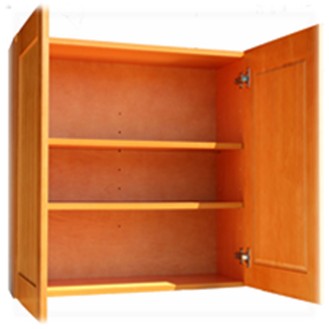
Frameless will look like this:
ADwall.jpg


Face frame will look like this (face frame left, frameless right):
cabinets.jpg


Most kitchen cabinets are face frame. A face frame, in my opinion, will be sturdier since you have the frame around the doors to add ridigity. On a frameless, you don't have this and the front tends to be a bit more rickety on large cabinets. The frameless does maximize the opening for large items, as you don't have the frame in the way on the top and sides. In terms of ease of construction, the frameless is easier as it involves less pieces and is one of the reason why it was invented (for cheap mass production).
 

kbs2244

Well-known member
Joined
Nov 11, 2006
Messages
14,065
I would say the choice of MDF is more an appearance one.

If you want a hard, high gloss, factory applied finish, go with it.
If you prefer a warmer look, use wood of some kind and apply your own finish.
(Finishes are an art and science of their own.)
 

bkcorwin

Active member
Joined
Jul 10, 2013
Messages
32
apologies if some of this has already been said as I didn't read every reply but.

I know others have steered you away from MDF, but i have used IKEA kitchen cabinets all over the place including my garage. For cabinets that are mounted to the wall, they are extremely sturdy (wall mounting adds a lot ). In fact just last weekend I put up sixteen feet of wall cabinets in my garage for a whopping 450 bucks. I have a complete woodshop setup to build cabinets in my garage, large table saw, router table, tooling to cut pockets for euro hinges, kreg jig etc. I built 30+ rail and stile shaker style doors for my old kitchen. Yet, I cannot even buy the material for what I can get complete cabinets from IKEA for.

In both face frame and full overlay you need to make sure you can cut the pockets for the hinges. Rockler sells a nice simple jig that comes with a router bushing. Then you just set the depth and route the pocket with an up cut bit in a router. Its very easy and pretty quick.

a 3/4" back on a cabinet is really thick and a lot of material. I might run some stretchers and sheet the back with 1/4 material.

As far as construction of the cabinets go, I would look into building cabinets that have a separate toe kick. Integrated toe kicks require processing plywood sides to the proper dimensions and then cutting out the notch for the toe kick. In a separate toe kick build, the boxes are just that, boxes. You then set the cabinets on top of a ladder base built from 2x4s or a torsion box from cdx ply or something like that. This makes it very easy to level all the cabinets since all you have to do is level the ladder base then slap the boxes on top ( you then need to trim out the base ).

I honestly wouldn't bother with the dado either. I've pocket screwed and glued a bunch of cabinets and it is a very strong connection.
 
OP
V

Vicious Customs

Well-known member
Joined
Jan 3, 2012
Messages
66
Thank you all for the feedback. I'll be checking the local bookstore for cabinet building books, and I'm sure that it, with this information, will get me all the information I need.

I think I've settled on a frameless cabinet design, mostly because I prefer the look.

I'll be traveling for business for the next couple of weeks, but hope to start mid-October.

Again, thanks for all the input! It truly is appreciated!
 

buening

Well-known member
Joined
Dec 17, 2007
Messages
1,338
Location
Decatur, IL
I know others have steered you away from MDF, but i have used IKEA kitchen cabinets all over the place including my garage. For cabinets that are mounted to the wall, they are extremely sturdy (wall mounting adds a lot ).

There were three reasons why I didn't go with MDF for my boxes. One was the fact that standard screws don't work well with MDF, and Confirmat screws can get expensive if doing a lot of cabinets (plus couldn't find them locally). Two was the weight. 3/4" MDF weighs a ton and I was building large cabinets by myself. Three was the fact that if you don't laminate or paint them, they will swell up like a sponge due to moisture. I was planning on painting mine. If you get any water on your garage floor, the bottom end grains touching the floor of an MDF box will not likely have the intact from sliding them around.....thus it would have swelled up on me. If you don't get the laminate joints properly sealed, it can **** up water through there on the bottom as well.

I did use MDF for my doors because plywood flat-panel doors tend to warp over time, whereas MDF doesn't.


In both face frame and full overlay you need to make sure you can cut the pockets for the hinges. Rockler sells a nice simple jig that comes with a router bushing. Then you just set the depth and route the pocket with an up cut bit in a router. Its very easy and pretty quick.

I assume you mean concealed hinge pockets, in which assuming you measure the distance to the hole correctly all you really need is a 1 3/8" forstner bit to drill the hole (correct is 35mm, but is essentially 1 3/8"). Typically the manufacturer of the hinge will give you drilling distances, like this (page 9): http://www.grassusa.com/downloads/Grass_3000.pdf

As far as construction of the cabinets go, I would look into building cabinets that have a separate toe kick. Integrated toe kicks require processing plywood sides to the proper dimensions and then cutting out the notch for the toe kick. In a separate toe kick build, the boxes are just that, boxes. You then set the cabinets on top of a ladder base built from 2x4s or a torsion box from cdx ply or something like that. This makes it very easy to level all the cabinets since all you have to do is level the ladder base then slap the boxes on top ( you then need to trim out the base ).

Agree. I did an integrated toe kick and it was more work. With casters, a toe kick isn't needed which appears to be where the OP might be going.
 

bkcorwin

Active member
Joined
Jul 10, 2013
Messages
32
Agree with everything this guy below says. :thumbup:. All my ground contact pieces are dimensional lumber.

The ladder base separate toe kick was mainly targeted towards his comment of also building some inside cabinets later

There were three reasons why I didn't go with MDF for my boxes. One was the fact that standard screws don't work well with MDF, and Confirmat screws can get expensive if doing a lot of cabinets (plus couldn't find them locally). Two was the weight. 3/4" MDF weighs a ton and I was building large cabinets by myself. Three was the fact that if you don't laminate or paint them, they will swell up like a sponge due to moisture. I was planning on painting mine. If you get any water on your garage floor, the bottom end grains touching the floor of an MDF box will not likely have the intact from sliding them around.....thus it would have swelled up on me. If you don't get the laminate joints properly sealed, it can **** up water through there on the bottom as well.

I did use MDF for my doors because plywood flat-panel doors tend to warp over time, whereas MDF doesn't.


I assume you mean concealed hinge pockets, in which assuming you measure the distance to the hole correctly all you really need is a 1 3/8" forstner bit to drill the hole (correct is 35mm, but is essentially 1 3/8"). Typically the manufacturer of the hinge will give you drilling distances, like this (page 9): http://www.grassusa.com/downloads/Grass_3000.pdf


Agree. I did an integrated toe kick and it was more work. With casters, a toe kick isn't needed which appears to be where the OP might be going.
 
OP
V

Vicious Customs

Well-known member
Joined
Jan 3, 2012
Messages
66
You guys are amazing. I knew this was the right place to ask. Thanks again! I'll be posting up pics when the project gets started. I'm sure it'll be slow going, well, because I'm slow. It's all good, and it'll be well worth it.
 

z28toz06

Well-known member
Joined
Nov 30, 2005
Messages
1,012
Location
Connecticut
I used 3/4" oak plywood (oak was on sale at the time, otherwise too expensive) for the shell of my cabinets in my garage, and I think 5/8" thick MDF for the doors. My tall cabinet is 4' wide x 8' tall x 2' deep. The cabinets above the bench are 40" tall x 4' wide x 12" deep and there are two end to end. I didn't use any fancy jointery, just glued and screwed the joints and its pretty solid. I used the same 3/4" plywood for the shelves, and due to the weight I was planning for the shelves and their spans I used 1"x1"x3/16" angle iron screwed to the front edges of the shelves. I recessed the shelf clip strips in the side walls and surface mounted the strips on the backwall of the large cabinet, and used the V-shaped clips to hold the shelves (see below for example). Hind sight, the shelf clips are the weak link of the cabinets. I could sit on the 48" span shelf and the angle iron would hold me perfectly, but the clips pull out of the strips. I need to take some pictures of my cabinets, as I'm sure it will help you picture it better

addsh5-3201.jpg


By the way, my cabinets were built using only a circular saw and a long pipe clamp as a guide. No table saw and no fancy Kreg system. The pipe clamp as a guide took longer since I had to measure more than with a table saw, but I used the tools I had in the limited space my garage allows. A dado blade would have made recessing the shelve strips easier, but a circular saw for each edge and a chisel removed the strip of plywood to recess it.

BTW, my cabinets are the frameless style and utilize Grass brand concealed self closing hinges.

you can make a great saw guide for 10 bucks. Kreg jig is only 30 bucks.

 
To avoid these ads, REGISTER NOW!
Top Bottom