To avoid these ads, REGISTER NOW!

Does Anybody Stick Weld Anymore?

Shop Dad

Well-known member
Joined
Nov 5, 2014
Messages
160
Location
Princeton, NJ
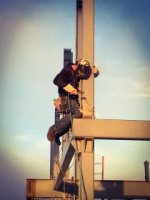
I get to your neck of the woods often as my sister is in Glendale and mom in Peoria. I'm no expert but most of my (hobby and home)welding is done outside with stick. Yes, it's not the hot glue gun, point and shoot of MIG but I bet you are a better MIG welder for the stick training you have done. I work in NYC and on one of my lunch walks I stopped to watch workers on a new building going up. They were stick welding the framework.

You asked if anyone stick welds any more and the answer is clearly "hell yeah." That doesn't mean its what you need to do if you are just working with steel tubing fabrication. That may not be the same for everyone in the class.
 
Last edited:
To avoid these ads, REGISTER NOW!

Coach James

Well-known member
Joined
Jun 24, 2005
Messages
8,933
Location
Sandhills of North Carolina
When I took a welding course at the community college a few years ago, my instructor had me learn OA welding first. I had to do it until I could consistently make welds he couldn't break with a sledge hammer and vise.

Next was the cutting torch.

After that we went to mig. Miller 130 and a Miller 210.

Now, I want to learn how to stick weld.

Coach
 

AA/FC

Well-known member
Joined
Dec 9, 2010
Messages
2,080
If we were trying to be professional welders I can see the heavy emphasis on stick. But few people that I'm aware of use stick to put on a quarter panel or weld 0.084 wall box tubing to build a workbench or make a barbecue or smoker. I think the audience should determine, to some degree, what the priorities should be.


All of the exhaust ductwork above an exhaust hood in any commercial kitchen needs to be completely welded solid with no leaks.... not for air leakage, it's to keep any grease from leaking out and running down the outside of the duct and collecting on the top side of the exhaust hood, which would be a fire hazard. This ductwork is usually black iron 18 gauge (roughly .050 I believe) sheet metal...... I have personally welded several Italian restaurants worth of "grease duct" with a stick welder.

Using a stick welder to weld sheet metal may not seem practical to you, but it happens in the real world more often than you think. I have found that the only people who cringe at the thought of welding sheet metal with a stick, are usually guys who **** at stick welding to begin with. Once you become good at stick welding then suddenly welding sheet metal is no big deal.
 
Last edited:

Surreal001

Well-known member
Joined
Feb 25, 2014
Messages
105
I'm a student and they gave out evaluation forms as the end of the class is fast approaching. Before I went off on how outdated I thought the course was I figured I should find out what others think. Here's what I think they should do to improve the class.

1) Start off with stick but midway through the stick program switch off from 6013 and get into 6010/6011 and 7018. Or blow off the 6013 altogether and go with 7014 which I feel is a much better all position rod.
2) For the gas welding use 1/16" coupons as 1/8" coupons take forever to weld and I can't see anybody welding 1/8" plate with gas.
3) We spent 6 weeks on stick, five weeks on gas and one week on MIG. Seems to me that one week should be stolen from stick and gas and added to MIG.
Sounds reasonable. I'd rather TIG than anything else personally but stick is my go to method on old farm equipment and anything that needs to stick together in less than ideal shop circumstances. MIG is almost like using a big hot glue gun once you know how to stick weld.

Sent from my SM-G950U using Tapatalk
 

jfrey123

Well-known member
Joined
May 22, 2016
Messages
76
Location
Sparks, NV
MIG is almost like using a big hot glue gun once you know how to stick weld.


I've been welding a very short amount of time, home hobbyist 4x4 guy so nothing resembling professional, and I 100% agree with this statement. Done a couple projects with supervision from people smarter than I, and then a buddy decided to make me take the local community college welding course with him. Like $400 for all the metal and rods we could burn, ridiculous value. Instructor is an old union welder, and insists/demands every new student taking welding start on stick. Learning to watch your puddle and control lateral speed, arc length and feed all by hand was presented as some of the most important lessons, and I can't find fault in that logic. He believes anyone who can run stick well will pick up most other welding much easier.

Brought those skills home to the little Lincoln wire squirter I got, and instantly produced better looking welds. The hot glue gun analogy is pretty spot on. I would like to take more classes down the line, but I get by more okay now thanks to learning stick.
 

earlthegoat2

Well-known member
Joined
Jun 11, 2011
Messages
877
Location
SE GA
They emphasize stick welding because that is where the REAL money is at. Pipeline, ship building,and equipment repair. Some custom fab work will use MIG but not anything that requires x ray inspection quality welds. Inspection standard welds is what schools teach and right now no MIG process is rated to produce inspection quality welds. Once again, they are teaching what will make the student money not just generally teaching them to weld.

Kind refreshing that’s schools will actually teach students what will make them money not what will make the school money and then leave the students hung out to dry after graduation.
 
Last edited:

MagKarl

Well-known member
Joined
Oct 15, 2012
Messages
684
Location
Olympia, WA
I look at stick and gas sort of like driving a manual.

Mig is like driving an automatic.

I really like to weld, I'm not a production welder. I enjoy the process as much as the resulting thing I'm building. I hardly ever use my Mig anymore.
 

bobcatdan

Well-known member
Joined
Jan 4, 2011
Messages
9,948
Location
Kaukauna,WI
Stick welding is still very common in the right fields. Used often in industrial repair. For field work it's pretty much the preferred way. Fixing something out in the field, mig is a lot of dicking around unless it's absolutely the better method for the job.
 

ssdave

Banned
Joined
Apr 11, 2015
Messages
2,913
Location
Eastern Oregon
If I were in your position, I'd put on the evaluation that you suggest they offer a course of "hobby welding". Aim it at the old duffers that just want to learn how to run their mig to do hobby stuff at home.

As many have stated above, the course is correctly designed to teach real world, employable welding skills.

I went through a similar welding program many years ago when I thought I'd quit engineering school and go weld on the Alaska pipeline. What that taught me is that it's much more difficult to weld with MIG to the same penetration, strength, and integrity that you can with stick. We spent a lot of our time welding coupons and breaking them on a tensile strength machine to see how strong they were. Ugly, uneven welds with stick almost invariably broke 15 to 25% stronger than the most beautiful, smooth MIG welds. Once you got good at stick and were able to produce even, smooth welds without edge erosion and end craters, the strength went up to double MIG welds.

When I got done with that program, the only thing I would have changed is I would have added a 8 hour a week class on welding TIG. We didn't learn enough of that.
 

sberry

Banned
Joined
Jun 18, 2005
Messages
35,747
Location
Brethren, Michigan
Solid wire is actually very good. They make it in several flavors including some hi impact ones etc. It can be very clean and most of it is the same tensile wire found in rods. It stores well.
Wire may be a bit more fussy for fusion than stick electrodes, the power used can be lower and care needs to be taken to melt well in to the base metal and this can be a problem on starts especially, the metal is simply laying on top.
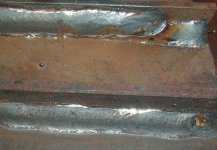
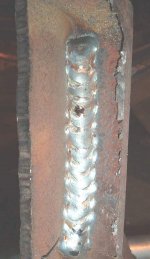
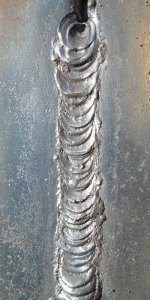
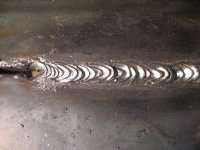
1st, Hobart 210 030 solid, 2nd, same with the machine way too hot for uphill, turn it down closer to the door chart for this. 3 pic, 6011 up no bevel on 1/3, could have been filled a bit more. 4 pic, overhead same 6011, mo bevel and a simple gap. 5 pic, 2 passes of 7018 and 6 pic is 1/8 7018 AC, I don't do this all the time anymore and the AC version is way loose compared to DC. You have to weave and really hang in there on up with it.
 

Attachments

  • Hob set test.JPG
    Hob set test.JPG
    79.7 KB · Views: 61
  • hob vert 30a1.JPG
    hob vert 30a1.JPG
    42.2 KB · Views: 58
  • 6011 ob vert.JPG
    6011 ob vert.JPG
    67.3 KB · Views: 58
  • 6011 oboh.JPG
    6011 oboh.JPG
    60.4 KB · Views: 58
  • 7018 vert 2p.JPG
    7018 vert 2p.JPG
    26.6 KB · Views: 53
  • 7018AC vert.JPG
    7018AC vert.JPG
    62.6 KB · Views: 55

BreeStephany

ALLIANCE MEMBER
Joined
May 19, 2012
Messages
851
Location
Oregon
When I went through school for welding, we were taught SMAW, GMAW and oxy/fuel in our first semester and GTAW, fabrication technique and plasma / carbon arc cutting in our second semester.

When I worked in the fabrication field, I primarily used SMAW and carbon arc, mostly working on heavy equipment. Did a TON of hard facing and teeth replacement on buckets. Did a little bit of GTAW and a lot of GMAW sheet metal fabrication and custom order fabrication, but by far, I have burned a LOT more stick rods than filler metal with tig and mig combined.

I think that stick and oxy/fuel should still be taught before tig and mig because a lot of the principles can be applied to both tig and mig, and more so, teach you to be a better welder because there is less you can get away with using stick or oxy/fuel than mig.

Just my two cents.
 

HanShotFirst

Well-known member
Joined
Jun 29, 2015
Messages
846
Location
NW Nevada
And let's not forget, you can do some fine detail and somewhat precise welding with a stick welder if you're patient, use the right rod and heat setting. In gunsmithing, which is dominated by TIG welding, I used a stick welder for about a decade and no one could tell the difference. But once I when I finally got a TIG, life became SO much easier.

Point being, if it's what you have and you're patient; you can get most jobs done with a stick welder.
 

HanShotFirst

Well-known member
Joined
Jun 29, 2015
Messages
846
Location
NW Nevada
I've been asked to evaluate the welding program at a local community college and in my opinion this program is geared toward 1955. There is a heavy emphasis on stick welding and on Ox-Acetylene welding and to me these are both artifacts of the industrial revolution. MIG and TIG are covered but much more briefly and in far less depth than I think they should be. Most of the class consist of welding 1/4" coupons with stick (and they use that crappy 6013 electrode instead of 7014 or 7018 both of which I think are superior) and then it's on to Ox-Acetylene to weld 1/8" thick coupons which I think is stupid since I'd only use Ox-Acetylene for sheet metal as it takes too damn long to gas weld 1/8" coupons. If they want to teach me how to gas weld up a muffler I'm OK with that. For 1/8" plate I've got an HTP Propulse 200. Ox-Acetylene cutting was a 10 minute demo with no student hands on. To me that's the primary purpose of gas today.

The only people that I know of that routinely use stick are pipe welders and I'm way too old to be working in a refinery. In Germany they have pulse MIG and pulse Stick and a lot of advanced welding technology in their schools. Here in American we're teaching students skills that they needed in 1940 to weld tanks together. Another reason we're falling behind.
I wish I could find a OA welding class, I always wanted to learn that. Back in the old days, most gunsmithing (I'm a gunsmith) welding was done with an OA setup, so it would be cool to learn.

Now, on to your point...

I would agree that the emphasis should be on Mig and Tig since they are by far the most prevalent in manufacturing (and flux core). SMAW/Stick most certainly does need to be taught. Anyone who wants to be a welder should know how to stick weld, since there are a few industries that still use it, and in a LOT of industries, it is still number 1 for in field repairs. And of course, all the theory very much applies.

On the OA side, at a very minimum, everyone should learn how to cut with a torch.
 

EOC_Jason

Well-known member
Joined
Jun 25, 2012
Messages
11,388
Location
Bentonville, AR
I learned on a stick... good old lincoln cracker box... You can probably find one of those in any barn across the country. I never touched a MIG until just recently since that is what my neighbor had and I needed to weld something.

As others have said, stick seems to be what is used in the industrial settings for various reasons. MIG is more home users and lighter fabrication. TIG is kind of a specialty / art all in itself. I guess it's all about using the right tool for the job...

I would think / expect a "general" class to be pretty balanced in teaching arc & mig, and less on TIG / torch...
 

Furious Filipino

Well-known member
Joined
May 25, 2016
Messages
85
Location
San Francisco East Bay
I'm a practicing engineer and have been taking welding classes for the past year and half continuously.

I am taking classes at a local community college as well, but it seems like the majority of your issues are into the program offerings of your particular college, and your expectations of how you wanted to be taught.

The choices we had for any entry-level welder with no experience were as follows:

Survey Class/Welding Hobbyists and Artists: 18 weeks, stick, flux core/dual shielded, tig, mig; flux core and mig were not emphasized--probably 2 weeks total for both; you come in with a project and the instructors help you with it

Beginning Stick / Flux Core: 18 weeks, flux core was given about a week, you had to produce 3/8" thick test coupons for BOTH stick and flux core, for a face and root bend test

Beginning Tig / Mig: 18 weeks, mig was given about a week, you had to produce 3/8" thick test coupons for BOTH tig and flux core for a face and root bend test.

Out of the 3 paths to take, there is very little emphasis on semi-automatic (wire feed) processes, because once you can prove that you can weld using stick or tig, getting your settings for the wire feed machine and producing solid, even visually appealing welds should only take you 30 minutes, tops.

I'm in the advanced tig class this semester, and I haven't touched the wire feed machine all semester. Last Thursday, I set the wire feed machine up in 10 minutes, and welded my test coupons in about half an hour, including proper inter-*** temp checks. That shows how little there is to wire feed welding.

If you can stick weld well, you will far and away have a better understanding of travel speed, angle, puddle control, and heat control than someone that has only wire feed experience. The guys who come into this program with "years" of welding experience (mostly home hobbyists with wire feed machines and big egos) are often humbled by students with no welding experience but a willingness to learn the hard processes first.

Gas welding is very much like tig welding, so they are analogous in the motor control and skills needed.
 

johninct

Well-known member
Joined
Dec 21, 2010
Messages
2,595
If you can stick weld and gas weld, you can easily pick up MIG & TIG welding. Also, for the amount of welding that I do, it doesn't make sense for me to have more than a good, quality brand buzz box and tank set.

My thoughts exactly!!!
 

dogdog

Well-known member
Joined
Nov 15, 2011
Messages
12,711
All dependents on the program and it's targeted audiences, if that welding program is target for people becoming a welder, stick and O/A should be the first thing they learn... If it is for home mechanics or some one just looking for specific welding to fabricating something at home, I think just update the description as mentioned hobby/fabricator/advance welding course.


this is when I was researching to attend a welding course to refresh my knowledge eons ago... then the schools, only have stick and O/A and when Mig machine was super expensive, Tig machine is super rare in school.

The local college here offer proper basic welding course, at least the course description you learn welding symbols, and stick and O/A. then they offered seperate advanced welding course in Mig and a separate one for Tig, this is a adult continue education course aimed at helping welders getting certified, I guess.

Then if you see Lincolin / Hobart welding school they offered 2 or 3 weeks fabricator course that concentrates mostly on Tig....aimed for Professionals that wants to weld but doesn't want to be a pro welder.
 
Last edited:

Swingpress

Well-known member
Joined
Mar 16, 2017
Messages
537
Stick is relevant but it's uses are limited. In my opinion tig should see heavy emphasis but things like carbon-arc gouging and learning to weld heavy plate/pipe should still see adequate time since it still has a specialized demand. I would think things like friction welding and being able to properly back-purge a tig weld on aluminum/stainless would get a lot of hands on time.
 

RivennHewn

Well-known member
Joined
Jun 4, 2011
Messages
10,370
Location
PNW
We still see quite a bit of stick out in the field.
 

Attachments

  • 772694ED-DD76-4264-8349-0106A22C3451.jpg
    772694ED-DD76-4264-8349-0106A22C3451.jpg
    9.1 KB · Views: 107
To avoid these ads, REGISTER NOW!

Ramblin Man

Well-known member
Joined
Jun 13, 2015
Messages
224
Location
Middle Tennessee
I have limited experience welding as compared to others here. And I cannot weld now, due to having a defibrillator put in my chest after a heart attack.

But, one thing I would add is I would want to learn to stick weld along with oxtcetylene weld due to the fact that trying to Mig weld outside on a windy day always was a problem to me, because the wind blowing the gas away messed things up, for me.

Others may have advise and a work around I do not know about. Like I said, I was not very experienced.
 

3 Gun Shooter

Well-known member
Joined
Jan 29, 2015
Messages
880
We still see quite a bit of stick out in the field.

If you are working on pipelines and in refineries you do a lot of stick welding. Working for a natural gas company used to do a lot of stick welding, now to just do it to build manifolds, underground everything is plastic.
 

earlthegoat2

Well-known member
Joined
Jun 11, 2011
Messages
877
Location
SE GA
If anything I think hobbyists/mechanics put too much emphasis on TIG. Its all I seem to ever hear non welders talk about. "I want to learn to TIG weld" I can TIG well enough and people are in awe to hear me say it or worse, see me do it.

It is far and away my least used process in the hobby/mechanic world. Sure its nice to know when you need to weld up that magnesium chainsaw case or motorcycle fuel tank but is that all its for? If you have found yourself a niche in some precision aluminum or SS welding then yeah or prototyping here and there sure TIG is quite relevant but that is not hobbyist type stuff. I find for large Al or SS projects the MIG is the best option. The only TIG I do anymore is repairing commercial kitchen equipment which usually has thin SS. This is few and far between though and I work at a place that has 4 large restaurant style kitchens.
 

sberry

Banned
Joined
Jun 18, 2005
Messages
35,747
Location
Brethren, Michigan
I can tig, got one, a 300 synch. Havnt used it in 15 years.
 

Attachments

  • Welder group new.jpg
    Welder group new.jpg
    145.3 KB · Views: 87
Last edited:

sberry

Banned
Joined
Jun 18, 2005
Messages
35,747
Location
Brethren, Michigan
I can tig, got one, a 300 synch. Havnt used it in 15 years. It works as a cart, it's next to the electric service. I could really move it to storage, it's not all in the way as best it can be.
 

Oregon rock crusher

Well-known member
Joined
Jun 28, 2016
Messages
1,906
Location
West of Salem
Stick weld...but of course. I can't even imagine trying to switch wire out in a mig for many of the smaller welding jobs that pop up. Cast iron, tool steel, hard facing, and structural all benefit from different rods. Got a bolt broken off deep in there, grab a stick of extractalloy and be done with it. Stick welding is just too versatile a solution to die and specialty rods are, well just that, special and damn nice to have. Ed.
 

Attachments

  • Rod fridge full.jpg
    Rod fridge full.jpg
    145.7 KB · Views: 112

L.Cheapo

Well-known member
Joined
Oct 23, 2014
Messages
5,899
Stick weld...but of course. I can't even imagine trying to switch wire out in a mig for many of the smaller welding jobs that pop up. Cast iron, tool steel, hard facing, and structural all benefit from different rods. Got a bolt broken off deep in there, grab a stick of extractalloy and be done with it. Stick welding is just too versatile a solution to die and specialty rods are, well just that, special and damn nice to have. Ed.

Is that a refrigerator?
 

Sycan

Well-known member
Joined
Aug 5, 2015
Messages
414
If you can stick weld and gas weld, you can easily pick up MIG & TIG welding. Also, for the amount of welding that I do, it doesn't make sense for me to have more than a good, quality brand buzz box and tank set.

It's funny you say that, and I do agree with you. When I was early 20's I was a learning to be a millwright at a woodmill. I was a self taught welder, and being in my early 20's I was pretty smart. The company paid for a welding class for me at our local college and the first couple weeks was OA welding. I didn't need to learn that ****, and sure enough 15 years later I buy a TIG welder and I'm fricken useless with it! At least once the instructor got to stick welding I realized he was smarter than me and I learned alot about stick welding that I still use almost daily.
 

ttpete

Well-known member
Joined
Mar 8, 2011
Messages
6,737
Location
Dearborn, MI
And let's not forget, you can do some fine detail and somewhat precise welding with a stick welder if you're patient, use the right rod and heat setting. In gunsmithing, which is dominated by TIG welding, I used a stick welder for about a decade and no one could tell the difference. But once I when I finally got a TIG, life became SO much easier.

Point being, if it's what you have and you're patient; you can get most jobs done with a stick welder.

For a hobbyist, there's always a place for a decent O/A rig. It's a good source of heat and for working with non-ferrous metals. Those who home build aircraft torch weld chrome moly (4130) tubing structural members because the process makes it unnecessary to normalize the structure that would be required if it was done with TIG.

The key to gas welding is to not use a big clunky torch where it's not needed. I do most everything with small "aircraft" size torches that are lightweight and easy to manipulate. My favorite is the Meco Aviator Jet series that are made of aluminum and have a selection of 9 different welding tips and even one small rosebud and a neat little cutting attachment. Unfortunately, Victor bought Meco and discontinued the line. They do have a nice small brass aviator series, though.
 

23ford

Well-known member
Joined
Jul 26, 2014
Messages
517
Location
Turley America
Oxy-acetylene weldingius still used a lot for small jobs......I have a gas rig for it also 2 stick units, mig and tig....But give me a gas unit ....
 

earlthegoat2

Well-known member
Joined
Jun 11, 2011
Messages
877
Location
SE GA
Folks never seem to lump brazing and silver soldering (also brazing) in with Oxy fuel welding. These are still very relavant processes.
 

Ridwaan Gallow

Well-known member
Joined
Mar 18, 2015
Messages
92
Location
Cape Town, RSA
Simply put..

Stick welding is the most basic welding that can be done.. simple to understand.. easy to learn.. therefore it is so widely taught..

So i wouldnt be too quick to pull them over the coals for it, cos welding is still welding.. the only thing that matters is skill & taking pride in your work..
 

maintguy

Well-known member
Joined
Nov 20, 2014
Messages
393
Location
North central Indiana
The last factory I was maintenance at,only had a stick welder. It freaking sucked. It wasn't mobile either. Had to take everything a part and take it to the shop to weld.
 

earlthegoat2

Well-known member
Joined
Jun 11, 2011
Messages
877
Location
SE GA
Stick welding is not easy compared to MIG. As far as newbie learning curves go, I think it is easier to produce competent welds faster with MIG. If someone learns on MIG and then tries to stick, they will cry like a millennial because its not instant gratification enough for them.

Stick machines are cheap and don't require a million accessories to still be effective and versatile. IME, their only real drawback is welding thin materials.....which can still be done with them......with sufficient skill.
 

ctb

Well-known member
Joined
May 8, 2011
Messages
1,121
Location
Central Europe
I started evening classes for welding at the local college 35 years ago. Back then MIG's weren't affordable for diy's and most hadn't even heard of the process.

So we started with O/A. The basics. Drawing a bead, welding with no filler, then with filler.
Cutting, then brazing. Then we went on to stick. Straight, uphill, downhill all tested with one of those machines that measure the force necessary to break the weld.

Then I went to work mining and learnt that welding in a classroom and welding outside in all sort of crazy positions were about as different as night and day. Yet what I learnt in that classroom was applied successfully and other than welding weird metals like 100 year old manganese punchplate I didn't have too many problems.

Eight years ago I went out and bought a MIG. Never used one before but after a half hour of playing around with the settings I was doing decent welds. What I'd learned on O/A transposed directly onto MIG. I used my invertor stick welder to build my sliding 18' entrance gate, outside where the MIG would have been useless.

I think the OP's course was balanced about right, but if he knew in advance what the course contained why is he questioning it now? Why didn't he just search for one with more TIG and MIG?
 

Mr Ratchet

Well-known member
Joined
Mar 3, 2011
Messages
928
Location
Michigan
I'm self taught and started with stick/arc. I still do most of my welding with stick because that's what I own. If I need to weld something thinner I'll use my brothers Mig welder. I think Mig is easier to do even though I have no issues stick welding.
 

Tinner

Well-known member
Joined
Aug 31, 2013
Messages
1,101
Location
N.E. Wisconsin
Some custom fab work will use MIG but not anything that requires x ray inspection quality welds. Inspection standard welds is what schools teach and right now no MIG process is rated to produce inspection quality welds.

********. I've worked in ASME and AWS certified shops and done X-ray MIG work in both. Oshkosh Truck, a defense contractor in this area requires prospective welders to pass an x-ray MIG test to be considered for employment. Innershield was invented to weld ship hulls. Bridges and water towers are partially prefabbed in shops using various MIG processes. You're grossly misinformed.

Any welding process can be subjected to x-ray inspection if the manufacturer or end user determines it to be a critical application.
 
Last edited:
To avoid these ads, REGISTER NOW!
Top Bottom