To avoid these ads, REGISTER NOW!

Does heated garage need vapor barrier?

69RT3X9

Member
Joined
Jun 14, 2012
Messages
14
Location
Cedar Rapids, IA
I am buying a house with a 3-car drywall finished and painted garage. The exterior walls have R-19 rolled insulation in them. The house adjoining walls have R-23 net and blow insulation in them.

I want to heat the space with a ceiling mounted Reznor UDAP-60 heater. Should I be concerned that there is no plastic vapor barrier under the drywall? Will heating the space during a cold winter result in moisture inside my wall or will the painted drywall serve as an effective enough barrier?

Anyone have any past experience with similar setups? Did moisture problems develop?
 
To avoid these ads, REGISTER NOW!

BobRae

Well-known member
Joined
Oct 2, 2014
Messages
96
I am buying a house with a 3-car drywall finished and painted garage. The exterior walls have R-19 rolled insulation in them. The house adjoining walls have R-23 net and blow insulation in them.

I want to heat the space with a ceiling mounted Reznor UDAP-60 heater. Should I be concerned that there is no plastic vapor barrier under the drywall? Will heating the space during a cold winter result in moisture inside my wall or will the painted drywall serve as an effective enough barrier?

Anyone have any past experience with similar setups? Did moisture problems develop?

You need a vapour barrier on the warm side of all outside walls or you risk developing moisture in the cold spaces. Further, if you live in a an area that accumulates snow, you could have ice damming from the heat escape.
 
Last edited:

kelpaso1

MEMBER EMERITUS
Joined
Sep 28, 2009
Messages
3,962
Location
New Brunswick
I am buying a house with a 3-car drywall finished and painted garage. The exterior walls have R-19 rolled insulation in them. The house adjoining walls have R-23 net and blow insulation in them.

I want to heat the space with a ceiling mounted Reznor UDAP-60 heater. Should I be concerned that there is no plastic vapor barrier under the drywall?Yes Will heating the space during a cold winter result in moisture inside my wallYes or will the painted drywall serve as an effective enough barrier? I believe there is a paint out there that acts as a vapor barrier but not sure of the name

Anyone have any past experience with similar setups? Did moisture problems develop?

If you park a car in there with snow and slush in a heated garage your garage windows will fog up. That is how much moisture that is in your garage and that moisture will get behind the drywall and mold the framing and insulation without a vapor barrier.
 
To avoid these ads, REGISTER NOW!

kbs2244

Well-known member
Joined
Nov 11, 2006
Messages
14,065
In theory .... yes
But garage doors are big, and when open they let out a whole lot of vapor.
The colder outside the better since the vapor will follow the heat.

So, if it where you keep your DD I would just go with a good oil based paint.
You will be ventilating it often.
But if it is a shop where it will spend more time closed up. then you need to think about it.
 

MagKarl

Well-known member
Joined
Oct 15, 2012
Messages
684
Location
Olympia, WA
It wouldn't bother me. Plastic under the drywall seems to be a regional practice. It's not common in my area.
 
OP
6

69RT3X9

Member
Joined
Jun 14, 2012
Messages
14
Location
Cedar Rapids, IA
Hi Guys,

Thanks for the advice. This house is in Cedar Rapids Iowa. We get some below zero temps in the winter for short periods of time, but I would say the usual temps during winter months are in the upper teens to low twenties (F).
 

BobRae

Well-known member
Joined
Oct 2, 2014
Messages
96

From the site: "Latex is a coating designed to reduce the loss of moisture through walls and ceilings"

It can't help with moisture loss through light fixtures, wall plugs, etc. In addition, I doubt it is building code approved as a true moisture barrier. I'm sure all paints and primers with Acrylic offer some resistance to moisture movement, but so does the drywall itself. I think I read somewhere that a hole the size of a nail in a vapour barrier can, in humid/cold climates allow for the transfer of a cup of water over a period of time (not sure what period).

For the OP, it may not matter in his climate, but for those of us in the colder climes, a vapour barrier is essential for a dry, rot free structure. I recently completed the renovation of my 25' x 25' garage. I used Roxul Comfort bats in the walls and a put up 2" of Styrofoam SM 4 x 8 sheets under the ceiling joists. I added an approved vapour barrier on the warm side of everything. Where I used staples, I used pieces of tuck tape to seal them. I used plastic "boots" behind all of the wall plugs and electrical boxes.

The overnight lows have been dropping to 0C (32F) overnight here and frost is showing on the roof of the house and garage. You can tell the insulation and barrier are working when the garage is 22C, the outside is 0C and there is no frost melt where the roof meets the eavestrough.

A building envelope specialist I consulted (for a problem with ice damming on my house) said that ice damming isn't caused so much by poor insulation as it is by moisture escape into the attic space. Moisture travel is a major contributor to reduced insulation effectiveness as well as heat transfer through the wall/ceiling. If my experience so far is any guide, I'd say he is right, because I only have R10 in the attic so far.

For those of you wondering why I put SM sheets under the joists, it is because due to the roof structure, I couldn't get spray foam into some of the spaces without taking the roof off the garage and spraying downward onto the ceiling of the garage. As soon as I complete a few wire runs, I'll be blowing in cellulose insulation to bring the attic value up to R45. That should help keep the heat in when the overnight lows reach -35C.
 
Last edited:

Rickss96

Well-known member
Joined
Sep 23, 2010
Messages
455
Location
SoCal
For the OP, it may not matter in his climate, but for those of us in the colder climes, a vapour barrier is essential for a dry, rot free structure. I recently completed the renovation of my 25' x 25' garage. I used Roxul Comfort bats in the walls and a put up 2" of Styrofoam SM 4 x 8 sheets under the ceiling joists. I added an approved vapour barrier on the warm side of everything. Where I used staples, I used pieces of tuck tape to seal them. I used plastic "boots" behind all of the wall plugs and electrical boxes.

And where did you place the vapor barrier on the walls? On the outer side of the inner wall, or the inner side of the outer wall?
 

Denwood

Well-known member
Joined
Sep 22, 2014
Messages
4,200
Location
Thunder Bay, Ontario, Canada
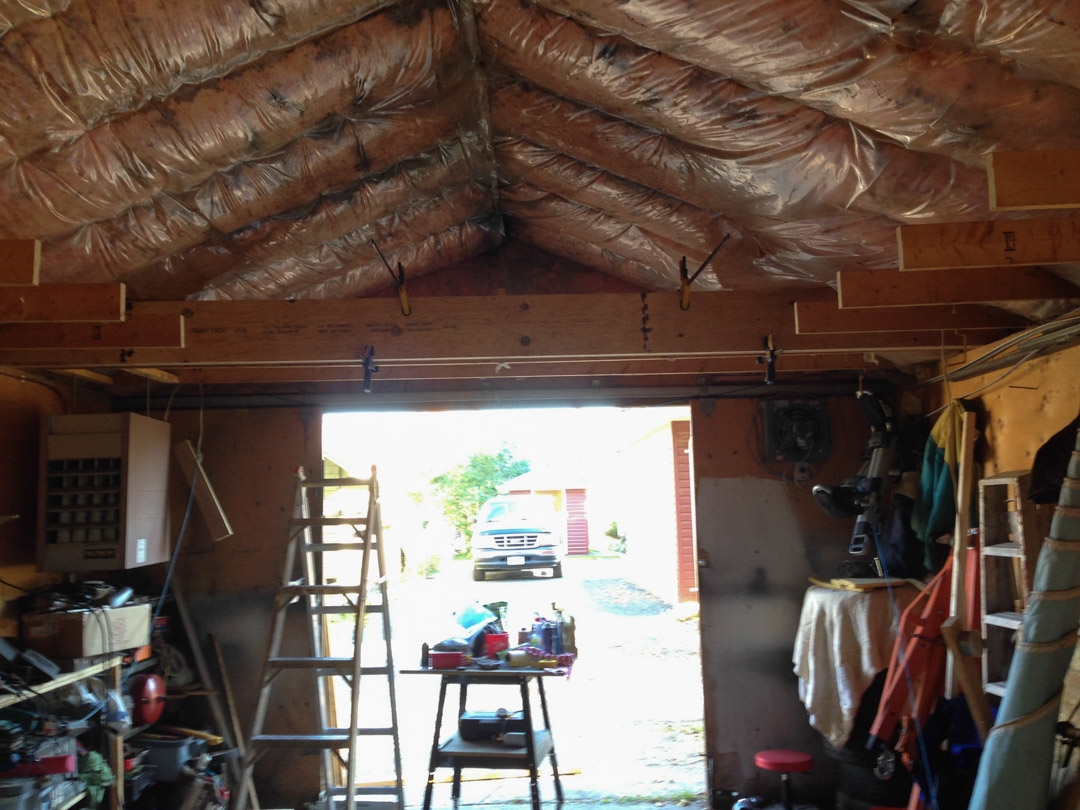
This is what vapour leaks look like if you don't properly vapour barrier. The previous owner put up fiberglass and plastic..however unprotected. Every rip in the plastic, or bad joint is black from air leaks/dust and moisture. If left as is, eventually, there would have been rot in the roof rafters. At the ridge, there was evidence of moisture staining..and this is a garage which is only heated during use. We're in a cold climate.

ridge1.jpg


And now, spray foamed with close cell foam:

foam4.jpg
 
To avoid these ads, REGISTER NOW!
Top Bottom