To avoid these ads, REGISTER NOW!

Does my electrical plan look good?

burninghXcsoul

Well-known member
Joined
Nov 3, 2017
Messages
156
Location
South Central PA
So I just built a 30x40 pole building. Thread is here https://www.garagejournal.com/forum/showthread.php?t=374469 I am no electrician but I have a friend who does commercial electric and he is going to help me out. I'm trying to figure out if I missed anything? Attached are the plans so far. It has to be inspected for code and then after thats done I'm going to put in the 220 lines. I'll have 1-30 amp for an air compressor, 1-30 amp for my 3 phases convertor for my mill/lathe, and 1-50 amp for my welder.

I have 12 wall receptacles that will be 20 amp. Then I have 12 ceiling receptacles for shop lights, air filter and what have that will also be 20 amp.

I've never had a shop that had all of my tools in one place so I'm trying to think if I'm missing anything. My current basement shop is 25x25 and I never really felt like I needed more wall outlets, I've always just hooked the table saw, jointer, planer, bandsaw, and what have you to an extension cord since they were all on mobile stands.

In my attached garage is where my mill, lathe, and horizontal bandsaw currently reside along with my welder. I've never really felt the need for more outlets in there either.

Any help or advice would be greatly appreciated, I'm basically starting out with a blank slate and would like to get it as close to right the first time.
 

Attachments

  • Slide1.JPG
    Slide1.JPG
    93.8 KB · Views: 126
  • Slide2.JPG
    Slide2.JPG
    91.3 KB · Views: 132
  • Slide3.JPG
    Slide3.JPG
    96.3 KB · Views: 113
To avoid these ads, REGISTER NOW!

cj7jeep81

Well-known member
Joined
Jul 11, 2006
Messages
463
Location
S.E. Indiana
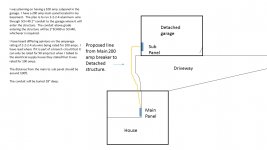
For the feed, 90 amps is the max you are allowed to breaker it with. It is 100amp if it is your primary feed, but liek you've read, needs to be 90.

My outlets are similar. I have one on every post on the side walls (where I've gotten to so far anyway). I put extra along an interior wall I built, but had several machines that were going there. Seems like a lot of receptacles in the ceiling, but that depends on your lighting. I only have 4 lights in my 40x64, but they are high-bay lights, so they do a good job of filling in the space (except the back 16', that has a loft and will be lighted separately).

Are you closing in your walls? If not, would always be easy enough to add more if down the road you wanted to. Unless you are planning on having a bunch of people over at once, I'm sure you'll be fine.
 

Angelfire

Well-known member
Joined
Mar 22, 2012
Messages
1,367
Location
New Mexico and Ireland
For the feed, 90 amps is the max you are allowed to breaker it with. It is 100amp if it is your primary feed, but liek you've read, needs to be 90.

.

Out of curiosity, why is he limited to 90A? I may have missed what his feed was but I have 100A in mine with no prob. Just curious.
 

Angelfire

Well-known member
Joined
Mar 22, 2012
Messages
1,367
Location
New Mexico and Ireland
As a branch circuit, 2 ga aluminum is limited to 90 amps.

hmmm, I don't see anything about 2ga. What am I missing here?


Edit: A bit weird but after a refresh, I see there are three thumbnails and the last one shows his plan for 2-2-2-4 Al. It wasn't there before.....I swear!
 
Last edited:

bjcouche

Well-known member
Joined
Sep 11, 2010
Messages
509
Location
Ohio
What you are planning will work, but there might be some alternatives that will save you some time and money without sacrificing anything. If those ceiling outlets will only be used for lighting, I would go with 14awg on a 15A circuit instead of 12awg. The 14awg will be cheaper and easier to work with. Then again, if you already bought a spool of 12awg for your tool outlets, and have enough left over to also do your lights, then there's no use buying a separate spool of 14...
Speaking of buying extra spools of wire... The way your ceiling outlets are drawn out, you'll have 2 conductor with ground going from your breaker panel to the first outlet. then from that first outlet ALL THE WAY TO THE SWITCH, you'll have to use 3 conductor with ground. That means you'll have to have a spool of 3 conductor with ground on hand. Instead, run the wire from your breaker panel to the switch first, then go to the outlets.
Also, keep in mind that all outlet and switch boxes need a neutral wire in them per NEC code, even if nothing in the box currently uses that neutral.
You don't show where your GFCI outlets are, unless you are going to purchase GFCI breakers (more expensive) instead. Keep in mind that those outlets on the ceiling, because they are outlets, also need GFCI protection. You cannot just make one of the outlets a GFCI outlet either because they are on the ceiling and not in an "accessible location". For GFCI protection of those ceiling outlets you will either have to use a GFCI breaker or install an additional first outlet on that circuit in an accessible location.
Also, those ceiling outlets need to be tamper proof as well. You never know when a two year old will climb a ladder and stick a couple paper clips in one of those ceiling mounted outlets.
Brian
 

terabitdan

Well-known member
Joined
Jul 16, 2016
Messages
152
I regret not having two circuits in every box, should have listened to all the recommendations here on GJ! Tool and vacuum need different circuits... so I have extension cords to the other walls.

either use multi-wire branch circuit for each wall with 12/3 and dual GFCI in the first box or run two 12/2 on each side.

After doing a renovation using ENT that’s my personal favorite. Easy to run, cheap and 500’ rolls of multiple THHN colors are available in the box stores. Makes running 2 circuits simple. 1/2” ENT can have 8 THHN 12 stranded wires.

You might consider four switches for the lighting with every other light on a switch. Most of the time you won’t need all those lights on. Also 3/4 way switches between the garage doors.

I prefer to have lighting on a separate circuit, if you want ceiling outlets for other things run a separate circuit. You will hate popping a breaker or tripping a GFCI and be in the dark.

Consider using z-wave switches for the lighting. It’s nice to have the man door light come on when the garage door opens, and turn off when you shut the man door. They work just light regular switches, with extra features if you want to use it.


Sent from my iPhone using Tapatalk
 
Last edited:
To avoid these ads, REGISTER NOW!

ard

Well-known member
Joined
Feb 16, 2015
Messages
4,391
Location
Sierra Foothills... California
+1

Run 12/3 to each box, connected to a double breaker. At each box mount a double gang- one receptacle to each circuit. Can save you when using a chop saw AND a heater or a vacuum or a whatever.

Understand how this works? if not someone will explain

Personally I like EMT (ENT is ear nose and throat, no? ;) )...but once you place it, whatever circuit you need can be fished in. Like run a 1" pipe across to the far end, run switches, receptacle supplies and switch legs in it- but when you want to add a 30A drop, run the wires in the same pipe.
FWIW, zwave switches, in the house or home, can be put on a schedule, make the place look lived in. Among other neat tricks. They work as regular switches but can be controlled remotely.
 

PhysicsDude

Well-known member
Joined
Jan 28, 2013
Messages
805
Location
Dallas, TX
Any particular reason you put the lights in 2 zones? Do you anticipate being in one "zone" and not want the lights on the other "zone"?

In all my garages I've always had motion-sensor "occupancy" lights, enough light to find my way and get in and out of a vehicle or fridge, and then the rest of the lights on a switch for when I'm actually working in the garage.

In your case, I would put 4 lights on an occupancy/motion sensor (perhaps the middle row of lights, or the 4 corners?) and then the rest of the lights on a switch.

I think you'll end up walking into the garage, and flipping both switches on and off every time. Not really a good use of 2 light circuits IMO. A standard 2 tube 4' LED shop light draws around 40 watts. All your lights together won't even fill up a single 20 amp breaker's ampacity.
 

Falcon67

Well-known member
Joined
Jun 11, 2009
Messages
18,371
Location
Merkel, TX
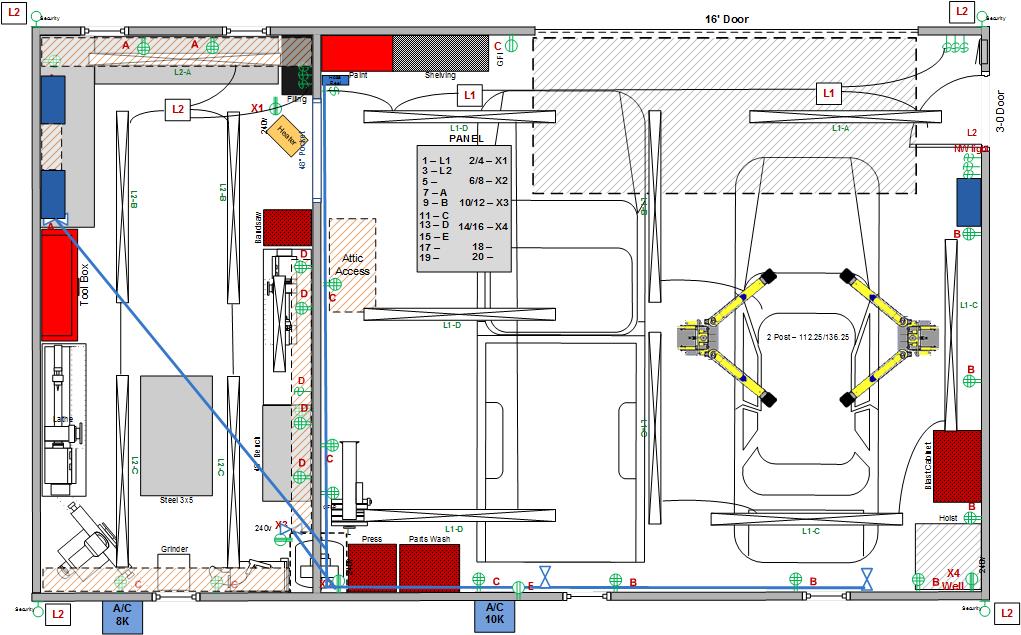
Only thing I'd change is using quad boxes instead of single gang. My mill has a separate feed for the VFD + 3 phase motor, and consumes a 3/4 of quad with 120V BS - table drive, back light, spindle light. Set the grinder next to it, or a fan and boom - one quad gone.

Agree on lights - I have 4 banks of lights and the first switch of the three near the door turns on one 8' fixture near the man door so you can see to move around without firing up a bunch of lights. It was the first to go LED because it tends to stay one a lot.

This is close to my final layout on the 24x40 - LOL. need updating for recent changes.

NewShop40_v6A_B.jpg
 
Last edited:
OP
B

burninghXcsoul

Well-known member
Joined
Nov 3, 2017
Messages
156
Location
South Central PA
Thanks for all the good input guys. I put the ceiling lights on 2 circuits because I was under the impression that most people only put 8 to 10 outlets on a 20 amp circuit. The double outlet box on 2 circuits sounds like a good idea. I didn't know about the GFCI. That was a question that I had emailed to the electrical inspector. My friend who is helping me is a commercial electrician at a local factory so he said that he is not really that familiar with residential codes.
 

walta

Well-known member
Joined
Jan 13, 2017
Messages
2,309
Location
Dutzow Missouri
Any outdoor lighting?

Power for overhead door operators?

Another lighting circuit for a single lamp over the tool box so when you need a quick trip to grab 1 tool you do not need to light up the whole place.

Walta
 

wyliesdiesels

Well-known member
Joined
Aug 14, 2012
Messages
19,994
Location
Modesto, CA
Thanks for all the good input guys. I put the ceiling lights on 2 circuits because I was under the impression that most people only put 8 to 10 outlets on a 20 amp circuit. The double outlet box on 2 circuits sounds like a good idea. I didn't know about the GFCI. That was a question that I had emailed to the electrical inspector. My friend who is helping me is a commercial electrician at a local factory so he said that he is not really that familiar with residential codes.

There is no code requirement on max number of outlets per circuit in residential.

For lighting, you are limited to 80% load of the circuit ampacity- 12a for 15a circuit and 16a for 20a circuit.
 
To avoid these ads, REGISTER NOW!
Top Bottom