To avoid these ads, REGISTER NOW!

Dream Lathe: 1943 Sidney

DocsMachine

Well-known member
Joined
Sep 16, 2006
Messages
1,869
Consider what a lathe of this caliber would cost you new. Probably a years salary.

-If you're lucky.

I have to admit I didn't really "need" my big lathe, and still kind of don't today. But once I'm done with it, I'll have a top-class machine nearly the equal of any of the big names, in terms of accuracy, power and capacity.

And the thing is, a machine of this class basically can't be had, new, today. No one makes them. Anything of a comparable size is built lighter and will cost three times what I'll have in this one when it's done, counting tooling.

Mine's 77 years old. If I lay off the deep-fried Snickers, there's no reason I won't see this thing's 100th birthday. :D

And with care, it'll have decades more life left in it even then.

Doc.
 
To avoid these ads, REGISTER NOW!
OP
C

ClappedOutBport

Well-known member
Joined
Mar 30, 2016
Messages
998
And the thing is, a machine of this class basically can't be had, new, today. No one makes them. Anything of a comparable size is built lighter and will cost three times what I'll have in this one when it's done, counting tooling.

Ain't that the truth. I can't think of anywhere that you can buy a modern day lathe with quiet gears. Even amongst the old ones, that still a very rare feature.


Mine's 77 years old. If I lay off the deep-fried Snickers, there's no reason I won't see this thing's 100th birthday. :D

And with care, it'll have decades more life left in it even then.

As someone else said, we never really own a quality machine. We're just it's curator for a while. I must give me dad huge credit for giving me such a machinery head start. I mean, how many kids (compared to you all) have access to this class of machines at 22? I can only imagine the machines I'll have at 40 or 60. So I must be very thankful for that, though I won't discredit my own work towards such machines.

-------------------

Well, I've finally gotten some stuff done that I have something to show for it. For starters, no more rust as its finally inside in it's temporary position. The ways did get a little rusty in the past few days, as we got 5" of rain over the weekend. The tarp helped a lot, but it's a cheapie. I might worry about the rust more if it was less worn.

attachment.php


I was supposed to have some friends help me push it in, but one flaked without saying a word, and the other calls me at the meeting time telling me telling me he is about ready to head my way. Thanks dude, but don't bother. I've already assumed I'm on my own. This project has been a bit of a "coming of age" project for me. Not that I have done similar stuff before, but that I'm realizing that I've got to learn to be able to do this stuff completely on my own. I can't rely on my friends or dad to be there when I need them, so I am learning to either get crafty or just simply work harder and get it done myself. If I have to wait on someone, then I'm probably just gonna go for it myself. Yes, it may take me 3 or 4 times longer, but at least I'll be making progress.

Thankfully dad's kubota is much more reliable than my friends. Dad also got home and was able to keep me from getting on and off the tractor 1000 times. Moving it went smoothly, thanks to some dollies a friend of dad had loaned him. There was a plastic storm drain in front of the shop doors that we had to navigate over, so when we got to it we lifted a corner with the johnson bar, pulled the front dollies out, rolled in over on the rear ones, then pulled the rears, put the fronts back in, and continued on. Repeat once for the tailstock end, and its in. Pretty slick.

attachment.php


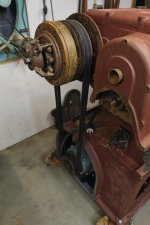
You can also see that I've rebuilt the clutch and gotten the motor installed. I'll have to pull the belts again to get some sheetmetal in, I'll take that opportunity to switch to the less used belts and grind a washer a bit so I can eek a little more adjustment out of it. These belts were definitely sized for the slightly larger pulley.

attachment.php


Some of the final colors have started going on as well. So here's sneak peek of the primary and the accent color.

attachment.php

attachment.php


And I got the tig cooler fixed up right (after putting yet another hole in the water hose!) and convinced dad we need a hose wrap. Once that is in I'll start brazing on the tailstock. I'm a bit nervous about it as the silicon bronze pulls like weld does. Torch brazing doesn't seem to exhibit that characteristic. I think I'll try to cool each braze pass down to the rest of the casting temperature, keep the heat at about 300F, and check it with the ram every pass to make sure that it's not getting warped.

I start my 8th college semester, so my progress will slow down. But, since we don't have to continually fight the weathers limitations, progress should speed up. So we'll see. I guess it depends on how much dad gets done.
 

Attachments

  • IMG_7103ECS.jpg
    IMG_7103ECS.jpg
    101.7 KB · Views: 390
  • IMG_7104ECS.jpg
    IMG_7104ECS.jpg
    69.6 KB · Views: 307
  • IMG_7105ECS.jpg
    IMG_7105ECS.jpg
    81.9 KB · Views: 388
  • IMG_7102ECS.jpg
    IMG_7102ECS.jpg
    89.7 KB · Views: 389
  • IMG_7100ECS.jpg
    IMG_7100ECS.jpg
    91.6 KB · Views: 391
Last edited:

DocsMachine

Well-known member
Joined
Sep 16, 2006
Messages
1,869
Ain't that the truth. I can't think of anywhere that you can buy a modern day lathe with quiet gears. Even amongst the old ones, that still a very rare feature.

-Yep. Too expensive to make, for most manufacturers. Even for the big guys like Monarch and American, they were still competing with a hundred other manufacturers back in the day- and in a factory environment, especially in the first half of the century, being "quiet" wasn't a selling point.

As someone else said, we never really own a quality machine. We're just it's curator for a while.

-Yup. My horizontal mill was made in 1962, my two smaller lathes in 1956, the big lathe in 1943, my old 'camelback' around 1909, and the old shaper in 1905.

I can trace the history, roughly, of the big lathe probably as far back as the 70s- and I'm at least the fourth owner since then. Prior to that it was probably in a military installation, so who knows how many hundreds of people used it.

My horizontal, when it arrived, had tags from three different factories, including US Twist Drill.

And, barring a calamity, all of my machines will leave my possession in better shape than they arrived. The Springfield weathered seventy years and any number of ham-fisted operators. After I'm done with it, it'll be good for at least another seventy.

I mean, how many kids (compared to you all) have access to this class of machines at 22?

-I was similarly lucky in that I started out (like, very early on) with full access to a lightly-equipped shop. Like, a gas torch, stick welder, drill press, a cheap bench grinder, moderate selection of hand tools, etc.

And arguably, NOT having a very-well-equipped shop likely helped me out in several ways: One, I had to think around the problem, come up with a solution I could do with the tools I had, maybe not the tools that would have been "correct" for the job. And two, it drove me to get tools of my own- and the corollary to that is being perpetually broke, I had to buy only what I could afford, and/or buy broken stuff and fix it.

I can only imagine the machines I'll have at 40 or 60.

-Yep. Back when I started my biz in '98 (get off my lawn! :D ) I had a Jet mill-drill and a Wissota bench grinder with a buffing wheel on one side. Every other tool I owned at the time would have fit into a 5-gallon bucket.

The Jet was so sloppy I'd mill on something for half an hour and then have to spend two more sanding it smooth.

I eventually added a Grizzly 9x20 lathe, stepped up- or maybe a little sideways- from there to an old Powermatic (basically a bare-bones Logan) which was physically larger but had a slower top speed and no QCGB, stepped up from there to a larger proper Logan (bigger bore, higher top speed, gearbox, collets, etc.) then added a Sheldon and then the Springfield.

If you'd asked me 20 years ago what kind, style or size lathe I wanted, I'm not sure I'd have been able to tell you. I might have just blurted "Southbend" as that was one of the only home-shop-size machines I knew by name. :D

Yeah, if I had it all to do over again (say I had to sell out and move) I'd probably wind up with an entirely different collection of machines- I had to buy what I could afford, or what was available, not necessarily what I might have 'wanted'- but on the other hand, I have a shop, today, that I couldn't even dream of 20 years ago.

Not that I have done similar stuff before, but that I'm realizing that I've got to learn to be able to do this stuff completely on my own.

-Been there, done that, got the drawer full of T-shirts. :D

Going through it now, with trying to learn how to operate multiple CNC machines, with zero local support. There's no community college, technical college, learning annex or even informal group of buddies I can call on, locally. I have to do it all via YouTube videos, badly-written manuals, and the support of boards like this one.

Some of the final colors have started going on as well. So here's sneak peek of the primary and the accent color.

-Can't say I'm a fan, I'm more of a traditionalist when it comes to machine colors, but it's your machine, not mine. :D

At least it's not baby blue and orange or something... oh, wait... :D

There's a regular on (or used to be) on the HSM boards, and if you ever saw his homepage, he had several build pages showing refurbishing several of his small machines. And it seemed like he went out of his way to make every machine a different color- and not just, well, regular colors, I mean things like hammered blue, metallic forest green, pearl yellow, etc.

Taken individually, each machine looked good.

But the group shot of his whole shop? Looked like Mickey Mouse blew a unicorn and then threw up into a bowl of Skittles. :)

Doc.
 

Roberts210

Well-known member
Joined
Dec 21, 2015
Messages
3,177
Location
Missouri
.......And arguably, NOT having a very-well-equipped shop likely helped me out in several ways: One, I had to think around the problem, come up with a solution I could do with the tools I had, maybe not the tools that would have been "correct" for the job............Doc.
Ditto here. I grew up on a farm and the only power tool Pop had was a 3/8th drill. So I learned to use handtools, and we had a lot of them. Brace & bits, wood chisels, cold chisels, breaker bar, wrenches of course (but no ratchet), axes, draw knife, files of every type, hacksaw, hand saws, hammers and sledges and mauls. I was forced to fix what was broken. Often I retreated to the junk pile near the corner of our barnyard--it was a large pile of broken implements and old machine parts that had accumulated over the previous 100 years. It was as tall as I was, and I'd sit next to it, pull out various pieces and figure out how I could modify it to fix something, or make something work. We couldn't afford to buy new, and I learned to scrounge and work outside the box. All this came in tremendously handy after I left home.
 

86turbodsl

Well-known member
Joined
Jul 1, 2005
Messages
6,558
Location
Michigan
There's a regular on (or used to be) on the HSM boards, and if you ever saw his homepage, he had several build pages showing refurbishing several of his small machines. And it seemed like he went out of his way to make every machine a different color- and not just, well, regular colors, I mean things like hammered blue, metallic forest green, pearl yellow, etc.

Taken individually, each machine looked good.

But the group shot of his whole shop? Looked like Mickey Mouse blew a unicorn and then threw up into a bowl of Skittles. :)

Doc.

WOW. That paints a picture... ROTFLMAO!!! :lol_hitti
 
OP
C

ClappedOutBport

Well-known member
Joined
Mar 30, 2016
Messages
998
Can't say I'm a fan, I'm more of a traditionalist when it comes to machine colors, but it's your machine, not mine. :D

At least it's not baby blue and orange or something... oh, wait... :D

There's a regular on (or used to be) on the HSM boards, and if you ever saw his homepage, he had several build pages showing refurbishing several of his small machines. And it seemed like he went out of his way to make every machine a different color- and not just, well, regular colors, I mean things like hammered blue, metallic forest green, pearl yellow, etc.
Taken individually, each machine looked good.
But the group shot of his whole shop? Looked like Mickey Mouse blew a unicorn and then threw up into a bowl of Skittles. :)

Doc.

attachment.php


Not gonna lie though, blue is pretty common. All of the machines at my highschool were at least half blue, the 20x192" Pacemaker Adam Booth used to use is blue, etc. We just spice it up a little with some accent color. Maybe not traditional, but common. I will say that I didn't have as much say in this one as the last one. If you look online, most are some shade of weird blue, dad wanted blue, and we both independently found the exact same color of red. Maybe it wasn't my first choice, but I think it's looking really sharp.

Hell, half of you guys out to just post your photos in grayscale, you could save bandwidth that way. ;)

-------------

Lots to do, but also lots done. When we went through this bearing this bearing holder, it had two angular contacts for the leadscrew. We tried to remove them, but of course they blew up because they had no strength in the opposite loading direction. We had to slit the bearings to get them out, but managed to do so with no damage to the holder. To make it easier for the next guy, (as the next guy is usually me) I added in some knock-out slots. The new bearings are tapered rollers. We saw no reason to go back with the angular contact. There is a seal, so these will be oil bath bearings.

attachment.php


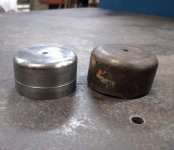
Also on the same part, there was a cap which kept the oil in which was (Surprise!) busted. I was gonna make a new one from some solid stock, preferable Aluminum, then steel, then cast. We had none of the three, but Dad did a good job in finding a plumbing cap which was just perfect and he roughed it in for me. I usually don't screw up parts, but I did **** this one up. It's supposed to be a press on the bearing race, and a slip in the holder. I misread my mic and was off by 25 thou. Luckily something seemed wrong and I checked before my last pass, so it ended up only being 2 thou over. Since the dimension was metric and I was working in inch it didn't raise any dimensional red flags. To compensate I made it a press on the OD by 2 thou and that squeezes it down onto the bearing race so I think it will hold oil fine. Looks damn close to the original as well.

attachment.php

attachment.php
 

Attachments

  • IMG_20200110_194840031S.jpg
    IMG_20200110_194840031S.jpg
    142.4 KB · Views: 336
  • IMG_20200110_194828704S.jpg
    IMG_20200110_194828704S.jpg
    111.3 KB · Views: 336
  • IMG_20191231_154303525_BURST001S.jpg
    IMG_20191231_154303525_BURST001S.jpg
    95.5 KB · Views: 334
  • good-good-let-the-hate-flow-through-you-34440149.jpg
    good-good-let-the-hate-flow-through-you-34440149.jpg
    19.4 KB · Views: 325
OP
C

ClappedOutBport

Well-known member
Joined
Mar 30, 2016
Messages
998
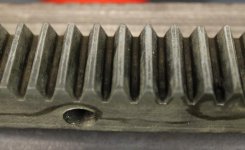
I also got the grease pig that was a rack cleaned up. Used nearly a whole can of brake clean since it wouldn't fit in the safety clean. I don't believe there is any reason to lubricate it if the apron has oil, as the gears should be bathed. Ugh, whatever. There is a little wear, but not bad. Certainly the contact isn't right any more.

attachment.php


The seal for the feedrod bearing died to the point where the backup band was rubbing and it made a nice groove in the shaft. Dad things we can get an extended length seal though, I'm sure we'll find a way around it.

attachment.php


The Tig wrap came as well so I can get back to the brazing. We'll see how that goes.

And the paint is coming along well. I think it looks really sharp. I didn't want the chip pan painted, but dad got so much overspray and drips in there that he went ahead and primed it and it will be blue. That's ok.

attachment.php

attachment.php


We are supposed to be investigating the main oil pump Sunday. It's supposed to be working, but the PO touched it, meaning now we have to. We're gonna drain, fill with diesel, run for a few minutes, then drain and fill with oil. Dad is wanting to use some 303 we have on hand just "for a short while", but after reading about it, I'm a bit concerned. Idk. Can't wear out a worn out machine. We ran it shortly today. I forgot to look for oil flow, and it's not extremely quiet. The 6212s in the clutch should have been replaced. They howl. Ah well, I've been through it once, not doing it again for a while. They can howl if they want to.
 

Attachments

  • IMG_7109ECS.jpg
    IMG_7109ECS.jpg
    78 KB · Views: 334
  • IMG_7110ECS.jpg
    IMG_7110ECS.jpg
    71.3 KB · Views: 334
  • IMG_7107ECS.jpg
    IMG_7107ECS.jpg
    114.9 KB · Views: 338
  • IMG_7108ECS.jpg
    IMG_7108ECS.jpg
    95.2 KB · Views: 336

DocsMachine

Well-known member
Joined
Sep 16, 2006
Messages
1,869
Not gonna lie though, blue is pretty common. All of the machines at my highschool were at least half blue, the 20x192" Pacemaker Adam Booth used to use is blue, etc.

-No offense intended about the colors. I may make a little fun of 'em, but hey, I make fun of Ford drivers too. (And I own a Ford. :D)

Like I said, I tend to be a traditionalist, I like old machines, and all the wartime stuff like this was grey, literally by government order. But as I also said, it's your machine, not mine, and it's just paint. What's far more important than the color is the fact it's actually getting saved, and saved well.

I'd rather see it painted day-glo pink with neon orange flowers than melted down because it's "too far gone to save". :D

We just spice it up a little with some accent color.

-Throw a big red "S" on there somewhere and call it Superman. :D

A few years ago, somebody, might even have been here on this board, showed a picture of his 10EE, recently rebuilt, and painted Cheeto Orange. I photoshopped a Dukes of Hazzard "01" onto the pic for him. :)

Again, being saved is more important than color... but that doesn't mean we aren't gonna needle you a bit about it. :)

Maybe it wasn't my first choice, but I think it's looking really sharp.

-They always look good in fresh paint, no matter the color. What kind of paint is it?

We tried to remove them, but of course they blew up because they had no strength in the opposite loading direction. We had to slit the bearings to get them out, but managed to do so with no damage to the holder. To make it easier for the next guy, I added in some knock-out slots.

-Nicely done! I had almost exactly that same problem. Bearings pressed in, with no way to push the seats out. I MIG welded a washer into the middle of the old race- that both shrank it a bit (an old mechanic's trick) and gave me something to grab with a slide hammer.

The replacement bearings had a "taller" race m(smaller ID) and so could be tapped with a drift if necessary, so I didn't need to add the grooves.

Looks damn close to the original as well.

-Nicely done, and I like how it looks largely original.

Doc.
 
OP
C

ClappedOutBport

Well-known member
Joined
Mar 30, 2016
Messages
998
-Throw a big red "S" on there somewhere and call it Superman.

Lmao. And no worries on the ribbing. Doesn't bother me a bit. But it doesn't mean I won't toss a little back. ;)

Hey if you think we're bad, you should check out Mark Sender on Instagram. He makes tattoo guns, and lets just say they are "colorful".

Paint is Rustolium Royal Blue. Both in the grey and white label cans, dad accidentally got both kinds. Doesn't seem to matter. Just brushed on. We've always had good luck with Rustolium.
 
Last edited:

DocsMachine

Well-known member
Joined
Sep 16, 2006
Messages
1,869
Used nearly a whole can of brake clean since it wouldn't fit in the safety clean.

-Brake Cleaner is expensive and evaporates pretty fast. On a greasy thing like that, try oven cleaner- You need to get the good stuff, with sodium hydroxide, but it worked wonders on the decades-old caked grease on my lathe.

Gotta let it soak, though, and it can't hurt to use a scraper to dig off the thick stuff first.

Really, there's no easy way but elbow grease for a lot of this stuff.

I didn't want the chip pan painted, but dad got so much overspray and drips in there that he went ahead and primed it and it will be blue.

-Yeah, chip trays, well, get chipped and scratched, not much you can do about that. Part of life unless you want to mask it off and leave it bare steel.

We're gonna drain, fill with diesel, run for a few minutes, then drain and fill with oil.

-Let it drain for a while, 'couple of days, if you can. Make sure you get as much diesel out before refilling as you can. And you're putting in freshoil, right?

Dad is wanting to use some 303 we have on hand just "for a short while", but after reading about it, I'm a bit concerned.

-What's "303"?

And you don't have to worry too hard about getting it "squeaky clean" in there- you mainly just want to flush out any contaminants, like dirt, rust or moisture. The diesel flush should do that just fine, but as you said, I sure wouldn't run it very long like that.

Refill with fresh oil and call it good.

We ran it shortly today. I forgot to look for oil flow, and it's not extremely quiet.

-Don't let "howling" bearings run too long. They tend to seize and possibly spin and damage stuff that's less easy to replace.

One of the very few videos I have up, is a quick demo of running mine through some of the gears shortly after I got it. At that point I had done very little other than fix two of the broken shifters, drained the original oil to look for chips or debris (none) and put it back in after some light filtering.

The "ticking" noise was coming from the clutch. Not sure exactly what it was.

Love the progress, keep it coming!

Doc.
 

DocsMachine

Well-known member
Joined
Sep 16, 2006
Messages
1,869
Hey if you think we're bad, you should check out Mark Sender on Instagram. He makes tattoo guns, and lets just say they are "colorful".

-It's like Ford vs. Chevy or Mac vs. PC or Coke vs. Pepsi. Everyone's got an opinion, and feels like they're obliged to tell you about it. :D

Again, I tend to be a traditionalist, and I also have to look at 'em all day. I'm a more or less full time machinist, and spend a great deal of time working with my machines. I've seen photos like that aforementioned Mickey-barf shop and personally, I'd get tired of working in a place like that after a while.

But that's just me. I've seen people paint their machines every possible color of the rainbow, and again, that's a lot less important than simply that the machine is being saved and used. There's a LOT of guys out there- especially on PM- that basically believe if it's not a CNC machine newer than about eight years, with at least a 20HP spindle, it's basically scrap and only worth being broken up and melted down.

Paint is Rustolium Royal Blue.

-A good enamel. I wound up using an alkyd enamel from a local building supplier. I don't know exactly what the "alkyd" part is, but it's intended for metal and machine use- tractors, farm implements, fenceposts, etc. And it holds up well, even against WD-40 and way oils.

I'm sure the Rust-Oleum will do just as well.

Doc.
 
OP
C

ClappedOutBport

Well-known member
Joined
Mar 30, 2016
Messages
998
-Brake Cleaner is expensive and evaporates pretty fast. On a greasy thing like that, try oven cleaner- You need to get the good stuff, with sodium hydroxide, but it worked wonders on the decades-old caked grease on my lathe.

I'll try that. Normally we purple power and pressure wash, but I didn't want to do that for such a small part.


-Yeah, chip trays, well, get chipped and scratched, not much you can do about that. Part of life unless you want to mask it off and leave it bare steel.

Bare steel was what I wanted, but this won't be bad. As long as the coolant doesn't mess with it, which it shouldn't.

-What's "303"?

Junk. At least according to the internet. https://www.tractorlife.com/2018/06...-the-dangers-of-303-tractor-hydraulic-fluids/
Yellow bucket hydraulic fluids. If we don't leave it too long, it will help as an additional flush.

-Don't let "howling" bearings run too long. They tend to seize and possibly spin and damage stuff that's less easy to replace.

Maybe. I washed them, and regreased them. I couldn't see any pitting, or other issues. They rolled fine, not like damaged bearings. They just made a little noise. I may be wrong, but I suspect they will quiet up. They had spun in the past, either due to the nut being too loose, or the nut being too lose because they had spun. The last guy in there used the old dutch key, I drilled for a new one, so they are tight now. If they seize up, they probably won't spin the bearing, but may instead spin the machine. Hard to say. But they are in no danger of that at the moment.

One of the very few videos I have up, is a quick demo of running mine through some of the gears shortly after I got it. At that point I had done very little other than fix two of the broken shifters, drained the original oil to look for chips or debris (none) and put it back in after some light filtering.

I'd seen that actually. It made me real glad we don't have spur gears. :eek:

Again, I tend to be a traditionalist, and I also have to look at 'em all day. I'm a more or less full time machinist, and spend a great deal of time working with my machines. I've seen photos like that aforementioned Mickey-barf shop and personally, I'd get tired of working in a place like that after a while.

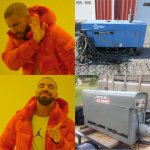
I wonder what welder Doc uses? :headscrat

attachment.php


Ahh.

:p
 

Attachments

  • doc meme 3.jpg
    doc meme 3.jpg
    96 KB · Views: 328

Provincial

Well-known member
Joined
Sep 21, 2011
Messages
6,872
Location
Near Salem, OR
Ford vs. Chevy type contention extends to tractor sites, too. Take Tractor Hydraulic Fluid: a lot of people think if you put anything but "Premium Tractor Hydraulic Fluid" in your old tractor that was built before it came out, you will ruin it. But if it was made before 1974, it was designed to use "303"-type fluid, or the old gear oils "303" replaced. "303" is not bad oil - just check the specifications it meets: Allison ATF, etc.

The gearbox on a lathe is designed to use a basic lubricating oil without the friction modifiers and detergents of ATF or THF. But using one of those oils for testing or break-in will not hurt anything. In fact, ATF is a good choice for flushing, as it suspends things so they drain out, because of the high detergent factor.
 

DocsMachine

Well-known member
Joined
Sep 16, 2006
Messages
1,869
I'll try that. Normally we purple power and pressure wash, but I didn't want to do that for such a small part.

-I generally did a "run" of parts. Pressure washing is dirty and nasty and leaves a mud puddle in my driveway, so I'd do a good sized batch of things all at once. If it was an assembly and I wasn't going to strip it down right away, I'd blow it off with compressed air, then re-hose it with WD-40.

As long as the coolant doesn't mess with it, which it shouldn't.

-As in the mixed oil/water type coolant? Unfortunately, that will soften and chip the paint. The sad fact is that kind of coolant- actually the emulsifier used to get the oil to mix with the water- softens all sorts of paints and coatings. Even catalyzed urethanes like they use on cars, and it'll even soften silicones and other sealants used on machine enclosures.

I painted the chip tray of my Logan with POR-15, and that seemed to be unaffected (although I didn't have coolant puddled in it 24-7 either) and I've heard people will use a catalyzed epoxy paint on the interior of their CNC enclosures.

Yellow bucket hydraulic fluids. If we don't leave it too long, it will help as an additional flush.

-Ah. Okay, first off, you don't need "hydraulic fluid"- you have no hydraulics, probably not even any O-rings, no friction plates (wet one, anyway) and no clutch bands. You- and I, and Turbo- basically just need a straight gear oil.

We don't even need detergents, as there's no combustion products, clutch materials or other generated debris to be carried off. Point in fact, by some arguments we specifically don't want detergents- what they do in, say, a car engine, is keep the gunk in suspension in the oil, specifically so that it can be carried away with the oil, and then deposited in the filter.

In the case of a lathe, first off, there's very little gunk generated (hopefully :D ) and anything that is, should be allowed to settle to the bottom where it'll stay and not cause any harm.

I'm not sure how your Sidney (Super Sidney? :D ) or Turbo's Pacemaker work, but my Springfield actually has a two-chamber sump in the base. The headstock drains through a pipe into the sump, where it lands in one side, then "overflows" into the other side- a classic "settling tank" method.

It's picked up by the pump in the second side then then pumped back into the gears. The factory setup just has a strainer- a coarse screen- and really only as an emergency measure, so a broken gear or trashed bearing won't recirculate junk and trash other parts.

When I refilled mine with fresh oil, I bought... I think it was Chevron brand ISO 68 oil. It's the basic recommended oil for gear-head machines like this, good quality, and doesn't have a bunch of expensive additives you don't really need. (And you don't need Chevron brand specifically- that was just the one local bulk seller I could get it at.)

I'd seen that actually. It made me real glad we don't have spur gears.

-Can't wait to see a video of yours running through the gears, or turning a part, etc. And you still owe us a photo of said herringbone gears. :D

I wonder what welder Doc uses?

:) :D

Actually I have a bright blue Miller TIG, a faded blue Miller MIG, a bright blue some-off-brand AC/DC stick welder, a red Lincoln MIG and a kind of grey-flesh-tone Hypertherm plaz. :D

But, I used to have a big 12" pedestal grinder that was bright yellow when I got it, my 40-ton press was blue with yellow accents, my Grizzly Bridgeport clone is their hammered metallic green, the Exacto mill was originally almost a baby blue, my horizontal mill was faded fire engine red, the big shaper was forest green, the Baldor grinder had been rattle-canned red, and the horizontal bandsaw was yellow-tan and baby-barf green. :D

I also have one car that's Arrest-Me Red, and a musclecar that's bright red with black go-fast stripes, so I'm not completely a stick-in-the-mud. :D

Doc.
 
OP
C

ClappedOutBport

Well-known member
Joined
Mar 30, 2016
Messages
998
-As in the mixed oil/water type coolant? Unfortunately, that will soften and chip the paint. The sad fact is that kind of coolant- actually the emulsifier used to get the oil to mix with the water- softens all sorts of paints and coatings. Even catalyzed urethanes like they use on cars, and it'll even soften silicones and other sealants used on machine enclosures.

Yes, that type. I wasn't going to paint the sump, but apparently that's already been done.

-Ah. Okay, first off, you don't need "hydraulic fluid"- you have no hydraulics, probably not even any O-rings, no friction plates (wet one, anyway) and no clutch bands. You- and I, and Turbo- basically just need a straight gear oil.

We don't even need detergents, as there's no combustion products, clutch materials or other generated debris to be carried off. Point in fact, by some arguments we specifically don't want detergents- what they do in, say, a car engine, is keep the gunk in suspension in the oil, specifically so that it can be carried away with the oil, and then deposited in the filter.

In the case of a lathe, first off, there's very little gunk generated (hopefully :D ) and anything that is, should be allowed to settle to the bottom where it'll stay and not cause any harm.

Well aware. In fact, the oil it calls for is still available today. Mobile DTE Heavy Medium. Right on the back. It's also $40 a gallon. No unreasonable, but dad wants to use the cheap **** for now. Your Chevron oil probably is classified as a hydraulic oil.

I'm not sure how your Sidney (Super Sidney? :D ) or Turbo's Pacemaker work, but my Springfield actually has a two-chamber sump in the base. The headstock drains through a pipe into the sump, where it lands in one side, then "overflows" into the other side- a classic "settling tank" method.

No pump in the base. It's in the back of the headstock.

-Can't wait to see a video of yours running through the gears, or turning a part, etc. And you still owe us a photo of said herringbone gears. :D

Believe me, I can't wait to do those things either! As for the herringbones, I'll have to borrow one of those cameras they film bigfoot with, as they both seem to be of the same elusivity. :D
 

DocsMachine

Well-known member
Joined
Sep 16, 2006
Messages
1,869
Yes, that type. I wasn't going to paint the sump, but apparently that's already been done.

-Well, the peeling paint won't hurt anything, but you'll want an intake strainer for the pump.

Well aware. In fact, the oil it calls for is still available today. Mobile DTE Heavy Medium.

-That sounds familiar. I'm not certain, but I think that's just a variant of the ISO 68. But really, this is one of those cases where any oil is better than no oil- you could get away with 10W-40 motor oil and the machine would likely hardly know the difference. :D

It's also $40 a gallon.

-Maybe for the name-brand Mobil stuff. The Chevron 68 I got was about $90 for a 5-gallon bucket. (And mine needs something like seven gallons.)

No unreasonable, but dad wants to use the cheap **** for now.

-Oil is the one place you shouldn't cheap out on. Nor do you have to keep "flushing" the thing out with different substances. Drain the original stuff, check it carefully for grits and gunks (let it settle, and check anything that settles out with a magnet) maybe do the diesel flush (can't hurt, I don't think, but probably not terribly necessary either- this isn't a car crankcase) and pour in some good quality fresh oil.

Yeah, you can save a few bucks by getting the cheap stuff, but this isn't a case where you have to change the oil twice a year. I'd wager the stuff I drained out of mine was at least twenty years old, possibly more like forty, and it wasn't anywhere near impossible it was original.

Buy the good stuff once and forget about it.

Your Chevron oil probably is classified as a hydraulic oil.

-Very likely. According to the guys on PM, it's very much a sort of "all purpose" oil, used in all sorts of gearboxes, lathes and milling machines, for spindle bearings, hydraulic systems, and some have used it as a cutting fluid in saws and screw machines.

No pump in the base. It's in the back of the headstock.

-My oil pump's up on the headstock too, helpfully mounted right behind the chuck where it can catch swarf, junk and errant chuck keys if you're not paying attention. :D

It's the sump that's down in the base. The guys on PM suggested that few, if any, other lathes used a sort of separated sump like that- most have it in the same casting as the main headstock gears.

One of my Springfield catalog pamphlet things suggests it was done that way to help keep the oil cooler. Probably not something I need to worry about. :)

Doc.
 
OP
C

ClappedOutBport

Well-known member
Joined
Mar 30, 2016
Messages
998
Well. One step forward, one step back.

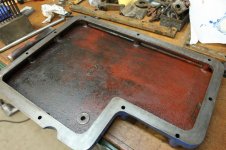
For one, I did pull the cover on Sunday. It was quite nasty on the sealing surface, which allowed some water to get in while it was outside. So I got that all cleaned up...

attachment.php


Everybody said:
Whatever dude, nobody cares! Show us the damn gears!

Fine. Impatient sons of bit...

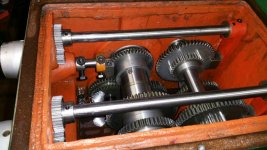
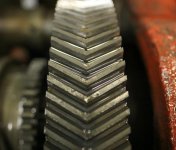
Anyway, feast your eyes. The herringbones do exist!

attachment.php

attachment.php

attachment.php


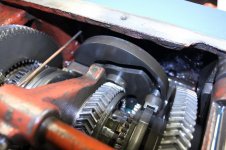
And I shot some video. If you've ever wondered how Sidney could shift 16 speeds with only 3 levers when contemporary lathes would use 4, it's shown in the video. Really neat mechanism.

Here is full size for the photos if you really want to poke around: https://drive.google.com/drive/folders/1q0ffxZOP_tEL71npmxtwyzHUVnd-_KWX?usp=sharing

So since this is Garage Journal and not PM and only a fraction of lathes in the world use this type of a setup, I should probably explain how it works. It's very similar to a car transmission. Power comes in on the rear shaft through a clutch. Then there are two intermediate shafts and the spindle shaft (front). The gears are in constant mesh, and are shifted by shift forks which slide dogs around to engage or disengage certain gears. Herringbone and Helical gears (used on Monarch lathes and some others) have the advantage of being quiet and offering smoother power-transmission as there is no "dead zone" in between their travel. The one advantage herringbones have over helical is that they do not require thrust bearings as the thrust component generated by half the gear is cancelled out by the other half. It's a bit of a moot point on this lathe as it seems that all the shafts have tapered roller/angular contact bearings anyway.

The biggest gear was probably 1.25-1.5 inches wide, and maybe 10" in diameter. It's crazy to think you could sell an entire Chinese mini-lathe for the cost of producing that one gear. Sadly I'll probably never use it since I don't particularly need to run at 20 RPM. Also comparing to Chinese lathes, it's crazy just how much stuff is packed inside. I never liked the generic lathes with the box headstock that looked totally devoid inside. It's clear on the Sidney that they set up the geartrain how they wanted and made as small of a box as possible and it's still huge.

attachment.php
 

Attachments

  • grizzly headstock.jpeg
    grizzly headstock.jpeg
    146.2 KB · Views: 277
  • IMG_7116ECS.jpg
    IMG_7116ECS.jpg
    99.1 KB · Views: 275
  • IMG_7115ECS.jpg
    IMG_7115ECS.jpg
    113.7 KB · Views: 277
  • IMG_7117ECS.jpg
    IMG_7117ECS.jpg
    134.5 KB · Views: 282
  • IMG_7111ECS.jpg
    IMG_7111ECS.jpg
    151.9 KB · Views: 279
OP
C

ClappedOutBport

Well-known member
Joined
Mar 30, 2016
Messages
998
Part 2:

So after getting the cover mating surfaces cleaned up, (Both planed btw!) I drained the oil. It was contaminated with water so it was hard to tell how nasty it was, but definitely had some gunk in it. I drained 2-3 quarts out of the 7-10 it is supposed to have. Hmm (Foreshadowing). I also found some large swarf in the bottom. The hell? Were people machining with the cover off? Idk. Probably pulled the cover without wiping around it first. Whatever. It didn't seem like any had gotten into the gears. The gears all seemed to be in acceptable shape, though there was a little wear visible on some, like the pinion on the largest reduction set.

I did not pull the pump as predicted, but did pull the "filter" housing and clean it like you are supposed to do "Every 30 days". Nothing seemed wrong with the 77 year old screen so I put that back in place and filled it with a little over 2 gallons of diesel. I had the VFD down to 10 HZ which is how I could get the video of it running. The pump worked fine but didn't have enough volume to make it up to the some of the oil pipes. We did discover some issue at 60hz however. The input shaft seal was dribbling diesel at an unacceptable rate, and it was really ******* out at the spindle behind the chuck mount. Sigh.
Input shaft seal is no biggie, but I don't want to have to pull the spindle apart. But I may not have to. Referencing the manual, it looks like it has what someone on PM called a "Labyrinth Seal". (Looks different than the ones online so IDK.) I've seen a few of them on the machine already, and the ones I've found looked like buttress threads, but not in a spiral. So, being that the book calls out no seal, and it instead looks like something I have seen elsewhere on the machine, I'm inclined to believe that there is no actual seal there. And it was probably running out because the diesel fuel was far thinner than the 30 weight oil it calls for in addition to it being a little overfull. Does this sound reasonable to you all?

attachment.php


Oh, and Doc: You'll be happy to know you are getting your way, on both accounts. In light of recent events and reading about the 303, dad decided it best to get some non-detergent 30 weight, and since he had to pull the clutch to get to the input shaft seal, he went ahead and put the 6212s on order. It looks like every other bearing in the headstock is still available should we have to dive in, hopefully we won't.

More pics:
attachment.php

attachment.php
 

Attachments

  • IMG_7114ECS.jpg
    IMG_7114ECS.jpg
    127.7 KB · Views: 280
  • IMG_7112ECS.jpg
    IMG_7112ECS.jpg
    139.9 KB · Views: 17
  • IMG_7120ECS.jpg
    IMG_7120ECS.jpg
    105.3 KB · Views: 277
  • IMG_7113ECS.jpg
    IMG_7113ECS.jpg
    61.9 KB · Views: 16
  • Headstock Seal.jpg
    Headstock Seal.jpg
    112.5 KB · Views: 279

86turbodsl

Well-known member
Joined
Jul 1, 2005
Messages
6,558
Location
Michigan
Thats a pretty slick shifter mechanism! Looks like everything is in good shape. i agree, run it with the 30w and see how it looks. i think it'll be fine.

Sent from my LG-TP450 using Tapatalk
 
To avoid these ads, REGISTER NOW!
OP
C

ClappedOutBport

Well-known member
Joined
Mar 30, 2016
Messages
998
Thats a pretty slick shifter mechanism! Looks like everything is in good shape. i agree, run it with the 30w and see how it looks. i think it'll be fine.

Sent from my LG-TP450 using Tapatalk

I think so too. After talking with a guy on PM, there is no oil seal other than the one I highlighted, and there is no reason for such a seal to wear, so as long as it worked from the factory, it should work now.

Those gears look beautiful. Not much wear at all.
Could have looked like this

Yikes. Yes, I suppose it could always be worse. The rest of the machine has looked sort of like that gear though. :lol_hitti
 
OP
C

ClappedOutBport

Well-known member
Joined
Mar 30, 2016
Messages
998
Wow , I wonder what they thought the advantage of that style of gears was.

Herringbone and Helical gears (used on Monarch lathes and some others) have the advantage of being quiet and offering smoother power-transmission as there is no "dead zone" in between their travel. The one advantage herringbones have over helical is that they do not require thrust bearings as the thrust component generated by half the gear is cancelled out by the other half. It's a bit of a moot point on this lathe as it seems that all the shafts have tapered roller/angular contact bearings anyway.

whistle.gif


I guess my posts are a bit dense haha.
 

Provincial

Well-known member
Joined
Sep 21, 2011
Messages
6,872
Location
Near Salem, OR
Machinists sometimes complain that the backlash in spur gears leaves an unsatisfactory surface finish. In theory, herringbone gears could reduce this tendency. I'm sure that salesmen used that argument!
 

DocsMachine

Well-known member
Joined
Sep 16, 2006
Messages
1,869
And I shot some video. If you've ever wondered how Sidney could shift 16 speeds with only 3 levers when contemporary lathes would use 4, it's shown in the video. Really neat mechanism.

-That IS cool. It's even more cool when you realize they designed that with pencil and paper, using nothing more sophisticated than a slide rule- a fact which still occasionally blows my mind. :D

My lathe shifts 12 speeds with three levers- one's a three position lever. I'm sure if they could have found room in the headstock for more gears...

springfield14.jpg


... They could have added a fourth quadrant and gotten sixteen. What's the speed range, by the way?

The one advantage herringbones have over helical is that they do not require thrust bearings as the thrust component generated by half the gear is cancelled out by the other half.

-It wasn't until you posted the photos that I recalled one of the reasons many of the other manufacturers didn't use herringbones: You can't shift the gears.

That is, a straight cut spur gear can be shifted into and out of mesh with another spur gear- herringbones obviously can't do that, and require dog clutches and splined shafts, as shown in your video, in order to shift.

That means more complexity for the same basic action, and that increases costs- and of course the herringbones cost more to make in the first place.

That undoubtedly limited their popularity.

I had the VFD down to 10 HZ which is how I could get the video of it running.

-I was gonna say. :D If I tried that with mine, with the lid off, I'd have had 20-foot stripes on either wall and across the ceiling. :)

I'm curious what kind of VFD you ended up with.

Oh, and Doc: You'll be happy to know you are getting your way, on both accounts. In light of recent events and reading about the 303, dad decided it best to get some non-detergent 30 weight[...]

-Curious why you didn't go with an ISO 68. Yeah, from what you linked about the "yellow bucket" oils, I can see wanting to stay away from the cheap stuff, but a name-brand Chevron, Mobil, Shell or other major manufacturer, should have good product for you.

And, since you don't have any actual hydraulics, it's almost irrelevant what kind of antiwear or or friction modifier is in the "tractor oil".

On the other hand, 30 Weight is about ISO 100, as opposed to ISO 68. That's going to be a little thick, I think- I don't know what, if any, real difference it'd make, but I know for a fact I absolutely do not want to have to take my headstock completely apart in order to replace some massive and fabulously expensive bearings.

I doubt the 30W will really hurt anything, but for a marginal difference in cost, I'd rather play it safe than sorry. :D

You might keep an eye on the oil pump flow- does that thing have a sight window or other flow indicator anywhere?

Yikes. Yes, I suppose it could always be worse. The rest of the machine has looked sort of like that gear though.

-I pulled the headstock cover off before buying mine. If the gears inside looked as bad as the rest of the machine- or worse, were covered in rust- I'd have passed on it. I can fix broken pins and cracked minor parts, but there's no way in hell I was going to open that headstock up, start swapping bearings at $300 a pop, and start machining and heat-treating new gears.

Fortunately, as in the pic above, they were shiny, clean, no appreciable wear, no detectable damage, and only one pencil-eraser sized spot of very light rust.

Machinists sometimes complain that the backlash in spur gears leaves an unsatisfactory surface finish.

-Actually what they complain about as far as spur gears go, is the occasional harmonic. The spindle speed versus the carriage feed all turning at just the right spot and gets a sort of very light vibration, which can show up as a sort of moire` pattern in the turned finish.

It's virtually never an actual problem, unless you'd doing extremely close-tolerance fits- press fits and the like. And it really doesn't happen often- especially in heavy lathes like this one.

The main benefit to the herringbones is they're quieter, and are a lot less likely to reach that "harmonic" stage.

Doc.
 

Provincial

Well-known member
Joined
Sep 21, 2011
Messages
6,872
Location
Near Salem, OR
Quote [Quote:
Machinists sometimes complain that the backlash in spur gears leaves an unsatisfactory surface finish.
-Actually what they complain about as far as spur gears go, is the occasional harmonic. The spindle speed versus the carriage feed all turning at just the right spot and gets a sort of very light vibration, which can show up as a sort of moire` pattern in the turned finish.

It's virtually never an actual problem, unless you'd doing extremely close-tolerance fits- press fits and the like. And it really doesn't happen often- especially in heavy lathes like this one.

The main benefit to the herringbones is they're quieter, and are a lot less likely to reach that "harmonic" stage.

Doc.]

The machinists I was around could scarcely use the word "harmonic", much less understand it. If you used a word like "moire", they would edge away from you, with an eyebrow arched!
 

DocsMachine

Well-known member
Joined
Sep 16, 2006
Messages
1,869
The machinists I was around could scarcely use the word "harmonic", much less understand it. If you used a word like "moire", they would edge away from you, with an eyebrow arched!

-If that's the case, then those machinists are blaming the machine for the poor surface finish. :D

You guys are making me want to pull the cover off the pacemaker...

-You haven't yet?!? I'm gonna have to ask you to turn in your Man Card. That's like buying a musclecar and never opening the hood.

:)

Doc.
 

86turbodsl

Well-known member
Joined
Jul 1, 2005
Messages
6,558
Location
Michigan
-You haven't yet?!? I'm gonna have to ask you to turn in your Man Card. That's like buying a musclecar and never opening the hood.

:)

Doc.

Ok, you got my attention with that. Since my actual job is gasoline engine development and I'm a serious gearhead with a real love of muscle cars, I can't let that stand. Not polluting the young lads' Sydney thread, roll on over to my thread, pics are incoming.

Sent from my LG-TP450 using Tapatalk
 
OP
C

ClappedOutBport

Well-known member
Joined
Mar 30, 2016
Messages
998
Machinists sometimes complain that the backlash in spur gears leaves an unsatisfactory surface finish. In theory, herringbone gears could reduce this tendency. I'm sure that salesmen used that argument!

Yes. This is why pretty much all of the super-precsion toolroom lathes (Rivett 1020S, Monarch 10EE, Hardinge HLV-H, etc) use large belts to get the power to the spindle.

-That IS cool. It's even more cool when you realize they designed that with pencil and paper, using nothing more sophisticated than a slide rule- a fact which still occasionally blows my mind. :D

It is truly amazing what the old mechanic engineers accomplished. After studying the shift lever for a while, I determined that the math isn't all that complicated. But to think of the design in the first place for it certainly is very impressive.

... They could have added a fourth quadrant and gotten sixteen. What's the speed range, by the way?

Good question. I meant to answer it when I made the post. Here is the OG tag.

attachment.php


The input shaft originally ran at 810 RPM according to the tag. Now it runs at precisely 1150RPM. So, multiply every gear by 1.42. So the new top speed is 800 RPM and the new minimum speed is 20RPM. Looks like the largest bull gear runs only the 14-81 speed range, so I guess that it will get used some.

That undoubtedly limited their popularity.

Yes, although Monarch sold a lot of machines with the same setup. If you're curious, you should look up the last Sidneys produced. They thought 16 speeds wasn't enough, so they upped it to 32. The 16 speed has 16 herringbones, so the 32 had even more. And they're hydraulically, sequentially shifted since I guess a shiftier was too complicated. I think a lot of them were aimed at the tracer market, where you have all the speed changes ready on a list as soon as an operation was done. Oh and they were extremely heavy by then too, as the basic 30" between centers model was up to 6500lbs. lathes.co.uk has the info on them if anyone is curious.

-I was gonna say. :D If I tried that with mine, with the lid off, I'd have had 20-foot stripes on either wall and across the ceiling. :) I'm curious what kind of VFD you ended up with.

I'd already heard of multiple people doing that so I knew better than to try at full speed. The VFD is one we were already using. It's a 5hp ebay clone of the HY's which I've heard are a clone of Hitachi(?). Dad abuses them, he uses them like rotary phase converters and has more than one machine running off them. As long as you oversize them they seem to handle it. This one will be dedicated though, and we will run some more wiring to reassign the other one to the existing circuit.

The reason he did it like that instead of using a RPC is that 7.5 years ago, he had 0 three phase machines. Now we have 7. So he just started tacking them on to the existing VFD (until it died). Then he got a bigger one and did the same. Again, I can't recommend it to anyone, but we do treat them like rotary phase converters for the 1hp motors, using machine switches, instant reversing, and running multiple machines at one. Eh. I've been lectured plenty, so save your fingers, but it will continue to work until we find the right RPC for the right price.


-Curious why you didn't go with an ISO 68.... 30 Weight is about ISO 100, as opposed to ISO 68. That's going to be a little thick, I think- I don't know what, if any, real difference it'd make,

I doubt the 30W will really hurt anything, but for a marginal difference in cost, I'd rather play it safe than sorry. :D

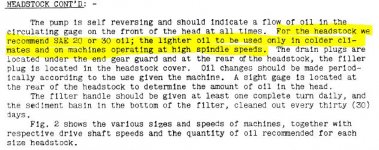
A-ha! Doc, you've been absolutely right about most things I've seen you post, but I've got you here. We are going with the 30 weight because both the book and tag expressly tell you to use S.A.E. 30 weight unless you live in a cold climate and/or(depending on how you interpret their wording) are running higher spindle speeds, then S.A.E. 20. That and non-detergent 30 weight as specked is $40 for 5 gallons. I'm sure the oil will be as good if not better than what they had in the 40s, and it was probably running 24/7 in the 40s. I think we'll be ok.

attachment.php


teaching.gif


but I know for a fact I absolutely do not want to have to take my headstock completely apart in order to replace some massive and fabulously expensive bearings.

I priced them because I was curious. All the intermediate shafts use common, metric double row angular contact bearings. The main spindle bearing can be had for around about $100. https://www.ebay.com/itm/TIMKEN-BEA...332408&hash=item2a81dcf970:g:rzcAAOSwX9FZEf-B

You might keep an eye on the oil pump flow- does that thing have a sight window or other flow indicator anywhere?

Yes. It was flowing plenty at 60hz.

You guys are making me want to pull the cover off the pacemaker...

You probably should. Just get your son to help you, eh? The Sidney's cover is heavy enough, and the pacemaker probably weights 3 times that. They aren't making them any more either. :p I had to replace one oil line because it was damaged from being hit by the cover being put on and off. The other side's line was scored up a bit but ok.

Ok, you got my attention with that. Since my actual job is gasoline engine development and I'm a serious gearhead with a real love of muscle cars, I can't let that stand. Not polluting the young lads' Sydney thread, roll on over to my thread, pics are incoming.

Sent from my LG-TP450 using Tapatalk

:bounce:
 

Attachments

  • IMG_7021S.jpg
    IMG_7021S.jpg
    150.1 KB · Views: 328
  • Oil.JPG
    Oil.JPG
    64.2 KB · Views: 317
OP
C

ClappedOutBport

Well-known member
Joined
Mar 30, 2016
Messages
998
And now, a treat especial.
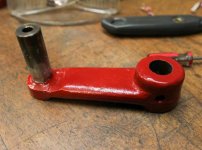
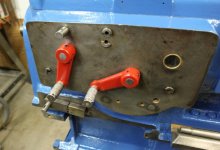
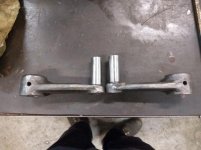
The broken headstock handles are fixed, and temporarily back on the machine.

attachment.php


So, how did I do it?
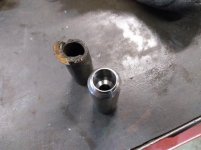
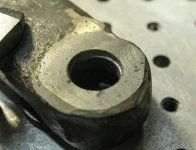
First, I loaded both handles up in the Tom Lipton mini pallet and milled off the old braze.

attachment.php


Then a 50x80 thousands step was bored into the tiny amount of cast iron left.

attachment.php


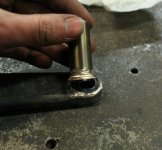
I then took a piece of drill rod (Why? Because it was round and smooth. At least I think it’s drill rod. All mystery metal to me) and machined the internal dimensions and left a small shoulder for a 1 thousands press fit.

attachment.php


They fit up perfectly after a little push with the Dake.

attachment.php


Continued in next post.
 

Attachments

  • IMG_7067S.jpg
    IMG_7067S.jpg
    31 KB · Views: 314
  • IMG_20191217_153939081S.jpg
    IMG_20191217_153939081S.jpg
    52 KB · Views: 315
  • IMG_7062S.jpg
    IMG_7062S.jpg
    52.2 KB · Views: 313
  • IMG_7057S.jpg
    IMG_7057S.jpg
    51.3 KB · Views: 318
  • IMG_7130S.jpg
    IMG_7130S.jpg
    50.4 KB · Views: 318
OP
C

ClappedOutBport

Well-known member
Joined
Mar 30, 2016
Messages
998
Part 2:
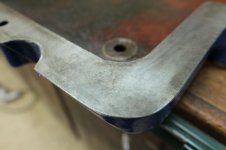
Care was taken to make the final height the same, even though the handles had been machined differently.

attachment.php


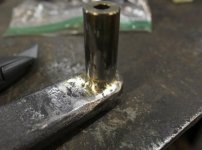
Then they were brazed on. First I did both with the tig, but I had trouble getting heat penetration down into the chamfer. After cleaning one totally up, I dropped it and it broke apart. No Bueno.

attachment.php


The other one I reworked with the tig, and the broken one I had dad torch braze. Torch brazing was the way to go. Even though I was careful and had it clamped in the vise when I tigged it, the forces still pulled it off center some :( . Dad’s one was perfect though. Though I had ground the first one the first time, dad did them the second time around and got a little carried away and removed well more fillet than needed, reducing their strength by a lot. Luckily, he mostly cut the drill rod which is plenty strong compared to the CI, but I would have much preferred a hearty fillet.

attachment.php

attachment.php


Then they were painted red, which I’m not as big of a fan as I originally was. Can’t stop thinking about superman haha. But I still like the blue. They’ll still need some proper springs and new taper pins, but at least I have something to shift it by for now.

attachment.php


I also don’t think their breakage was entirely or maybe at all due to ham-fistedness. Looking at if from an engineering perspective, it’s a bad design. The comparable Monarch CY has huge, heavy levers. This lever has a 3/4" OD and a 1/2" ID where it broke. So, only a tiny 1/8” wall thickness. To make matters much worse there is zero corner radius. It definitely takes some force to shift as well. So after thousands and thousands of shift cycles, I’m sure a tiny fatigue crack developed and propagated easily due to the lack of corner radius. So yeah, maybe it got wrecked in an accident, but the fact that both plungers and knurled pull-sleeves weren’t bent or damaged at all, I have to assume that it was fatigue that took the levers out. If they break again I’ll find someone with a CNC to make some steel ones I guess. But they should do for a while.
 

Attachments

  • IMG_20191217_213422811S.jpg
    IMG_20191217_213422811S.jpg
    54 KB · Views: 310
  • IMG_7077S.jpg
    IMG_7077S.jpg
    67 KB · Views: 313
  • IMG_7097S.jpg
    IMG_7097S.jpg
    45.9 KB · Views: 312
  • IMG_7099S.jpg
    IMG_7099S.jpg
    42.1 KB · Views: 310
  • IMG_7126S.jpg
    IMG_7126S.jpg
    59.2 KB · Views: 311

jabberwoki

Well-known member
Joined
May 1, 2009
Messages
6,473
Location
puyallup wa usa
Ok, you got my attention with that. Since my actual job is gasoline engine development and I'm a serious gearhead with a real love of muscle cars, I can't let that stand. Not polluting the young lads' Sydney thread, roll on over to my thread, pics are incoming.

Sent from my LG-TP450 using Tapatalk

Damn it, now I have to pull the cover off the Rivett :lol_hitti
 

DocsMachine

Well-known member
Joined
Sep 16, 2006
Messages
1,869
Good question. I meant to answer it when I made the post. Here is the OG tag.

-Aw, I didn't realize it'd been broken. That's a shame...

'Couple ways you could fix that: One would be to photo-etch a new brass sheet, which is actually pretty easy, or two would be to find somebody with a CNC mill or router, who could mill a high-relief copy out of aluminum.

You'd have to do some detail work making up the "artwork", either for an etching mask or for the CNC program, but that's relatively easy. (Well, it is for me, anyway. :D )

Point in fact, I'd been thinking of making a new spindle speed chart for mine, by the same photo-etch as the original, but with new numbers to more correctly list the actual speeds with the new, faster motor.

You could so the same. Etching could be done cheap, the milling would likely cost a bit more.


If you're curious, you should look up the last Sidneys produced. They thought 16 speeds wasn't enough, so they upped it to 32.

-I was just looking at some of my archived info, and a later (mid 50s?) catalog scan I had showed the entire line at the time (of Springfields) were in fact 16 speed, so it seems at some point they did add another quadrant.

The short-lived late sixties, early seventies models bumped that up to 24, and supposedly fully synchronized- as in shift on the fly. (Though almost certainly not mid-cut. :D )

A-ha! Doc, you've been absolutely right about most things I've seen you post, but I've got you here. We are going with the 30 weight because both the book and tag expressly tell you to use S.A.E. 30 weight unless you live in a cold climate[.]

-As with all of us, I only know what I've read. :D "ISO 68" is basically the reflexive response when anyone on PM asks what oil they need- if you don't know the exact specs of what you need, it's a very good default choice, and it IS what a large number of manufacturers generally recommend.

The only cases that I can think of off the top of my head, where you need something else, were the old Lodge & Shipley "Servo Shift" machines, which used an actual hydraulic mechanism, kind of like an automatic transmission, to shift gears, and anything that had a "wet" clutch- one that was mounted inside the gearbox with the rest of the goodies.

I learn stuff too, in these threads. :D

Doc.
 

DocsMachine

Well-known member
Joined
Sep 16, 2006
Messages
1,869
Then they were painted red, which I’m not as big of a fan as I originally was. Can’t stop thinking about superman haha.

-Sorry. :D

How about just re-spraying them with hammered silver rattlecan?

If they break again I’ll find someone with a CNC to make some steel ones I guess. But they should do for a while.

-Part of my clutch linkage had been broken at some point in the past, and brazed back together. Then in my own ham-fistedness, managed to re-crack it again.

When that finally goes back together, I plan to make up a new one out of heavy, welded steel.

Doc.
 

ttpete

Well-known member
Joined
Mar 8, 2011
Messages
6,737
Location
Dearborn, MI
Just a thought about gear lube. I've been working with an offshore boat powered with a 1500 hp helicopter gas turbine engine. The gearbox was made by the same shop that makes gearboxes for the unlimited hydroplanes, and their spec for gear oil is the ISO 68 EP gear lube. It's crystal clear and is even authorized for use in food machinery. The gearbox uses a dry-sump oil system with an oil cooler.

Be careful to get the EP stuff. I once had them try to give me the ISO 68 hydraulic oil instead.
 

86turbodsl

Well-known member
Joined
Jul 1, 2005
Messages
6,558
Location
Michigan
Where does one get this ISO68 oil? I saw TSC has ISO68, but it is labeled as hydraulic fluid. I'm sure it does not have the EP additives.
 

Provincial

Well-known member
Joined
Sep 21, 2011
Messages
6,872
Location
Near Salem, OR
J20 rated Tractor Hydraulic Fluid is sort of a multi-grade oil, with a viscosity rating similar to ISO68 when hot, and ISO32 when cold. Both 33 and J20 Tractor Hydraulic Fluids (when of good quality) have Extreme Pressure ratings for use lubricating heavily-loaded reduction gearing in tractors and other equipment, as well as wet clutches and brakes.

Remember that hydraulic systems include highly-loaded pumps and their associated gear reduction systems, so the fluid has to have serious anti-wear properties.
 

ttpete

Well-known member
Joined
Mar 8, 2011
Messages
6,737
Location
Dearborn, MI
Where does one get this ISO68 oil? I saw TSC has ISO68, but it is labeled as hydraulic fluid. I'm sure it does not have the EP additives.

I had to get mine from an industrial petroleum outfit. They filled a 5 gallon pail from a storage tank. It was clearly labeled EP.
 
To avoid these ads, REGISTER NOW!
Top Bottom