This is one of those topics where I’ve thought to myself many times “there has to be a better way”. When drilling out an existing hole in steel, say .030 to .060 oversize, how do you avoid the bit plowing into the edge of the hole and inevitably pulling the bit in at such a fast rate that you can’t control where the bit goes. More often than not I end up with a new hole that is off of the original centerline and a bit with a broken edge. I’m referring specifically to using a hand drill, in a drill press it doesn’t seem to be as much of a problem. I had this problem this past weekend when I was trying to drill out a 5/16 hole to install a thread insert. It wasn’t practical to use a drill press so I knew I would have to be careful but the new hole still ended up about .020 off the original position. I know .020 doesn’t sound like much but when you are trying to match an existing bolt pattern it just as well be a mile.


You are using an out of date browser. It may not display this or other websites correctly.
You should upgrade or use an alternative browser.
You should upgrade or use an alternative browser.
Drilling Technique- Enlarging an existing hole
- Thread starter LG63
- Start date
Kevin54
MEMBER EMERITUS
This is one of those topics where I’ve thought to myself many times “there has to be a better way”. When drilling out an existing hole in steel, say .030 to .060 oversize, how do you avoid the bit plowing into the edge of the hole and inevitably pulling the bit in at such a fast rate that you can’t control where the bit goes. More often than not I end up with a new hole that is off of the original centerline and a bit with a broken edge. I’m referring specifically to using a hand drill, in a drill press it doesn’t seem to be as much of a problem. I had this problem this past weekend when I was trying to drill out a 5/16 hole to install a thread insert. It wasn’t practical to use a drill press so I knew I would have to be careful but the new hole still ended up about .020 off the original position. I know .020 doesn’t sound like much but when you are trying to match an existing bolt pattern it just as well be a mile.
Usually in doing that, you need a way to center the hole, fasten it down rigid, then have a controlled way to open it up. A hand drill won't cut it. You normally need a mill to do it. One other way is to take another piece of metal, have the proper size of drill bushing put in, clamp both parts down solid where they won't move and your drill bushing will be your guide. If you have any machine shops around, they should be able to do it for you for a minimal price.
Alchymist
Well-known member
Large countersink bit and make a light countersink before drilling - usually helps center the bit.
Mud
Well-known member
Excellent advise Alchymist!
NicksRodz
Well-known member
Large countersink bit and make a light countersink before drilling - usually helps center the bit.
I have done this myself in the past.
Large countersink bit and make a light countersink before drilling - usually helps center the bit.
I'll definitely try this next time. Any thoughts on preventing the bit from self-feeding at such a fast rate? Are there special bits for this?
Mud
Well-known member
You may have to grind less relief into your drill bit
Last edited:
Bruce Lancaster
Well-known member
- Joined
- Apr 3, 2006
- Messages
- 1,642
The conical multi-sized drills (Uni-Bit, some name like that) feed into hole pretty neatly because they have tapered ramps between the size steps.
I once used one (turning it by hand) to greatly enlarge the hole in a thin plastic protractor to fit on a shaft. I went from around 1/3 up to maybe about 3/4, using numerous small increment steps on 2 sizes of drill, and when I was done I tested the setup and found it to be still concentric within what I could read.
I once used one (turning it by hand) to greatly enlarge the hole in a thin plastic protractor to fit on a shaft. I went from around 1/3 up to maybe about 3/4, using numerous small increment steps on 2 sizes of drill, and when I was done I tested the setup and found it to be still concentric within what I could read.
Mud
Well-known member
what do you mean Dub the drill ?
Tim The Tool Man
Well-known member
This:

How thick is the steel?
Blind hole, I had to drill about 1/2" deep for the thread insert.
what do you mean Dub the drill ?
Reducing the rake angle of the cutting edge. That reduces the tendency to self-feed. It's also commonly done for drilling materials such as brass where a high rake angle tends to result in poor cutting performance.
Alchymist
Well-known member
This:
He's only enlarging .030" to .060" - way smaller than the steps on one of those.
I'll definitely try this next time. Any thoughts on preventing the bit from self-feeding at such a fast rate? Are there special bits for this?
Grinding the angle at the tip of the bit determines feed rate - sharper the angle, more rapid the feed:
Attachments
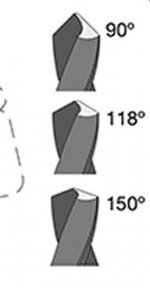
5mall5nail5
Well-known member
By hand is tough. Plain and simple.
3xpendable
Well-known member
I'll definitely try this next time. Any thoughts on preventing the bit from self-feeding at such a fast rate? Are there special bits for this?
Try a drill stop set to the desired depth
Reducing the rake angle of the cutting edge. That reduces the tendency to self-feed. It's also commonly done for drilling materials such as brass where a high rake angle tends to result in poor cutting performance.
Good posts. My thinking exactly.Grinding the angle at the tip of the bit determines feed rate - sharper the angle, more rapid the feed:
Loads of great drill bit info in this thread:
www.garagejournal.com/forum/showthread.php?t=135850
Alchymist
Well-known member
A drill stop won't do anything to slow the feed rate.
Thanks for the input. Doesn't sound like there's any silver bullet when drilling by hand. Next time I'll for sure countersink first, use a 135 deg bit, and try to hold my mouth right. I checked on 140 and 150 deg bits but they were all carbide and expensive.
beerdog
Well-known member
you could ream it by stepping it up a few sizes.
Greatbear
Well-known member
For holes in thin metal, I use a conical, non-stepped bit.
Alchymist
Well-known member
Pretty difficult reaming a blind hole.you could ream it by stepping it up a few sizes.
For holes in thin metal, I use a conical, non-stepped bit.
Op is talking about 1/2" or better deep in a blind hole.
RCStocker
Well-known member
There are pilot drills that have a round cylinder point the size of the hole you are drilling.
They have a 1/4" lead or more. The pilot keeps the drill from walking and the next step had a flatter angle and cuts the whole to the size required. I have a bunch of them. I got them 40 years ago when I was given a small machine shop. I don't know where you buy them now. I have seen end mills stepped down and I have turned drills on the lathe to cut down the shank and the pointed end. You can take a drill and make your own pilot drill. You just need to know how to sharpen your tooling and know the proper speed. You need to feed it by hand but it can be done. I have done it.
A counter sink works very well. If you take small steps drilling the hole larger it will not walk as far. Small steps works much better. You might need to go to a number or fractional drill bit but there are in between sizes. You can even step it up with a Metric bit to get to the size you want. Changing the point angle on the drill can also work well but you need to know how to sharpen bits buy hand. It is not hard. It takes a little practice but I use a regular 8 inch bench grinder all the time to sharpen bits. I have a $800 commercial sharpener and 2 drill doctors but I never use them. Just get a good scale and make sure both flutes are the same length Whey they are you know you are centered. I have a Starrett scale with the drill angle attachment but I seldom use it. I had an old time teach me how to sharpen bits when I was a kid and it really has helped me through the years.
A magnetic portable drill works great if you can get it mounted. As stated you just put a metal rod in the hole and chuck it up then flip the magnet lever. This works great for a drill press and vice as well.
Now I will need to look up pilot drills. I know someone must make them these days.
They have a 1/4" lead or more. The pilot keeps the drill from walking and the next step had a flatter angle and cuts the whole to the size required. I have a bunch of them. I got them 40 years ago when I was given a small machine shop. I don't know where you buy them now. I have seen end mills stepped down and I have turned drills on the lathe to cut down the shank and the pointed end. You can take a drill and make your own pilot drill. You just need to know how to sharpen your tooling and know the proper speed. You need to feed it by hand but it can be done. I have done it.
A counter sink works very well. If you take small steps drilling the hole larger it will not walk as far. Small steps works much better. You might need to go to a number or fractional drill bit but there are in between sizes. You can even step it up with a Metric bit to get to the size you want. Changing the point angle on the drill can also work well but you need to know how to sharpen bits buy hand. It is not hard. It takes a little practice but I use a regular 8 inch bench grinder all the time to sharpen bits. I have a $800 commercial sharpener and 2 drill doctors but I never use them. Just get a good scale and make sure both flutes are the same length Whey they are you know you are centered. I have a Starrett scale with the drill angle attachment but I seldom use it. I had an old time teach me how to sharpen bits when I was a kid and it really has helped me through the years.
A magnetic portable drill works great if you can get it mounted. As stated you just put a metal rod in the hole and chuck it up then flip the magnet lever. This works great for a drill press and vice as well.
Now I will need to look up pilot drills. I know someone must make them these days.
RCStocker
Well-known member
This is what I was talking about. You can have them custom made or you can make your own and I have seen them in all sizes years ago.
http://www.rcgroups.com/forums/showthread.php?t=1421440
http://www.rcgroups.com/forums/showthread.php?t=1421440
justanengineer
Well-known member
If you dont have the ability to offhand grind the drill point angle down a bit, I would suggest seriously increasing your speed and decreasing your feed rate to almost nothing. Quite often a very light touch will keep the drill from grabbing.
If youre going quite a bit oversize, my favorite tool to help things get started on center is a good old fashioned deburring tool.
If youre going quite a bit oversize, my favorite tool to help things get started on center is a good old fashioned deburring tool.
dirtydogintex
Well-known member
Doesn't someone call that style the 'Bullet'.... B&D?.... maybe w/a shorter center/pilot point?This is what I was talking about. You can have them custom made or you can make your own and I have seen them in all sizes years ago.
http://www.rcgroups.com/forums/showthread.php?t=1421440
Alchymist
Well-known member
Core drill
So how would a handheld core drill work to enlarge an existing hole by a few thousandths?
when enlarging a drilled hole.....with a drill press, mill or BUX drill
fold ~6-8 layers of cloth into a square larger than the existing hole
center the drill with it off.....now place the square over the hole and and turn the drill on and drill away
the fabric stops any chattering too
1st time i saw it done was 40+ years ago in Swtizerland
PS; don't chamfer it
fold ~6-8 layers of cloth into a square larger than the existing hole
center the drill with it off.....now place the square over the hole and and turn the drill on and drill away
the fabric stops any chattering too
1st time i saw it done was 40+ years ago in Swtizerland
PS; don't chamfer it
Alchymist
Well-known member
when enlarging a drilled hole.....with a drill press, mill or BUX drill
fold ~6-8 layers of cloth into a square larger than the existing hole
center the drill with it off.....now place the square over the hole and and turn the drill on and drill away
the fabric stops any chattering too
1st time i saw it done was 40+ years ago in Swtizerland
PS; don't chamfer it
Read the OP, he's doing this by hand. No drill press, no mill.
Read the OP, he's doing this by hand. No drill press, no mill.
Or as I like to say good-study, wrong course.
bad_idea
Well-known member
Some good input in this thread so far. I am surprised no one suggested an air drill though. I have a heavy duty 1/2" air drill at work and it allows more finesse in my opinion. Air drills don't grab like an electric does, they stall instead of taking you for a ride. I find it is easier to focus on lining up the bit when I am not worrying about the drill taking me for a ride! High rpms and very little feed rate is easier too, if it does grab, it will only stall. Less broken bits that way too.
Good idea. I don't have an air drill but I think I could use a cordless drill/driver with the clutch backed off to accomplish something similar.Air drills don't grab like an electric does, they stall instead of taking you for a ride.
If you have enough meat on the bit/thin enough material these are worth their weight in gold. Expensive? For a quality one hell yes, but so worth it.This:
sberry
Banned
Use a dull bit.
Alchymist
Well-known member
either a step bit or a reamer is the best and fastest way imho
Show me a step bit that has steps of .010 or .020 inch steps.
Can't understand why so many posters go off on a tangent from the OP request.
Reamers have been mentioned several times but the reamers I've used will only remove a few thousandths and they really need the rigidity of a drill press or mill. I looked around the Enco website at different reamers but didn't find anything that looked like it would work. Are there special reamers out there that will cut say .030" in a single pass and can be used by hand?