
You are using an out of date browser. It may not display this or other websites correctly.
You should upgrade or use an alternative browser.
You should upgrade or use an alternative browser.
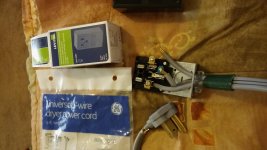
Dryer plug / outlet to welder adapter.
- Thread starter Lacota
- Start date

southalabama
Well-known member
I'd bump up the accidental life policy.
md21722
Well-known member
Welders are generally rated as intermittent loads.
My Miller 211 comes with a 14 AWG cord on it and can draw 16.6A at 230V. I believe NEC will let me use a 30A breaker. What's the big deal? Just leave the 30A? breaker there.
My Miller 211 comes with a 14 AWG cord on it and can draw 16.6A at 230V. I believe NEC will let me use a 30A breaker. What's the big deal? Just leave the 30A? breaker there.
That dryer receptacle is not a grounding device, it's a dual voltage 120/240 volt receptacle, a leftover from the time when it was allowed to ground the frames of ranges & dryers to the neutral, but today it's only allowed in existing installations that being said, the OP's adapter is not code compliant but it "works".
laser3kw
Well-known member
seriously- is your dryer in your garage?
I have an inverter tig that is rated the same way. I can plug it in a 120v outlet and run it at a reduced welding output or plug it into 230v (single phase) and run it at full output. I have a jumper plug that plugs into the welders standard 120v plug and then has a standard 3 prong 50amp NEMA 6-50 "welder" plug on it to plug into a standard NEMA 6-50-R receptacle.
I have an inverter tig that is rated the same way. I can plug it in a 120v outlet and run it at a reduced welding output or plug it into 230v (single phase) and run it at full output. I have a jumper plug that plugs into the welders standard 120v plug and then has a standard 3 prong 50amp NEMA 6-50 "welder" plug on it to plug into a standard NEMA 6-50-R receptacle.
taumac
Well-known member
seriously- is your dryer in your garage?
I have an inverter tig that is rated the same way. I can plug it in a 120v outlet and run it at a reduced welding output or plug it into 230v (single phase) and run it at full output. I have a jumper plug that plugs into the welders standard 120v plug and then has a standard 3 prong 50amp NEMA 6-50 "welder" plug on it to plug into a standard NEMA 6-50-R receptacle.
Yes, it's also common in Fl to have W/D in garages.
OP. I've seen it done but I did it with a WH on a 50a circuit. I just put a outlet and plug on the feed to WH. I flip breaker off unplug the WH and plug in welder and flip breaker on. I worked in the rental I was in and owner didn't had a issue with it cause panel was full.
Zeke
Well-known member
Look at my sig line, 2nd one. I'd say about 50% of all single family dwellings in CA have the washer and dryer in the garage. Not every one of those has a 240v outlet though. Welders don't need anything but 2 wires to work on 240v but it's a good idea to have the neutral blade go to the ground of the welder.seriously- is your dryer in your garage?
I have an inverter tig that is rated the same way. I can plug it in a 120v outlet and run it at a reduced welding output or plug it into 230v (single phase) and run it at full output. I have a jumper plug that plugs into the welders standard 120v plug and then has a standard 3 prong 50amp NEMA 6-50 "welder" plug on it to plug into a standard NEMA 6-50-R receptacle.
What NorCal says is Bible. The neutral wires are never considered an equipment ground. But it will work using an 'adapter'. And the adapter stays with the welder.
A real welding dedicated 240v outlet will have 2 hots and a GROUND.
sberry
Banned
If this comes from a main service panel then while it's not code compliant it's wired correct. If it comes from a 4 wire fed sub then it isnt.
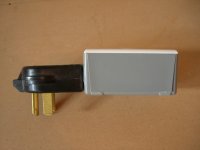
Reminds me of an 'adapter' I made when we were living at another house
I had a dedicated 30 amp circuit for my welder - but I also wanted to occasionally use a 240v 15 amp woodworking tool on the same circuit, an old Rockwell RC-33 Planer
I had a dedicated 30 amp circuit for my welder - but I also wanted to occasionally use a 240v 15 amp woodworking tool on the same circuit, an old Rockwell RC-33 Planer
Attachments


over40pirate
Well-known member
- Joined
- Aug 31, 2012
- Messages
- 160
Reminds me of an 'adapter' I made when we were living at another house
I had a dedicated 30 amp circuit for my welder - but I also wanted to occasionally use a 240v 15 amp woodworking tool on the same circuit, an old Rockwell RC-33 Planer
This caught my eye, as I have the same planer.
Would using the 15 amp planer, be a problem, on a 30 amp circuit, if the planer had an elec. problem? Would it maybe melt wires in the planer, instead of tripping the breaker?
Big Daddy Chop Shop
Well-known member
I grew up in a rental. Pops make an adapter and an extension cord for his Lincoln sparkbox, the garage only had 110. The dryer was in the basement of the house. When needed, he fed it thru the basement window and out to the garage. Not everyone has a "Garage-mahal", and believe me, my pops overdoes everything he does, but sometimes it is out of your control.
sberry
Banned
This caught my eye, as I have the same planer.
Would using the 15 amp planer, be a problem, on a 30 amp circuit, if the planer had an elec. problem? Would it maybe melt wires in the planer, instead of tripping the breaker?
This depends but it is a violation to have a recept larger than the breaker its on in this kind of circuit. Did the planer come with a factory cord?
taumac
Well-known member
This depends but it is a violation to have a recept larger than the breaker its on in this kind of circuit. Did the planer come with a factory cord?
Explain this? So I have a 50a outlet, 50a wire running with a 40a breaker in a violation? Wouldn't it be just the opposite?
wyliesdiesels
Well-known member
Explain this? So I have a 50a outlet, 50a wire running with a 40a breaker in a violation? Wouldn't it be just the opposite?
There isnt a 40a receptacle so code allows a 50a receptacle on a 40a circuit.
Last edited:
taumac
Well-known member
There isnt a 40a receptacle so code allows a 50a receptacle on a 40a circuit.
Oh ok cause you said larger recep than breaker was a violation so just checking.