

You are using an out of date browser. It may not display this or other websites correctly.
You should upgrade or use an alternative browser.
You should upgrade or use an alternative browser.
Educate me: What's this socket adapter?
- Thread starter 70Mach1
- Start date

rlitman
Well-known member
Probably for drain plugs.
3baygarage
Well-known member
Could be a square to hex adapter with that ball.
What’s the brand and the sizes?
What’s the brand and the sizes?
[emoji1]That socket is bad luck, someone put a hex on it!
Sent from my mobile device
ex-x-fire
Well-known member
I think its an adapter for industrial tools. Is it an Apex?
DFB
Well-known member
Once upon a time certain old sockets had hex drive, New Britan was one. My best guess is an adapter for those sockets to use them with sq. anvil drive tools, ratchets and extensions.
Make a duplicate post and also ask in the vintage tools section.
http://alloy-artifacts.org/Photos/t...t_set_ell_handle_cadmium_f_cropped_inset2.jpg
Make a duplicate post and also ask in the vintage tools section.
http://alloy-artifacts.org/Photos/t...t_set_ell_handle_cadmium_f_cropped_inset2.jpg
Could be a square to hex adapter with that ball.
What’s the brand and the sizes?
^^^THIS^^^
Sent from my iPad using Tapatalk
Hello, It's a socket for allen head bolts.
If it was, it wouldn’t have the spring loaded detent ball.
Sent from my iPad using Tapatalk
Last edited:
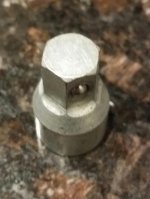
Ok, it measures for a 3/8 inch ratchet to 1/2 inch hex socket. Thanks for the replies. On my shelf of interesting stuff it goes.
How about an adaptor for using old style hex drive sockets with a modern ratchet? I find hex drive sockets for cheap, and with such an adaptor use them on all the beater jobs.
That socket is bad luck, someone put a hex on it!
Gets a
 from me too.
nicks78camaro
Well-known member
To attach a box wrench to a ratchet for more leverage?
engineer2
Well-known member
It's for pipe plugs.
DFB
Well-known member
To attach a box wrench to a ratchet for more leverage?
Now THAT is definitely thinking outside the box

Farmall450
Well-known member
It's for pipe plugs.
Why the detent, then? I'm on the adapter to old timey sockets bandwagon.
engineer2
Well-known member
So you don't lose the plug?Why the detent, then?
You are correct, it could be for old-timey sockets that were hex drive. I've got an old set that came with large allen wrench to drive the sockets.
Old Man Roger
Well-known member
Where would the socket go?To attach a box wrench to a ratchet for more leverage?
I'm with you guysWhy the detent, then? I'm on the adapter to old timey sockets bandwagon.
Not that I have any real educated reason..lolZRX61
Well-known member
If it was 17mm it would be for VW drain plugs & Kawasaki front axles.
So you don't lose the plug?
You should apply for the patent on that, no more dropping the sump plug in the drain can

eschoendorff
Well-known member
You should apply for the patent on that, no more dropping the sump plug in the drain can
This makes the most sense to me.
fartymarty
Well-known member
Pics.

I have a set of sockets that included that adapter. I bought these in 1967 from a local motorcycle shop. I needed them to work on my first motorcycle which I purchased from an Aldens catalog. A Kawasaki 85cc JT1 with ugly maroon/cranberry paint and whitewall tires. My first metric tools set, ....OK second set, since a small set came with the bike. Made in the USA, but no info on who made them. I think the set is only missing one piece that was a socket with a 1/2 hex on both ends to connect the 1/2 hex handle to the 1/2 hex straight blade screwdriver tool/short extension. 20 mm through 13 mm.


3baygarage
Well-known member
Cool. Sure was thoughtful to include an adapter for regular sq drive.
PugetDude
ALLIANCE MEMBER
I think the set is only missing one piece that was a socket with a 1/2 hex on both ends to connect the 1/2 hex handle to the 1/2 hex straight blade screwdriver tool/short extension. 20 mm through 13 mm.
Maybe the 1/2 hex straight blade screwdriver tool/short extension is intended to fit one of the sockets?

Private Lugnutz
Well-known member
New or used? While Indestro, and cheaper outfits like Oxwall and maybe a few others made hex drive well into to 50's, it's unusual. Also, I don't know if your adapter has it, but you see those flakes at the bottom of the square opening of the OP's socket? That is from cold-broaching, which was replaced by hot-broaching in the 40's. Usually those flaky residuals were knocked out or jammed up against the inside with a punch pin during the manufacturing process, but you often see that step skipped.I bought these in 1967 from a local motorcycle shop.
fartymarty
Well-known member
New or used?
Mine was sold to me as new, in '67.
...Also, I don't know if your adapter has it, but you see those flakes at the bottom of the square opening of the OP's socket? That is from cold-broaching, which was replaced by hot-broaching in the 40's. Usually those flaky residuals were knocked out or jammed up against the inside with a punch pin during the manufacturing process, but you often see that step skipped.
Mine appears punched, or jammed against the inside, that is if I understand what you are saying.

Maybe the 1/2 hex straight blade screwdriver tool/short extension is intended to fit one of the sockets?
I'm sure it was, for sure it was supposed to go in the missing socket with a 1/2 hex (female) on both ends which would make it into a short bulky extension. There may have been a stamped steel/assembled funky ratchet with a hex opening that the extension fit into as a drive for the sockets. I don't remember having one, but to be honest back in the 70s when I was making not more than minimum wage and still insisted on racing motocross my tools were all mutipurpose devices that frequently saw the business end of a hammer as punches and seal drivers or what ever was needed at the time. Certainly a flimsy stamped ratchet would not have survived long in those days. I'm sort of surprised that I still have what I have of this set.
New or used? While Indestro, and cheaper outfits like Oxwall and maybe a few others made hex drive well into to 50's, it's unusual. Also, I don't know if your adapter has it, but you see those flakes at the bottom of the square opening of the OP's socket? That is from cold-broaching, which was replaced by hot-broaching in the 40's. Usually those flaky residuals were knocked out or jammed up against the inside with a punch pin during the manufacturing process, but you often see that step skipped.
OP here. Thanks for explaining about the broaching. I was wondering about the material inside, and this clears up the mystery.
Where would the socket go?
I'm with you guys
A double box ended wrench. A variation on the old '2 wrench' cheat.
fartymarty
Well-known member
To attach a box wrench to a ratchet for more leverage?
Where would the socket go?
A double box ended wrench. A variation on the old '2 wrench' cheat.
Like Old Man Roger...I don't get it.
....below is what I came up with, but how is that useful in any practical way?
The double wrench would be of some leverage value for certain sizes, but would they include something for that limited usefulness?


isb cornbinder
Well-known member
This is a trick to mess with the round hole versus square hole persons in the test..
Dumber than lumber
Well-known member
- Joined
- Dec 19, 2015
- Messages
- 2,065
Pics.
Might be so you can use a box wrench to turn the ratchet. It sure who would want to do that though.
Private Lugnutz
Well-known member
This tool was correctly identified in post #3, then redundantly correctly identified in post #'s 8, 9, 13, and confirmed in posts #12 and #24. It is a hex-to-square drive adaptor. The 3/8-inch drive female square opening goes on the end of a 3/8-inch square drive ratchet. That leaves the 1/2-inch hex drive end to be inserted into the 1/2-inch hex drive sockets for turning.
fartymarty
Well-known member
This tool was correctly identified in post #3, then redundantly correctly identified in post #'s 8, 9, 13, and confirmed in posts #12 and #24. It is a hex-to-square drive adaptor. The 3/8-inch drive female square opening goes on the end of a 3/8-inch square drive ratchet. That leaves the 1/2-inch hex drive end to be inserted into the 1/2-inch hex drive sockets for turning.
Well, OK, sure just bring us all back to reality...dude we were trippin'
 ...what a buzz kill.
(jess mssin' witcha Lug'z, you are of course quite correct.)
This tool was correctly identified in post #3, then redundantly correctly identified in post #'s 8, 9, 13, and confirmed in posts #12 and #24. It is a hex-to-square drive adaptor. The 3/8-inch drive female square opening goes on the end of a 3/8-inch square drive ratchet. That leaves the 1/2-inch hex drive end to be inserted into the 1/2-inch hex drive sockets for turning.
Post 9 did not “redundantly correctly identify” the item. It AGREED with post 3 correctly identifying it.
Redundancy is overrated. [emoji2]
Sent from my iPad using Tapatalk
Private Lugnutz
Well-known member
In that case, it's a flux capacitor. (And I need to recalibrate my sarcasmometer...)...dude we were trippin'
Agreed. Sorry for lumping you in with the redundancy!Post 9 did not “redundantly correctly identify” the item. It AGREED with post 3 correctly identifying it.
In that case, it's a flux capacitor. (And I need to recalibrate my sarcasmometer...)
Agreed. Sorry for lumping you in with the redundancy!
I realize it was an overnight and an apology is redundant, but appreciated. [emoji1]
Sent from my iPad using Tapatalk