To avoid these ads, REGISTER NOW!

electric heat

Matt Matt

Well-known member
Joined
May 11, 2017
Messages
523
Location
Ontario
Baseboard heating is the best if you keep fans circulating rooftop heat. Put the heaters usually get in the way. Electrical is 100% efficient. But, if you’re heating electrically, and you’re keeping fans pushing the hot air down, you might as well not invest in LED lighting.

I am slowly pulling out all my electrical heat as now having NG at 1/3$ (This might not be an option for you).

Simple and cheap, keep the heat close to the ground if going electrical.
 
Last edited:
To avoid these ads, REGISTER NOW!

Firebrick43

Well-known member
Joined
May 12, 2015
Messages
14,015
Location
West central Indiana
Depends on what your local code is. Some places you cannot have a large propane tank in city limits, especially residential areas. I believe that is the case here as well. Also, I don't have room for a huge propane tank without it being in the way outside the garage, and there's not enough room for a propane fill truck to get down the driveway to fill it. Also, I'm not lugging 50 gallon or 100 gallon tanks around. That's a HUGE pain in the ***.

Your(and others) working awful hard to justify your decision (not saying it's wrong in your specific case) and then foist it on others.

Most local regs that some cities/town/HOA have against lp isn't that you can't have them, it's that they can't be visable. Most of the time some lattice and vines take care of the requirement.

LP tanks can be burried, hoses on trucks are 75'+, and what kind of drive can you get a pickup down with its mirrors out and not a medium duty truck. I can place my GMC 6500 flatbed nearly anywhere a pickup can go. It can actually turn tighter than a lot of extended/quad cab trucks.

And others 2.00+ quotes a just not true except some specific spikes during certain years. Summer fills are typically just over a dollar around here and if you have enough tank there is no need to fill during peak rates.

I say this as some energy "experts" convinced several neighbors to switch to central air source heat pumps around here. They all found their heat bills to be double or triple in the months of November thru March. Most have had an lp furnace reinstalled for a dual fuel setup. Are electrical rates are .12kwh.

IMHO the only place resistantance heat should be installed is localized heat used when the area is occupied. Even at hydro rates it's silly. The new mini splits that can heat at -5 would be the only electric choice for constant heating in my opinon worth while and in a shop they should not be hard to implement
 

bzinsky

Well-known member
Joined
Oct 27, 2014
Messages
5,565
so many people dislike baseboard

I love my baseboard in my house! it is so comfortable

Granted I have hydronic and not electric, but the baseboard themselves do a fantastic job of heating
 

Bolson32

Well-known member
Joined
Dec 6, 2016
Messages
541
Location
Lake Elmo, MN
Your(and others) working awful hard to justify your decision (not saying it's wrong in your specific case) and then foist it on others.

Well, you've seen the math in this guys situation. I don't think anyone is arguing that in a lot of scenarios NG or LP are the way to go. Just not in this guys situation. Or Mine, or Auto_Techs. I think we're just saying, "Hey, consider it because it might work just fine for you."

Which is because like 90% of posts are from guys saying exactly what you are, GAS IS THE ONLY WAY TO GO! When in reality...maybe, maybe not. There's obvious gray areas that need to be accounted for.


so many people dislike baseboard

I love my baseboard in my house! it is so comfortable

Granted I have hydronic and not electric, but the baseboard themselves do a fantastic job of heating

I believe resistance baseboards and hydronic baseboards are very different types of heat.
 

colinb

Well-known member
Joined
May 27, 2006
Messages
47
Saying that resistive electric heating is "100% efficient" is very misleading, because the heater itself is not the entire system. Since the consumer is paying for the inefficiencies in generating the electricity, we must include the power plant as part of the system. Depending on the type of plant, the efficiency is probably 30-50%. Add transmission line losses to that, and it shows why resistive electric heating is expensive.

All of this only has an indirect impact on the decision about a heating system (because electric rates are very different in different areas, etc.), but I think it's important to understand.

--Colin
 

2level

Well-known member
Joined
Apr 10, 2008
Messages
1,146
Location
Washington
In addition to electric cost per kWh vs. gas cost per therm or gallon; the upfront cost, maintenance cost, and life expectancy of the heating/cooling equipment must be considered. Other things to weigh in the HVAC system decision is the history of gas vs. electric costs in your area. And whether or not demand/energy usage will be heavy or light in your shop or garage.
 

nsula_country

Well-known member
Joined
May 23, 2013
Messages
1,534
Location
Northwestern Louisiana
Propane is only $2 gallon most places if you can get a larger tank. 20lb tank only has 4 gallons in it..

1 gallon of propane weighs 4.2 pounds. A "full" 20 lb cylinder should have 4.7 gallons or propane in it.

We can fill a "Full" 20lb here for $8.88+tax here at 2 different propane places (only on 20's though) Other size bottles are at market price per gallon. Sales pitch for business.

TSC about $10-$12.

Exchange bottles have 15 lbs and cost $18.99-$26.99 to swap out.

CT
 

Randy in Maine

Well-known member
Joined
Nov 21, 2010
Messages
2,176
Location
The Beach
Question for the OP, how do you heat your house and how far is it from your shop?

I heat my house using a boiler and just pump hot water to heat my shop, but my shop is reasonable close to my house (like 50feet). Just looking for options.....
 

nsula_country

Well-known member
Joined
May 23, 2013
Messages
1,534
Location
Northwestern Louisiana
I understand your situation.

I have no access to NG and Propane is another hassle to deal with.

Have a dedicated 200A service to 40x60x17 shop and plan to use a forced air furnace/HP.

CT
 

LaCorski

Well-known member
Joined
Oct 11, 2013
Messages
62
Location
Central Washington
Clawman,

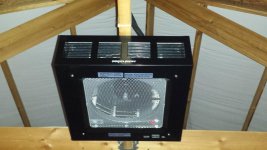
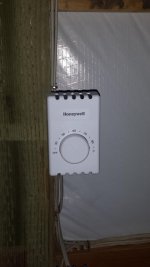
I too wasn't sure which direction to go in. I don't use my shop for work, just leisure and wanted something readily available and easy to maintain. My shop is 30 X 40 with mild insulation. I also didn't want to use a wood stove or run gas lines. I chose to run 3) of the Profusion ceiling heaters that are rated @ 5000 watts and around 16000 BTU's. Our power here in Washington state is pretty cheap, the few times I've ran them for a few hours hasn't affected my bill much at all. I'm not an electrician but did my homework and read up on how to wire these together using a definite purpose contact controlled by a 120v thermostat, it was pretty easy and now with a turn of the dial, I have heat! It’s a low temp stat so I can keep the shop just above 32 degrees with no issues. I really like them. Ordered from Menards online for about $100 each, along with wire, stat, contactor, box and accessories, I'm in to it about $450 in total. Luv them so far! Friends are jealous too! See my attached pics. Just thought I'd share, good luck!

LaCorski.
 

Attachments

  • 20171213_165335.jpg
    20171213_165335.jpg
    137.5 KB · Views: 38
  • 20171213_165355.jpg
    20171213_165355.jpg
    143.7 KB · Views: 38
  • 20171213_165415.jpg
    20171213_165415.jpg
    131.9 KB · Views: 32

drg5490

Well-known member
Joined
Dec 10, 2012
Messages
120
Clawman,

I too wasn't sure which direction to go in. I don't use my shop for work, just leisure and wanted something readily available and easy to maintain. My shop is 30 X 40 with mild insulation. I also didn't want to use a wood stove or run gas lines. I chose to run 3) of the Profusion ceiling heaters that are rated @ 5000 watts and around 16000 BTU's. Our power here in Washington state is pretty cheap, the few times I've ran them for a few hours hasn't affected my bill much at all. I'm not an electrician but did my homework and read up on how to wire these together using a definite purpose contact controlled by a 120v thermostat, it was pretty easy and now with a turn of the dial, I have heat! It’s a low temp stat so I can keep the shop just above 32 degrees with no issues. I really like them. Ordered from Menards online for about $100 each, along with wire, stat, contactor, box and accessories, I'm in to it about $450 in total. Luv them so far! Friends are jealous too! See my attached pics. Just thought I'd share, good luck!

LaCorski.


So did you use 3 separate 30 amp breakers then? Or did you wire it differently? Those would be ideal in my situation..thanks
 
To avoid these ads, REGISTER NOW!

PassnThru

Well-known member
Joined
Jan 5, 2010
Messages
6,510
Location
Bowling Green KY
Saying that resistive electric heating is "100% efficient" is very misleading, because the heater itself is not the entire system. Since the consumer is paying for the inefficiencies in generating the electricity, we must include the power plant as part of the system. Depending on the type of plant, the efficiency is probably 30-50%. Add transmission line losses to that, and it shows why resistive electric heating is expensive.

--Colin

You seem to be torturing facts for a point here. Efficiency in this respect refers to the amount of heat you get from a unit of something you have purchased. You have paid a set price for that unit - how much do you get out of it. Electricity - basically 100%. Gas - it varies but rarely over 90%. It only matters what you pay for it and what you get out of it - the inefficiencies in the production or distribution don't even relate to the equation for the end consumer.
 

tdkkart

Well-known member
Joined
Jun 17, 2006
Messages
6,887
Location
Eastern Iowa
I heat 30x40x12 with in floor radiant powered by an electric on-demand water heater. Works awesome, clean, quiet, safe, no fumes, maintenance free.

Yes, it is "expensive" sorta, by like the OP has said, it's only 4-5 months a year. This year mine is running pretty cheap cuz it hasn't gotten that cold yet.

I love it, no reason to change to anything else.
 

Matt Matt

Well-known member
Joined
May 11, 2017
Messages
523
Location
Ontario
Well, you've seen the math in this guys situation. I don't think anyone is arguing that in a lot of scenarios NG or LP are the way to go. Just not in this guys situation. Or Mine, or Auto_Techs. I think we're just saying, "Hey, consider it because it might work just fine for you."

Which is because like 90% of posts are from guys saying exactly what you are, GAS IS THE ONLY WAY TO GO! When in reality...maybe, maybe not. There's obvious gray areas that need to be accounted for.


I believe resistance baseboards and hydronic baseboards are very different types of heat.


You’re absolutely correct and I tried to take this into consideration. For human purposes it’s best to keep “electric” heat close to the ground(or near any cold draft or Windows). Hot air rises. Down Circulation keeps the air comfortable. Most electric heaters have a fan to direct thermal Air if not baseboard.


Efficiency of the heat is one thing, efficiency of the building it is another thing. The available sources of heat need to be Waighed by the customer , with efficiency knowledge.

I have about 450 square-foot shop/Garage that is attached by two walls and the ceiling. The two exterior walls, One with garage doors garage doors are R9 and the other exterior wall is R12.
I like to keep my shop at 70°F, the outside temperature today is -11°F. The 81°F differential I am running 95% NG, and 5% electric. At my main job that I’m using NG, I just keep the thermostat always at 70°F.

My other shop only has electrical and Wood heat. I don’t keep that shop to operational/Working temperatures. First thing I do is turn on the lights and then 2=>5000W Electric heaters, then I lite the woodstove and usually walk around the property for half hour. Within an hour the woodstove will maintain comfortable working temperatures. The shop is very well insulated with R20 walls and R50 attic.

Electric heat and wood heat is very dry (and very efficient). Electric heat is considered high efficiency with a high expense. Wood heat is dependent on your free source. for a sudden change in heat to metals, looking for moisture in shock of cold, Electric, wood, high-efficiency gas are your best heating sources.

Below is my heating situation for Home shop. 5000 W heater and 30,000 BTU NG
 

Attachments

  • FB8219EF-06D4-43EB-BD28-C6A131E21ECD.jpg
    FB8219EF-06D4-43EB-BD28-C6A131E21ECD.jpg
    14.4 KB · Views: 24
Last edited:

rburke65

Well-known member
Joined
Nov 10, 2007
Messages
12,349
Location
Canfield, Ohio
I am all electric in my home using base board heaters. NG is not available. Pretty happy with the baseboard heaters....quite and in 47 years we haven't had one that needed to be replaced.
 

terabitdan

Well-known member
Joined
Jul 16, 2016
Messages
152
And others 2.00+ quotes a just not true except some specific spikes during certain years. Summer fills are typically just over a dollar around here and if you have enough tank there is no need to fill during peak rates.


According to the US Energy Information Agency here https://www.eia.gov/dnav/pet/pet_pri_wfr_a_EPLLPA_PRS_dpgal_w.htm the average rice for residential delivered propane in the US is $2.461 last week. Average prices per state vary wildly and are listed on the site.

Energy prices are local, what is cheap in some places is expensive others. When deciding what’s the best heat source everyone should use something like this calculator https://ag.purdue.edu/extension/renewable-energy/Documents/ON-Farm/heatcalc.xls using their local rates along with their usage pattern to decide what’s best for them.

For example, using my 32x20’garage it’s about $600 less per year to heat with 78% efficient natural gas furnace 24x7 than electric. But heating it only 12 hrs per week would take a long time at $.75/hour electric resistance heating cost to payback a $3k upfront cost.

I was curious if increasing insulation has a better payback than changing to natural gas. Based on my heat load calculations going from R15 to R21 in the walls and R38 to R60 in the attic with electric heat would only save about $70/yr for 24x7 heating.

I don’t disagree with Firebricks conclusion that electric resistance heat for 24x7 is the most expensive to operate, just pointing out $2/gl propane is not fantasy for some.


Sent from my iPhone using Tapatalk
 

finn

Well-known member
Joined
Mar 27, 2005
Messages
16,209
Location
The UP, God's country
As of Tuesday, propane was $1.79/gallon, #2 heating oil was $2.50/gallon, electric was $.23/kWh, wood was free, but I have to hire someone to climb on the roof to clean the chimney twice a year, and The nearest NG pipeline is five miles away.

As pointed out, energy costs are somewhat local.
 

Bolson32

Well-known member
Joined
Dec 6, 2016
Messages
541
Location
Lake Elmo, MN
For example, using my 32x20’garage it’s about $600 less per year to heat with 78% efficient natural gas furnace 24x7 than electric. But heating it only 12 hrs per week would take a long time at $.75/hour electric resistance heating cost to payback a $3k upfront cost.

I was curious if increasing insulation has a better payback than changing to natural gas. Based on my heat load calculations going from R15 to R21 in the walls and R38 to R60 in the attic with electric heat would only save about $70/yr for 24x7 heating.

Just out of curiousity, are you taking into account that even if you heat it "24/7" the furnace isn't running anywhere near that much? Even if I kept my garage at 45 on the thermostat I would be shocked if the electric heater ran for more than ~6 total hours in a full day. Especially if I'm not in and out a bunch.

Your second point seems to be consistent with my research as well. Past a certain point, as long as you've taken care of most air infiltration, insulation has diminishing returns. It seems to be a comfort issue mostly. I.e. going from R38 to R60 may not technically save you a bunch of money, the building would feel more comfortable as there'd be less temperature swings. But at the end of the day we're talking about garages and shops, not living rooms and bedrooms.
 

Showkey

"MEMBER EMERITUS"
Joined
Aug 9, 2014
Messages
8,638
Location
Wausau WI
When making a fuel comparison it cost per btu that matters........plug in your cost for the fuel. The calculator factors in the efficiency of the device. Your annual cost will vary by the local weather.

There a dozens of these calculators

https://www.efficiencymaine.com/at-home/home-energy-savings-program/heating-cost-comparison/

https://coalpail.com/fuel-comparison-calculator-home-heating

http://www.energydepot.com/residentialenergycalculator/

Your ROI is going to vary by location, amount of time the unit is in use and all in install costs.
 
Last edited:

terabitdan

Well-known member
Joined
Jul 16, 2016
Messages
152
I’m using the average heating degree days over the last 3 years locally along with the u-value for the building to estimate heat costs.

Since I used a 72 deg base temp in calculating the degree days my estimate is a bit high, but the relative costs would be right. Mini-split Heat pump around 35% the cost of electric and natural gas about 23%.

Starting with a base temp of 50 or 60 would make it that much harder to get payback on a $3k upfront cost.


Sent from my iPhone using Tapatalk
 

LaCorski

Well-known member
Joined
Oct 11, 2013
Messages
62
Location
Central Washington
drg5490:

I have them all on one 60amp breaker, 8 gauge wiring and one definite purpose contactor. Each take 20 amps to run. Seems to do quite well so far. It is a relativity cheap way to heat the place when I'm out there and I can keep it just above freezing. I know there are more efficient ways to go however It's purely for comfort when I'm out there and to keep the cars from seeing frozen temps, I'm not working out of the garage as a living.

LaCorski.
 

drg5490

Well-known member
Joined
Dec 10, 2012
Messages
120
drg5490:

I have them all on one 60amp breaker, 8 gauge wiring and one definite purpose contactor. Each take 20 amps to run. Seems to do quite well so far. It is a relativity cheap way to heat the place when I'm out there and I can keep it just above freezing. I know there are more efficient ways to go however It's purely for comfort when I'm out there and to keep the cars from seeing frozen temps, I'm not working out of the garage as a living.

LaCorski.

Thanks👍🏻
 
To avoid these ads, REGISTER NOW!
Top Bottom