To avoid these ads, REGISTER NOW!

Electrical diagnostics tools?

buffalobill

Well-known member
Joined
May 7, 2011
Messages
1,081
Location
Western NY
Been running into lots of electrical problems on our equipment at work, what's some good stuff to have beyond my power probe, wavetek multimeter, test light, strippers, and crimp pliers? I need a good set of long test leads, and a good set of back probes. What else is out there that makes electric diagnosis easier?
 
To avoid these ads, REGISTER NOW!

lbhsbz

Well-known member
Joined
Jan 13, 2010
Messages
1,172
Location
Long Beach CA
My go-to tool is my old snap-on vantage graphing DMM. It's not as fast as a scope, but it's not as much of a PITA either. Get a set of backprobe T-pins, a good lead assortment, and maybe some piercing probes (seal up the hole when you're done).

I have an original power probe that comes in real handy when I'm doing elec. work on boats, since they're fiberglass and it can be hard to find a ground sometimes when you need to test a circuit.
 
OP
B

buffalobill

Well-known member
Joined
May 7, 2011
Messages
1,081
Location
Western NY
Yep, I have a set of retractable leads coming from napa in the morning, I'm looking around for a back probe set. What's an O scope?

It's funny you mention experience, my partner at work and I were stumped over an electical problem with a plow at work, he's been doing this 20 years. We threw in the towel and took it to a shop. Sure enough, they found bad wiring under the dash. We haven't got extra wire to ruin at work, so I really didn't have a good way to bypass the harness. That's why the leads are coming. Next time I'll be ready!!
 
OP
B

buffalobill

Well-known member
Joined
May 7, 2011
Messages
1,081
Location
Western NY
My power probe is great for lights, but I swear the biggest problem has been poor connections, connectors, and splices. It's nice not guessing if the component itself works.

It doesn't help that I'm dealing with rusty dump trucks with salt boxes, covered in fluid film, lol.....
 

texasprd

Well-known member
Joined
Sep 6, 2010
Messages
376
Location
San Antonio, TX
"o scope" - oscilloscope. I have an old vantage, and it has a single-channel oscilloscope. I think SnapOn calls it a wave-form viewer, but I could be wrong. It lets you see nifty stuff like the actual electrical wave-form of a fuel-injector pulse or ignition-firing event. You can see when the ground occurs and releases, the voltage spikes, duration, etc. Or if you're looking at an abs wheel sensor or a magnetic ignition trigger, you can see the AC waves

if you're doing automotive work, check out aeswave.com
 
Last edited:

theoldwizard1

Well-known member
Joined
Feb 22, 2011
Messages
43,114
Location
SE MI
My power probe is great for lights, but I swear the biggest problem has been poor connections, connectors, and splices. It's nice not guessing if the component itself works.

It doesn't help that I'm dealing with rusty dump trucks with salt boxes, covered in fluid film, lol.....

A Power Probe will tell that the load works. It won't tell you if adequate voltage or current is getting to it. I am not a fan.

An old fashion incandescent test light or a Load Pro will tell that you are getting voltage and adequate current at the test point (back to my comment of knowing how to use Ohm's Law). Because a typical test light will only draw 250mA (1/4A) some guys will put a different bulb in the handle so that it draws about 750mA or they make up a load of 2 bulbs that will draw 1-2A.
 
OP
B

buffalobill

Well-known member
Joined
May 7, 2011
Messages
1,081
Location
Western NY
I'm still building my experience, unfortunately so is the guy I work with, and he has been around the block a time or two. I'm liking the ideas in this thread though, before I got this job, all I had was a spark checker, multimeter, and a soldering iron.
 
OP
B

buffalobill

Well-known member
Joined
May 7, 2011
Messages
1,081
Location
Western NY
A Power Probe will tell that the load works. It won't tell you if adequate voltage or current is getting to it. I am not a fan.

An old fashion incandescent test light or a Load Pro will tell that you are getting voltage and adequate current at the test point (back to my comment of knowing how to use Ohm's Law). Because a typical test light will only draw 250mA (1/4A) some guys will put a different bulb in the handle so that it draws about 750mA or they make up a load of 2 bulbs that will draw 1-2A.


?? My power probe tells me the voltage on the screen? I
 

theoldwizard1

Well-known member
Joined
Feb 22, 2011
Messages
43,114
Location
SE MI
We haven't got extra wire to ruin at work, so I really didn't have a good way to bypass the harness. That's why the leads are coming. Next time I'll be ready!!
Test leads are usually 18 gauge so you don't want to run more than about 10A sustained.

Bad grounds will kill you also. I made up a 12' test lead (banana plugs on each end) so if I am suspect I can always get ground directly from the battery.

If you are working on trucks, you would need a 20-30' lead. Buy 18 gauge silicone insulated wire on eBay. About $15 for 30'.
 

American Locomotive

Well-known member
Joined
Jan 8, 2017
Messages
10,941
Location
Rhode Island
As mentioned, really the best thing you can do is get experience. I recommend checking out YouTube channels like EEVBlog. It has a lot of good videos on basic electrical theory and multimeter usage. I see lots of guys with multimeters, but very few really know how to make good use of them.

As far as tools go, the only thing I would add to that would be alligator-clip probes, and the special clip-probes for hanging on wires.
 
Last edited:

theoldwizard1

Well-known member
Joined
Feb 22, 2011
Messages
43,114
Location
SE MI
?? My power probe tells me the voltage on the screen?
It depends on how you are using it ! If you are just using it to light a bulb that has been disconnected from the harness, it is just telling you battery voltage bing applied to the load. Not very useful.

If you are back probing a load that you believe is live that might be useful, but you had to validate the load and the connector first.

Like I said, a 12V test light is frequently a better tool. Watch South Main Auto and Pine Hollow Auto Diagnostics on YouTube. I don't recall them EVER using a Power Probe, but the use simple test lights all of the time.
 

theoldwizard1

Well-known member
Joined
Feb 22, 2011
Messages
43,114
Location
SE MI
As mentioned, really the best thing you can do is get experience. I recommend checking out YouTube channels like EEVBlog.
EEVblog is too high tech for most auto technicians ! Watch South Main Auto and Pine Hollow Auto Diagnostics.

As far as tools go, the only thing I would add to that would be alligator-clip probes, and the special clip-probes for hanging on wires.
The BEST alligator clips (that slip on 4mm banana plugs) are Mueller BU-60. The insulated boots are sold separately (second page). The have many other different styles from small to booster cable size. They also sell fully insulated alligator clips.

attachment.php


Yes, they cost more and you are NOT going to find them at your auto parts or big box store. I get mine from Mouser.com.


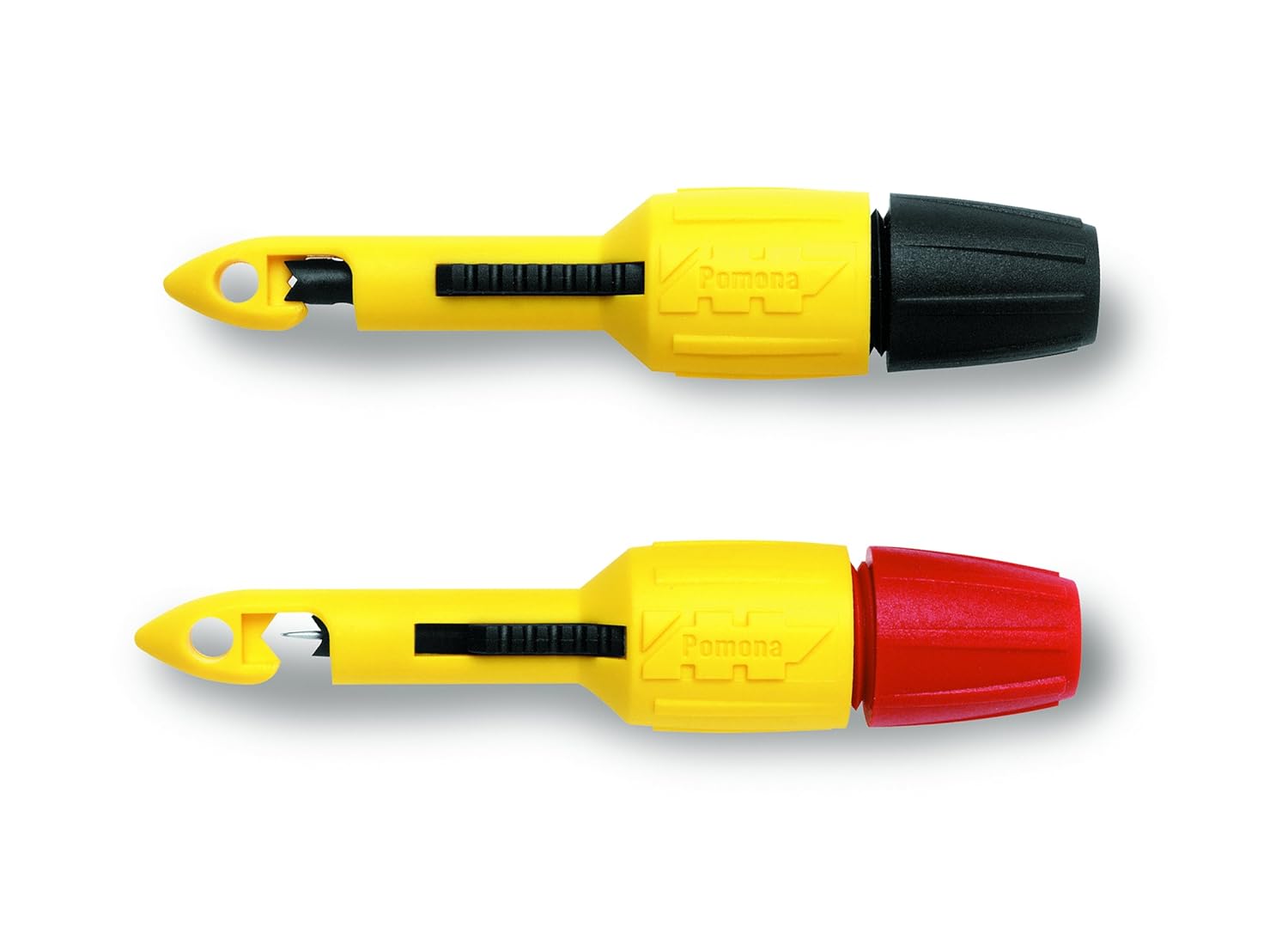
Pomona 6405
are the best wire piecing probes

71iRkmOphvL._SL1500_.jpg
 

Attachments

  • Capture.jpg
    Capture.jpg
    37 KB · Views: 338

Fedwrench

ALLIANCE MEMBER
Joined
Dec 9, 2007
Messages
14,952
Location
Valley of the sun
Electrical Diagnosis isn't about the tools so much as your ability to use them. Look for electrical diagnosis videos on You Tube. They're mostly free and can offer a wealth of information. Look for scannerdanner, motorage, wells mfg and others.
 

ttpete

Well-known member
Joined
Mar 8, 2011
Messages
6,737
Location
Dearborn, MI
EEVblog is too high tech for most auto technicians ! Watch South Main Auto and Pine Hollow Auto Diagnostics.


The BEST alligator clips (that slip on 4mm banana plugs) are Mueller BU-60. The insulated boots are sold separately (second page). The have many other different styles from small to booster cable size. They also sell fully insulated alligator clips.

attachment.php


Yes, they cost more and you are NOT going to find them at your auto parts or big box store. I get mine from Mouser.com.


Pomona 6405
are the best wire piecing probes

71iRkmOphvL._SL1500_.jpg

I'm not a fan of piercing wire insulation in automotive applications. It can cause invisible corrosion which is difficult to find.

For test leads, clips, and general electric-electronic components, there's a store in Westland that's about the last place in SE MI for it. It's The Electronic Connection at the corner of Ford Rd and Newburgh.
 
To avoid these ads, REGISTER NOW!

fordnut85

Well-known member
Joined
Sep 6, 2012
Messages
231
As many have said before knowledge is a must. A GOOD multimeter with a GOOD set of leads will tackle most any electrical issue. Everything else just makes it easier and faster. Google "voltage drop testing" and learn how to use it.

Sent from my Pixel using Tapatalk
 

Bobioz1

Well-known member
Joined
Jun 26, 2013
Messages
821
Location
Northern il. (For now)
Yep, I have a set of retractable leads coming from napa in the morning, I'm looking around for a back probe set. What's an O scope?

It's funny you mention experience, my partner at work and I were stumped over an electical problem with a plow at work, he's been doing this 20 years. We threw in the towel and took it to a shop. Sure enough, they found bad wiring under the dash. We haven't got extra wire to ruin at work, so I really didn't have a good way to bypass the harness. That's why the leads are coming. Next time I'll be ready!!

Get Dan Sullivan's book "Fundamental Electrical Troubleshooting". It will improve your skills. Powerprobes are excellent diagnostic tools for electrical work.
 

Welderguy24

Well-known member
Joined
Apr 5, 2011
Messages
267
Location
Alexandria, MN
A good ratcheting crimper for heat shrinks that will give you a solid crimp but also will not pierce the heat shrink.

https://www.matcotools.com/catalog/product/CT8000A/CRIMPING-TOOL-FOR-STANDARD/

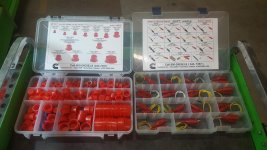
Cummins electrical test lead kit, not just for Cummins, can use it on everything. can be had at any Cummins dealer for around $100. Right hand side of 1st pic.

Good NON-LED test light, misc jumpers, relays, fuses, breakout harness for common connectors, terminal release tools (deutsch, weather pack) as seen in 2nd pic.

EDIT: Forgot about my Snap-On "Seam Ripper". Could buy a actual seam ripper for cheaper, but for 15 bucks you get a warranty, and I have broken several. This thing is the cats pajamas for ripping apart wire loom or multi wire (like 2 or 7 wire in a jacket)

https://store.snapon.com/Soft-Grip-...-Tool-Soft-Grip-Sheathing-Ripper-P643133.aspx

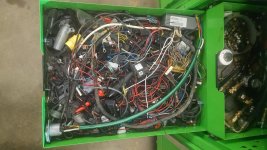
Get a "Save your a$$" drawer/box with random connectors, old harness', they will always come in handy, as seen in pic 3.

Not pictured, but I use a 4x6 high beam headlight and a set of jumper leads to load test circuits. But be very sure the circuit is totally isolated and that you know what your doing before sparking it up.
 

Attachments

  • 2017-10-05 14.11.00.jpg
    2017-10-05 14.11.00.jpg
    147.4 KB · Views: 83
  • 2017-10-05 14.19.15.jpg
    2017-10-05 14.19.15.jpg
    149.3 KB · Views: 75
  • 2017-10-05 14.10.09.jpg
    2017-10-05 14.10.09.jpg
    153.5 KB · Views: 65
Last edited:

FigureItOut

Well-known member
Joined
Sep 14, 2015
Messages
3,267
Location
Bentonville AR
Most of what I use has been mentioned. Back probes are essential and not just a time saver like many electrical testing tools. T-pins from the fabric store work great and I keep several in my box along with my real back probes. Load Pro leads are great and have been mentioned, as has Fundamental Electrical Troubleshooting.

Personally I hate to tackle an electrical issue without a good schematic. I'd give up everything else and be happy with just a meter and a schematic.

Learn to read current across fuses. Learn voltage drop testing. Learn both Ohm's and Kerchoff's laws. Also learn to disassemble all the various looms and connectors so you can get to stuff. Don't be afraid to carefully drop a BCM or get to the back side of a power distribution module.

If you don't have a good understanding of relays, get there. Same with negatively switched circuits and multiplex if you ever come across that.

Oh and by the way, it's always the ground.
 

Heavy Metal Doctor

Well-known member
Joined
May 26, 2010
Messages
5,417
Location
Mason Dixon Line
We haven't got extra wire to ruin at work,

Wait...Are you saying they expect you to repair these trucks but give you no supplies like a roll of wire you can use for testing?

I don't have much to add expect to agree with most of what's already been said. Some basic tools and knowing how to use them is what will cover 90% of problems. Once you get more experience you will find bigger / more in depth issues that require some specialty tools like a higher level amp clamp for your mutli-meter.

I use a "fuse saver" kit a lot for shorts - resetable breaker tool goes in place of the fuse your working on and it also has a buzzer that will go off when it trips. Plug it in and wiggle the harness / poke around till you hear the buzzer and you know you're close.

I also use a relay test kit often on circuits with relays involved. The adapters make it possible to leave the relay hooked up and either test what voltage you have / where or jumper the tester to trigger the relay and prove out which half of the circuit is the problem.
 
Last edited:

Rarified27

Well-known member
Joined
Jan 22, 2010
Messages
763
Location
Between PA and NJ
Good NON-LED test light

I have to second this- the LED lights I've used are on or off. Incandescents give you a much better clue as to how much, checking off some more potential problems before you rip everything apart.

After spending $20 on a nice one, then discovered the $4 one at HF works just as well.

If it matters to you- skip the coiled cord. Sometimes the clamps slip and the non-coiled don't have added velocity when they rocket into you.
 
Last edited:

GTA Matt

Well-known member
Joined
Aug 30, 2010
Messages
3,148
Location
Zebulon, NC
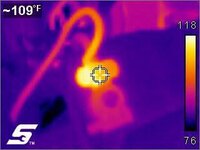
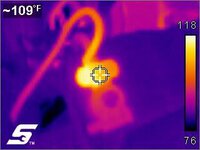
Thermal imager is my new favorite tool. Extremely sensitive, you can tell which fuses in a fuse box have current running through them. Any connections or wiring with high resistance are easy to spot. So many uses. My favorite back probes are thexton thx490x since they're so versatile and sgt23500 for smaller terminals. Load pro is invaluable, power probe has plenty of uses beyond turning modules into beer cans, most don't utilize it's full potential. Power probe ect3000 works great for finding open or shorted wiring, or simply tracing wiring. Amp clamp and a scope, even if it's a $100 u-scope will save time and make diag 100% certain. Fuse buddies go hand in hand with the amp clamp.

We all know what this is, and this was just running at idle, not even cranking.186e24e39adbda1dd5058e20871b939a.jpg818fa2c37f2d1844cab33e6634ee7463.jpg

Sent from my SM-G930V using Tapatalk
 

Attachments

  • 186e24e39adbda1dd5058e20871b939a.jpg
    186e24e39adbda1dd5058e20871b939a.jpg
    12.9 KB · Views: 6
  • 818fa2c37f2d1844cab33e6634ee7463.jpg
    818fa2c37f2d1844cab33e6634ee7463.jpg
    66.8 KB · Views: 4
OP
B

buffalobill

Well-known member
Joined
May 7, 2011
Messages
1,081
Location
Western NY
Wait...Are you saying they expect you to repair these trucks but give you no supplies like a roll of wire you can use for testing?

I don't have much to add expect to agree with most of what's already been said. Some basic tools and knowing how to use them is what will cover 90% of problems. Once you get more experience you will find bigger / more in depth issues that require some specialty tools like a higher level amp clamp for your mutli-meter.

I use a "fuse saver" kit a lot for shorts - resetable breaker tool goes in place of the fuse your working on and it also has a buzzer that will go off when it trips. Plug it in and wiggle the harness / poke around till you hear the buzzer and you know you're close.

I also use a relay test kit often on circuits with relays involved. The adapters make it possible to leave the relay hooked up and either test what voltage you have / where or jumper the tester to trigger the relay and prove out which half of the circuit is the problem.


Lol, yep, that's what I'm saying, town is cheap, supplies are a joke! The only 3/8 ratchet in the toolbox was one of those 5 dollar plastic backed chinesium wonders when I first got there, been donating my good spares since I got the job, since it makes life easier around the shop...
 

MUD DAWG

Well-known member
Joined
Jan 6, 2010
Messages
396
Location
Ontario, Canada
As already mentioned, check out Daniel Sulivan on YouTube and decide if his load pro leads are good for you or not. He works mainly on trucks which is a bonus for you.
 

MUD DAWG

Well-known member
Joined
Jan 6, 2010
Messages
396
Location
Ontario, Canada
Thermal imager is my new favorite tool. Extremely sensitive, you can tell which fuses in a fuse box have current running through them. Any connections or wiring with high resistance are easy to spot. So many uses.

I really wish I had enough use for a thermal imager, to justify buying a decent one. I too think they're uber cool.

Question. I totally get how you'd use it in a high resistance situation, but what about when something is unplugged? With a meter you can check for voltage, and with loadpro you can check ghost voltage, but how does a thermal imager help in this case?
 

American Locomotive

Well-known member
Joined
Jan 8, 2017
Messages
10,941
Location
Rhode Island
I really wish I had enough use for a thermal imager, to justify buying a decent one. I too think they're uber cool.

Question. I totally get how you'd use it in a high resistance situation, but what about when something is unplugged? With a meter you can check for voltage, and with loadpro you can check ghost voltage, but how does a thermal imager help in this case?
It doesn't. But it's just another helpful diagnostic tool. Although to be fair, a multimeter could have also found that poor connection at the battery terminal just by measuring the voltage drop between one end of that wire and the battery terminal.
 

Heavy Metal Doctor

Well-known member
Joined
May 26, 2010
Messages
5,417
Location
Mason Dixon Line
Lol, yep, that's what I'm saying, town is cheap, supplies are a joke! The only 3/8 ratchet in the toolbox was one of those 5 dollar plastic backed chinesium wonders when I first got there, been donating my good spares since I got the job, since it makes life easier around the shop...

Ohhhh, Jeeesshhh!! ...I understand. I'm in an equipment dealer where more than half our customers are gov't fleet shops from tiny towns to federal installations..its amazing some of them function at all!....I get calls from them asking to order basic nuts and bolts. I'd seriously have a talk with the higher ups - there has to be someone / some way to purchase basic supplies. I mean, they get cleaner and toilet paper for the bathroom, they gotta have an account with someone who also sells shop supplies. Grainger, MSC - class c solutions, or something where you can get what you need. Gotta be a town manager type of guy with purchasing card.

I'd highly recommend using bare crimp terminals and then good sealant filled heat-shrink over them. No chance of crushing / tearing the heat-shrink since it installed after the crimp. I realized this is what the OEM's on our machinery do and started doing it this way years ago and have never had a connection issue.

Also: the meter lead / probe kit like Wamsutta put up is and excellent idea. I bought the SO version a few months ago and use it constantly, switching between the different probes / clips. I really like the large alligator clip that lets you get an easy ground almost anywhere since it opens wider than the commonly supplied little clip on test leads.
 

2ndGearRubber

Well-known member
Joined
Mar 24, 2014
Messages
14,185
Location
Pittsburgh
Wait...Are you saying they expect you to repair these trucks but give you no supplies like a roll of wire you can use for testing?

Technicians are expected to supply their own tools.... and wire, and consumables, and extension cords, and scanners, and gasket maker, and funnels, and hardware, and PB blaster, and anything the shop needs that costs money.

Charge shop supply fee, have no shop supplies. It's almost like it's just an add on profit line. :mad:


EDIT: And Bill, don't be donating a thing. Sets a bad precedent, trust me I've been there. If ratchets are needed that badly, people can go to the store an buy one.
 
Last edited:

Heavy Metal Doctor

Well-known member
Joined
May 26, 2010
Messages
5,417
Location
Mason Dixon Line
Technicians are expected to supply their own tools.... and wire, and consumables, and extension cords, and scanners, and gasket maker, and funnels, and hardware, and PB blaster, and anything the shop needs that costs money.

Charge shop supply fee, have no shop supplies. It's almost like it's just an add on profit line. :mad:


EDIT: And Bill, don't be donating a thing. Sets a bad precedent, trust me I've been there. If ratchets are needed that badly, people can go to the store an buy one.


This is part of why I like running my shop and stay where I am in spite of other issues. At least I can get whatever I need for tools / supplies! The owner wants to complain about me spending 10K/ year on brake cleaner and wire ties? (owners son actually, getting set to take over, has been questioning invoices a little) I just tell him "you want to get the work do or not?!" :lol_hitti
I even started an Amazon account with the company Amex attached - get online, order what I need on Prime and have it within 2 days if I can't wait for the monthly shop supply guys visit.

I also agree - don't donate too much! There's a line between helping yourself get the work done (which makes you look good), and being taken advantage of....
 

GTA Matt

Well-known member
Joined
Aug 30, 2010
Messages
3,148
Location
Zebulon, NC
It doesn't. But it's just another helpful diagnostic tool. Although to be fair, a multimeter could have also found that poor connection at the battery terminal just by measuring the voltage drop between one end of that wire and the battery terminal.
Sure, lots of different ways to skin that cat, but the imager sure makes it easy to pinpoint the exact location of the problem. As for finding opens in wiring, that's where the ect3000 comes in.

Sent from my SM-G930V using Tapatalk
 

theoldwizard1

Well-known member
Joined
Feb 22, 2011
Messages
43,114
Location
SE MI
For those who don't want to spend the money on connector back probes, use bulletin board T-pins. Large diameter (stiffer) and longer than straight pins. Grab them with an insulated alligator clip.
 
Last edited:
To avoid these ads, REGISTER NOW!
Top Bottom