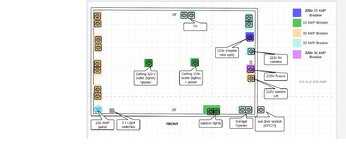
I was hoping to find a "I wish I did this when I built my garage" thread of lessons learned but I didn't see one...
After renovating several homes and building several workshops over the years, I have a few "general" suggestions:
Add more outlets/receptacles than you think you'll need, because you'll need them. It's a lot easier, faster, and cheaper to add them while you are constructing the garage/shop than adding them afterwards.
Allow for more more light fixtures (luminaires) than you think you'll need. LED lighting is efficient and relatively cheap. If it's a small shop, and if the ceiling isn't very high, consider installing a bunch of protected LED strip lights, placed and spaced so that you have bright, evenly-distributed lighting that does not cast harsh shadows. It's a PITA to work on things when there is too much lighting contrast. I use low-profile LED lighting to allow the garage doors to clear the lights when opened.
Plan for unforeseen future equipment. You might want to add an extra 240V receptacle here and there for that unexpected big equipment item that was a bargain you discovered right after you cashed your paycheck. Been there, done that.
My current shop ('retirement hobby shop') is quite small. It consists of a double garage, with one side devoted to the workshop and the other side to a combination of tool/supply storage and my wife's car. There is a center dividing wall, which provides some needed additional wall-mounted storage and tool racks (as well as ceiling-hung storage) and receptacle space. TBH, the shop is really too small for me, even as a hobby shop, but I get by somehow, partly with some overflow material and equipment storage areas in the basement, shed, shipping containers, and attic above the garage. I'm giving you an idea of the size of the shop because the number of electrical receptacles that I installed is just barely adequate. There are two 50A 240V receptacles, one 30A 240V receptacle, 18 interior 20A 120V duplex receptacles, and one 20A 120V outdoor receptacle in a weatherproof enclosure (I plan to add an exterior 50A 240V receptacle soon). Even with all of these receptacles, I still didn't have quite enough above the workbenches for convenience, so for one workbench I installed an additional 8-receptacle strip on the workbench frame.
Obviously, you need to do all of the wiring to code, with proper permits and inspections, etc., but also go the extra mile and take
photos of all of the wiring before you cover the walls with drywall, plywood, or whatever, and file the images in a secure place. Believe me, when it comes time to making future changes or additions, it will come in very handy to know where all of the wires are located without having to use a circuit tracer, and even if you have a circuit tracer, there will probably be things blocking the way, such as shelving, benches, peg boards, etc.
Don't buy your cable piecemeal. Longer rolls of cable are often cheaper per foot than short rolls.
Get whatever specialized tools you need to make the work easier and safer and done properly. For example, torque screwdriver(s) for proper terminal screw torque, etc.
Spend a few bucks (well, maybe more than a 'few') and buy the current electrical code book for the code used in your community, or get an online subscription, or whatever (check your local library), and make it your bedtime reading...maybe not as exciting as a good mystery, but worth the time.
Good luck with the project.