To avoid these ads, REGISTER NOW!

electrical I may have missed

realien

Well-known member
Joined
Apr 24, 2017
Messages
63
Location
Atlanta
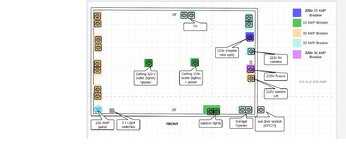
I am about to build a 20 x 28 garage and move out of the house garage so we an use if for my wife's car and storage , 1/2 will be for my car/lift/tools and the other half for my woodshop (cabinet making, hobbies etc)

I am laying out the electrical for current and potential future needs and want to make sure I didn't miss anything, it will be a 100 AMP sub panel and I don't intend to have any electric vehicles.. I wrench on my own car and friends cars, fixing stuff or modifications etc..

The left side has a lot of sockets because I have table saw, chop saw, sander, track saw, and may eventually get a planer, the right side is really for the lift, car charger, and other occasionally powered tools

I was hoping to find a "I wish I did this when I built my garage" thread of lessons learned but I didn't see one :)
 

Attachments

  • 2023-01-19_11-12-45.jpg
    2023-01-19_11-12-45.jpg
    162.8 KB · Views: 164
To avoid these ads, REGISTER NOW!

BillK

Well-known member
Joined
Aug 24, 2006
Messages
9,321
Location
Beautiful Southern Maryland
Cant help with the electrical but you might want to rethink the size. 20' deep is simply not enough to work on a car, even if you have absolutely nothing on the wall in front of it. My attached garage is about 22' deep from the door to the front wall and its still a pain just to check fluids once a week. Granted I have larger vehicles. But if you are going to work on other peoples stuff you might want to keep that in mind. My Detached garage is 24 x 24 and even that is not really great when working on my Chevelle.

I suppose if all of the cars you see are like Smart Cars you might be ok :)
 
OP
R

realien

Well-known member
Joined
Apr 24, 2017
Messages
63
Location
Atlanta
Cant help with the electrical but you might want to rethink the size. 20' deep is simply not enough to work on a car, even if you have absolutely nothing on the wall in front of it. My attached garage is about 22' deep from the door to the front wall and its still a pain just to check fluids once a week. Granted I have larger vehicles. But if you are going to work on other peoples stuff you might want to keep that in mind. My Detached garage is 24 x 24 and even that is not really great when working on my Chevelle.

I suppose if all of the cars you see are like Smart Cars you might be ok :)
yeah I've been throught the debate myself.. my car will fit (mclaren 12c) and my wife cayenne.. but not our truck, but due to city of Atlanta and the lot size I couldn't go any deeper due to the setbacks etc.. (I already got a variance for going 5' into the current setback). I may end up putting another traditional door opposite to the garage door so I can have a car stick out the back if I have to.. but we'll see :)
I have done a to scale graph paper layout with the cars and cabinets all movable to figure out what will go where and there will be nothin in front of where a car pulls in. my current space is 20' deep so I'm used to it..
 

larry_g

Well-known member
Joined
Apr 28, 2007
Messages
16,879
Location
oregon
You may want a 240 vac in the ceiling to power the lift. If your a serious woodworker then you may want 240vac in the wood shop to power bigger tools if you want to grow. I also agree that 20' depth is not a usable depth for automotive work. You may want to visit a shop that has a lift and measure what is required in width to place the lift and work around it. You also want to measure a vehicle with doors open for width and the tailgate down with a pickup. Then add another 2' to those on each side/end for room to move around . If you intend to pull engines then add in the room needed to move the crane/engine hoist around.

Good luck on your build.
 

mike93lx

ALLIANCE MEMBER
Joined
Dec 9, 2013
Messages
37,527
Location
Richmond, VA
Well, it's 120v and 240v, but that's nitpicking.

Where is all the lighting? A McLaren and you are going to plug in a few strip lights?
 

mike93lx

ALLIANCE MEMBER
Joined
Dec 9, 2013
Messages
37,527
Location
Richmond, VA
Or is the aqua color supposed to be 20A? You shouldn’t have 120v on larger than 20A breaker.
The labeling is likely wrong, but you can definitely have larger than a 20a breaker on 120v. There just aren't really many applications for it
 

Drill Sergeant Arc

Well-known member
Joined
Jan 7, 2017
Messages
486
Location
Ore-gun
yeah I've been throught the debate myself.. my car will fit (mclaren 12c) and my wife cayenne.. but not our truck, but due to city of Atlanta and the lot size I couldn't go any deeper due to the setbacks etc.. (I already got a variance for going 5' into the current setback). I may end up putting another traditional door opposite to the garage door so I can have a car stick out the back if I have to.. but we'll see :)
I have done a to scale graph paper layout with the cars and cabinets all movable to figure out what will go where and there will be nothin in front of where a car pulls in. my current space is 20' deep so I'm used to it..
Put in one of those old style swing up and out garage doors on the back, it won't interfere or block your ceiling light fixtures and will act as an extension of your roof overhang to furnish shade and even shed rain if needed.
 

Blue Chips

Well-known member
Joined
Jan 25, 2012
Messages
199
Location
Maine
I was hoping to find a "I wish I did this when I built my garage" thread of lessons learned but I didn't see one...

After renovating several homes and building several workshops over the years, I have a few "general" suggestions:

Add more outlets/receptacles than you think you'll need, because you'll need them. It's a lot easier, faster, and cheaper to add them while you are constructing the garage/shop than adding them afterwards.

Allow for more more light fixtures (luminaires) than you think you'll need. LED lighting is efficient and relatively cheap. If it's a small shop, and if the ceiling isn't very high, consider installing a bunch of protected LED strip lights, placed and spaced so that you have bright, evenly-distributed lighting that does not cast harsh shadows. It's a PITA to work on things when there is too much lighting contrast. I use low-profile LED lighting to allow the garage doors to clear the lights when opened.

Plan for unforeseen future equipment. You might want to add an extra 240V receptacle here and there for that unexpected big equipment item that was a bargain you discovered right after you cashed your paycheck. Been there, done that.

My current shop ('retirement hobby shop') is quite small. It consists of a double garage, with one side devoted to the workshop and the other side to a combination of tool/supply storage and my wife's car. There is a center dividing wall, which provides some needed additional wall-mounted storage and tool racks (as well as ceiling-hung storage) and receptacle space. TBH, the shop is really too small for me, even as a hobby shop, but I get by somehow, partly with some overflow material and equipment storage areas in the basement, shed, shipping containers, and attic above the garage. I'm giving you an idea of the size of the shop because the number of electrical receptacles that I installed is just barely adequate. There are two 50A 240V receptacles, one 30A 240V receptacle, 18 interior 20A 120V duplex receptacles, and one 20A 120V outdoor receptacle in a weatherproof enclosure (I plan to add an exterior 50A 240V receptacle soon). Even with all of these receptacles, I still didn't have quite enough above the workbenches for convenience, so for one workbench I installed an additional 8-receptacle strip on the workbench frame.

Obviously, you need to do all of the wiring to code, with proper permits and inspections, etc., but also go the extra mile and take photos of all of the wiring before you cover the walls with drywall, plywood, or whatever, and file the images in a secure place. Believe me, when it comes time to making future changes or additions, it will come in very handy to know where all of the wires are located without having to use a circuit tracer, and even if you have a circuit tracer, there will probably be things blocking the way, such as shelving, benches, peg boards, etc.

Don't buy your cable piecemeal. Longer rolls of cable are often cheaper per foot than short rolls.

Get whatever specialized tools you need to make the work easier and safer and done properly. For example, torque screwdriver(s) for proper terminal screw torque, etc.

Spend a few bucks (well, maybe more than a 'few') and buy the current electrical code book for the code used in your community, or get an online subscription, or whatever (check your local library), and make it your bedtime reading...maybe not as exciting as a good mystery, but worth the time.

Good luck with the project. :)
 

nadogail

Well-known member
Joined
Jan 23, 2009
Messages
31,956
Location
Coronado, CA
I have found The Electrical Code Handbook more user friendly than just the Code Book. In addition to the Code, there are explanations and examples to guide an inexperienced user.
 

atk406

Active member
Joined
Jan 11, 2010
Messages
38
Location
Bismarck, ND
What Blue Chips said, spot on. More outlets and especially more lights than you think, and add circuits to support them. I would offer:
  • Are you using a jackshaft door opener instead of a ceiling mounted opener because of the lift? If so, go ahead and put an outlet in place for a jack shaft garage door opener, but LEAVE the outlet in the ceiling because the jack shaft openers come with a remote light that you will want located there. It's also a good spot for a retractable extension cord, right in the center of the work space. You can also use the outlet for the jackshaft opener on the outside wall to power a ceiling mounted retractable extension cord, which will be right next to your garage door and really handy for driveway projects.
  • Consider hardwiring for an exhaust fan. I wish I had put in a big exhaust fan.
  • Not sure where you are with things like security cameras or other electronic thingies, but consider running Cat6 cable to wherever you might want a camera or other device, especially if you want to use POE. Maybe route all that to a spot by your TV for a mini wiring closet. And have the electrician run Cat6 to your detached shop along with the supply for the subpanel. You can do all the low voltage wiring yourself, so it's not too costly and kind of fun.
  • Since you are having the electrician run an exterior line and will be tapping into your home panel, consider adding a transfer switch and external plug for a generator. It will add some cost for sure, but it's the perfect time to do it if that is something you would like to have. A detached shop is also a much safer place to store fuel, so you have that new advantage too if you want a generator.
  • Put an exterior outlet in the soffit if you or someone in your household likes holiday lights:)
Good luck and enjoy the process.
 

KansasArt

Well-known member
Joined
Jan 29, 2020
Messages
280
Location
Kansas
If it’s just you in the garage you could run a smaller feeder line and just put in a 60 amp service. Maybe do a load calc and see what you need. That would save some coin that you could use elsewhere in the build.
 

CraigStu

Well-known member
Joined
May 22, 2014
Messages
4,030
Location
Blacksburg, Va
I would add a few more 120V outlets on the back wall. I thought I had enough in mine but I now have a power strip surface mounted on the wall w/ a 3ft wire plugged in at two locations. I would also think about and additional 220V. Your panel is in the left front and your planned 220V are on the right wall. It wouldn't take too much additional wire to ad a 220V maybe midway back on the left wall and then continue over to the right wall. If you want it on a separate breaker that would add a bit of expense but not that much.
 
OP
R

realien

Well-known member
Joined
Apr 24, 2017
Messages
63
Location
Atlanta
Well at least you are down South where it doesnt get quite as cold as here so you can work with the door open if you have to :)
I went and measured my current space this morning, I work on the car in there now on a lift.. its 17'. so I'll have maybe 2 extra feet (counting wall thickness) ;)
 

Blue Chips

Well-known member
Joined
Jan 25, 2012
Messages
199
Location
Maine
  • Consider hardwiring for an exhaust fan. I wish I had put in a big exhaust fan.
Good point about hard-wiring for certain equipment items that won't be changing location. For example, I installed a through-the-wall exhaust fan over a workbench, which is great when grinding or welding. The fan itself actually resides on the exterior side of the wall, so it doesn't take up any significant amount of room in my small shop. I also installed an old whole-house central vacuum unit that I picked up for next to nothing and ran pipe to a couple of different locations. It's a vortex-type unit that doesn't require a filter, and it vents outside.

It sounds like you'll have plenty of ceiling height, so you'll have lots of different lighting options, but again, whatever kind of lighting you choose, make sure you'll have enough lights and spaced so that there are no deep shadows anywhere.
 

duneslider

Well-known member
Joined
Jan 20, 2013
Messages
2,262
Location
Riverton, Utah
I think electrical is hard to "fully" plan out but it is not expensive to add a few more outlets. I added what I thought was a LOT of outlets, WAY more than I have ever had and I still find myself wishing I had more and I have installed several "power bars" with multiple outlets at workbench areas. I really probably should have put outlets every two feet or so in the areas where I work. The part of the garage where I just park cars has been fine with a couple outlets on each wall but even one of my bench walls with 3 outlets is not enough. The other option is to just do outlets surface mounted with conduit and have the ability to add additional in fairly easily in the future.
 
To avoid these ads, REGISTER NOW!

Higgins

Well-known member
Joined
Dec 25, 2009
Messages
1,934
Location
Shepheardsville, KY
I think electrical is hard to "fully" plan out but it is not expensive to add a few more outlets. I added what I thought was a LOT of outlets, WAY more than I have ever had and I still find myself wishing I had more and I have installed several "power bars" with multiple outlets at workbench areas. I really probably should have put outlets every two feet or so in the areas where I work. The part of the garage where I just park cars has been fine with a couple outlets on each wall but even one of my bench walls with 3 outlets is not enough. The other option is to just do outlets surface mounted with conduit and have the ability to add additional in fairly easily in the future.
I would suggest you look at running metal raceway around the exterior walls. That allows you to add or move electrical services around the garage.
Mind you it’s not cheep, but very easy to make changes in the future!!!
 

dcg9381

Well-known member
Joined
Jun 20, 2018
Messages
11,754
Location
Austin, TX
Personally, I'd run a 60A copper feed from your 100A panel over to the other side of the garage. I'd likely wall mount a Siemen's Talon surface panel, which has 50A, 30A, and 20A GFCI put in. From that sub-panel, I'd run whatever you want down the right side of your garage plan. Those sub-panels have another 4 slots available.

I've found it's really useful to have a panel on opposite side of the wall from the main. If you got in a bind in the future, from that surface mount panel, you add whatever you want in PVC or metal conduit without having to open the drywall again.


1674228105976.png
 

Blue Chips

Well-known member
Joined
Jan 25, 2012
Messages
199
Location
Maine
Just a thought...
Is 3-phase power available in your neighborhood? If so, how close is it to your planned shop/garage, and have you checked to see how much the power company would charge to run 3-phase to your shop? I built a 3-phase rotary converter to run a couple of my equipment items (mill and lathe). The converter works very well, but it's an extra thing to have to deal with, and it takes up needed space. Even if you might not have any 3-phase equipment now, it's very easy to suddenly find yourself with a new toy or two that like to eat 3-phase power.
 
OP
R

realien

Well-known member
Joined
Apr 24, 2017
Messages
63
Location
Atlanta
Thanks for all the replies..

I do have power for the lift already on the right, and I'm moving the lift I have its a 120v lift..
I do have 3 light circuits, two for the ceiling and one for outside
I do have an open 220v for "future" use
I have one outside outlet
I have outlets for security cameras
I added more outets on the back wall
I updated the breakers to be 20A for the 120v circuits and 30A for the 220v circuits..

I will be meeting with a licenced electrician to review it all and make changes, I'm just trying to plan a baseline..
 

Attachments

  • House floor plan - House floor plan.png
    House floor plan - House floor plan.png
    347.5 KB · Views: 98

Garcky

Well-known member
Joined
Sep 10, 2022
Messages
3,434
Location
Twin Cities Metro Area, Minnesota
I am about to build a 20 x 28 garage and move out of the house garage so we an use if for my wife's car and storage , 1/2 will be for my car/lift/tools and the other half for my woodshop (cabinet making, hobbies etc)

I am laying out the electrical for current and potential future needs and want to make sure I didn't miss anything, it will be a 100 AMP sub panel and I don't intend to have any electric vehicles.. I wrench on my own car and friends cars, fixing stuff or modifications etc..

The left side has a lot of sockets because I have table saw, chop saw, sander, track saw, and may eventually get a planer, the right side is really for the lift, car charger, and other occasionally powered tools

I was hoping to find a "I wish I did this when I built my garage" thread of lessons learned but I didn't see one :)
Consider installing all outlets 40" up from the floor. That will accommodate most workbenches and is more convenient everywhere. Also, make sure there is an 120v outlet just inside of the drive door on both sides. I also recommend quad outlets at every location.
 

Blue Chips

Well-known member
Joined
Jan 25, 2012
Messages
199
Location
Maine
I've never seen a 400-500 sqft garage / shop that had 3-phase tools.
It might not be all that common, but I know several people with 3-phase mills, lathes, shapers, saws, etc., in their garage-size shops. I have a Bridgeport Series I mill and a Clausing lathe that run 3-phase. I also have a wood planer with a big 3-phase motor on it, just waiting for some place to put it. Since my shop is small, I have to drag the planer out of my shed and use it outside. One really nice thing about having 3-phase power is that sometimes real bargains can be had on used, high-end industrial-grade equipment. This is the rotary phase converter that I put together to run my 3-phase stuff. I adapted a hand truck to hold it, since I need to be able to move it around.

IMG_8516.jpg
 

brooktre

Well-known member
Joined
Oct 5, 2014
Messages
176
Location
Northeast Pennsylvania
I agree with two really good ideas that were mentioned:
dcg9381's idea of a separate sub-panel would give you a lot of flexibility and would cover the future 240v items listed
duneslider's idea of conduit allows for easy expansion

I don't see an air compressor if you're planning on using one.

Standard 120v breakers are 15 amp (14 gauge wiring) and 20 amp (12 gauge wiring). Your lighting should be 15 amp and most electrical outlets in a shop should be 20 amp. You can get by with 15 amp outlets if your sure that they will only be used for specific items (TV, camera), but in a shop you'll want most to be on a 20 amp. 30 amp would require 10 gauge wiring which is over kill and expensive unless you have a specific piece of equipment.
 

mike93lx

ALLIANCE MEMBER
Joined
Dec 9, 2013
Messages
37,527
Location
Richmond, VA
It might not be all that common, but I know several people with 3-phase mills, lathes, shapers, saws, etc., in their garage-size shops. I have a Bridgeport Series I mill and a Clausing lathe that run 3-phase. I also have a wood planer with a big 3-phase motor on it, just waiting for some place to put it. Since my shop is small, I have to drag the planer out of my shed and use it outside. One really nice thing about having 3-phase power is that sometimes real bargains can be had on used, high-end industrial-grade equipment. This is the rotary phase converter that I put together to run my 3-phase stuff. I adapted a hand truck to hold it, since I need to be able to move it around.

IMG_8516.jpg
3 phase equipment is a lot more common than 3 phase service. 3 phase in residential is really rare
 

Blue Chips

Well-known member
Joined
Jan 25, 2012
Messages
199
Location
Maine
duneslider's idea of conduit allows for easy expansion
Regarding conduit, it's a very good idea for easy access for later changes/updates, and I'm currently wiring a basement with PVC conduit. Just be mindful of where you place the conduit, so that it will not be in the way of things you want to mount on walls or ceilings.
 

Bucko

Well-known member
Joined
Aug 23, 2021
Messages
679
As others have said, put more receptacles than you think you need. It never fails that the perfect spot for your tool box will end up covering up that only outlet on the wall.

Code may already be 20a breakers in your area but if its only 15a I would still run 20a outlets with several dedicated for heavy load items.

My shop entrance door is over 100 feet from the closest door from my house which is also the corner of the house. If a light gets left on I have to trek back out there. I'm likely going to put the lights on a timer and the compressor as well so you may want to consider that up front.

Don't forget low voltage stuff for alarms, cameras, cat6 for internet.

Exterior outlets are always handy and if you are a Christmas light person, adding some outlets at the soffits come in handy.
 

mike93lx

ALLIANCE MEMBER
Joined
Dec 9, 2013
Messages
37,527
Location
Richmond, VA
Code may already be 20a breakers in your area but if its only 15a I would still run 20a outlets with several dedicated for heavy load items.
20a receptacles are unnecessary in nearly all cases. They just don't get used and are more expensive than 15's
 

Bucko

Well-known member
Joined
Aug 23, 2021
Messages
679
20a receptacles are unnecessary in nearly all cases. They just don't get used and are more expensive than 15's
While I agree that for 90% of homeowners that is correct. Seeing that he has listed the intended purpose of the space will be, "1/2 will be for my car/lift/tools and the other half for my woodshop (cabinet making, hobbies etc)" I would put him in the other 10%. I am of the mind set of the "buy once, cry once" ideology I would pay the extra for the receptacles and romex and know I won't have to worry about popping breakers. Seeing that a box of 10 standard 15a is about $12, a commercial 15a is about $20 and 20a commercial is about $30, 250' of 14/2 romex is about $120 and 250 ' of 12/2 is $150 I don't think thats a big price jump in the grand scheme of things.

NEC is the bare bones minimum recommendation and 20a is suggested in nearly half the house now but of course local jurisdictions will dictate and some places have no requirements but to each his own I guess.
 

mike93lx

ALLIANCE MEMBER
Joined
Dec 9, 2013
Messages
37,527
Location
Richmond, VA
While I agree that for 90% of homeowners that is correct. Seeing that he has listed the intended purpose of the space will be, "1/2 will be for my car/lift/tools and the other half for my woodshop (cabinet making, hobbies etc)" I would put him in the other 10%. I am of the mind set of the "buy once, cry once" ideology I would pay the extra for the receptacles and romex and know I won't have to worry about popping breakers. Seeing that a box of 10 standard 15a is about $12, a commercial 15a is about $20 and 20a commercial is about $30, 250' of 14/2 romex is about $120 and 250 ' of 12/2 is $150 I don't think thats a big price jump in the grand scheme of things.

NEC is the bare bones minimum recommendation and 20a is suggested in nearly half the house now but of course local jurisdictions will dictate and some places have no requirements but to each his own I guess.
You are missing what I meant.

12/2 nmb and 20a breakers are a smart move. You just don't need to use 20a receptacles. 15's are code compliant on a 20a circuit, as long ad there is more than a single receptacle, and a duplex is enough to meet that
 

Norcal

Well-known member
Joined
Mar 16, 2008
Messages
13,754
20a receptacles are unnecessary in nearly all cases. They just don't get used and are more expensive than 15's
If equipment needs a 20A plug it needs a dedicated circuit, period! I keep seeing people mention 120V & 220V receptacles, 127/220V is possible but almost unheard of in the US, but there no 120/220V.
 

Copymutt

Well-known member
Joined
Sep 3, 2016
Messages
3,390
Location
Colorado
I ran double duplex 20A. every 8’ & 4’ off the floor. That turned into a great choice, but did not help when dedicated partial bay was dedicated to metal working or set up of an internet/ browsing/charging station. I had to add ceiling drops for both those. Otherwise cords were underfoot or work area gets compromised. Consider an RV outlet for future also.
 

u2slow

Well-known member
Joined
Nov 20, 2011
Messages
3,590
Location
BC
I am laying out the electrical for current and potential future needs and want to make sure I didn't miss anything,

I was hoping to find a "I wish I did this when I built my garage" thread of lessons learned but I didn't see one :)

I'm wiring mine after. Big load off my mind. It made the insulating and boarding much easier.
 

Bucko

Well-known member
Joined
Aug 23, 2021
Messages
679
You are missing what I meant.

12/2 nmb and 20a breakers are a smart move. You just don't need to use 20a receptacles. 15's are code compliant on a 20a circuit, as long ad there is more than a single receptacle, and a duplex is enough to meet that
Why yes a 15a receptacle can be used on a 20a breaker but once again we are talking minimum requirements. What I like about the 20a outlet is visually different and makes it easy to recognize you are plugging into a 20a circuit. If someone wants to save a few dollars than by all means just throw that cheap 15a residential outlet on there.
 

mike93lx

ALLIANCE MEMBER
Joined
Dec 9, 2013
Messages
37,527
Location
Richmond, VA
Why yes a 15a receptacle can be used on a 20a breaker but once again we are talking minimum requirements. What I like about the 20a outlet is visually different and makes it easy to recognize you are plugging into a 20a circuit. If someone wants to save a few dollars than by all means just throw that cheap 15a residential outlet on there.
Who said cheap? The guts of a commercial 15a are the same as a 20a and it's cheaper.

Your money, spend it how you want
 
To avoid these ads, REGISTER NOW!
Top Bottom