To avoid these ads, REGISTER NOW!

Electrical Wire Nut Tool

gotwheels

Well-known member
Joined
Jan 2, 2011
Messages
120
I may be involved in a new house electrical wiring project. My question is what tool do professional electricians use for electrical wire nut installation? Is there a good functional hand tool? I would prefer to avoid carrying a drill/driver and, also, save my fingers/hands.

Any other must have tools beyond a wire stripper with plier ends, linemans pliers, hammer, 4-in-1 screwdriver, and a romex vinyl sheath stripper (metal basic tool)? Thanks
 
To avoid these ads, REGISTER NOW!

pistolpete1313

Well-known member
Joined
Sep 17, 2013
Messages
182
Location
Fort Collins, CO
I may be involved in a new house electrical wiring project. My question is what tool do professional electricians use for electrical wire nut installation? Is there a good functional hand tool? I would prefer to avoid carrying a drill/driver and, also, save my fingers/hands.

Any other must have tools beyond a wire stripper with plier ends, linemans pliers, hammer, 4-in-1 screwdriver, and a romex vinyl sheath stripper (metal basic tool)? Thanks
I'm on mobile so no link but the ideal brand screwdriver with the universal wire nut spinner in the handle is nice


Sent from my Pixel using The Garage Journal mobile app
 

ddawg16

Well-known member
Joined
Jul 11, 2008
Messages
21,005
Location
S. California
Wire nut tool? My fingers. For red and above, get the wirenuts with 'wings' on them for better twist strength.

Other tools.....
4 in 1 screw driver
Cordless drill with screw bits. (those outlet screws can be long.
Box cutter (for removing sheath

And simple wire strippers. I don't need no fancy stripper.

4A854_AS01
 

rlitman

Well-known member
Joined
Oct 18, 2010
Messages
24,591
Location
Long Island
I use the wings, and have strong fingers. A dozen or so of those may wear me out, but I've never felt the need to use a tool.
 

Xcursion88

Well-known member
Joined
Apr 18, 2013
Messages
785
Tool?
Get some good wire strippers.
https://www.kleintools.com/catalog/...tapult-solid-and-stranded-wire-strippercutter
As example. Many mfg of that style. Just don't buy chink.
Cutters on the end as sometimes you don't have the room to use the cutter on linesman pliers.
Pliers.

Here is the key...and of course with wiring there are ways to do things half assed that can work...or the proper way that will last a lifetime.

You need to twist the wires together before using a wire nut. Twist together even going up the insulation some. Then just turn your wire nut on. Make sure your wire nut is big enough to cover the exposed bare wire.

Push in junction box..tighten everything up.

That's it.
 

redidbull

Well-known member
Joined
Feb 20, 2011
Messages
322
Location
SW Connecticut
Wire strippers and lineman's pliers. Like said basic stripper and then twist the wires with the pliers and twist on the wire nut. I was taught to wrap a turn of electrical tape on the nut so do that also. Jim
 

2manytools

Well-known member
Joined
Feb 2, 2016
Messages
4,330
Location
Mt Pleasant, MI
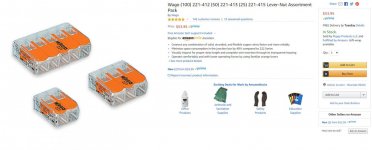
No twisting involved with the Wago Wall Nuts. I'm sure plenty will prefer the traditional wire nut, but I like this just as well. They are great when the f-tard that does some of the wiring in your house cuts the wires too short to wire nut easily.
 

hsvtoolfool

Well-known member
Joined
Jul 29, 2015
Messages
185
Location
Rocket City USA
No offense intended, but your question suggests you should hire an electrician. This is especially true if the job is big enough that you're concerned about wire nuts tiring your fingers. While this isn't rocket science, it does require training and practice. Poorly joined wires can cause fire. Running plugs and 1-way switches isn't complex, but code violations that seem frivolous and nonsensical can bite your **** when you try to sell your property later.

With that said, I worked my way thought college as a electrician back in the mid-1980s under the watchful eye of a master craftsman electrician...

For 14 GA and larger solid copper, get some big Klein Linesman pliers and that Klein stripper pliers shown above. Watch a video on how to strip wires, use the Linesman pliers to twist the bare copper for a tight, solid bond (it takes practice and good grip strength), use the Linesman pliers to cut the twist at the correct length for your wire nut (the cut "smears" the ends together and creates a sharp edge that good wire nuts love), and finally spin the wire nut on with your fingers good and tight.

The wire nut shrouds the twist to prevent shorts and also helps prevent the twisted wires from loosening over time. The wire nut provides only light mechanical support by biting into the wires to lock them in place. It's really the Linesman pliers that creates a tight twist and a strong mechanical bond. The blunt Linesman pliers cutter chomps/squashes the soft copper together to "seal" or "cap" the twist. The result of a good wire-twist in 12 GA copper can't be pulled apart even with no wire nut.

I haven't done this stuff in 30 years, so I doubt I have the grip strength any more for a real "pro" twist in 12 or 10 GA copper. When it's done right, the twisted wires looks more like a stack of BBs rather than a Barber Pole. In other words, you want the most twists-per-inch possible. The goal is maximum wire-to-wire surface area to carry current loads without heating up. This gets really difficult and requires serious grip strength when 3 or 4 wires are twisted together inside a ceiling light box. Frankly, I wouldn't trust myself to do this right anymore with my wimpy, engineer forearms.

For doorbell wire or sprinkler system wire (16 GA and smaller), just twist the wires together with your fingers tightly as possible, and then spin on the wire nut. I prefer to use my Linesman pliers for a good tight twist even with light wires because I once sliced my index finger open on some bell wire that had a sharp edge I didn't see. In any case, the wire nut plays a bigger role holding things together and making good contact with bell wire. Some guys just put the bare wires side-by-side and then spin the wire nut on. This action both grabs and twists the wires together. I think you can waste a lot of time trying to get the wire nut to "catch" with this technique, but to each his own. The bottom line is that small gauge wire carries very little current so a good wire twist is really not that critical.

Always use the correct wire nut size for your wire gauge. There's a large size nut for 14 and 12 gauge wire and many smaller sizes for sprinkler system and bell wire.

Finally, there are "pro" wire nuts that have "wings" for finger grips for 14 GA and larger wire. You can apply more torque and it saves your fingers over time. The ones I like are red and available at electrical supply houses. Smaller gauge wire nuts don't have these "wings", but you also don't need them.

Just watch some videos and practice. The techniques are hard to describe with text. It is feasible to DIY your own electrical in many areas, but you must research and follow your local electrical code. Wire nuts are a trivial topic compared to knowing your codes. I hope this helps.
 

dogdog

Well-known member
Joined
Nov 15, 2011
Messages
12,711
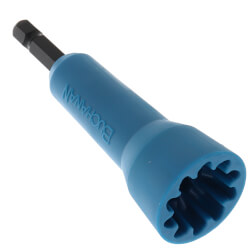
I have something different, it's at the end of one of those multi functional screw drivers from Commercial Electric, green color that they sold at HD... (now I can't find it) basically it's a multi functional screw driver with extra comfortable grip and at the end with a wire nut setting on the other side of the handle... While googling found this might be what the OP is looking for... probably better with some of those 7.2v drivers...

30-902-1.jpg


https://www.supplyhouse.com/Ideal-3...MI9unu2PfK4AIVaLXtCh3FkgksEAQYASABEgI7X_D_BwE

I mean if you got to use this type of tools, either you have a medical condition, you are doing it day in and day out .... a house worth of electrical connectors... it's nothing....

You would just pre-twist with electrician's pliers (one or two turns) and cap it on... whats the big deal?
 
Last edited:

engineer2

Well-known member
Joined
Dec 13, 2009
Messages
11,795
Location
Chicago burbs

Attachments

  • ideal-electrical-screwdrivers-nut-drivers-35-083-64_1000.jpg
    ideal-electrical-screwdrivers-nut-drivers-35-083-64_1000.jpg
    26.2 KB · Views: 44

Git

Well-known member
Joined
May 18, 2008
Messages
6,894
Location
S Cal
I agree with the WAGO comment

When they wired my house, the electrician decided to just crimp the grounds together with a copper sleeve. Made it a real pain in the *** when I upgraded to Z-Wave switches and dimmers. WAGO lever locks might cost a little more upfront, but they are so easy to work with, it's worth it - at least to me. And then I can recount the story where I had a problem with some outlets not working and finally traced it back to several neutral wires that were twisted together with a wire nut. It looked like they were all connected, but one of the wires was actually broken, right where you use a stripper to remove the insulation

attachment.php
 

Attachments

  • GR8-242.jpg
    GR8-242.jpg
    84.9 KB · Views: 337
To avoid these ads, REGISTER NOW!

JBH

Well-known member
Joined
Jan 17, 2018
Messages
811
I may be involved in a new house electrical wiring project. My question is what tool do professional electricians use for electrical wire nut installation? Is there a good functional hand tool? I would prefer to avoid carrying a drill/driver and, also, save my fingers/hands.


Not my job but I’ve done a little bit of wiring work...
As others have mentioned, the Ideal 21-in-1 ratcheting screwdriver has an effective wire but twister on the back, though often wire nuts packed with ceiling fans or light fixtures won’t have enough for it to grab ahold of. The screwdriver itself is pretty nice too, except that it doesn’t take standard bits. Reasonably inexpensive, too.
 
Joined
Jan 3, 2019
Messages
5
Location
TX
Fingers... Klein tools are pretty much all I use... dikes-sidecutters are nice to have also... I have some Milwaukee, Dewalt & HF stuff for electrical work but mostly grab Klein

A ratcheting screwdriver is nice too if not using cordless drill/impact
 

theoldwizard1

Well-known member
Joined
Feb 22, 2011
Messages
43,115
Location
SE MI
If you can not sufficiently tighten a wire nut with your fingers, there is something wrong !

Occasionally, when trying to twist more than 2 wire together, you need some help just getting the wires twisted. Linesmen pliers have jaw that are specifically designed th slide over the wires as you twist them. Start with extra long bare wire. Do at least 3 full twists with the pliers. Trim them excess and apply them nut giving at least one additional full twist.
 

pstemari

Well-known member
Joined
Jan 7, 2012
Messages
903
Location
Seattle
Using pliers to twist the wires together is really the key thing. Making certain to get a symmetric twist is important, especially when working with different gauges of wire.

I like to hold the insulated part of the wire with my needlenose pliers, then grab the ends with the lineman's pliers and twist them tight.

Sent from my Pixel XL using Tapatalk
 

scooby074

Well-known member
Joined
Oct 26, 2008
Messages
5,233
Location
Nova Scotia
Klein curve strippers. Klein Linesmens aka hammer. and Ideal Twisters for marrettes. No tool to twist, just fingers (after twisting with linesmens)
 

Mr Ratchet

Well-known member
Joined
Mar 3, 2011
Messages
928
Location
Michigan
I use my fingers for wire nuts. When I built my house, I wired the whole thing. I did not have to nut the bare grounds. The inspector said that there must be at least four tight twists to keep them together. I used a pair of slip joint pliers for that.
I use a few tools for wiring switches, outlets, light/junction boxes. Knipex 10" wire cutters, SO slip joint pliers, razor knife, Williams ratcheting T-handle screw driver (phillips bit), and a Wera cabinet screw driver. I use a razor knife and run it down the middle of the wire to slice one side of the out side insulation. I pull the wires free and use my dykes to snip off the outer insulation and the paper. Then I cut it to length with my dykes and use them to strip the hot and neutral wires. Twist the grounds at least four times with the slip joints. Trim all of them except any that go to the ground on the switch/outlet. Wire nut any hot or neutral wires and connect the rest to the switch/outlet. The same goes for light and junction boxes. Use the ratcheting screw driver on the switch/outlet to attach it to the box. Use the cabinet screw driver for the cover plate.

I've also used this method on my basement when I finished it off, my shed and pool house. I've also wired a coupe houses and basements for friends.
 

Rattle

Active member
Joined
Dec 28, 2018
Messages
36
Location
Vancouver, bc
Forget about the Romex stripper. A utility knife with replaceable blades way more versatile. I prefer the ones that fold like a pocket knife.

Skip a 4-1, 10-1 screwdriver and instead go for separate decent quality screwdrivers you require.

Wire nuts are basically like electrical tape and are not difficult to twist on my hand if you have twisted the conductors with a pair of pliers first.
 

Marctrees

Well-known member
Joined
Mar 5, 2015
Messages
6,265
Location
TX/LA border - Toledo Bend
NEVER buy wire nuts w/o wings.

Kinda like buying phillips deck screws when you can buy Torx.

THOSE are the ones most difficult on the fingers.

Really silly.

My personal pref is specifically either Ideal Wing nuts, or second choice.. 3M Ranger nuts.

Often it helps to bend your bundle at 90 degrees a few inches away from the nut.. so now you have something much easier to hold rather than major finger pressure trying to keep a bundle from spinning while you tighten the nut w the other hand.

Kinda like using a T handle allen wrench compared to small ell "regular" one.

Marc
 

Marctrees

Well-known member
Joined
Mar 5, 2015
Messages
6,265
Location
TX/LA border - Toledo Bend
If I was still in the wiring biz, I would probably also be carrying a tool like in post #16 but NOT in a drill, rather just plugged into a short hand holder.

That would DEFINATELY be a finger saver.

Marc
 

speed bump

Well-known member
Joined
May 28, 2008
Messages
6,317
Location
Butte Montana
I have a couple of Ideal screwdrivers with a wire nut twister in the handle. Maybe I am just a wimp but I break it out whenever I have a bunch of wire nuts to do. It's faster because I don't have my fingers in with the rest of the wires and I usually do a better job of ensuring the connection was adequately twisted together.
 

Marctrees

Well-known member
Joined
Mar 5, 2015
Messages
6,265
Location
TX/LA border - Toledo Bend
The ones w a hole for the nut in the handle **** end may be ok for some.. but I found them like intuitively ergonomically clumsy and weird.

Part if it is it just feels weird in the hand.. and ALSO the fact that everytime you withdraw it from your pouch you need to flip it end for end.

Wasted effort if you do it hundreds of times x day.

Just did not work out for me.

Marc
 

usdemt

Well-known member
Joined
Nov 1, 2010
Messages
644
Location
South Dakota
I am no professional but have wired houses and garages. I have gone to Wago push in style. They are super easy to use and almost the same price wise as wire nuts. I have not had good luck with them for stranded wire even though they say they can be used as such.

I keep one of the Ideal drivers with the wire nut wrench in the handle and it does come in handy once in a blue moon but usually its just quicker to do it with my hand. I like it, but i dont think it makes it any quicker.
 

Marctrees

Well-known member
Joined
Mar 5, 2015
Messages
6,265
Location
TX/LA border - Toledo Bend
The Wago thing may be great... I have NO idea.

It is "New School"

What I do know is.. Traditional well properly installed Wire nuts on a properly pre twisted connection are excellent.

Thing is.. That method has NO negatives other then the manual and brain education to do it properly labor.

Marc
 

usdemt

Well-known member
Joined
Nov 1, 2010
Messages
644
Location
South Dakota
The Wago thing may be great... I have NO idea.

It is "New School"

What I do know is.. Traditional well properly installed Wire nuts on a properly pre twisted connection are excellent.

Thing is.. That method has NO negatives other then the manual and brain education to do it properly labor.

Marc

Except that the proper process of using a wire nut involves stripping, twisting then using the nut. Wago nuts is just strip the wire and push. They are certified and once the wire is in and has a little twist to it making it easier to put everything back in the box. There are negatives to wire nuts, lots of them...but I guess with everything 50 years of innovation only held back by tradition....:shocking:
 

sberry

Banned
Joined
Jun 18, 2005
Messages
35,747
Location
Brethren, Michigan
Wing nuts are good but some of the crappier splice jobs I have seen is by professionals. It's not a law you pre twist first, I don't and don't like it. I lay them together carefully with enough strip I can see they are drawing all the same length , when it's done they are tight enough they are twisted in an assembly. I think pre twisting can actually be detrimental. It adds extra steps.
 

sberry

Banned
Joined
Jun 18, 2005
Messages
35,747
Location
Brethren, Michigan
Nothing wrong with getting a tool for a little help. The only reds I had in my pocket yesterday were ones without wings, I had to work at it a little to get them tight.
For giggles I looked at Ideal vid, I see that pre twist is a recommended method, I wasn't sure it was.
 
Last edited:

pcmeiners

Well-known member
Joined
Aug 13, 2009
Messages
7,868
Location
In the only town in Pennsylvania, Bloomsburg.
"If you can not sufficiently tighten a wire nut with your fingers, there is something wrong !"

Seriously, it sounds like a lot of people just don't know their limitations.

"I think pre twisting can actually be detrimental. It adds extra steps. "

In NYC the "professional " electricians many times do not pre-twist. Can't tell you how many lose wire bundles, shorts, open circuits I have found due to this. As it is often the case, most of the issues are due to poor workmanship, not the materials or procedures.
 
To avoid these ads, REGISTER NOW!
Top Bottom