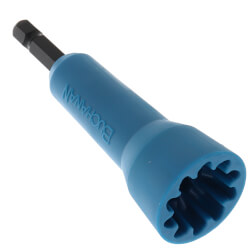
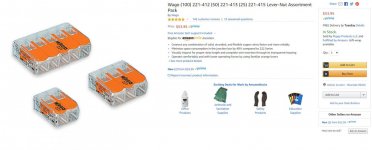
No offense intended, but your question suggests you should hire an electrician. This is especially true if the job is big enough that you're concerned about wire nuts tiring your fingers. While this isn't rocket science, it does require training and practice. Poorly joined wires can cause fire. Running plugs and 1-way switches isn't complex, but code violations that seem frivolous and nonsensical can bite your **** when you try to sell your property later.
With that said, I worked my way thought college as a electrician back in the mid-1980s under the watchful eye of a master craftsman electrician...
For 14 GA and larger solid copper, get some big Klein Linesman pliers and that Klein stripper pliers shown above. Watch a video on how to strip wires, use the Linesman pliers to twist the bare copper for a tight, solid bond (it takes practice and good grip strength), use the Linesman pliers to cut the twist at the correct length for your wire nut (the cut "smears" the ends together and creates a sharp edge that good wire nuts love), and finally spin the wire nut on with your fingers good and tight.
The wire nut shrouds the twist to prevent shorts and also helps prevent the twisted wires from loosening over time. The wire nut provides only light mechanical support by biting into the wires to lock them in place. It's really the Linesman pliers that creates a tight twist and a strong mechanical bond. The blunt Linesman pliers cutter chomps/squashes the soft copper together to "seal" or "cap" the twist. The result of a good wire-twist in 12 GA copper can't be pulled apart even with no wire nut.
I haven't done this stuff in 30 years, so I doubt I have the grip strength any more for a real "pro" twist in 12 or 10 GA copper. When it's done right, the twisted wires looks more like a stack of BBs rather than a Barber Pole. In other words, you want the most twists-per-inch possible. The goal is maximum wire-to-wire surface area to carry current loads without heating up. This gets really difficult and requires serious grip strength when 3 or 4 wires are twisted together inside a ceiling light box. Frankly, I wouldn't trust myself to do this right anymore with my wimpy, engineer forearms.
For doorbell wire or sprinkler system wire (16 GA and smaller), just twist the wires together with your fingers tightly as possible, and then spin on the wire nut. I prefer to use my Linesman pliers for a good tight twist even with light wires because I once sliced my index finger open on some bell wire that had a sharp edge I didn't see. In any case, the wire nut plays a bigger role holding things together and making good contact with bell wire. Some guys just put the bare wires side-by-side and then spin the wire nut on. This action both grabs and twists the wires together. I think you can waste a lot of time trying to get the wire nut to "catch" with this technique, but to each his own. The bottom line is that small gauge wire carries very little current so a good wire twist is really not that critical.
Always use the correct wire nut size for your wire gauge. There's a large size nut for 14 and 12 gauge wire and many smaller sizes for sprinkler system and bell wire.
Finally, there are "pro" wire nuts that have "wings" for finger grips for 14 GA and larger wire. You can apply more torque and it saves your fingers over time. The ones I like are red and available at electrical supply houses. Smaller gauge wire nuts don't have these "wings", but you also don't need them.
Just watch some videos and practice. The techniques are hard to describe with text. It is feasible to DIY your own electrical in many areas, but you must research and follow your local electrical code. Wire nuts are a trivial topic compared to knowing your codes. I hope this helps.