To avoid these ads, REGISTER NOW!

Electrolysis rust removal gone wrong

mrklean

Member
Joined
Apr 16, 2024
Messages
17
Hey all,

Cast Iron pans are kitchen tools, right? L'est that's the way I chose this place to post..... :)

I know plenty of people have used electrolysis to remove rust from anything, and it does work great. Unless you don't read really far into the process and some of the bumps in the road.... I.e. Myself.

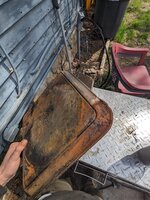
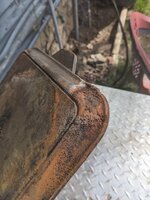
I grabbed a handy large rubbermaid tub, some 14ga romex, chunks of 1/2" rebar, an ebay boost-buck converter, a laptop power supply, and salt. Put everything together, neg on parts, pos on anodes, etc and let'er eat at 13v ~3.5amps. What a nasty mess came off of my ~10 cast iron pans I stacked together and wired together in the bath. Pan check after a day, and it's definitely doing its job! Because of the ~40lbs of steal in the bin, I decided to let it sit for a few days. (insert foreshadowing here)

Flash forward, and I go to clean my anodes and find that, well, they're mostly missing. They've been eaten away. A concerning find at best. I pull the pans from the solution and find out the hard way, that enough rust/debris/iron oxides/etc will collect in the bottom of the tank that it can make some sort of layer at the bottom that will conduct electricity from the anode to the crud directly and cause degradation of my anodes and deposition of that material into the pans that are touching this layer on the bottom. At least that's what I ~think happened.

Long story short, my pans were too close to the bottom of the tank and appear to have had the steel from the rebar hastily deposited on them. Only in an area that appears to be where they we're within ~3-4 inches of the bottom of the tank. I tried to scrape this steel off, and some has chipped off, but it's not fun to get off.

Electrolysis to the rescue, again, right? If it can deposit the material, it might be able to take it back off? I ran a single pan, floating high in the water column to ensure I didn't get a twofer, and yes, it ~kind of, loosened up the thicker deposit areas where they are able to flake off. The problem is this took 3-4 days in the tub, it really doesn't appear to be fully removed, just the thick areas, and I have ~10 pans to do now.

Does anyone have any advice on what happened / is there anything I can do?
 

Attachments

  • PXL_20240416_155757116.jpg
    PXL_20240416_155757116.jpg
    898.3 KB · Views: 293
  • PXL_20240416_155814567.jpg
    PXL_20240416_155814567.jpg
    1 MB · Views: 305
  • PXL_20240416_155818102.jpg
    PXL_20240416_155818102.jpg
    734.2 KB · Views: 299
  • PXL_20240416_155824761.jpg
    PXL_20240416_155824761.jpg
    921.7 KB · Views: 304
To avoid these ads, REGISTER NOW!

Digster

Well-known member
Joined
Jul 20, 2021
Messages
65
Everybody has something they like to use for stripping cast iron. Personally I put them in a backyard fire pit when I use it. Leave them in there all night as the fire burns out and they are in the coals. In the morning remove them and was thoroughly moving straight into process of seasoning them, use your preferred method for seasoning.
 

RTM

Well-known member
Joined
May 13, 2019
Messages
13,082
Location
SF Bay Area
Put everything together, neg on parts, pos on anodes,
Brain fade here, but I thought it was Red to Rust. Don’t quote me. I’ve only done it one time.

Yep or Black to pan!


Here's your answer on polarity

From my 2003 copy of the web page of lord knows who anymore

Clip the "positive" red lead of your battery charger to the object you've chosen for an anode and place to the side or at one end of your vat.


I think @mrklean got that part right. reverse it, and you are derusting your anode. You other guys might want to check your notes.
 
OP
M

mrklean

Member
Joined
Apr 16, 2024
Messages
17
Salt? Why salt, all I've ever used is washing soda, which is sodium bicarbonate. Salt give you hydrogen and chlorine as off gasses.
It's all I had laying around. Tank is outside, so chlorine production isn't a worry for me.
Here's your answer on polarity

From my 2003 copy of the web page of lord knows who anymore

Clip the "positive" red lead of your battery charger to the object you've chosen for an anode and place to the side or at one end of your vat.


I think @mrklean got that part right. reverse it, and you are derusting your anode. You other guys might want to check your notes.
@RTM, yes you are correct. Electricity flows, counter intuitively, from Negative to Positive. So as I understand it, you want electron flow away from your part
Yep or Black to pan!
I would scrape everything you can off.
One of them look's gone.
I can see what you're saying with it looks gone from pictures, that is actually rusty and pitted deposits on top of the metal, the cast iron underneath is a-ok. Just got to figure out a way to get it off in spots where it's not so thick and chippable.
 

pelletman

Well-known member
Joined
Apr 5, 2016
Messages
1,264
Location
Worcester, People's Republic of Massachusetts
The black (negative) goes to the pan, black to black you want to attract the rust to the positive anode. I don't understand why you are using salt, it should be washing powder. You should also NOT do multiple pans at once, electrolysis works on line of sight, one pan at a time.
 

dogdog

Well-known member
Joined
Nov 15, 2011
Messages
12,711
I can see what you're saying with it looks gone from pictures, that is actually rusty and pitted deposits on top of the metal, the cast iron underneath is a-ok. Just got to figure out a way to get it off in spots where it's not so thick and chippable.
at least from your post, your polarity seems to be correct.

you sure it is not the salt it self? It will corrode raw cast irons pretty fast... it's probably not electrolysis. Don't remember the basic chemistry.. you can google it.

baking soda and bake it in the toaster over for 300F for 30 minutes or something when I can not find my super wash soda or that sodium tricarbonate or sodium carbonate in a pinch . ... not sodium bicarbonate ( baking soda)... heating up will release one of the carbon atoms or something. Super wash soda is cheap. $4 at target.

 
Last edited:

Beerhippie

Well-known member
Joined
Oct 13, 2023
Messages
9,669
Location
Far NE Oregon
Salt....

I'll bet those pans would have rusted badly without the current!

Why use one of the worst sources of rust we commonly encounter to remove rust?

The chloride ions from the salt are hard to remove. A simple rinse won't usually do the trick. The metal will keep on rusting as long as the chlorides are present on/in the surface. This is why road salt is so insidious and persistent.
 

gleman

Well-known member
Joined
Jun 24, 2019
Messages
2,977
Location
Michigan And Florida too!
I think @mrklean(ironic for this post)was close.

Except for throwing all the iron pans into a saltwater tank and leaving them for a prolonged period.

Which would be more effective, one large anode on one side or two anodes 180⁰ apart in the tank?

What's the ideal amperage for electrolysis? I usually just put my old Diehard on 2a. Would cutting up a 1a wall wart work just as well?
 

Beerhippie

Well-known member
Joined
Oct 13, 2023
Messages
9,669
Location
Far NE Oregon
I think @mrklean(ironic for this post)was close.

Except for throwing all the iron pans into a saltwater tank and leaving them for a prolonged period.

Which would be more effective, one large anode on one side or two anodes 180⁰ apart in the tank?

What's the ideal amperage for electrolysis? I usually just put my old Diehard on 2a. Would cutting up a 1a wall wart work just as well?
I use electrolysis extensively for cleaning steel, iron and cast iron. It's the easiest and most effective technique I've tried.

Electrolysis is somewhat line-of-sight--not entirely, but a surface directly facing the anode will clean much faster than one that's "shadowed". I either use multiple anodes or a single anode and turn the work occasionally.

I use mostly lye--sodium hydroxide or caustic soda--for my electrolyte. If you're comfortable, experienced and careful in working with caustic solutions, it's the best as it will remove grease and paint--which will work as resists with other electrolytes like washing soda--and rust.

(PSA: Lye will also rapidly remove flesh. If you get any on you, it takes many gallons of water to flush it off and you'll need to ditch any clothing that was wetted with it. A trip through the washing machine will make the clothes safe to wear again, but simple rinsing WILL NOT. Lye in the eyes is a nightmare--WEAR SAFETY GOOGLES!)


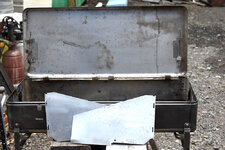
Here's an example of cleaning with lye and electrolysis, a large "suitcase" camp stove case, covered in many years of food residue, grease and several layers of paint:

49899655857_075207738f_b.jpg

After a few hours in my large electrolysis vat (35 gallon plastic barrel) with hot water and lye:

49906000063_00a0bcb207_b.jpg

The two wind screen "wings" in front got a little bit of elbow grease with a maroon ScotchBrite pad, but the rest is as it came out of the tank. A few minutes work and it'll be paint-ready.

I have been told that washing soda works almost as well, but I have lye and I'm careful.

I'd never consider using a chloride of any kind on ferrous metals. Chlorides are what I use when I want force things to rust, for instance, a rustic finish on outdoor ironwork.

Amperage will determine cleaning speed, to a fair degree. I use a 30A bench power supply--the same one I use for plating--and I like to see somewhere between 5 and 10A draw. Things that affect the current draw (amps) are surface area of the work and the anode(s) and concentration of the electrolyte. I generally limit the draw to 10A or less just to keep heat down in the wires.

I run the PS at 12 volts for electrolysis. Wattage (V * A) is actually what's doing the work, so a higher voltage means the same result at a lower amperage and allows use of smaller wires and power supplies.

The size of power supply you use will set the upper limit of the current draw, but does not determine it--refer to Ohm's Law (it's not just a good idea!): Volts=Amps * Resistance. Too concentrated an electrolyte or too much surface area of the work and anode(s) can cause an unprotected PS or your wiring to burn out--or burn up.

I use the amperage display of my PS to determine my electrolyte concentration. I put the workpiece and anode in the vessel I'll be using, fill with very hot water and then add my lye until I hit the amperage I've set as my target--so I have no nice formulas for you. Somewhere around 1/4 cup/gallon would be a good guess.
 
OP
M

mrklean

Member
Joined
Apr 16, 2024
Messages
17
Stellar post @Beerhippie.

at least from your post, your polarity seems to be correct.

you sure it is not the salt it self? It will corrode raw cast irons pretty fast... it's probably not electrolysis. Don't remember the basic chemistry.. you can google it.

baking soda and bake it in the toaster over for 300F for 30 minutes or something when I can not find my super wash soda or that sodium tricarbonate or sodium carbonate in a pinch . ... not sodium bicarbonate ( baking soda)... heating up will release one of the carbon atoms or something. Super wash soda is cheap. $4 at target.

Never heard of the conversion trick. I stole the wife's baking soda from our fridge and slapped it in the oven.

I figured electrolyte was electrolyte, hence the salt. I'll report back after I dump my tub and refill it with water and my fresh baked baking soda.
 

dogdog

Well-known member
Joined
Nov 15, 2011
Messages
12,711
Stellar post @Beerhippie.


Never heard of the conversion trick. I stole the wife's baking soda from our fridge and slapped it in the oven.

I figured electrolyte was electrolyte, hence the salt. I'll report back after I dump my tub and refill it with water and my fresh baked baking soda.

LOL.... she'll slap you into the oven when the fridge smells.

anyways.. don't need that much just about few spoon full was all I have used on that 27-ish gallon tub or something..
 
To avoid these ads, REGISTER NOW!

Beerhippie

Well-known member
Joined
Oct 13, 2023
Messages
9,669
Location
Far NE Oregon
Why fool around? If you spend 5 bucks or so, you can get a 3 1/2 pound box of this and you’ll be set for a very long time. Supermarket, Walmart Amazon, Lowe’s …easy to find.
9C2D25AA-8B92-4E84-B7D5-1D73DCC0939A.jpeg
Lye, should you wish to risk it, is also on the shelf and inexpensive:

52979903159_3e06f69759_b.jpg

That was ACE last year, but still there. Plumbing aisle.

Something important I forgot in the previous post:

Always add lye to water! Not the other way around! Lye dissolving in water is an exothermic reaction--it creates heat--lots of heat. In fact, adding a small amount of hot water to a large amount of dry lye crystals can result in what's called a "violently explosive exothermic reaction". Since such a reaction will throw hot, concentrated lye everywhere, I consider it something to avoid.

In fact, when dissolving nearly any dry or concentrated chemical in water, it makes sense to do the same. The larger volume of water will act as a heat sink just in case.
 

MoonRise

Well-known member
Joined
Nov 5, 2010
Messages
4,028
Location
NJ
Salt? Why salt, all I've ever used is washing soda, which is sodium bicarbonate. Salt give you hydrogen and chlorine as off gasses.

Washing soda is sodium carbonate.

Baking soda is sodium bicarbonate.

You can turn sodium bicarbonate into sodium carbonate by baking it in an oven to drive of some water molecules and some CO2.

2NaHCO3 → Na2CO3 + H2O + CO2

Washing soda is a stronger alkali (pH about 10-11, depending on solution strength) than sodium bicarbonate (pH about 8 or so, again depending on solution strength).

Both are weaker than sodium hydroxide (aka lye, which can reach a pH of ~14). Which is a STRONG alkali. Head the warnings above about adding lye to water and not the other way around, and about dangers to body parts (dissolves them, skin or eyes or other parts).

As to the OP, I'd tend to using an angle grinder with a wire wheel. Because I have those items, and they work to remove rust from steel/iron. At the risk of removing some of the base material.
 

LopezBart

Well-known member
Joined
Oct 13, 2023
Messages
2,525
Location
Lopez Island, WA
TSP (tri-sodium phosphate) also works well for this, and has a pretty high pH (12-14), but avoids the heating issues w/ lye. I've boiled parts in a relatively weak TSP solution to clean them with good results.
 

Beerhippie

Well-known member
Joined
Oct 13, 2023
Messages
9,669
Location
Far NE Oregon
TSP (tri-sodium phosphate) also works well for this, and has a pretty high pH (12-14), but avoids the heating issues w/ lye. I've boiled parts in a relatively weak TSP solution to clean them with good results.
I regularly boil the CI burners off the commercial kitchen range here in a lye solution to remove the baked-on grease and crud. Just have to treat it with respect. Unfortunately, I haven't found anything that works remotely as well. Maybe a blast cabinet--but I don't have one.
 

LopezBart

Well-known member
Joined
Oct 13, 2023
Messages
2,525
Location
Lopez Island, WA
I regularly boil the CI burners off the commercial kitchen range here in a lye solution to remove the baked-on grease and crud. Just have to treat it with respect. Unfortunately, I haven't found anything that works remotely as well. Maybe a blast cabinet--but I don't have one.

I spent summer of 80 working as a research assistant in Ag Engineering at UC Davis; we did some work on solar drying prunes to help farmers save on natural gas, since it was quite expensive at the time. Anyway, if you don't check the skins (crack them), you get plum brandy because the plum skins are quite tough and keep the water in. We blanched the plums in a metal basket 5 gallons worth at a time, dipping them in a dilute boiling lye solution in a 55 gallon drum, the heat coming from a hose from the university steam plant. It sounding like a giant expresso machine frothing milk as the steam bubbles collapsed. I've thought about such a setup for cleaning bulky items; I have plenty of steam from an old steamboat boiler. Everything that went into the barrel was cleaned right down to the steel.
 

Beerhippie

Well-known member
Joined
Oct 13, 2023
Messages
9,669
Location
Far NE Oregon
I spent summer of 80 working as a research assistant in Ag Engineering at UC Davis; we did some work on solar drying prunes to help farmers save on natural gas, since it was quite expensive at the time. Anyway, if you don't check the skins (crack them), you get plum brandy because the plum skins are quite tough and keep the water in. We blanched the plums in a metal basket 5 gallons worth at a time, dipping them in a dilute boiling lye solution in a 55 gallon drum, the heat coming from a hose from the university steam plant. It sounding like a giant expresso machine frothing milk as the steam bubbles collapsed. I've thought about such a setup for cleaning bulky items; I have plenty of steam from an old steamboat boiler. Everything that went into the barrel was cleaned right down to the steel.
I've visited and worked in several places that used direct-steam injection to heat water. Damn, but that's LOUD!

Oh, yeah, electrolysis... that's what the thread was about.... Used it again today to clean an old tool--IH farm implement wrench with about twenty layers of paint. I think my favorite part of it is that it's about 0% involvement once set up and running. I can be doing several other things while the "scrubbing bubbles" do the work for me. It's pretty much a tie between electrolysis and ultrasonic for my favorite cleaner.
 
OP
M

mrklean

Member
Joined
Apr 16, 2024
Messages
17
Right, update....

Dumped my black water mess of water and salt. Unfortunately my brain went, salt water will kill the grass and anything it touches, so I dumped it in the gravel driveway. Now it looks like BP had their next major oil spill. Turns out that black oxide and iron stains clear stone....

Baking the wife's baking soda from the fridge seems to have worked? Added it to a rubbermaid container and filled with water. Added electricity and it bubbles again. If I could stop dropping the new file I'm using as an anode into the bottom of the tub, that'd be great.

First pan in the soak was not a pan at all, but a cast iron dutch oven lid, that had some serious iron plating. The loose flakey iron seems to be gone, however, there is definitely an area of shiny iron (steel?) plating left over that won't come off. I baked it in the oven to see what it dried like. Shiny over the dark gray of cast iron. Not flakey though.

I'm going to let this pan sit out in the elements and re-rust to see how the new iron plate reacts. If it doesn't start to loosen up, I think I'm just going to call these pans blemished and put them to work in my kitchen. A little bit of extra iron underneath the seasoning never hurt anyone. Or at least I think so....

Live and learn. Unfortunately, I really learned on 10 pans, not all cheap modern junk either....

More updates to come. And maybe some pictures
 

pfaustus

Well-known member
Joined
Feb 6, 2016
Messages
361
Salt....

As I understand it, you want to avoid using anything with a chloride as an electrolyte. The chlorine ions restart the rust immediately after the metal leaves the water. Supposedly, museums preserving marine artifacts use low power electrolysis until testing shows no more sodium from sea water coming off. Years. Decades even. They talk about using electrolysis for the Monitor here: https://sanctuaries.noaa.gov/news/aug16/restoring-the-turret-of-the-uss-monitor.html
 
Last edited:
OP
M

mrklean

Member
Joined
Apr 16, 2024
Messages
17
Salt....
And TSP

As I understand it, you want to avoid using anything with sodium as an electrolyte. The sodium restarts the rust immediately after the metal leaves the water. Supposedly, museums preserving marine artifacts use low power electrolysis until testing shows no more sodium from sea water coming off. Years. Decades even. They talk about using electrolysis for the Monitor here: https://sanctuaries.noaa.gov/news/aug16/restoring-the-turret-of-the-uss-monitor.html
Interesting idea on the turret. Hopefully my few days of soak in salt water did not do the same vs the 140 years.

Coating and sealing the cast iron in seasoning (plasticized oil) should hopefully stop any lingering sodium from causing issue. But if it doesn't. Well. Im out about a hundo but they might make cool targets.
 

Beerhippie

Well-known member
Joined
Oct 13, 2023
Messages
9,669
Location
Far NE Oregon
Tell your wife that the baking soda in the fridge was "worn out" and needed to be replaced!

Then go out and buy some washing soda....

Maybe find some less valuable rusty metal to practice on?
 

pfaustus

Well-known member
Joined
Feb 6, 2016
Messages
361
Beerhippie, Probably. Except I wrote about the wrong chemical. I remembered sodium as the bad guy, but it was chlorine. I fixed it, but you had already quoted it.
 

Beerhippie

Well-known member
Joined
Oct 13, 2023
Messages
9,669
Location
Far NE Oregon
Salt....

As I understand it, you want to avoid using anything with a chloride as an electrolyte. The chlorine ions restart the rust immediately after the metal leaves the water. Supposedly, museums preserving marine artifacts use low power electrolysis until testing shows no more sodium from sea water coming off. Years. Decades even. They talk about using electrolysis for the Monitor here: https://sanctuaries.noaa.gov/news/aug16/restoring-the-turret-of-the-uss-monitor.html
It's the chlorides from the sodium chloride that cause the problems. Maybe the sodium is just an easier indicator to track?

Sodium hydroxide--lye--will absolutely not cause iron to rust. We use lye for a cleaner in the brewery--as most do--and it will strip paint like no one's business, but the iron (structural steel) around the brewery just turns black and stays that way in a near-100% RH environment.

We avoid chlorides like the plague. Under acidic conditions--like, for instance, beer--they will make stainless steels of the best grades rust. Chlorine dioxide is fine and commonly used as a sanitizer.
 

Lorydr

Well-known member
Joined
Sep 10, 2015
Messages
645
Location
Piqua, oHIo
I have no business doing electrified & chemical cleaning of parts. Baking soda media in a crude blaster from my air supply cleaned up my carb so well.

I sometimes put ketchup on a rusty part, and it does an ok job.
 
To avoid these ads, REGISTER NOW!
Top Bottom