Hey all,
Cast Iron pans are kitchen tools, right? L'est that's the way I chose this place to post.....
I know plenty of people have used electrolysis to remove rust from anything, and it does work great. Unless you don't read really far into the process and some of the bumps in the road.... I.e. Myself.
I grabbed a handy large rubbermaid tub, some 14ga romex, chunks of 1/2" rebar, an ebay boost-buck converter, a laptop power supply, and salt. Put everything together, neg on parts, pos on anodes, etc and let'er eat at 13v ~3.5amps. What a nasty mess came off of my ~10 cast iron pans I stacked together and wired together in the bath. Pan check after a day, and it's definitely doing its job! Because of the ~40lbs of steal in the bin, I decided to let it sit for a few days. (insert foreshadowing here)
Flash forward, and I go to clean my anodes and find that, well, they're mostly missing. They've been eaten away. A concerning find at best. I pull the pans from the solution and find out the hard way, that enough rust/debris/iron oxides/etc will collect in the bottom of the tank that it can make some sort of layer at the bottom that will conduct electricity from the anode to the crud directly and cause degradation of my anodes and deposition of that material into the pans that are touching this layer on the bottom. At least that's what I ~think happened.
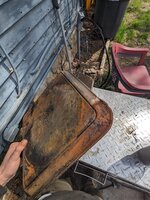
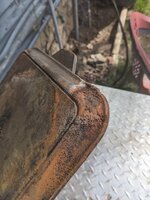
Long story short, my pans were too close to the bottom of the tank and appear to have had the steel from the rebar hastily deposited on them. Only in an area that appears to be where they we're within ~3-4 inches of the bottom of the tank. I tried to scrape this steel off, and some has chipped off, but it's not fun to get off.
Electrolysis to the rescue, again, right? If it can deposit the material, it might be able to take it back off? I ran a single pan, floating high in the water column to ensure I didn't get a twofer, and yes, it ~kind of, loosened up the thicker deposit areas where they are able to flake off. The problem is this took 3-4 days in the tub, it really doesn't appear to be fully removed, just the thick areas, and I have ~10 pans to do now.
Does anyone have any advice on what happened / is there anything I can do?
Cast Iron pans are kitchen tools, right? L'est that's the way I chose this place to post.....
I know plenty of people have used electrolysis to remove rust from anything, and it does work great. Unless you don't read really far into the process and some of the bumps in the road.... I.e. Myself.
I grabbed a handy large rubbermaid tub, some 14ga romex, chunks of 1/2" rebar, an ebay boost-buck converter, a laptop power supply, and salt. Put everything together, neg on parts, pos on anodes, etc and let'er eat at 13v ~3.5amps. What a nasty mess came off of my ~10 cast iron pans I stacked together and wired together in the bath. Pan check after a day, and it's definitely doing its job! Because of the ~40lbs of steal in the bin, I decided to let it sit for a few days. (insert foreshadowing here)
Flash forward, and I go to clean my anodes and find that, well, they're mostly missing. They've been eaten away. A concerning find at best. I pull the pans from the solution and find out the hard way, that enough rust/debris/iron oxides/etc will collect in the bottom of the tank that it can make some sort of layer at the bottom that will conduct electricity from the anode to the crud directly and cause degradation of my anodes and deposition of that material into the pans that are touching this layer on the bottom. At least that's what I ~think happened.
Long story short, my pans were too close to the bottom of the tank and appear to have had the steel from the rebar hastily deposited on them. Only in an area that appears to be where they we're within ~3-4 inches of the bottom of the tank. I tried to scrape this steel off, and some has chipped off, but it's not fun to get off.
Electrolysis to the rescue, again, right? If it can deposit the material, it might be able to take it back off? I ran a single pan, floating high in the water column to ensure I didn't get a twofer, and yes, it ~kind of, loosened up the thicker deposit areas where they are able to flake off. The problem is this took 3-4 days in the tub, it really doesn't appear to be fully removed, just the thick areas, and I have ~10 pans to do now.
Does anyone have any advice on what happened / is there anything I can do?


:max_bytes(150000):strip_icc()/chemical-reaction-pipette-0-5m-solution-of-sodium-carbonate-na2co3-in-0-25m-solution-of-lead-ii-nitrate-pb-no3-2-white-lead-ii-carbonate-precipitate-pbco3-result-pb-no3-2-na2co3-pbco3-nano3-667616693-58a3b6885f9b58819ca93ae9.jpg)