To avoid these ads, REGISTER NOW!

Electronics - Modifying decorative RGBW light strips

onewheat

Well-known member
Joined
Feb 19, 2012
Messages
1,286
Location
Knoxville, TN
I have a 5 conductor flexible RGBW LED strip that has three 12' connectible sections for a total of a 36' tape. I want to modify it with some space between sections so I have four 5' sections with a foot or so of wire between sections so I can individually light four horizontal bar shelves without a vertical light section running between shelves. There are cut spots on the strips in 1' increments that you can make the strips shorter. I am cutting in 5' sections and resoldering and connecting with a solid 22-24 gauge wire. I have done this with two sections and when I add the third, only the first two feet of the section lights up. I thought I had a bad section, so I cut another strip and the same thing happens - only the first two feet of the third 5' strip lights up.

So my question is - in adding soldered wire to the circuit, am I creating additional resistance that makes the voltage too low further down the circuit not allowing LEDs past 12' to light up or am I just running into two bad sections in a row? All sections worked previously to cutting and soldering. I am kind of winging this and it isn't like I can call customer support to ask.

Maybe another option would be to run all sections individually from the controller vs running them in-line thus having FOUR 5' runs from the controller vs a 20' run (with four 5' sections separated by a length of wire)?

Any ideas?
 
To avoid these ads, REGISTER NOW!

Brian_WK

Well-known member
Joined
Jun 30, 2015
Messages
1,177
Location
NE South Dakota
Your getting too much of a voltage drop by the 3rd string if you are wiring in series. The solder isn't the issues its the conductors in the strip lights the gauge is to small with the amp load from the LED You can Use http://www.calculator.net/voltage-drop-calculator.html To determin the theroretical length you can do before you either need to add another transformer/power source or a larger guage jumper to the leads from the transformer.

Or your:
Maybe another option would be to run all sections individually from the controller vs running them in-line thus having FOUR 5' runs from the controller vs a 20' run (with four 5' sections separated by a length of wire)?

Would work
 
OP
O

onewheat

Well-known member
Joined
Feb 19, 2012
Messages
1,286
Location
Knoxville, TN
Or your:
Maybe another option would be to run all sections individually from the controller vs running them in-line thus having FOUR 5' runs from the controller vs a 20' run (with four 5' sections separated by a length of wire)?

Would work

I think I will try this to see. It supposedly will power more than the 36' that comes with it but I wasn't sure how much the bell wire was interfering with voltage down the line.
 

rlitman

Well-known member
Joined
Oct 18, 2010
Messages
24,651
Location
Long Island
From what I've seen, the reason that these are sold in 3m (around 16') strips, is that is the longest length you can reliably light by just powering one end. Any more than that, and no matter how big your power supply, the wiring within the strip just can't support that much current.

So, if you give each piece a home run with wire, you should be good.

Or, if you were planning this out from day 1, another option would be to use 24V strips. They hit the market when people started seeing the limitations of 12V.
 
OP
O

onewheat

Well-known member
Joined
Feb 19, 2012
Messages
1,286
Location
Knoxville, TN
I am using 24v strips and I have 22.9v at the start of the third section.

I did unsolder the third section and soldered it to a 1' piece and plugged it in direct to the front of the line and it works normally - this supports the voltage drop theory. I guess I'm starting over.
 
Last edited:
OP
O

onewheat

Well-known member
Joined
Feb 19, 2012
Messages
1,286
Location
Knoxville, TN
Well, that worked! So far, so good - need to install and hope everything holds.
65552bca775041c35d1ea0db30bcf0da.jpg


Sent from my iPhone using Tapatalk
 

Attachments

  • 65552bca775041c35d1ea0db30bcf0da.jpg
    65552bca775041c35d1ea0db30bcf0da.jpg
    356 KB · Views: 0

PhysicsDude

Well-known member
Joined
Jan 28, 2013
Messages
805
Location
Dallas, TX
How did you fix your issue? Powering it from both ends?

I find it pretty hard to believe that a couple feet of 22AWG wire would cause the LEDs down the line to not work at all. I mean you're talking about adding less than .1ohms to the system. I've cut and spliced many 12V LED strips and have never had anything like this happen.

Is this RGB strip not dimmable? Wouldn't the LEDs start to dim rather than not work at all?

Most "24V" power supplies are actually more like 25V or 26V power supplies, and most of the bigger units have an adjustment knob somewhere on them which raises or lowers the voltage by 1-2 volts. If your power supply has an adjustment you can try raising the voltage.
 
To avoid these ads, REGISTER NOW!

Viper98912

Well-known member
Joined
Oct 20, 2012
Messages
1,132
Location
GA
Are you sure you didn't wire the last section backwards? Remember that diodes are directional, so you need to be connecting the correct ends together (I've made this mistake previously, only to desolder, flip, and resolder)
 

PhysicsDude

Well-known member
Joined
Jan 28, 2013
Messages
805
Location
Dallas, TX
Dimming LEDs works by pulsing them. They don’t dim by dropping voltage. They just shut off.

Many dimmers work using PWM, pulsing the voltage, but LEDs will definitely dim in response to dropping true DC voltages. LEDs have a "cutoff" voltage where they will turn off, but its not an abrupt stop, especially with current limiting resistors that are 99% always present. For instance a white LED will

If you took a light strip and slowly decreased the voltage from 24.0V to its cutoff voltage, say 22.0V you would see the strip dim well before you see it turn off.

If you took a 5m (16ft) LED strip powered at one end I don't think any person with their naked eye could perceive the difference in brightness from the beginning of the strip to the end of it. I doubt there's more than a few percent drop of light output. The length limitation is due to the current carrying capability of the wires in the LED strip, not a voltage drop limitation.

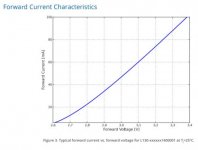
See attached graph from the data sheet of a 100ma rated white LED. It has full rated light output at 3.4V, but will still give off ~10% output at ~2.7V, mind you this is without a current limiting resistor, which would smooth and elongate the curve.

These 24V RGB LED strips typically have 6 LEDs per segment, where you can cut them. If the LEDs have an operating voltage range of ~.5 volts, then 6 of them have a range of 3 volts. You wouldn't have them completely shutting off at 22.9V. The white LED 12V strips I've dealt with the most will still give off some light at 8-9 volts.
 

Attachments

  • LEDPVCurve.jpg
    LEDPVCurve.jpg
    17.1 KB · Views: 2
Last edited:
OP
O

onewheat

Well-known member
Joined
Feb 19, 2012
Messages
1,286
Location
Knoxville, TN
Are you sure you didn't wire the last section backwards? Remember that diodes are directional, so you need to be connecting the correct ends together (I've made this mistake previously, only to desolder, flip, and resolder)

Yep, sure - the 3rd section of 5' would light for the first two feet but not after the second "cut" line. I unsoldered that section and added another 5' section and it did the same thing - lit for the first 2' of the 5' - not after the second "cut" line.

So I added wire leaders to four of the 5' sections and spliced them all to the end of the first 5' section. The only issue it gives me is in "chase" mode or one of the other sequential modes, it will run the first 5' section and then the other four sections simultaneously. In order to get all 5 to work simultaneously, I'd have to cut the feed line (there is a plug into the first section) and splice into that with the other four, but not knowing the gauge of that wire inside and what it was like inside the sheathing I didn't want to risk killing the controller and screwing it all. I will most likely be sticking with solid colors or slowly changing colors which they all do simultaneously the way I have it.
 

PhysicsDude

Well-known member
Joined
Jan 28, 2013
Messages
805
Location
Dallas, TX
Yep, sure - the 3rd section of 5' would light for the first two feet but not after the second "cut" line. I unsoldered that section and added another 5' section and it did the same thing - lit for the first 2' of the 5' - not after the second "cut" line.

So I added wire leaders to four of the 5' sections and spliced them all to the end of the first 5' section. The only issue it gives me is in "chase" mode or one of the other sequential modes, it will run the first 5' section and then the other four sections simultaneously. In order to get all 5 to work simultaneously, I'd have to cut the feed line (there is a plug into the first section) and splice into that with the other four, but not knowing the gauge of that wire inside and what it was like inside the sheathing I didn't want to risk killing the controller and screwing it all. I will most likely be sticking with solid colors or slowly changing colors which they all do simultaneously the way I have it.

So this LED strip can do "chase" patterns? Different segments can be lit differently at different times? Its 5 wire 24V?

Do you have a link to the product you're using? The only LED strips I've seen related to what you're describing are either 24V 5 wire where each color has its own wire and the entire strip changes the same colors at the same time, or a 5V strip with 3 or 4 wires, with controller that has different parts light up differently (addressable LEDs).

I wouldn't be worried about cutting the wire from the controller (with the controller off). Sounds like you want them all wired from the same feed in parallel, so I would cut the feed wire from the controller to the 1st strip in half and splice all the other strips in there.
 
OP
O

onewheat

Well-known member
Joined
Feb 19, 2012
Messages
1,286
Location
Knoxville, TN
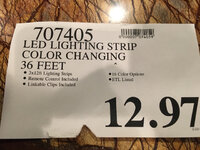
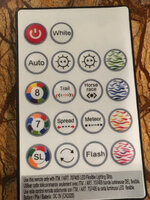
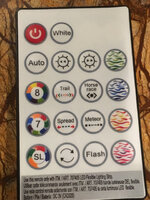
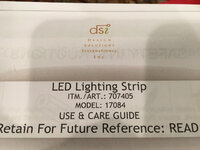
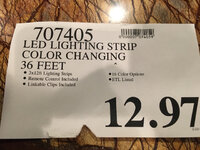
I don't have a link - I got them at Costco a while back and haven't seen them since. This is what I have on the light strips.

c3a9ecf784b140813ff346dd5641e792.jpg26ff7c01f8f43656effde9e81dc1af9b.jpg736c6e894aea650ef82e35209bae0b77.jpgc03839e65c31ad1e21c4ee61e2d11327.jpga71d15b863acb0ac315783016f24d054.jpg


Sent from my iPhone using Tapatalk
 

Attachments

  • a71d15b863acb0ac315783016f24d054.jpg
    a71d15b863acb0ac315783016f24d054.jpg
    335.6 KB · Views: 0
  • c03839e65c31ad1e21c4ee61e2d11327.jpg
    c03839e65c31ad1e21c4ee61e2d11327.jpg
    318.9 KB · Views: 0
  • 736c6e894aea650ef82e35209bae0b77.jpg
    736c6e894aea650ef82e35209bae0b77.jpg
    234 KB · Views: 0
  • 26ff7c01f8f43656effde9e81dc1af9b.jpg
    26ff7c01f8f43656effde9e81dc1af9b.jpg
    309.2 KB · Views: 0
  • c3a9ecf784b140813ff346dd5641e792.jpg
    c3a9ecf784b140813ff346dd5641e792.jpg
    371.6 KB · Views: 0

PhysicsDude

Well-known member
Joined
Jan 28, 2013
Messages
805
Location
Dallas, TX
Huh. Well that's very interesting. Pretty cool LED strip though.

The issue you're having with some segments not lighting up definitely has to do with the "addressing" of the pixels and the signals being sent through the strip.

That's an oddball setup, but I don't know why it wouldn't work when you splice it at the cut points. All the LEDs/controllers obviously work separately.

The only thing I can think of is if you have some strips backwards. Those controllers work by having a "data in" and "data out", so that they know what order the controllers are in. The first LED controller in the string makes itself address #1, and then sends the data to the next LED controller which makes itself address #2, etc. etc.

If you have the strip backwards and the "data out" port becomes the "data in" port, you will have issues.
 
OP
O

onewheat

Well-known member
Joined
Feb 19, 2012
Messages
1,286
Location
Knoxville, TN
Huh. Well that's very interesting. Pretty cool LED strip though.


The issue you're having with some segments not lighting up definitely has to do with the "addressing" of the pixels and the signals being sent through the strip.


That's an oddball setup, but I don't know why it wouldn't work when you splice it at the cut points. All the LEDs/controllers obviously work separately.


The only thing I can think of is if you have some strips backwards. Those controllers work by having a "data in" and "data out", so that they know what order the controllers are in. The first LED controller in the string makes itself address #1, and then sends the data to the next LED controller which makes itself address #2, etc. etc.


They all work now. I couldn’t get it to go past the first two feet of the third 5’ segment when they were wired in series with the wire added between sections and since it was a 5’ section, it couldn’t have been backwards if the first part of the section lit up. All the segments work when wired as Home Runs. They are definitely sequential though. When alternating segment colors, the first section will go color 1, 2, 1, 2, 1 and then the following 4 sections in parallel will run 2, 1, 2, 1, 2. Sticking with the three 12’ sections plugged into each other, it works for all 36’. Adding the wire in series must have dropped the voltage or added resistance enough to affect proper operation as I couldn’t get lit past 12’.


Sent from my iPhone using Tapatalk
 
To avoid these ads, REGISTER NOW!
Top Bottom