FordTruckWench
Well-known member
Yes, of course, but...
(Oh, the eternal struggle between engineers and fabricators. I'm both in this instance.)
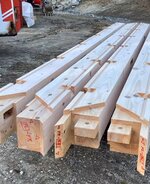
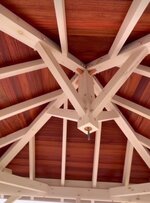
I need to cut double beveled points on 4x4's to use them as diagonal braces. (Think of the difference between a flat roof, shed roof, gable end roof, and hip roof. I need the "gable end" style - except asymmetric.)
My spreadsheet has all the dimensions and angles, and of course can calculate any other needed values. Which numbers are actually useful for cutting the lumber on a compound miter saw?
My thinking: Start with the OverAll Length (OAL) and chop material to this length*. Then measure in from the end to where a heel of a bevel needs to be. Set the saw to the calculated angle. Line the saw blade up to the mark on the edge of the board, and cut. Repeat.
Other possibility: Start by cutting to OAL. Then mark the point on the end (not centered!) where the bevels meet. Cut one bevel. Cut the opposite bevel.
Any other approaches? Any comments that I'll never be able to precisely make the cuts?
Actual numbers for one piece:
OAL: 42 7/64
Angles: 32.75, and 57.25
Heel location from end: 1 19/32 (both sides the same by design)
Tip position from side: 1 1/32 (or 2 15/32 from the other side)
Face widths of the bevels: 2 15/16 and 1 57/64
* Not practical to use one angled cut to make two pieces with that angle: Too many unique pieces, and I'll be pairing dissimilar pieces to best use each piece of lumber.
(Oh, the eternal struggle between engineers and fabricators. I'm both in this instance.)
I need to cut double beveled points on 4x4's to use them as diagonal braces. (Think of the difference between a flat roof, shed roof, gable end roof, and hip roof. I need the "gable end" style - except asymmetric.)
My spreadsheet has all the dimensions and angles, and of course can calculate any other needed values. Which numbers are actually useful for cutting the lumber on a compound miter saw?
My thinking: Start with the OverAll Length (OAL) and chop material to this length*. Then measure in from the end to where a heel of a bevel needs to be. Set the saw to the calculated angle. Line the saw blade up to the mark on the edge of the board, and cut. Repeat.
Other possibility: Start by cutting to OAL. Then mark the point on the end (not centered!) where the bevels meet. Cut one bevel. Cut the opposite bevel.
Any other approaches? Any comments that I'll never be able to precisely make the cuts?
Actual numbers for one piece:
OAL: 42 7/64
Angles: 32.75, and 57.25
Heel location from end: 1 19/32 (both sides the same by design)
Tip position from side: 1 1/32 (or 2 15/32 from the other side)
Face widths of the bevels: 2 15/16 and 1 57/64
* Not practical to use one angled cut to make two pieces with that angle: Too many unique pieces, and I'll be pairing dissimilar pieces to best use each piece of lumber.