To avoid these ads, REGISTER NOW!

Engineering specification

bluedog225

Well-known member
Joined
Jan 31, 2012
Messages
3,241
Location
Texas
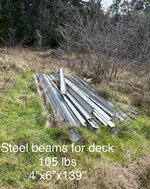
Is anyone aware of a published specification cee purlin weak axis bending? I can’t locate anything, but that doesn’t mean a lot.

I’m noodling around with the idea of using this for decking on 24” centers.

This would be half the cost of aluminum deck boards or bar grating.

I’ve seen 14 gauge used for anti slip planks.

I’m not an engineer. Pardon me if I’ve phrased this question incorrectly.

Thanks


IMG_3156.jpeg
 
To avoid these ads, REGISTER NOW!
OP
B

bluedog225

Well-known member
Joined
Jan 31, 2012
Messages
3,241
Location
Texas
I don’t think gauge metal should be subjected to loads on the weak axis, probably why no data for it.

I got the idea from this 14 gauge material. They seem to use it in this application.

It looks like they simply punched it for the surface texture.

I’m wondering if it’s foolish to rely on a table like this. Or do the surface deformations add strength?

Either way, the cee I originally posted will have some strength. Especially over 24 o.c. (technically 20” o.c. due to the supporting surface.


IMG_2094.pngIMG_2095.jpeg
 
OP
B

bluedog225

Well-known member
Joined
Jan 31, 2012
Messages
3,241
Location
Texas
How would you fasten it to joists?

Call manufacturer. Buy a piece or two and some tube sand and test it out.

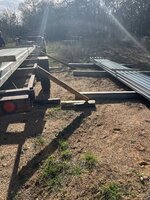
I was thinking 25’ pieces. Welded to the 4”x6” h-beam joists. (*edit “w-beam”)

I think I will buy some.

tube sand?

IMG_3016.jpeg
 
Last edited:

billconner

Well-known member
Joined
Jul 20, 2021
Messages
6,930
Location
Thousand Islands NYS
I was thinking 25’ pieces. Welded to the 4”x6” h-beam joists.

I think I will buy some.

tube sand?

IMG_3016.jpeg
Weight. Build a small sample section and load it up. Tube sand is simple for calculating weight. You want to design for 50 PSF? Load it to 75 or 100.
 

Attachments

  • 4effdf11-1da6-468a-b424-e5b920a800f8.jpeg
    4effdf11-1da6-468a-b424-e5b920a800f8.jpeg
    5.6 KB · Views: 11

Torque&Recoil

Well-known member
Joined
Dec 13, 2015
Messages
426
Location
NE Ohio
What is the loading? In other words, what is the deck holding up? Is this a roof or a floor? People? A car? A tractor? Need to know how heavy, and is it a point load, or a distributed load.

Please take the next bit as genuine help, and you may already know this - those beams are called "I-beams" because the strength direction is when they are oriented like the capital letter "I". If you orient them like the capital letter "H", they might only be 1/10th as strong.
 
OP
B

bluedog225

Well-known member
Joined
Jan 31, 2012
Messages
3,241
Location
Texas
What is the loading? In other words, what is the deck holding up? Is this a roof or a floor? People? A car? A tractor? Need to know how heavy, and is it a point load, or a distributed load.

Please take the next bit as genuine help, and you may already know this - those beams are called "I-beams" because the strength direction is when they are oriented like the capital letter "I". If you orient them like the capital letter "H", they might only be 1/10th as strong.
Thank you. I vaguely thought I had the term wrong. But I thought an I-beam had a different (tapered) profile. This is not my area of expertise and always happy to learn.

This will be a deck for people on a single family residence (cabin).
 
OP
B

bluedog225

Well-known member
Joined
Jan 31, 2012
Messages
3,241
Location
Texas
Weight. Build a small sample section and load it up. Tube sand is simple for calculating weight. You want to design for 50 PSF? Load it to 75 or 100.

This I can do. In my mind, this cee channel has to be at least as strong as a wooden 2x6. And I’d be fine with wood on 24” centers. But will verify.
 
OP
B

bluedog225

Well-known member
Joined
Jan 31, 2012
Messages
3,241
Location
Texas
You also have to factor in single vs multispan loading on the joists.

I don’t know what that means.

A while back I bought the engineering for dummies book. I thought I’d learn a thing or two. But the preface clearly indicated a prerequisite familiarity with material science that was well above my pay grade.
 

Torque&Recoil

Well-known member
Joined
Dec 13, 2015
Messages
426
Location
NE Ohio
The single span has maximum bending moment in the middle, and only shear at the supports. The multi-span case also has a bending moment at the center support, so it is less obvious where it would break. In simple terms, if you stand where it says "Load" on the left, and a big guy jumps up and down where it says "Load" on the right - you will experience some up/down motion as well, as the beam snakes like the letter "S".

A good design considers both deflection and strength. I once built a small loft using 2x6 joists and while it never fell down, walking on it was a bit unnerving.

I used this online tool a month ago, to determine beam sizing for a long span loft in my barn. They offer free access for a short period of time. I'm not suggesting that you run it yourself (OK if you want to mess around), but perhaps some other ME or CivE on here would be willing to check your proposal out. My free subscription has expired, and I don't really want to pay for more time, not to mention I have other projects going on. You have to know dimensions, loading, and be able to sketch the cross section of the Cee purlins online. Then the program will give you both stress and deflection. https://skyciv.com/structural-software/beam-analysis-software/

It's easy to say that maybe you want the deck to be 3 or 4 times stronger than the biggest party you'd ever throw, with the heaviest people you know standing around, but I'm not sure what a good standard is for deflection. All I can say is that you don't want the floor moving very much under your feet. Perhaps a CivE can chime in here if there is a standard used in building construction.

All that said - I have a feeling (not a blessing, only a feeling !) that after you do your due diligence and check the design - it's going to be fine. Not too many people make decks out of steel I-beams !
 
To avoid these ads, REGISTER NOW!

Torque&Recoil

Well-known member
Joined
Dec 13, 2015
Messages
426
Location
NE Ohio
Hey, here's a simpler and perhaps better idea. Get one Cee purlin. Put it on two wood blocks spaced maybe 4' apart. Have your heaviest friend stand in the middle. See if it deflects or bends. If 4' spacing is acceptable, then you should be fine with your proposed 2' spacing. I would always use a smaller spacing than whatever your test says is acceptable, to give a factor of safety.

You could even do the same test as a multi-span case. Three wood blocks, at 4' and 8'. Heavy friend stands in the middle of the first span, you stand in middle of second span. Have him jump up and down.

You might even find that you can open up the spacing further. But I would always build it to tighter spacing than what your test case shows to be acceptable. You always want a factor of safety, especially when people are involved.
 

billconner

Well-known member
Joined
Jul 20, 2021
Messages
6,930
Location
Thousand Islands NYS
Thank you. I vaguely thought I had the term wrong. But I thought an I-beam had a different (tapered) profile. This is not my area of expertise and always happy to learn.

This will be a deck for people on a single family residence (cabin).
Really they're called wide flanges - usually W or WF - or S for standard. WFs are very rectilinear in section and S the flanges are tapered from web to edge. I seems to be used for S, and H seems to be used for WF. It sounds like you have WF beams, which are far more common today.
 

billconner

Well-known member
Joined
Jul 20, 2021
Messages
6,930
Location
Thousand Islands NYS
Hey, here's a simpler and perhaps better idea. Get one Cee purlin. Put it on two wood blocks spaced maybe 4' apart. Have your heaviest friend stand in the middle. See if it deflects or bends. If 4' spacing is acceptable, then you should be fine with your proposed 2' spacing. I would always use a smaller spacing than whatever your test says is acceptable, to give a factor of safety.

You could even do the same test as a multi-span case. Three wood blocks, at 4' and 8'. Heavy friend stands in the middle of the first span, you stand in middle of second span. Have him jump up and down.

You might even find that you can open up the spacing further. But I would always build it to tighter spacing than what your test case shows to be acceptable. You always want a factor of safety, especially when people are involved.
I think this is good thought. I prefer tube sand because it's a little more quantifiable than "a friend" but that can work. I feel 2' to 4' a little extreme since bending is exponential. Needs to be 4 times as strong for double the distance. Also one channel is not really representative of a bunch of channels laid side by side. Just don't want to kill the project by overkill.
 

Boogerman

Well-known member
Joined
Jan 28, 2021
Messages
832
Location
aspen cove hill
None of the redneck sand or buddy loading needed. Just calculate the I value of the C purlin, do a multi span load diagram, determine maximum moment, and calculate bending force; compare to capacity of the steel.

I'll post in screen shots below. I value around weak axis is .3693 in^4. Since beam is 2 inches, C = 1 in. Max moment - 50 ft-lb, or 600 in-lb. for a spacing of 2 feet o.c. and 60 psi loading on a multi-supported 12 foot section. Using Fb=MC/I gives Fb = 1626 psi. Assuming 36,000 psi steel and 4x safety factor, Fallowable = 9,000 psi; so the beam is loaded to less than 1/4 of it's allowable strength. Shear is trivial in this case, but could be checked. Deflection is almost non existent at .002 inches.

Before I get jumped on by all the last decimal point and correct method obsessed engineers, I know this ignores dead loads, assumes a huge factor of safety, doesn't use LRFD design principles; but the answer is that the proposed beam is overdesigned sufficiently to make more detailed analysis unnecessary.
 

Attachments

  • 12 ft beam 120 lb load.JPG
    12 ft beam 120 lb load.JPG
    78.2 KB · Views: 21
  • ceepurlincalc.JPG
    ceepurlincalc.JPG
    96.2 KB · Views: 21
Last edited:

Torque&Recoil

Well-known member
Joined
Dec 13, 2015
Messages
426
Location
NE Ohio
Perfect ! I didn't have the time to do that myself and I really didn't want the OP to head off into mathemagical land without a guide. Are you ME or CE ? I am really a Dynamics guy myself.
 
OP
B

bluedog225

Well-known member
Joined
Jan 31, 2012
Messages
3,241
Location
Texas
None of the redneck sand or buddy loading needed. Just calculate the I value of the C purlin, do a multi span load diagram, determine maximum moment, and calculate bending force; compare to capacity of the steel.

I'll post in screen shots below. I value around weak axis is .3693 in^4. Since beam is 2 inches, C = 1 in. Max moment - 50 ft-lb, or 600 in-lb. for a spacing of 2 feet o.c. and 60 psi loading on a multi-supported 12 foot section. Using Fb=MC/I gives Fb = 1626 psi. Assuming 36,000 psi steel and 4x safety factor, Fallowable = 9,000 psi; so the beam is loaded to about 1/4 of it's allowable strength. Shear is trivial in this case, but could be calculated. Deflection is almost non existent at .002 inches.

Before I get jumped on by all the last decimal point and correct method obsessed engineers, I know this ignores dead loads, assumes a huge factor of safety, doesn't use LRFD design principles; but the answer is that the proposed beam is overdesigned sufficiently to make more detailed analysis unnecessary.
Dang. Thanks!
 

davejo

Well-known member
Joined
Oct 29, 2015
Messages
277
Location
(VA)
None of the redneck sand or buddy loading needed. Just calculate the I value of the C purlin, do a multi span load diagram, determine maximum moment, and calculate bending force; compare to capacity of the steel.

I'll post in screen shots below. I value around weak axis is .3693 in^4. Since beam is 2 inches, C = 1 in. Max moment - 50 ft-lb, or 600 in-lb. for a spacing of 2 feet o.c. and 60 psi loading on a multi-supported 12 foot section. Using Fb=MC/I gives Fb = 1626 psi. Assuming 36,000 psi steel and 4x safety factor, Fallowable = 9,000 psi; so the beam is loaded to less than 1/4 of it's allowable strength. Shear is trivial in this case, but could be checked. Deflection is almost non existent at .002 inches.

Before I get jumped on by all the last decimal point and correct method obsessed engineers, I know this ignores dead loads, assumes a huge factor of safety, doesn't use LRFD design principles; but the answer is that the proposed beam is overdesigned sufficiently to make more detailed analysis unnecessary.
Definitely interesting.

The website i linked has Cee section "effective" properties and they list 6x2.5 14g with .723 Iy in one direction and .61 the other direction.

Also is 55k steel, i think
 
OP
B

bluedog225

Well-known member
Joined
Jan 31, 2012
Messages
3,241
Location
Texas
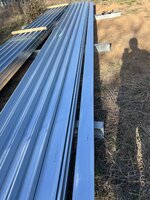
We’re doing this. Fifty 2.5”x6”X 26’ cee channel planks. Upper and lower decks.

I stood on one at 6’ on center. Seems plenty strong. Esp on 24” centers. Almost ready to get started.

IMG_3341.jpeg

IMG_3343.jpeg
 

My Old Tools

Well-known member
Joined
Jun 4, 2014
Messages
5,424
Location
Hamrick Lake, TX
I would bet pretty much any amount of money they will work just fine. I would also bet they will be hot as hell if they are in the sun. That's the reason I wouldn't use them.
 
OP
B

bluedog225

Well-known member
Joined
Jan 31, 2012
Messages
3,241
Location
Texas
Fortunately, they’re on the east side of the building. I’m going to paint them with something. I would like to put some anti-skid on there anyway, and I’ll paint them a color that will cut down on the glare from the sunrise. I’ve been thinking about whether I’m a good enough painter to carefully roll on a coat of paint on the top of these things without having it drip down the sides. I think I can pull it off after they are installed. There are some tricks to painting galvanized I forgotten. I think I need to etch it, then prime with a galvanized primer,, then paint it. I’ll probably go with Rustoleum.
 
Last edited:
OP
B

bluedog225

Well-known member
Joined
Jan 31, 2012
Messages
3,241
Location
Texas
None of the redneck sand or buddy loading needed. Just calculate the I value of the C purlin, do a multi span load diagram, determine maximum moment, and calculate bending force; compare to capacity of the steel.

I'll post in screen shots below. I value around weak axis is .3693 in^4. Since beam is 2 inches, C = 1 in. Max moment - 50 ft-lb, or 600 in-lb. for a spacing of 2 feet o.c. and 60 psi loading on a multi-supported 12 foot section. Using Fb=MC/I gives Fb = 1626 psi. Assuming 36,000 psi steel and 4x safety factor, Fallowable = 9,000 psi; so the beam is loaded to less than 1/4 of it's allowable strength. Shear is trivial in this case, but could be checked. Deflection is almost non existent at .002 inches.

Before I get jumped on by all the last decimal point and correct method obsessed engineers, I know this ignores dead loads, assumes a huge factor of safety, doesn't use LRFD design principles; but the answer is that the proposed beam is overdesigned sufficiently to make more detailed analysis unnecessary.

IMG_7554.jpeg

A brief update on this. I mocked up a couple of spans. One at 4’ o.c. and one at 5’.

Standing in the middle at about 180 lbs. Almost zero deflection on a single plank at 5’. I’m tempted to go 4’ o.c. instead of 2’.
 
Last edited:

kwb

Well-known member
Joined
May 1, 2009
Messages
1,769
Location
PNW
Good luck with painting galvanized surface.
It can be done, but even with all the prep done just right the paint isn't going to stay stuck long term.
 
OP
B

bluedog225

Well-known member
Joined
Jan 31, 2012
Messages
3,241
Location
Texas
I’m reading it does take some prep. Though I’ve had Henry’s cool roof on my galvalume roof for well over a decade, and it shows no sign of peeling. And the only prep I did there was Dawn and a floor broom. It’s possible that stuff has some type of clear coating on it though.

It’s possible I’m going to go with some type of non-skid tape. Or, since the thing is only 25’ x 10’, there are some outdoor snaplock type tiles I could use, mats, or outdoor rugs.

She suggested artificial turf. We will see.
 

dutchgray

Well-known member
Joined
Sep 28, 2014
Messages
6,461
Location
Dorset. England.
I would expect the galvanise to wear through pretty quickly if you didn't paint it, all the cold rolled sections i have ever worked with are very lightly galvanised so I would think painting is a must, maybe a grippy truck bed lining type of surface in a suitable colour.
 
To avoid these ads, REGISTER NOW!
Top Bottom