To avoid these ads, REGISTER NOW!

Epoxy Anchors - Help Needed please

mk3cn4

Member
Joined
Jul 1, 2012
Messages
23
Hi everyone, I've searched and read many many many posts on this board about this topic but still have some questions there were no answers to, you'd really be helping someone in need if you can comment!!

Quick overview: installed a 9000lb. 2 post lift (Atlas bp9000), didn't blow out dust in holes because I am a newbie, and wedge anchor bolts are slowly pulling up few threads at a time each time I use the lift. Have at least 5" of 4000PSI, concrete is 8 months old.

After reading all the posts here I decided on using epoxy and threaded studs in place of wedges because it's apparently waaay stronger. Don't want to make any mistakes this time so need someone to check my plans for me.

Got one bolt out as the guinnea pig. I continually cranked on one of the bolts with a pipe on my wrench and it came most of the way up before the bolt started spinning, then crowbarred while turning with air impact gun to get the rest of the way out, used a screwdriver to distort the wedge piece left in hole and got it out with needlenose pliers (was amazed that worked). No cracks in cement from stress of yanking out bolt, hole still looks pretty good.

First question I couldn't find answer to: are the 12" long 3/4" threaded rods sold in Lowes strong enough or do I need special strength rods? Was going to sawsall them in two and then have two 6" rods for my anchors. Will use their #8 strength nuts and washers for this, that OK?

Second question: What's the strongest sub-$100 expoxy solution I should be using? Is the Quikrete High Strength Anchoring Epoxy
(http://www.lowes.com/pd_354677-286-...rete+anchor+epoxy&pl=1&currentURL=&facetInfo=) the best to use here? I hate to go into hundreds of dollars for one lift install with the dual gun and stuff like that. Many of the message threads here had broken links to the different epoxies because they were old, so if someone could throw me a link or two that'd be great.

Is there a kit that has killer strong epoxy and bolts maybe I couldn't find here or googling that might work better together?

Third question, can someone please check my work? Here's what I am going to do:

1) clean the anchor rods to make sure there's no oil residue (car brake cleaner has been suggested)
2) drill hole out to larger 7/8" (or whatever epoxy manufacturer says)
3) use wire brush hole cleaner and compressed air and clean the heck out of the hole (you can bet I will do this part very thoroughly).
4) follow epoxy manufacturer instruction for prefilling hole and setting bolt while twisting.

Now, the most important question, are there ANY OTHER CATCHES I need to be aware of?

Please assume I know nothing. I didn't even know to use compressed air to get all the dust out of the holes the first time around, thought a shopvac was enough, clearly not because this one bolt I pulled all the way out had dust all through it. If I didn't mention it above I'm probably not aware of it, please help me from being an idiot a second time.

Thank you!!!
 
Last edited:
To avoid these ads, REGISTER NOW!

Milton Shaw

Well-known member
Joined
Feb 11, 2011
Messages
4,835
Fastenal has a one tube epoxy anchor system that is dispensed with a regular caulk gun. The tube comes with a one time mixing tube that would go down in a 9/16 hole. Follow instructions should give 10,000 lb pull out or more per anchor. Most systems usually require a special gun but Fastenal has one that uses a regular caulk gun.
 
OP
M

mk3cn4

Member
Joined
Jul 1, 2012
Messages
23
Ok, will check them out. Just to make it easier for everyone I found the link for the quikcrete stuff here showing it's specs:

http://www.quikrete.com/PDFs/DATA_SHEET-Anchoring Epoxy- High Strength 8620-31.pdf

Says:

" Maximum loads are calculated for a safety factor of 25% of ultimate load.

A 5/8 diameter threaded rod in a 3/4 diameter hole embedded to 5 5/8
depth will yield an ultimate load of 28,000 lbs in 3,500 psi concrete at 4
hours at 77
F (25 C). Therefore the minimum load time is 4 hours"

That's why I used it as an example, sounded VERY strong.

I wish I knew more about this stuff, I'd like to find a way to compare apples and apples, if they all had a common rating to go by, then I could just pick the strongest I could afford!! :)
 
Last edited:

AndyL

Well-known member
Joined
Feb 22, 2012
Messages
1,371
Location
Vancouver
Might want to go look up the tech specs on the hilti hvu anchor system - very nice system, probably stronger than you need - no dispenser, just drop the capsule in, drop in your rod, mix and done...
 
OP
M

mk3cn4

Member
Joined
Jul 1, 2012
Messages
23
I'm on it!!

Thanks for that one, wasn't even on my list.

Anyone else having input I'd really appreciate it.

If I screw this up a second time my family will probably disown me.
 

rponfick

Well-known member
Joined
Feb 27, 2012
Messages
80
They make longer wedge bolts than you probably used. I would drill all the way through the concrete and then you could just drive the bolts out the bottom if this issue comes up again.

It was my understanding that you don't drill the holes out any larger than the bolt instructions call for, and just inject the epoxy into the hole while installing the wedge bolts. I would not use bolts or threaded rod secured from Lowes. I would get products designed for what you are doing.

I just went throught this with my Atlas 9000 overhead bar lift. I wish I had used longer bolts than those supplied. My bolts seem to be holding, but I have a little more thread showing above the mounting plate than I would like. The overhead beam lift is more forgiving because a lot of the force is taken by the upper beam.

Ralph.
 

skamp

Well-known member
Joined
Jul 20, 2007
Messages
644
Location
Cypress, TX
Lowes sells redhead anchors and the G5 epoxy. Don't go cheap for something like this. Do it right.

Steve
 
OP
M

mk3cn4

Member
Joined
Jul 1, 2012
Messages
23
They make longer wedge bolts than you probably used. I would drill all the way through the concrete and then you could just drive the bolts out the bottom if this issue comes up again.

Hmm, that'd be a good idea, but the 2nd reason I am going with epoxy is because with all the ripping and tearing I am going to be doing to these holes to get the old bolts out, I bet they are probably going to be closer to 7/8" than 3/4", and I couldn't find a 7/8" anchor bolt googling, and I don't want to go to the full 1".
 
OP
M

mk3cn4

Member
Joined
Jul 1, 2012
Messages
23
Lowes sells redhead anchors and the G5 epoxy. Don't go cheap for something like this. Do it right.

Steve

Ok, I didn't know there were redhead "threaded rod" type anchors, I'll avoid the 3/4" generic bulk threaded rods they have out on display for general purpose and instead look for redhead threaded rod anchors. Those will probably come with the nuts too, and you're right I'll feel better knowing it was designed for that purpose. Didn't know about those.

EDIT: now that I think about it, didn't that solution have a $80 applicator gun I had to buy? Isn't that overkill for 12 bolts? Wonder if I could rent one of those somewhere.

EDIT #2: The link for the specs for that epoxy is here: http://www.itwredhead.com/pdfs/submittals/G5_sub.pdf and says it's Ultimate Tension is 19,000lbs 3/4" with 6.75 embedment. Doesn't sound much different than the Kwikrete one I mention above (actually sounds less), except I don't need to buy that $80 application gun for a mere 12 bolts. Am I off base on that one?

Still gonna check out Fastenal (as mentioned Post #2 above) and Hilti (probably overkill) as well.

Thanks everyone.
 
Last edited:
OP
M

mk3cn4

Member
Joined
Jul 1, 2012
Messages
23
That suggestion for Fastenal paid off another way, they do have 7/8" wedge anchors that are 6" long that I couldn't find before, of course I was probably searching for the wrong terms since I don't know all the lingo...

Hmm, now I am second guessing this whole thing. Maybe I should just re-drill out to a clean 7/8" and use those? THIS time I'll clean out the holes though. Maybe I'll try 1 and see how it goes.

Sorry I'm all over the map on this guys, but I want to get the right decision without shooting a mouse with a $300 elephant gun.
 
Last edited:
OP
M

mk3cn4

Member
Joined
Jul 1, 2012
Messages
23
Fastenal has a one tube epoxy anchor system that is dispensed with a regular caulk gun. The tube comes with a one time mixing tube that would go down in a 9/16 hole. Follow instructions should give 10,000 lb pull out or more per anchor. Most systems usually require a special gun but Fastenal has one that uses a regular caulk gun.

Just searched their site and there's a gazillion on there, do you have one in particular that you know is super strong and doesn't need the special gun?

Thanks!
 
OP
M

mk3cn4

Member
Joined
Jul 1, 2012
Messages
23
Might want to go look up the tech specs on the hilti hvu anchor system - very nice system, probably stronger than you need - no dispenser, just drop the capsule in, drop in your rod, mix and done...

Spent maybe 10 minutes checking this one out, seems very convenient and if I had to do 100 bolts this would be cool, but I think the cost is going to be way higher for the convenience. If it's way stronger then maybe it's worth it but I don't need the convenience for so few bolts, and so far what I am seeing these epoxies are all similar.

Besides the fact that Hilti doesn't show prices on their site and I couldn't easily find a site that showed prices of this Hilti system.

Thanks for the idea though.
 

jhelrey

Well-known member
Joined
Sep 15, 2010
Messages
7,238
Location
MN
Make sure you drill through your pad too so you can just pound the bolts down if you mess up.
 

AndyL

Well-known member
Joined
Feb 22, 2012
Messages
1,371
Location
Vancouver
Actually they're way more convenient for the 10-20 anchor scenario, as the dispensing guns are expensive as all heck (same with the tubes of epoxy). You'd have to call your local hilti dealer for pricing. My pricing is about on par with the sleeve anchors at despots... but I have an account, and spend a good 8k+ worth them a year - ymmv...

Spent maybe 10 minutes checking this one out, seems very convenient and if I had to do 100 bolts this would be cool, but I think the cost is going to be way higher for the convenience. If it's way stronger then maybe it's worth it but I don't need the convenience for so few bolts, and so far what I am seeing these epoxies are all similar.

Besides the fact that Hilti doesn't show prices on their site and I couldn't easily find a site that showed prices of this Hilti system.

Thanks for the idea though.
 

ddawg16

Well-known member
Joined
Jul 11, 2008
Messages
21,005
Location
S. California
Give your local concrete business a call. They should know the name of the building hardware place. This is not your local Lowes or HD...they typically specialize in Simpson ties and other anchor systems. Not only will they have just about any wedge bolt you want, they will have the threaded rod and epoxy.

Yes....the epoxy requires a special 2-tube gun....you can rent those...or buy a cheap one for about $30.....but the epoxy is some really good ****.....according to the deputy inspector who 'observed' me putting in my anchor bolts (threaded rods), an epoxed threaded rod 6" into concrete is stronger than the typical 12" J bolt....in reality, a J bolt will actually just pull out of the hole...the metal just straightens out.
 

joes169

Well-known member
Joined
Sep 19, 2011
Messages
663
Location
WI
Two-part anchoring epoxies are readily available here in a single tube that will fit the a standard 10oz caulk gun. They simply mix in the replaceable nozzle, and by the time they exit the nozzle, they're ready to use. If you want to save the rest of the tube for the near future, you simply toss the nozzle away and use a new one next time. I can't speak for other regions, but they're easily found on the shelves here at Menards, HD, the local hardware store, Fastenal, most every lumber yard, etc........
 

56rpm

Well-known member
Joined
Apr 19, 2012
Messages
354
Location
Bakersfield, Ca
I'll second the Simpson products. I've used hundreds of their products and will continue to use them. They are even sold and my local Lowes.
 

Az Scooter

Well-known member
Joined
Dec 30, 2009
Messages
1,500
I would go withthe Hilti system, just based on convenience. The Tubes tend to dry and get hard, and ruin a complete tube. Plues, you can buy just as much epoxy as you need to do the job.
 
To avoid these ads, REGISTER NOW!

wssix99

Well-known member
Joined
Mar 2, 2011
Messages
5,155
Location
Chicago, IL
Quick overview: installed a 9000lb. 2 post lift (Atlas bp9000), didn't blow out dust in holes because I am a newbie, and wedge anchor bolts are slowly pulling up few threads at a time each time I use the lift. Have at least 5" of 4000PSI, concrete is 8 months old.

After reading all the posts here I decided on using epoxy and threaded studs in place of wedges because it's apparently waaay stronger. Don't want to make any mistakes this time so need someone to check my plans for me.

Have you confirmed that you are properly balancing your load on the lift? It sounds like your old anchors were in pretty well. If the load is perfectly balanced, there is no upward force on those bolts at all.
 
OP
M

mk3cn4

Member
Joined
Jul 1, 2012
Messages
23
Have you confirmed that you are properly balancing your load on the lift? It sounds like your old anchors were in pretty well. If the load is perfectly balanced, there is no upward force on those bolts at all.

I respectfully disagree (funny, I just posted a similar reply in another thread heh heh) but the outermost bolts have tremendous upward pressure.

Here's a link:

http://www.maxjaxusa.com/faqs/common-concerns.html

Their example is 3000 lbs load, at 9000 each bolt is like 9000 upward force, especially if it's a baseplate lift.

If you look at their picture it's pretty obvious why, the lift pole is like a giant crowbar pulling upwards on the outer anchor bolts.
 
OP
M

mk3cn4

Member
Joined
Jul 1, 2012
Messages
23
Here's where I settled:

Since I have some depth left in my concrete and I've only yanked out 1 anchor bolt, I am going to drill all the way through my concrete with 7/8" bit and try a longer 7/8" anchor. If that holds fine, I'll then go through all the ones that are backing out one by one and do this solution. If not, I could then pound it through the floor which should leave the 7/8" holes in fair enough condition to use them for 3/4" threaded bolts and epoxy (epoxy wants the extra room anyway according to manufacturers' recommendations I am reading).

Anyone have anything else to add feel free, I'll post results of what I find.

ANYONE READING THIS WHO IS INSTALLING A LIFT, BLOW OUT AND CLEAN YOUR HOLES BEFORE ANCHORING. This is a ginormous pain in the keister for such a little mistake, I had no idea something that little could ruin the whole job.
 

rponfick

Well-known member
Joined
Feb 27, 2012
Messages
80
I cannot agree with Maxjax snide comment that the overhead bar is just an "elegant way to hide the cables and hoses". They are designed to prevent inside load on the post by carrying that load in the beam. I think if you research carefully, there are many comments by the manufacturers as to the difference between the baseplate lift and the overhead bar lift.

But, that is just my 2 cents worth.

Ralph
 
OP
M

mk3cn4

Member
Joined
Jul 1, 2012
Messages
23
I cannot agree with Maxjax snide comment that the overhead bar is just an "elegant way to hide the cables and hoses". They are designed to prevent inside load on the post by carrying that load in the beam. I think if you research carefully, there are many comments by the manufacturers as to the difference between the baseplate lift and the overhead bar lift.

But, that is just my 2 cents worth.

Ralph

I totally understand your point, but I'd rather play it safe.

I need to look at an overhead style to get a better idea how strong the crossbar is. It might even be that some are designed to hold weight and some are just "elegant ways to hide cables", maybe it's both! I see your point though.

For the record, mine is baseplate and everthing I am talking about in this thread is for my lift, so that's why I am so focused on the anchors being strong. There's no dispute on the baseplate having the forces.
 
Last edited:

wssix99

Well-known member
Joined
Mar 2, 2011
Messages
5,155
Location
Chicago, IL
I respectfully disagree (funny, I just posted a similar reply in another thread heh heh) but the outermost bolts have tremendous upward pressure.

Here's a link:

http://www.maxjaxusa.com/faqs/common-concerns.html

Their example is 3000 lbs load, at 9000 each bolt is like 9000 upward force, especially if it's a baseplate lift.

If you look at their picture it's pretty obvious why, the lift pole is like a giant crowbar pulling upwards on the outer anchor bolts.

That MaxJax link is a good one with regard to explaining the forces involved.

My comment was assuming you were seeing the front or rear bolts pulling out, not the side ones.

Is your issue with a MaxJax lift? The dynamics on their lift/base plate are different from a full size lift and I could definitely understand their bolts seeing a greater pull out stress. (The more the base plate extends inward and under the lift arms, and the closer the lifting points are moved backward towards the posts, the lower the moment arm of the load, and the less the outer bolts will want to pull out.)

Longer bolts or anything you can do to increase surface area contact with the concrete will increase your strength. The same goes for a mechanical connector, epoxy connector, or whatever.
 
OP
M

mk3cn4

Member
Joined
Jul 1, 2012
Messages
23
Latest news in my dilemma, I was going to drill out the hole to 7/8" and use a 7/8" wedge anchor, but after googling it turns out that the MINIMUM SPACING would be off. 7/8" has to be spaced further apart.

So, I drilled out the hole to 7/8" and used a longer 6" inch long 3/4" anchor bolt and G5 epoxied it in. Lowes had the epoxy gun on sale/closeout for $69.99 and the epoxy is only $25 for each dual-cylinder cartridge, so I went for it.

So, for this first bolt at least, all looks good. Epoxied it in, and it's holding torque.

Found an interesting way to stress test, not sure how good of an idea this is but it made me feel better about the strength, I had a trailblazer lifted about 1 foot off the ground and while lowering it I sorta "bumped" the hydraulic release in and out creating a little bit of rythim with the car making it sorta bounce a little on the lift. It was enough bouncing that it made the posts have a little motion, but I figured that had to really stress those anchors on my baseplate Atlas BP9000. The anchors failing at 1' would be nowhere near as bad as a failure of full lift. Anyway, it all held well.

So, I guess I am going to do this process with the remaining wedge anchors as they are all still slowly pulling out with vibration.

While googling it seems that there are very few people with this problem as I kept seeing my own post (this thread) show up in the results, so I am going to keep this thread updated in the spirit of sharing with the community for the next guy who might be having this problem and googling for an answer.
 

james_98188

Active member
Joined
Dec 14, 2012
Messages
34
Location
Seattle
Great thread, I'm in a similar situation. I used a number of 5/8th inch stainless anchor wedges from Boltdepot.com to pull down the sill boards down tight against the concrete pad I had installed for the shed Tuffshed crappily installed. Their installation had large gaps left betwen the sill boards and the concrete, and water was getting in. Some of the anchor wedges started slipping a little while I was torquing them to the specified values, but they've been holding well and the installation's now water-tight.

Not lucky with the 1/2 anchor wedges I tried using for my IR air compressor installation in the same shed. I quit after two of the compressor's three mounting points already pulled out. (One of the compressor's feet actually cracked in the process, but that'll be a different adventure. I've been WANTING to get a TIG welder....). I'd used a hammer drill to drill down to the recommended minimum depth of 2 1/4 in. and, after considering just drilling deeper and trying again, I've decided to play it safe, drill deeper, AND go with epoxy bolts as they're supposed to be stronger. Quikrete has a good video on the installation process:

http://www.quikrete.com/athome/Video-Anchoring-Epoxy.asp

The key players seem to be Quikrete, Simpson, and Hilti. A search on Amazon with a sort by user review showed some people unhappy with Simpson, but I had no hits on Quikrete and Hilti.

The Quikrete website states that the hole should be 1/16 in. to 1/4 in. larger than the diameter of the threaded rod you're using, and the hole depth should be 4 1/2 times the diameter of the bolt, or 9 times for a heavy duty installation for heavy vibration or high load installations (ie, for an air compressor or lift). That means for my 1/2 inch bolts (based on the size of the holes on my IR compressor feet) I should be drilling 4 1/2 inch deep holes - which is what I'll do.

Now, I'm trying to decide between Quikrete and Hilti, and what threaded rods I should be using.


Please assume I know nothing. I didn't even know to use compressed air to get all the dust out of the holes the first time around, thought a shopvac was enough, clearly not because this one bolt I pulled all the way out had dust all through it. If I didn't mention it above I'm probably not aware of it, please help me from being an idiot a second time.
Thank you!!!
 
Last edited:

james_98188

Active member
Joined
Dec 14, 2012
Messages
34
Location
Seattle
My garage probably isn't high enough to justify a lift installation, but it's still a tempting idea. The thing is, the idea of a two post lift seems a little unsettling to me, as I doubt the load would ever be ideally balanced. I've a mid-engined sports car, and the process for removing the engine is kind of like with a Volkswagen - one drops it out from below. So, the car would be on the lift in two configurations - with, and without the engine. As the engine isn't right at the car cg, the fore/aft load on the lift would shift. A failure of a two post lift due to fore/aft loads could be catastrophic.

Have you confirmed that you are properly balancing your load on the lift? It sounds like your old anchors were in pretty well. If the load is perfectly balanced, there is no upward force on those bolts at all.
 

james_98188

Active member
Joined
Dec 14, 2012
Messages
34
Location
Seattle
Yes, of course there are different strengths of threaded rods - just as there are different strengths of bolts. Different alloys and, I imagine, heat treats. There's the soft metal hardware that you can get at your neighborhood hardware store that you could easily twist the head off with hand tools, all the way up to the high strength, high temperature hardware used in commercial airplane turbofan engines.

Check out the Hilti site:

http://www.us.hilti.com/holus/page/module/product/prca_catnavigation.jsf?lang=en&nodeId=-60860

They offer carbon steel, stainless steel, and HAS-E B hardware. Seems for something like a lift, you'd want the strongest you could get.

On the Garage Equipment Supply site someone else mentioned on this site:

http://www.gesusa.com/product-p/1380115.htm

They sell the following hardware for lift installations. That'd probably be the least you'd want to consider.

http://www.toggler.com/wejit/wejit_wedge.html

Their hardware is Carbon Steel, grade 5.8, with zinc plating.

Are there different strengths of threaded rods?
Wow this is so confusing.
 

sberry

Banned
Joined
Jun 18, 2005
Messages
35,747
Location
Brethren, Michigan
I think the real stresses on a lot of anchors is over estimated by the non engineer. I have seen soe stuff you really got to wonder about but a couple of tapcons hold my comp from sliding away. The bolt job on my hoist is nothing to write home about, dealer installed.
 

sberry

Banned
Joined
Jun 18, 2005
Messages
35,747
Location
Brethren, Michigan
Have you confirmed that you are properly balancing your load on the lift? It sounds like your old anchors were in pretty well. If the load is perfectly balanced, there is no upward force on those bolts at all.

Yes, in some cases with ideally rigged car it could stand on its own without bolts. The base design was a factor for me with the Mohawk, it has some other minor issues from the installation I need to fix but I liked the big footprint.
 

james_98188

Active member
Joined
Dec 14, 2012
Messages
34
Location
Seattle
My scheme for mounting my air compressor is as shown in the photo. The idea was to let the thing's vibrations be isolated from the concrete hence the vibration pad - and then it occurred to me that if it was vibrating against the bolt through the attaching nut, that would defeat the purpose - hence the sorbothane isolator on top of the compressor foot.

However, the mechanical anchor wedge failed during installation (actually, the concrete the wedge was installed in failed) while the wedge was being torqued.

Current plan is to replace the mechanical anchor with an epoxy anchor.

The concrete pad is 12 inches thick at the edges, but only 4 inches thick in the center. I like this idea of drilling all the way through for driving out the threaded rods out the bottom if necessary later on, AND also for obtaining maximum embedment.

Not yet having any experience with anchor epoxy, how much working time does one have before it starts setting up? And I'd probably have to have something holding the shaft to keep it from sinking while the epoxy is setting up, yes?

photostream


They make longer wedge bolts than you probably used. I would drill all the way through the concrete and then you could just drive the bolts out the bottom if this issue comes up again.

It was my understanding that you don't drill the holes out any larger than the bolt instructions call for, and just inject the epoxy into the hole while installing the wedge bolts. I would not use bolts or threaded rod secured from Lowes. I would get products designed for what you are doing.

I just went throught this with my Atlas 9000 overhead bar lift. I wish I had used longer bolts than those supplied. My bolts seem to be holding, but I have a little more thread showing above the mounting plate than I would like. The overhead beam lift is more forgiving because a lot of the force is taken by the upper beam.

Ralph.
 

james_98188

Active member
Joined
Dec 14, 2012
Messages
34
Location
Seattle
The photo:

http://www.flickr.com/photos/16521220@N04/8690685374/in/photostream

My scheme for mounting my air compressor is as shown in the photo. The idea was to let the thing's vibrations be isolated from the concrete hence the vibration pad - and then it occurred to me that if it was vibrating against the bolt through the attaching nut, that would defeat the purpose - hence the sorbothane isolator on top of the compressor foot.

However, the mechanical anchor wedge failed during installation (actually, the concrete the wedge was installed in failed) while the wedge was being torqued.

Current plan is to replace the mechanical anchor with an epoxy anchor.

The concrete pad is 12 inches thick at the edges, but only 4 inches thick in the center. I like this idea of drilling all the way through for driving out the threaded rods out the bottom if necessary later on, AND also for obtaining maximum embedment.

Not yet having any experience with anchor epoxy, how much working time does one have before it starts setting up? And I'd probably have to have something holding the shaft to keep it from sinking while the epoxy is setting up, yes?

photostream
 

nukefission

Member
Joined
Nov 28, 2011
Messages
7
Location
Woodbridge, VA
Sorry for bringing up an old thread.

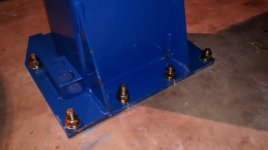
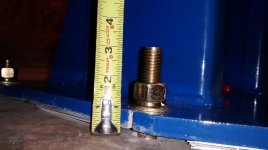
mk3cn4, how did you resolve this? I'm experiencing virtually the same issue, with the same lift. During my installation of the posts, several of the anchors were pulling up too far out of the concrete, in some cases not allowing application of full torque because I run out of socket. Like you, I only vacuumed the dust out of the holes rather than cleaning them with a brush and compressed air. The difference with my situation is that the slab is right at 4" thick. I drilled all the way through and it's possible some concrete may have flaked out a bit under some of the holes. That said, several of the anchors bit properly and accept full torque.

Some pics attached. On one post only one of the anchors pulled up too much. The other post, however, has several pulled up too much. Also showcase a "best" and "worst" anchor. Like you, I've been researching alternative anchors (wedge, sleeve, epoxy). It's possible mine are just slipping out like yours due to the dust. I haven't tried pulling one out yet (or driving it into the ground). Hoping I can salvage the existing holes and not have to move the lift or cut and repour.
 

Attachments

  • 1.jpg
    1.jpg
    125.9 KB · Views: 56
  • 3.jpg
    3.jpg
    126.3 KB · Views: 53
  • 5.jpg
    5.jpg
    133.6 KB · Views: 58
  • 6.jpg
    6.jpg
    127.6 KB · Views: 58

matt_i

Well-known member
Joined
Mar 14, 2008
Messages
10,722
Location
SE Michigan
Mr Fission. What I suggest is this. An epoxy anchor should not visibly move at all, ever.

So, if they are pulling up its not adhered to the concrete and is useless.

I would suggest getting a ratcheting box wrench and use the screw thread to jack the rod completely out of the concrete and then throw it away. It will probably be a fight as epoxy is adhered to the threads. One way around it is to cut various lengths of 3/4" black pipe as a spacer tube, and continue to use the good/unpolluted threads to pull out the rod. I would keep the nut and thread oiled while doing this.

Use the hammer drill to core out the same hole again, I would go 2" deeper if you can, taking great pains to blow them out with a long thin tube that will easily go all the way to the bottom of the hole. Don't just blow into the top of the hole with a stubby air gun. It will not work. Get the air under the dust and blow it out. Shop vac running at the same time will cut the dust cloud. I like to withdraw the tube in a slow spiral, blowing the entire time, repeat a couple of times until no dust is produced.

Then cut new rods and start again. I recommend Sika AnchorFix2 which I bought at Home D. Its around $20 a tube.

I also recommend ordering B7 threaded rods from McMaster Carr. They will be like a Grade 5 bolt in strength. The threaded rods you get at electrical supply and at big box are Grade 2 at best.

If, you drilled all the way into the subgrade, you can hammer the rod all the way into the earth, with a slightly smaller dia steel rod and a large hammer like a sledge. If it doesn't move easily then you didn't drill deep enough and more beating is going to damage the slab.
 
Last edited:

wssix99

Well-known member
Joined
Mar 2, 2011
Messages
5,155
Location
Chicago, IL
I recommend Sika AnchorFix2 which I bought at Home D. Its around $20 a tube.

This is likely not safe to use:

"Limitations
THE NTSB HAS STATED THAT THIS PRODUCT IS APPROVED FOR SHORT TERM LOADS ONLY AND SHOULD NOT BE USED IN SUSTAINED TENSILE LOAD ADHESIVE ANCHORING APPLICATIONS WHERE ADHESIVE FAILURE COULD RESULT IN A PUBLIC SAFETY RISK. CONSULT A DESIGN PROFESSIONAL PRIOR TO USE.
- Not for use in overhead applications."

Most exposxies creep and don't do well under sustained tensile loads, like some of the anchor bolts on a two post lift may see. There are special "overhead use" formulations that should do the trick and I recall that most manufacturers will recommend specific products that can be used for their applications.
 
Last edited:

strutaeng

Well-known member
Joined
Dec 12, 2011
Messages
2,243
Location
Dallas, TX
Wow, an old thread comes alive again!

I know a little about these anchors, but I have no clue about auto lifts. It seems that there's no uplift on these baseplates? Correct?

Or, is there some uplift when the car is being lowered or raised? 3000lb? Tensile only?

As a general recommendation to anyone: don't ask about installation instructions on these threads, or anywhere but the manufacturers' instructions. Each manufacturer is unique. The general procedure is two blows, two brushes, two blows, but some require three. Check instructions since they also recommend air psi, cfm, drill bit diameter, etc. Some products allow cored holes, some don't.

Without knowing loads, one is just guessing about adequacy. It doesn't seem there is a sustained tensile load so creep should not be an issue, but I may be wrong.

I would check lift manufacturer for loads and anchorage recommendations.

If I were to build a garage with a lift I would put a small stiffened slab/footing on the legs; inexpensive during construction. This can also be installed after the fact, just more work. That way you have a more robust support and a deeper member for anchor embedment. Again, assuming a point reaction of 3,000 to 4,000 lb.

Good luck
 

joes169

Well-known member
Joined
Sep 19, 2011
Messages
663
Location
WI
As a general recommendation to anyone: don't ask about installation instructions on these threads, or anywhere but the manufacturers' instructions. Each manufacturer is unique. The general procedure is two blows, two brushes, two blows, but some require three. Check instructions since they also recommend air psi, cfm, drill bit diameter, etc. Some products allow cored holes, some don't.

This is undoubtedly important, you HAVE TO brush the holes clean as well as blow them out with a long nozzle.
 
To avoid these ads, REGISTER NOW!
Top Bottom