

You are using an out of date browser. It may not display this or other websites correctly.
You should upgrade or use an alternative browser.
You should upgrade or use an alternative browser.
Erosion Control
- Thread starter PALYDIN11
- Start date

gregtwojeeps
Well-known member
Agreed ^^^
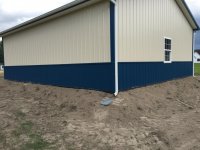
Just add one note. With that nice colored siding I think in interest of keeping the mud off of it, I would put one strip of sod around the building close just under the siding , then seed the rest in the first week of Sept. (Month of seeding depends on where you are located) jmo
Just add one note. With that nice colored siding I think in interest of keeping the mud off of it, I would put one strip of sod around the building close just under the siding , then seed the rest in the first week of Sept. (Month of seeding depends on where you are located) jmo
I'll agree, get a few pices of solid 4" tile and get the rainwater away from the building. Get some good dirt, not clay, and get some grass seed down.
mz44
Well-known member
Grass seed, straw, and a sprinkler
If it was me............. I would purchase a load of dirt and grade it out a little better. Plant grass and extend the downspouts further away from the garage. Every year spread dirt around to fill in low spots.
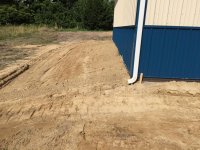
Thanks for the advice. I will do that. I take it I can grade it out with a small skid steer.
Agreed ^^^
Just add one note. With that nice colored siding I think in interest of keeping the mud off of it, I would put one strip of sod around the building close just under the siding , then seed the rest in the first week of Sept. (Month of seeding depends on where you are located) jmo
I am in Maryland. I will lay the strip of sod down after the grading.
Whats there now is select fill. What are the better soils to use? Thanks.
I'm not sure what "select fills" would be but in the pictures, it looks quite sandy to me, which would wash out quite easily.
I'm not sure what "select fills" would be but in the pictures, it looks quite sandy to me, which would wash out quite easily.
Yes it is sandy. It also has a few chunks of clay in it. It was the fill for the concrete pad. Any suggestions on the best dirt/soil to use would be greatly appreciated. Thanks.
Thanks for the advice. I will do that. I take it I can grade it out with a small skid steer.
Oyeah. Probably what anyone professionally would do. You could do it with a wheelbarrow and shovel but ain't nobody got time for that.
Can't help you on soil recommendation as I don't know your area but anyone you can purchase it from should be knowledgeable. Just let them know your situation.
bczygan
Well-known member
Clear the site of all building materials (wood, cement, bricks, etc.), as well as any buried stumps, rocks, stones or other debris that is larger than 2-3 inches (4-5 cm) in diameter.
Rough grade the entire area to eliminate any drainage problems. This would include sloping the grade away from building foundations, eliminating or reducing severe slopes and filling low-lying areas. Use a tractor-mounted box blade for rough grading large areas. Use hand tools for small areas. Rough grading may uncover more debris to be removed.
Initial tilling, to a depth of at least 2 inches (5 cm), should be completed prior to adding any topsoil or soil amendments. This will control most annual weeds; alleviate subsoil compaction; permit a bonding of the topsoil to the subsoil; and improve root penetration and water movement.
Add topsoil to achieve a total topsoil depth of 4-6 inches (10-15 cm), after firming. The soil type should be loamy sand, sandy loam, clay loam, loam, silt loam, sandy clay loam or other soil suitable for the area. To the extent possible, practical, affordable and available, incorporate humus (fully decomposed organic matter) into the topsoil.
Conduct a Soil Test. The test results will give you a report on the nutrient levels, CEC (Cation Exchange Capacity), and pH along with recommendations on correcting any deficiencies. Following the recommendations may include correcting acid or alkalinity levels, adding soil amendments and/or adjusting fertility.
If amendments and fertilizer are added, work them into the top 3-4 inches (7 to 10 cm) of the soil.
Finish grade the entire site, maintaining the rough grading contours and slopes, using a tractor-mounted box blade on large areas or a heavy-duty rake on smaller sites.
Roll the area with a lawn roller one third full of water to firm and settle the surface and reveal any low spots that should be filled to match the surrounding grade surface. If time permits, allow the area to settle further with rainfall or by applying irrigation water.
This site is now ready for installation of the seed, sod, plugs, or sprigs.
Follow the post-installation procedures and develop a long-term maintenance program to insure your new lawn will be a beautiful, useful investment for years to come.
Rough grade the entire area to eliminate any drainage problems. This would include sloping the grade away from building foundations, eliminating or reducing severe slopes and filling low-lying areas. Use a tractor-mounted box blade for rough grading large areas. Use hand tools for small areas. Rough grading may uncover more debris to be removed.
Initial tilling, to a depth of at least 2 inches (5 cm), should be completed prior to adding any topsoil or soil amendments. This will control most annual weeds; alleviate subsoil compaction; permit a bonding of the topsoil to the subsoil; and improve root penetration and water movement.
Add topsoil to achieve a total topsoil depth of 4-6 inches (10-15 cm), after firming. The soil type should be loamy sand, sandy loam, clay loam, loam, silt loam, sandy clay loam or other soil suitable for the area. To the extent possible, practical, affordable and available, incorporate humus (fully decomposed organic matter) into the topsoil.
Conduct a Soil Test. The test results will give you a report on the nutrient levels, CEC (Cation Exchange Capacity), and pH along with recommendations on correcting any deficiencies. Following the recommendations may include correcting acid or alkalinity levels, adding soil amendments and/or adjusting fertility.
If amendments and fertilizer are added, work them into the top 3-4 inches (7 to 10 cm) of the soil.
Finish grade the entire site, maintaining the rough grading contours and slopes, using a tractor-mounted box blade on large areas or a heavy-duty rake on smaller sites.
Roll the area with a lawn roller one third full of water to firm and settle the surface and reveal any low spots that should be filled to match the surrounding grade surface. If time permits, allow the area to settle further with rainfall or by applying irrigation water.
This site is now ready for installation of the seed, sod, plugs, or sprigs.
Follow the post-installation procedures and develop a long-term maintenance program to insure your new lawn will be a beautiful, useful investment for years to come.
LS6 Tommy
Well-known member
Army Engineers used to use Kudzu... 
Tommy
Tommy
Kevin54
MEMBER EMERITUS
If you have the money, what about putting up some landscape blocks to build a small wall around the garage? You could do it in either landscape retaining wall blocks, or you could use pressure treated lumber. Sink some 4x4's down into the ground about 6' apart, then lag some 2x6's to them to build the wall. Run your downs underneath the dirt and out of the side of the wall.
Or have a few dump truck loads of topsoil brought it and feather the ground way out so you don't have such a high hill so close to the garage. Again, run your downs underneath the soil and out away from the building. Feathering out the ground out may be the cheapest option, but will still run about a grand, maybe a little more. Whatever you do, you want to fix it so it is easy to mow around.
BTW....The building looks great. Any other pics of it?
And lastly, Welcome to Garage Journal. Glad to have you aboard and hope you hang around for a long time to come!!!
Or have a few dump truck loads of topsoil brought it and feather the ground way out so you don't have such a high hill so close to the garage. Again, run your downs underneath the soil and out away from the building. Feathering out the ground out may be the cheapest option, but will still run about a grand, maybe a little more. Whatever you do, you want to fix it so it is easy to mow around.
BTW....The building looks great. Any other pics of it?
And lastly, Welcome to Garage Journal. Glad to have you aboard and hope you hang around for a long time to come!!!
Jess
Well-known member
Around my shop and storage shed, I graded a slight slope away from the building and installed a row of landscape ties all around the sides, put down commercial landscape fabric and a few inches of 1/2 crush with no fines. This keeps the building clean, and provides a place to set up a ladder or scaffolding for roof and gutter maintenance. An added bonus, is that it provides a small break around the structures to stop ground fires in the dry grass and brush further away. For yours, I would extend the downpipes further away and seed the rest.
Yes it is sandy. It also has a few chunks of clay in it. It was the fill for the concrete pad. Any suggestions on the best dirt/soil to use would be greatly appreciated. Thanks.
Soil varies from region to region, part of the reason members always suggest putting a general location in your profile. That being said, whatever they use as top soil in your area is what I would suggest.
gregtwojeeps
Well-known member
When I was destumping and re- doing my back/front yards I could see I needed a single axle dump truck load of top soil. ..
I called the local sand/soil landscape/supply company and asked what a single axle load of top soil would cost delivered to my house. The nice lady said ," Our TOP grade soil that has been screened/filtered with no rocks/clods that is delivered and dumped on site will be.... $498.75....
No top soil for me....
I called the local sand/soil landscape/supply company and asked what a single axle load of top soil would cost delivered to my house. The nice lady said ," Our TOP grade soil that has been screened/filtered with no rocks/clods that is delivered and dumped on site will be.... $498.75....
No top soil for me....
csp
Well-known member
I wouldn't plant anything next to the building. I would use a crushed stone for at least 2' next to the structure after making the grade quite a bit less steep. A 2% grade is enough to move water downhill. It looks like you're approaching 100% there, which just means what you have will erode faster.
bczygan you should at least give a link to whatever sites you always cut and paste information from. Give credit where credit is due.
bczygan you should at least give a link to whatever sites you always cut and paste information from. Give credit where credit is due.
If you have the money, what about putting up some landscape blocks to build a small wall around the garage? You could do it in either landscape retaining wall blocks, or you could use pressure treated lumber. Sink some 4x4's down into the ground about 6' apart, then lag some 2x6's to them to build the wall. Run your downs underneath the dirt and out of the side of the wall.
Or have a few dump truck loads of topsoil brought it and feather the ground way out so you don't have such a high hill so close to the garage. Again, run your downs underneath the soil and out away from the building. Feathering out the ground out may be the cheapest option, but will still run about a grand, maybe a little more. Whatever you do, you want to fix it so it is easy to mow around.
BTW....The building looks great. Any other pics of it?
And lastly, Welcome to Garage Journal. Glad to have you aboard and hope you hang around for a long time to come!!!
Yes. I will be here awhile.
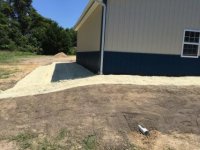
Yes here is what I have so far.
Attachments

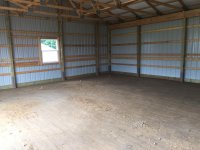
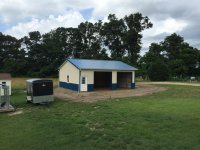
If you have the money, what about putting up some landscape blocks to build a small wall around the garage? You could do it in either landscape retaining wall blocks, or you could use pressure treated lumber. Sink some 4x4's down into the ground about 6' apart, then lag some 2x6's to them to build the wall. Run your downs underneath the dirt and out of the side of the wall.
Or have a few dump truck loads of topsoil brought it and feather the ground way out so you don't have such a high hill so close to the garage. Again, run your downs underneath the soil and out away from the building. Feathering out the ground out may be the cheapest option, but will still run about a grand, maybe a little more. Whatever you do, you want to fix it so it is easy to mow around.
BTW....The building looks great. Any other pics of it?
And lastly, Welcome to Garage Journal. Glad to have you aboard and hope you hang around for a long time to come!!!
Thank you. I will take care of the downs.
Money is a little tight at the moment.
Trey T
Well-known member
If that's sandy dirt, you need to bring in several cu-yd of top soil and level it out and avoid steep slope. You can't grow much on sandy soil bc there's no organic stuff for grass to grow into.
Put down grass and establish uniform vegetation to prevent erosion. That's typically the the most economical method for short and long terms
Put down grass and establish uniform vegetation to prevent erosion. That's typically the the most economical method for short and long terms
Empty Pockets
Well-known member
I ran a 20' section of 3" pipe under ground, fed the downspout into it, and drained it into a natural occurring ditch near the house. then seeded above it
If that's sandy dirt, you need to bring in several cu-yd of top soil and level it out and avoid steep slope. You can't grow much on sandy soil bc there's no organic stuff for grass to grow into.
Put down grass and establish uniform vegetation to prevent erosion. That's typically the the most economical method for short and long terms
Yes it is sand and clay. I will plan to bring in more dirt and a layer of top soil to finish the job. Would it be a good idea to tamp whet I have now to compact it more, or just wait until just before I add the top soil?
Clear the site of all building materials (wood, cement, bricks, etc.), as well as any buried stumps, rocks, stones or other debris that is larger than 2-3 inches (4-5 cm) in diameter.
Rough grade the entire area to eliminate any drainage problems. This would include sloping the grade away from building foundations, eliminating or reducing severe slopes and filling low-lying areas. Use a tractor-mounted box blade for rough grading large areas. Use hand tools for small areas. Rough grading may uncover more debris to be removed.
Initial tilling, to a depth of at least 2 inches (5 cm), should be completed prior to adding any topsoil or soil amendments. This will control most annual weeds; alleviate subsoil compaction; permit a bonding of the topsoil to the subsoil; and improve root penetration and water movement.
Add topsoil to achieve a total topsoil depth of 4-6 inches (10-15 cm), after firming. The soil type should be loamy sand, sandy loam, clay loam, loam, silt loam, sandy clay loam or other soil suitable for the area. To the extent possible, practical, affordable and available, incorporate humus (fully decomposed organic matter) into the topsoil.
Conduct a Soil Test. The test results will give you a report on the nutrient levels, CEC (Cation Exchange Capacity), and pH along with recommendations on correcting any deficiencies. Following the recommendations may include correcting acid or alkalinity levels, adding soil amendments and/or adjusting fertility.
If amendments and fertilizer are added, work them into the top 3-4 inches (7 to 10 cm) of the soil.
Finish grade the entire site, maintaining the rough grading contours and slopes, using a tractor-mounted box blade on large areas or a heavy-duty rake on smaller sites.
Roll the area with a lawn roller one third full of water to firm and settle the surface and reveal any low spots that should be filled to match the surrounding grade surface. If time permits, allow the area to settle further with rainfall or by applying irrigation water.
This site is now ready for installation of the seed, sod, plugs, or sprigs.
Follow the post-installation procedures and develop a long-term maintenance program to insure your new lawn will be a beautiful, useful investment for years to come.
Hello. When you say sub soil, do you mean more of the fill dirt and then topsoil worked into that? Thanks.
csp
Well-known member
Subsoil is whatever is directly beneath the topsoil.
crabjoe
Well-known member
If it were me ... I'm cheap this way ... I would check with the county to see if they have a compost program. Baltimore Co and Harford county both do and it's cheap.. Balto Co is no charge, but you have to load it yourself. Harford was $10 a yard (More like 2 yards) and they loaded it. If it's available, it's usually at the county landfill or the sewage treatment plant.
Take the compost and put a thick layer down, everywhere, then till it in, then seed. Grass will grow like crazy in it with a little water.
BTW you want to make sure you got your grading done b4 adding the compost.
Oh.. I did this in a section of my yard, but was to lazy to till. I took my tractor w/ a front end loaded and just mixed it as best I could and used the loaded to grade at the same time... Grass seed came in like weeds ... really thick and green.
One other thing.. If you mix in enough compost to that sand, you call dirt, it'll look and feel like the best top soil you've ever seen.
Take the compost and put a thick layer down, everywhere, then till it in, then seed. Grass will grow like crazy in it with a little water.
BTW you want to make sure you got your grading done b4 adding the compost.
Oh.. I did this in a section of my yard, but was to lazy to till. I took my tractor w/ a front end loaded and just mixed it as best I could and used the loaded to grade at the same time... Grass seed came in like weeds ... really thick and green.
One other thing.. If you mix in enough compost to that sand, you call dirt, it'll look and feel like the best top soil you've ever seen.
four.cycle
Well-known member
PALYDIN11, I don't know what kind of rainfall you receive in Maryland, but:
If that were up to me, I would first get those downspouts moving the water down and off the slope - extend them maybe downhill or run them into a French drain system of some sort.
On that slope, running a lawnmower is going to be a pain in the ***.
The suggestion of laying in 1/2" or 3/4" crush (with NO fines!) is good, but that might be a challenge on that slope gradient - you'd have to lay it in and pack it with a pneumatic packer to get it to stay, and even then you might have problems in heavy rain.
Do NOT plant kudzu or English Ivy - kudzu is a nuisance and English Ivy will creep up the walls and literally tear the building apart. (I don't even know if kudzu will grow that far north.)
If if were to me, I would re-grade it to lessen the severity of the slope gradient - which will probably require moving some sort of material in unless you can move it from another place on your parcel.
Then I would plant it with Vinca Minor (periwinkle). It's a fairly benign plant, grows to a height of about 6-8 inches, grows anywhere (even in poor soil), is drought tolerant, puts out a pretty blue flower once a year, and when it gets too big and mangy, you simply run the lawnmower over it and mow it right down to grade - it will come back with a vengeance. It will NOT climb up the walls of the structure like ivy or some other "ground cover" plants. It will establish a stable enough root structure to hold things together. You'd want to get a few flats of little starts and put it in and water it in well - and be patient - it can take two or three years for it to get established, but once it does, it takes off like a house afire.
https://en.wikipedia.org/wiki/Vinca_minor
(* before planting anything as a "ground cover" be sure to check with your County weed control board to make sure you're not considering anything that may cause problems later. *)
If that were up to me, I would first get those downspouts moving the water down and off the slope - extend them maybe downhill or run them into a French drain system of some sort.
On that slope, running a lawnmower is going to be a pain in the ***.
The suggestion of laying in 1/2" or 3/4" crush (with NO fines!) is good, but that might be a challenge on that slope gradient - you'd have to lay it in and pack it with a pneumatic packer to get it to stay, and even then you might have problems in heavy rain.
Do NOT plant kudzu or English Ivy - kudzu is a nuisance and English Ivy will creep up the walls and literally tear the building apart. (I don't even know if kudzu will grow that far north.)
If if were to me, I would re-grade it to lessen the severity of the slope gradient - which will probably require moving some sort of material in unless you can move it from another place on your parcel.
Then I would plant it with Vinca Minor (periwinkle). It's a fairly benign plant, grows to a height of about 6-8 inches, grows anywhere (even in poor soil), is drought tolerant, puts out a pretty blue flower once a year, and when it gets too big and mangy, you simply run the lawnmower over it and mow it right down to grade - it will come back with a vengeance. It will NOT climb up the walls of the structure like ivy or some other "ground cover" plants. It will establish a stable enough root structure to hold things together. You'd want to get a few flats of little starts and put it in and water it in well - and be patient - it can take two or three years for it to get established, but once it does, it takes off like a house afire.
https://en.wikipedia.org/wiki/Vinca_minor
(* before planting anything as a "ground cover" be sure to check with your County weed control board to make sure you're not considering anything that may cause problems later. *)
Last edited:
PALYDIN11, I don't know what kind of rainfall you receive in Maryland, but:
If that were up to me, I would first get those downspouts moving the water down and off the slope - extend them maybe downhill or run them into a French drain system of some sort.
On that slope, running a lawnmower is going to be a pain in the ***.
The suggestion of laying in 1/2" or 3/4" crush (with NO fines!) is good, but that might be a challenge on that slope gradient - you'd have to lay it in and pack it with a pneumatic packer to get it to stay, and even then you might have problems in heavy rain.
Do NOT plant kudzu or English Ivy - kudzu is a nuisance and English Ivy will creep up the walls and literally tear the building apart. (I don't even know if kudzu will grow that far north.)
If if were to me, I would re-grade it to lessen the severity of the slope gradient - which will probably require moving some sort of material in unless you can move it from another place on your parcel.
Then I would plant it with Vinca Minor (periwinkle). It's a fairly benign plant, grows to a height of about 6-8 inches, grows anywhere (even in poor soil), is drought tolerant, puts out a pretty blue flower once a year, and when it gets too big and mangy, you simply run the lawnmower over it and mow it right down to grade - it will come back with a vengeance. It will NOT climb up the walls of the structure like ivy or some other "ground cover" plants. It will establish a stable enough root structure to hold things together. You'd want to get a few flats of little starts and put it in and water it in well - and be patient - it can take two or three years for it to get established, but once it does, it takes off like a house afire.
https://en.wikipedia.org/wiki/Vinca_minor
(* before planting anything as a "ground cover" be sure to check with your County weed control board to make sure you're not considering anything that may cause problems later. *)
I am planning on working on the slope next week. I have ordered 2 more loads of fill to grade a more shallow slope. The Vinca Minor sound like a robust plant.
four.cycle
Well-known member
PALYDYN11 said:The Vinca Minor sound like a robust plant.
Very much so, and it is dark green all year. Requires virtually no maintenance, and when it gets established it's thick enough that it chokes out most other plants (except Himalaya Blackberry (Rubus Procerus), but that stuff will almost grow in concrete.)
Makes a dense network of runners above ground and a fairly aggressive, if shallow, root system. I put in a mess of it over at my sister's place on the "no mans land" strip between her and the adjoining parcel - there are three retaining walls holding the bank up - at one point the vertical drop is about 12 feet in a distance of maybe 10 feet - so more than a 50% slope.
There's salal (Gaultheria shallon) on part of that bank farther back, but I would advise against it - it tends to get out of hand in short order. I'm going to apply glysophate to it in her back yard and kill it off - it choked out the azaleas and hydrangeas back there so it's getting the death-spray treatment.
And again, avoid English Ivy - it's just nasty stuff. Already declared a noxious weed in Oregon. I wish they'd do it here too. Kills cottonwoods and alders in municipal parks around here.
If you have the money, what about putting up some landscape blocks to build a small wall around the garage? You could do it in either landscape retaining wall blocks, or you could use pressure treated lumber. Sink some 4x4's down into the ground about 6' apart, then lag some 2x6's to them to build the wall. Run your downs underneath the dirt and out of the side of the wall.
Or have a few dump truck loads of topsoil brought it and feather the ground way out so you don't have such a high hill so close to the garage. Again, run your downs underneath the soil and out away from the building. Feathering out the ground out may be the cheapest option, but will still run about a grand, maybe a little more. Whatever you do, you want to fix it so it is easy to mow around.
BTW....The building looks great. Any other pics of it?
And lastly, Welcome to Garage Journal. Glad to have you aboard and hope you hang around for a long time to come!!!
UPDATE. I got a good deal on a couple of loads of fill and topsoil as seen in the photo. I don't have a lot of experience filling and grading with the skid steer. I was thinking of dumping the dirt against what is already in place and let it naturally roll down hill, and then try to grade it. Any help on the correct method would be appreciated.
Attachments
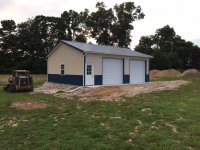
UPDATE. I got a good deal on a couple of loads of fill and topsoil as seen in the photo. I don't have a lot of experience filling and grading with the skid steer. I was thinking of dumping the dirt against what is already in place and let it naturally roll down hill, and then try to grade it. Any help on the correct method would be appreciated.
Attachments

If it were me ... I'm cheap this way ... I would check with the county to see if they have a compost program. Baltimore Co and Harford county both do and it's cheap.. Balto Co is no charge, but you have to load it yourself. Harford was $10 a yard (More like 2 yards) and they loaded it. If it's available, it's usually at the county landfill or the sewage treatment plant.
Take the compost and put a thick layer down, everywhere, then till it in, then seed. Grass will grow like crazy in it with a little water.
BTW you want to make sure you got your grading done b4 adding the compost.
Oh.. I did this in a section of my yard, but was to lazy to till. I took my tractor w/ a front end loaded and just mixed it as best I could and used the loaded to grade at the same time... Grass seed came in like weeds ... really thick and green.
One other thing.. If you mix in enough compost to that sand, you call dirt, it'll look and feel like the best top soil you've ever seen.
I have my fill compacted pretty good now. I am getting the compost to go with the little bit of topsoil that I have. I was wondering if I mixed the 2 could I just rake it into the top layer of the fill, of would it still be better to till it? Thanks.
Attachments
If you have the money, what about putting up some landscape blocks to build a small wall around the garage? You could do it in either landscape retaining wall blocks, or you could use pressure treated lumber. Sink some 4x4's down into the ground about 6' apart, then lag some 2x6's to them to build the wall. Run your downs underneath the dirt and out of the side of the wall.
Or have a few dump truck loads of topsoil brought it and feather the ground way out so you don't have such a high hill so close to the garage. Again, run your downs underneath the soil and out away from the building. Feathering out the ground out may be the cheapest option, but will still run about a grand, maybe a little more. Whatever you do, you want to fix it so it is easy to mow around.
BTW....The building looks great. Any other pics of it?
And lastly, Welcome to Garage Journal. Glad to have you aboard and hope you hang around for a long time to come!!!
I graded everything, tested the top soil, limed it, tilled it into subsoil, seeded rolled and added the erosion control mat. I do have a some grass emerging now.
Attachments

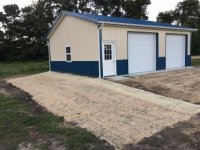
Hey now, that looks quite nice.

jives
Well-known member
Dramatic improvement. . . well done. Now, August is a terrible time to plant grass. Too hot, not enough rain. If you plant now you will need to water the daylights out of it. Or, wait until September. If you wait you will need to keep the weed from growing. Roundup will be your friend.