To avoid these ads, REGISTER NOW!

ERV questions

thunderskunk

Well-known member
Joined
Oct 4, 2022
Messages
130
I am sifting through the countless posts of similar nature. Making my own just to get the specifics out and see if you fine forum goers have other input.

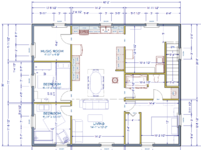
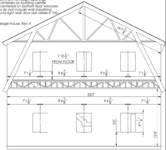
We are 90% through a DIY garage-house project. I've been thinking about HRV since before we started, but things progressed father than I expected while I was deployed and now we're having to design/install after the fact. A few sample prints attached.

Our building:
  • 33x40 ft garage-house. 2x6 walls with rockwool insulation. Located in Vermont, high winds and very cold.
    • 12 ft ceiling height downstairs, open bay with three garage doors used as a combined automotive and machine shop
      • Slab has radiant heat, one zone
    • 8 ft upstairs, 3-bedroom 1-bath house
      • Still installing: three zones of in-floor radiant heat with reflectors.
      • Coal stove with vent through roof as secondary heat
      • Attic has gable vents
      • Bathroom and dryer have separate vents
      • Range hood planned but not installed

Questions:
  • How do you size the pipe for incoming air ducts?
    • For downstairs, I want to pull the fresh air in from the attic vent, go down through a 2x6 internal no-load wall, then pass it through the exhaust for heat recovery. Is 4" duct pipe too small for an air intake?
    • If you're looking at the floorplan, the wall in question is between the music room and the next bedroom. This is 6" wide to accommodate the electrical panel. the idea would be to pull fresh air from this end of the building, push it through a larger exhaust pipe for heat recovery, and pump it into the downstairs. The exhaust would start at that end and work it's way to the opposite gable, going into the attic through dead space around the stairs and replacing one of the attic gable vents with an exhaust fitting. If a filter is installed, it would be downstairs around the stairs.
  • Can I put my air intake inside the attic close to the gable vents?
    • This would save cutting a hole in the wall. Not a huge deal, but everything counts.
  • What are folks using for air dust collection filters for garages these days?
    • The main concern is welding and car exhaust fumes in the shop. The vapors from the CNC coolant will also collect and bring oil with it. I don't want to exhaust this out the side of the house and end up with blackened, greasy siding if I can avoid it.
 

Attachments

  • Screenshot 2024-11-25 095908.png
    Screenshot 2024-11-25 095908.png
    93 KB · Views: 4
  • Screenshot 2024-11-25 095145.png
    Screenshot 2024-11-25 095145.png
    206.6 KB · Views: 4
To avoid these ads, REGISTER NOW!

dcg9381

Well-known member
Joined
Jun 20, 2018
Messages
11,627
Location
Austin, TX
The HRV you select should include details on proper pipe size.
Where are you at? What type of climate. In TX, I've found HRVs to be mostly unnecessary as it's very difficult to "tightly seal" a house and moisture (because we're on HVAC most of the time) is not a concern.

The simplest "fresh air" intakes are a simple damper controlled by the HVAC system.. Technically not an HRV perhaps. I no longer do fresh air systems in southern climates. Up north, HRV or ERV all day long.

For the shop, I run fans when doing work that generates nasty stuff and open the doors. In a wood shop, we run a suspended filter on a switch that is dust control.
 
OP
T

thunderskunk

Well-known member
Joined
Oct 4, 2022
Messages
130
The HRV you select should include details on proper pipe size.
Where are you at? What type of climate. In TX, I've found HRVs to be mostly unnecessary as it's very difficult to "tightly seal" a house and moisture (because we're on HVAC most of the time) is not a concern.

The simplest "fresh air" intakes are a simple damper controlled by the HVAC system.. Technically not an HRV perhaps. I no longer do fresh air systems in southern climates. Up north, HRV or ERV all day long.

For the shop, I run fans when doing work that generates nasty stuff and open the doors. In a wood shop, we run a suspended filter on a switch that is dust control.
Location: Northern Vermont. Cold and windy. ERV or HRV is necessary, at least downstairs.

For the residential upstairs: Tightly sealed. We're told we need to plastic the walls before drywall for "energy code" which is a comical read. You want the exterior to be vapor-sealed so water doesn't get in, you want the interior vapor sealed to keep moisture from escaping with the interior heat, but you want one or the other to breath in case moisture gets in to avoid mold... they even make a vapor barrier that adjusts whether it seals or not based on humidity. Which do you want, sealed or not sealed? We went with sealed. Now I need fresh air.
How tight is the building? What's the blower door result?

For the garage portion; the original idea was it was unnecessary; The main doors are not well sealed and cars are going in and out daily. The mechanic keeps running the vehicles inside the building with the door closed, so now it's a big problem, sealed or not.

We're not ready for the blower door test yet.
 
OP
T

thunderskunk

Well-known member
Joined
Oct 4, 2022
Messages
130
CFM...

This is ridiculous. First off; I'm a mechanical engineer. I don't do HVAC, but I certainly took classes on it.

Article on calculating CFM for HRV

Internal dims are 32x39, so based on the two code formulas:
  • 32*39/100+7.5*5=50 cfm OR:
  • 32*39/100*3+7.5*5=75 cfm
Then it says double it...

You get crazy high numbers if you use other free calculators.

I remember someone saying they welded up their own fittings and fed their incoming air through their outgoing air, and it acted as an HRV.

Then again, if I really only need 100 CFM upstairs, I could probably do the upstairs and downstairs with a 200 CFM unit.
 

fitter30

Well-known member
Joined
Jun 23, 2019
Messages
2,960
Location
Peace Valley,mo
With a working shop ground level, living area above there will be strict codes from engine exhaust, welding fume exhaust, chemical and paint fumes. Possibly make up air for shop and living area. Without pressurized living area everytime the man door to enter living is open dirt and fumes can enter. Might pay to have mechanical engine o look at your project. Egress might also be a problem with one stairway.
 
To avoid these ads, REGISTER NOW!

Denwood

Well-known member
Joined
Sep 22, 2014
Messages
4,180
Location
Thunder Bay, Ontario, Canada
1. Install 6" intake and exhaust, ideally as close to the ERV as possible. Miniumum 10 feet apart and well away from any furnace/heater exhausts etc. Do not place intake or exhaust for the ERV in your attic!!
2. In your climate (high drying in winter) you want an ERV, not an HRV.
3. I'd take a look at the EV Premium L from RenewAire as it has a large and efficient (88%@60CFM) core, and is priced affordably.
4. Your garage should not be part of this ventilation system in any way. I would exhaust only in your shop, so that negative pressure is maintained when working in there.
5. I've attached an older manual from Venmar in PDF format. Everything you need for duct sizes is on page 12.
6. Plan on at least 20-25 CFM per occupant.

Current best practice is to pull stale air from your kitchen and baths, and deliver to main living and sleeping areas. This will keep CO2 levels manageable at night in the bedrooms where you will typically see the highest concentrations. Think about filtration (the systems included in ERV/HRV use expensive filters and don't work great regardless) outside the unit. In a cold climate you can place a filtration box on the "warm" side of fresh air supply so you don't have to insulate it.

I do my filtration outside the house as I have a carbon canister integrated to deal with fire smoke etc. and building new, I would 100% do this again. You also don't have to worry about freeze up or condensation etc as the filter box is kept at outside temps. In summer I have a 5" MERV 16 in there. Carbon is dialed in or out as required. We have increasing periods of fire smoke in the summer, so this system keeps fresh air inbound regardless.

You can read more in this thread: https://www.garagejournal.com/forum...rofit-with-smoke-filter-for-300.505161/page-2

1732577939868.png

1732577976899.png

1732578103414.png
 

Attachments

  • 30_5_en_v_installation-manual.pdf
    2.8 MB · Views: 1
  • 1732578010107.png
    1732578010107.png
    1.4 MB · Views: 1
OP
T

thunderskunk

Well-known member
Joined
Oct 4, 2022
Messages
130
With a working shop ground level, living area above there will be strict codes from engine exhaust, welding fume exhaust, chemical and paint fumes. Possibly make up air for shop and living area. Without pressurized living area everytime the man door to enter living is open dirt and fumes can enter. Might pay to have mechanical engine o look at your project. Egress might also be a problem with one stairway.
A few points to this: fortunately my project predates July 2024, so I work off the 2020 version. Not a huge deal; the 2024 version seems a bit more readable and adds things that don't apply to me, but more importantly I can use RESCheckWeb to build and print the certification. Vermont is one of the few states where the builder can certify the project as meeting these requirements.

I still need to meet the requirements, but I won't be failing my own certification. "New Construction" requires an ERV, "addition" does not with the caveat that some additions may qualify as "New Construction." I'd say this one does need an ERV, which is new to me. I thought it was optional.

Fire department OK'd egress; there's a requirement for very specifically sized-windows which we installed as instructed. We're framed for an upstairs porch eventually, but that's not a requirement.
1. Install 6" intake and exhaust, ideally as close to the ERV as possible. Miniumum 10 feet apart and well away from any furnace/heater exhausts etc. Do not place intake or exhaust for the ERV in your attic!!
2. In your climate (high drying in winter) you want an ERV, not an HRV.
3. I'd take a look at the EV Premium L from RenewAire as it has a large and efficient (88%@60CFM) core, and is priced affordably.
4. Your garage should not be part of this ventilation system in any way. I would exhaust only in your shop, so that negative pressure is maintained when working in there.
5. I've attached an older manual from Venmar in PDF format. Everything you need for duct sizes is on page 12.
6. Plan on at least 20-25 CFM per occupant.

Current best practice is to pull stale air from your kitchen and baths, and deliver to main living and sleeping areas. This will keep CO2 levels manageable at night in the bedrooms where you will typically see the highest concentrations. Think about filtration (the systems included in ERV/HRV use expensive filters and don't work great regardless) outside the unit. In a cold climate you can place a filtration box on the "warm" side of fresh air supply so you don't have to insulate it.

I do my filtration outside the house as I have a carbon canister integrated to deal with fire smoke etc. and building new, I would 100% do this again. You also don't have to worry about freeze up or condensation etc as the filter box is kept at outside temps. In summer I have a 5" MERV 16 in there. Carbon is dialed in or out as required. We have increasing periods of fire smoke in the summer, so this system keeps fresh air inbound regardless.

You can read more in this thread: https://www.garagejournal.com/forum...rofit-with-smoke-filter-for-300.505161/page-2

Great write up, thanks! Yea the more I looked into it, the less appealing connecting the two floors' ventilation seemed. Given the height of the building, I'm not sure I can put the filter outside unless I pull fresh air from downstairs. Not sure that works with an ERV. We'll see.
 

fitter30

Well-known member
Joined
Jun 23, 2019
Messages
2,960
Location
Peace Valley,mo
HRV and ERV use various mediums to transfer heat/ moisture. This media can't handle dirt so premium have to be used. Inside air 4" thick prefilter 10" thick after filter. Check with the manufacture of the unit about this topic.
 
OP
T

thunderskunk

Well-known member
Joined
Oct 4, 2022
Messages
130
Based on this feedback and other threads, I'm installing three fresh air supply ducts in each of the three bedrooms and two exhaust ducts: One on the kitchen and one in the pantry at the top of the stairs. Range hood is it's own, unconnected exhaust.

Eyeballing the Broan B210E75R for an ERV; it's not terribly expensive and a lot of folks seem happy with them.


No connecting the garage with the ERV, got it. Stinks as that's a large body of hot air just getting spewed out of the building, but then again you need exhaust in the summer too.

Add: So what's the best way to do the garage exhaust? Should I just do a louvered exhaust vent and a fan with a cover? I'd prefer to avoid the cover as someone is going to forget to put it back or remove it for sure.
 
Last edited:

Denwood

Well-known member
Joined
Sep 22, 2014
Messages
4,180
Location
Thunder Bay, Ontario, Canada
We had a “fume” room in my commercial building (designed to be kept negative pressure) that exhausted via a louvered hood, but I added an interior box with a hinged cover so at -30C there were no draft issues. You can install an ERV in your shop too…you just don’t want it part of your living space in any way. Also, VOCs may be exchanged over ERV medium, so an old school HRV core would the better bet if you plan on painting etc. For this application you would also 100% want an internal filter box for stale air to keep the core clean. A 24x16 box that will take 2” or 4” filters would be ideal.

Internal OEM filters are usually expensive, and quite restrictive above MERV11. If you have the option, I would toss these and use external with a common filter size, like 24x16. The ECM motors (you want these) in units like the Broan auto balance and will use at minimum 8-10% less power with the larger external filters. Running 24/7, it is significant.

Our HRV is transferring 764 watts (@75 CFM) at this moment with ambient at 23F, so that’s a minimum of what we would be tossing out with a plain exhaust at 75CFM with no heat recovery.

IMG_1074.png
 
Last edited:
To avoid these ads, REGISTER NOW!
Top Bottom