To avoid these ads, REGISTER NOW!

Evolution of socket drive sizes over time

Hakeem

Well-known member
Joined
Jan 22, 2024
Messages
1,245
Location
Chicago
To avoid these ads, REGISTER NOW!

Dave455

Well-known member
Joined
Mar 19, 2013
Messages
5,797
Location
Sussex, England
These things are so darned cute. The colors of these cars are also amazing and no longer found. The depth of color of old fashioned painted cars is amazing. But especially post war Britain's industrial (stately?) car colors (and interiors) is really special. I feel like American cars went from being all black to brown and then to a series of ugly greens, maroons, then worse. The British cars, if green, had gray under tones, they might be putty colors, or taupes.

Living in West Dorset, it was a great privilege to be only a short drive to the Hayne's Motor Museum, which has big collections of cars from this era. I went often just to visit some of the cars I really loved. It was a place I liked to take visitors who loved cars. They didn't have workshop tours when I lived there (that I know of). Would have liked to see that. Maybe next time I visit my old haunts!
Yes, I think that’s part of the reason so many survived. They were reasonably well built and are easy to drive too. Despite the compact size, there’s plenty of room to work round the engine.

The early versions with the Morris engine were very underpowered, but the Series II and III with the BMC A Series engine (particularly the Series III with a massive 1000cc’s) were a vast improvement.

You couldn’t run the A Series on a mixture of petrol and paraffin though (gasoline and kerosene to our U.S. readers) which you could with the original Morris unit, as many owners proved during the 70’s oil crisis…!

An elderly lady in my village used to drive one. They have a strange resonance in the exhaust system at some rpm’s, very noticeable when you change through some gears. Observing my neighbour departing one day, an old guy in my village shop commented (in a thick Sussex accent) “Oi wonder if she knows it’s making that FAAARtin’ sound…?”

You’re right about the colours. Very much “of the period”. The colour of the vehicle shown was quite common. Called “Almond Green” if memory serves.
 
Last edited:

AEAdam

Well-known member
Joined
May 27, 2023
Messages
2,718
Location
SE PA
That chart is so well-done, I never knew it was an original creation of yours.

May I have your permission to print it out and share it with my classmates?

Edit: also, could you please clarify the “dry torque” values? Is this the yield point for a lightly oiled fastener?
For sure, Phil. Share it. Thanks for asking and the kind words!

The (junk) science of torque:
Torque is a very poor way of measuring bolt stretch. As engineers, we want fastener tensile stress or strain, not torque.

The problem with torque as an indicator of tensile stress is that torque is highly dependent on friction. Oils, greases, dry film lubes, sealants, CICs all affect friction. So the people who did the testing that generated the torque values, recorded 2 main surface conditions.

Dry torque values were those generated with fresh, perfectly clean hardware that had a light oil finish (go figure) or dry film lube applied.

Wet torque values involved the addition of heavy weight oils (like oil baths, not films), sealants, greases etc.

Typically wet torque values are 10% +/- lower than dry torque values. The assumption is that the “wet” conditions have lower friction, so less torque is required to achieve the same bolt stretch.

Industry doesn't consume chalky oxidized hardware. So we have no torque numbers for that condition.

Here are couple thoughts:
  • Use your torque wrench! Sometimes it matters, sometimes not, but it never really hurts and helps train your hands
  • Try to restore hardware and mating (we call them "faying" or "fay") surfaces to "like new" condition. Hardware should be free from grit or corrosion.
  • Light oil, like 3 in 1, doesn't change the torque values. There's no appreciable difference in bolt stretch between a light oil and WD-40 for example.
  • I use an awful lot of anti-sieze, including on my lugs. If you want to be militant about it, you can reduce the target torque 10% when you use anti-seize. But my wheel lugs are never really clean. I doubt it really matters.
  • Consistent preload can be more important than achieving a specific target torque. Especially for joints with gaskets. Achieving consistent preload (bolt stretch) requires 2 things: consistent torque and similar mating surfaces.
Hopefully that's clear.
 
Last edited:

J.A.F.E.

Well-known member
Joined
Sep 25, 2008
Messages
1,745
Location
Formerly Area 49 now Area 52
@mikey03 -
You are opening a can of worms here.
I'm not sure if anyone here has actually drawn up a chart of all the various drive sizes and their evolution through the years.

1/8" square drive (Snap-on - see post #18)

1/4" square drive
1/4" hex drive

9/32" square drive

5/16" hex drive (Walden 5/16" hex drive socket set)

3/8" square drive
3/8" hex drive

7/16" square drive (Blackhawk)
7/16" hex drive

.448 hex drive (Britool)

1/2" square drive
1/2" hex drive

9/16" square drive

5/8" square drive
5/8" hex drive (Accles & Pollock - U.K)

11/16" hex drive

3/4" square drive

13/16" hex drive

7/8" hex drive (?)(not sure on this one) :headscrat

1" square drive
1" hex drive (Walden Worcester)

^ I left the spaces deliberately... I think I'm missing quite a few. I'll update this as more entries are added to the thread. I can't remember all of them off the top of my head.


Snap-on had 1 1/2 drive - that is to say ratchet, breaker bar, etc.
 
OP
M

mikey03

Well-known member
Joined
May 17, 2024
Messages
2,043
The (junk) science of torque:
Torque is a very poor way of measuring bolt stretch. As engineers, we want fastener tensile stress or strain, not torque.
I heard this said a few times but honestly I am having a hard time picturing it. What exactly is bolt stretch and why does it happen when you thread it into something?
 

AEAdam

Well-known member
Joined
May 27, 2023
Messages
2,718
Location
SE PA
I heard this said a few times but honestly I am having a hard time picturing it. What exactly is bolt stretch and why does it happen when you thread it into something?
Bolt threads are a spiral. If you imagine one tiny piece of a thread, it would be like a ramp or wedge. As you turn the bolt, the mating parts are forced up the ramp toward the head.

Egyptians built ramps to raise heavy objects. By pulling a large stone laterally, they were able to lift it vertically.

In a car engine, combustion creates pressure forces pistons up and down, which in turn rotate a shaft, which powers the car somehow (the shaft could turn the wheels thru a transmission or could turn a generator which generates electricity).

That combustion pressure must be trapped between the engine block and the cylinder heads. The bolts that hold those parts together compress a gasket in between them. Each time a cylinder fires, the bolts holding the heads on the blocks stretch, relieving some of the compression in the head gasket. If there isn’t enough “preload“ in the bolts, the head gasket compression could reduce to nothing and leak combustion gas, robbing the engine of power.

In reality, all the metal parts in an engine actually change size when the bolts are torqued. It isn’t just the head gasket that gets compressed. When you torque a lug nut for example, the 80-100ftlbs of torque you apply is developing over 2000lbs of tension in the bolt or 2000lbs of compression to the mating parts. This is the mechanical advantage of an Egyptian ramp.
 

Orangina

Well-known member
Joined
Apr 17, 2021
Messages
312
Location
Germany, Berlin
...seems like back in the day 3/8 drive didn’t exist it was all 1/4 and 1/2 drive....
I have compiled the history of a German automotive tool manufacturer over the last century:
Curiously, the 1/4" drive was only announced in 1950 for electricians.

hazet-drive-type-and-socket-history-en.png
or as PDF: https://www.vw-t2-bulli.de/download/hazet/hazet-drive-type-and-socket-history-en.pdf

The main tools on my cars are 1/2" - some are the bigger 3/4", like at 46 mm axle nuts - on bicycles and small parts 1/4".
I don't use the 3/8" here at all, because the socket range is to limited at force - and my projects are too small for the 1".
In my collection I also have vintage 9/16" hexagon drive tools from the mid 1920s - so to speak, the predecessor of 1/2".

regards,
 
Last edited:

pfbz

Well-known member
Joined
Dec 17, 2008
Messages
954
Not sure how far back you want to go, but the 1941 SnapOn catalog shows 3/8" ratchets not dissimilar from what is offered today...

1748738755515.png
 

pfbz

Well-known member
Joined
Dec 17, 2008
Messages
954
What I find more interesting is that to my knowledge there is/was never was a competing metric drive standard?

What other items or standards comes to mind that are used globally but have no metric alternative?
 

Hannahranga

Well-known member
Joined
Mar 8, 2023
Messages
211
Safely or in reality? Because those are two very different ends of the spectrum lol.
Yeah I spent an afternoon installing 30mm nylocs with a 3/8 impact (final tightening with a spanner) was it a great idea no but it was much quicker than just using the spanner.
 

Hannahranga

Well-known member
Joined
Mar 8, 2023
Messages
211
What I find more interesting is that to my knowledge there is/was never was a competing metric drive standard?

What other items or standards comes to mind that are used globally but have no metric alternative?

I believe the Japanese are stubborn enough to market 1/2" drive tools as it's metric equipment. But yeah not very common.
 

Al Borland

Well-known member
Joined
Jan 20, 2016
Messages
1,598
What I find more interesting is that to my knowledge there is/was never was a competing metric drive standard?

What other items or standards comes to mind that are used globally but have no metric alternative?
European Metric Standard for air fittings is actually old British Whitworth. So, Metric isn't always "Metric".
 

oscarsnapkin

Well-known member
Joined
Feb 22, 2025
Messages
460
Don't forget ⅛" drive.
1000023611.png
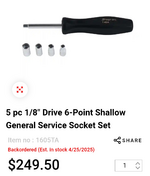
I’m surprised they still sell that. After seeing your post I entered the part# into Snap-On’s website but nothing came up. Yet, your picture is obviously new based on the date. I have the set pictured. It doesn’t really serve any purpose other than to say that I have it. Anyone know if they ever made anything else 1/8” other than what is shown in the photo? I’d love an 1/8” racthet if it exists. By the way, Snap On, if your listening, you need to have your collective heads checked if you’re charging $250 for that “set.”
 
To avoid these ads, REGISTER NOW!

Snapped-off

Well-known member
Joined
Feb 22, 2012
Messages
4,728
Location
Indiana
I’m surprised they still sell that. After seeing your post I entered the part# into Snap-On’s website but nothing came up. Yet, your picture is obviously new based on the date. I have the set pictured. It doesn’t really serve any purpose other than to say that I have it. Anyone know if they ever made anything else 1/8” other than what is shown in the photo? I’d love an 1/8” racthet if it exists. By the way, Snap On, if your listening, you need to have your collective heads checked if you’re charging $250 for that “set.”
I wonder if it's being phased out. I could only pull up 3 sockets. They're under 1/4" general service sets.
 

oscarsnapkin

Well-known member
Joined
Feb 22, 2025
Messages
460
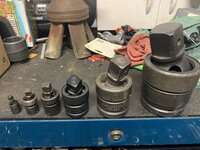
Snapped this photo today. I thought it was fitting for this thread. 1/4” up to 1 1/2”.
 

Attachments

  • IMG_2646.jpeg
    IMG_2646.jpeg
    644.2 KB · Views: 26

oscarsnapkin

Well-known member
Joined
Feb 22, 2025
Messages
460
I got a set over 25 years ago. I need a ratchet and a couple of extensions.
Does anyone know for sure if they ever made a 1/8” drive ratchet? I’ve never seen one in person, in a catalog or online. The socket driver would probably be more than adequate for any fastener that small. I always figured the 1/8” set was more of a gimmick than an actual tool.
 

BlitzcrankJapan

Well-known member
Joined
Dec 9, 2019
Messages
135
Location
Gold Coast, Australia
Speaking strictly automotive.

Garage Journal conned me into thinking 3/8" would be great. I now regret buying so much 3/8". With 1/4" and 1/2" drive it literally does everything, and 1/2" drive seems to have the biggest catalogue.

When you have 3/8" drive it works great, BUT you still need 1/4" for interior and electrical, and you still need 1/2" for suspension / wheel work. So you end up just buying extra for almost no reason.
The only reason I like 3/8" now is that it is lighter weight than 1/2", so makes a good emergency socket set to have in the car. How ever if you have a larger vehicle such as a 4wd then you should probably be carrying 1/2" anyway.

I carry Koken 3220M socket set and a hand full of combination spanners on road trips in my car. Can do most repairs with those.
 

rooster59

Well-known member
Joined
Nov 16, 2014
Messages
935
Location
Land of the Pines
Honda V6 crank bolt. You’re not taking that off with 3/8. 1/2 with extensions, you can feel the extensions wind up, probably not coming off. 3/4 is no problem.
 

Samuel D

Well-known member
Joined
Apr 9, 2019
Messages
638
I carry Koken 3220M socket set and a hand full of combination spanners on road trips in my car. Can do most repairs with those.
Might work for your car, but most cars need an extensive array of bit sockets these days – typically not included in sets.

I don’t fancy my chances at roadside repair these days so carry little in the car. Besides, modern cars are pretty reliable for the first few hundred thousand kilometres – assuming you stay on top of the service schedule, use good tyres, and keep an eye on the battery.
 

oscarsnapkin

Well-known member
Joined
Feb 22, 2025
Messages
460
Might work for your car, but most cars need an extensive array of bit sockets these days – typically not included in sets.

I don’t fancy my chances at roadside repair these days so carry little in the car. Besides, modern cars are pretty reliable for the first few hundred thousand kilometres – assuming you stay on top of the service schedule, use good tyres, and keep an eye on the battery.
I always figured tool manufacturers were in bed with auto makers to come up with ‘new’ types of fasteners in order to force techs to have to buy new tools. How many different styles of socket head bolts do we really need?
 

BlitzcrankJapan

Well-known member
Joined
Dec 9, 2019
Messages
135
Location
Gold Coast, Australia
What I find more interesting is that to my knowledge there is/was never was a competing metric drive standard?

What other items or standards comes to mind that are used globally but have no metric alternative?
Automotive wheels (rims). Still sold in inches. Have never even seen specifications which show the metric equivalent. Such as 1/2" (12.7mm) for ratchets.

Strange because apart from large off-road tires, you never really see tires sold in inches. It's always metric of some kind. The usual 225/55R and then an 'inch' measurement 17" wheel.
You do how ever in special cases see tires sold with what I think is the French style size listing. That is tread width (not section width like normal tire sizing gives) x diameter in Centimetres. Example would be 19/63-17. 19cm tread width. 63cm diameter. 17" wheel.
 

rust in the eye

Well-known member
Joined
Oct 2, 2017
Messages
2,742
Location
Chicagoland
Automotive wheels (rims). Still sold in inches. Have never even seen specifications which show the metric equivalent. Such as 1/2" (12.7mm) for ratchets.

Strange because apart from large off-road tires, you never really see tires sold in inches. It's always metric of some kind. The usual 225/55R and then an 'inch' measurement 17" wheel.
You do how ever in special cases see tires sold with what I think is the French style size listing. That is tread width (not section width like normal tire sizing gives) x diameter in Centimetres. Example would be 19/63-17. 19cm tread width. 63cm diameter. 17" wheel.
Michelin deviated from this convention with their TRX tires which were 390mm or 415mm rim size
 
To avoid these ads, REGISTER NOW!
Top Bottom