To avoid these ads, REGISTER NOW!

Extractor overview (pic heavy)

OP
G

garfunkle24

Well-known member
Joined
Mar 18, 2008
Messages
3,428
Location
Saskatoon, Canada
Vibration

It took me a fairly long while as a mechanic to understand the true value of vibration and how much it can help you.

My air hammer (PH3050) get used daily, but you don't need an air hammer to use vibration to your advantage.

1. Take a tapered punch and give the broken bolt a few good wacks. This will help break the rust bond between the fastener and housing. This will also let penetrants in there to work their magic.

2. Next I take my (Air)hammer and spend a while hitting all around area the bolts are stuck in I then like to use my penetrant and then give everything another good vibrating.

3. Once ready for the extraction, have someone beat on the housing (or vibrate with an hammer) the whole way through the extraction.

Vibration has lot more uses than just loosening broke bolts though. Vibration, particularly in combination with heat, is very effecting in both the installation and and removal of press fit parts.

One good example if pulling a pulley from a shaft. The pulleys we usee at work are aluminum and fairly easier to break. I set up the puller with some tension on it, but stop shy of breaking the pulley!

I then apply my air-hammer to either the centre of the pulley or to the end of the puller pressure screw. After this, the puller should loosen up slightly. Tighten up and repeat. If you can, have a buddy run the air hammer the whole time while you wind on the puller, it works even nicer. If you got 2 buddies, you have 1 running a torch, one with an air-hammer and one cranking the puller!
 
Last edited:
To avoid these ads, REGISTER NOW!
OP
G

garfunkle24

Well-known member
Joined
Mar 18, 2008
Messages
3,428
Location
Saskatoon, Canada
Chemicals

There are many off-the-shelf penetrants you can buy, including PB Blaster, Kroil, liquid wrench etc. From what I can gather on this board, Kroil is about the most revered.

One thing I have to note is that WD40 is NOT a great penetrant. It is is a jack of all trades; Part lubricant, part solvent, part penetrant, part water-dispersant etc.

There are plenty of "home made" varieties which I've heard good things about, to include an acetone/ATF mix and also bees or paraffin wax.

Here are my hot penetrant tips:


1. If you broke one of several bolts, soak all the others as many times as possible before trying to remove them.

2. If you can heat the bolt without heating the housing too much and then apply penetrant, it will help wick it in to the threads.

3. You have to get some seperation between parts before the penetrant can do anything at all. For example, using vibration etc you can loosen the crud between bolt/housing allowing the penetrant to enter.

4. Do it verticle. If possible, when soaking with a penetrant, have the wokpiece oriented upwards so the penetrant can 'sit' on the joint. Engline stands are real handy for this. I'll leave the penetrant to sit and keep checkin it and top up as required as it slowly seeps through the joint.

5. Wasn't sure if this should be in the heat section? Anyhow, Loctite has a product called "Freeze and Release". It is basically a supercold liquid in spray form. You could, for example, spray a bolt with it and it would shrink away from the housing making it easier to remove.
 
Last edited:

Monte

Well-known member
Joined
Dec 23, 2008
Messages
12,664
Location
Germany
5. Wasn't sure if this should be in the heat section? Anyhow, Loctite has a product called "Freeze and Release". It is basically a supercold liquid in spray form. You could, for example, spray a bolt with it and it would shrink away from the housing making it easier to remove.

Probably the same from a different manufacturer:

"Wurth Rost Off Ice removes rust from nuts and bolts quickly and easily, allowing them to move again.

Rost Off Ice induces the "cracking effect" in which the material cools, cracking the contamination, and allowing the active substance to rapidly penetrate the rust."


Wurth_Rost_off_Ice_z.jpg
 

Tom2

Well-known member
Joined
Dec 19, 2008
Messages
2,209
Yea - I think I will try that freeze off stuff next time I have a bad broken bolt. Yet to test it out.


A machinist magazine did a comparison. WD40 and PB Blaster tested basically the same. Liquid wrench, slightly better. Acetone and Power steering fluid tested the best.

I've used all - I honestly don't notice any noticable difference between any of the products. As a result - I just use WD40. Its fairly cheap and doesnt stink terribly. Have used wax..But WD40 is easier to use, and works better. So I don't really buy into the whole "WD40 isn't a penetrant, you have to use PB Blaster". Because I've used both thousands of times and notice zero difference between the two.


Would like to try Kroil - but have never seen it in a store..
 

PepperCrab

Well-known member
Joined
Feb 19, 2011
Messages
120
Sorry to revive an old thread, but are the drill guides that come with the spline type extractors sold seperately? Does anyone know where I could purchase them? Thanks.
 

MBfreak

MEMBER EMERITUS
Joined
Dec 10, 2010
Messages
2,301
Location
Linkoping , Sweden
Garfunkel,
great thread.
I recently broke a very well seated fluted extractor rod that was banged in a 6mm screw, way down in a 8 mm hole.
And as noted , extractors are HARD.
Any attempt o machine oit with hand held tools failed.
Took the part off , and a friendly motor repair shop used a wire arc machine to remove the tool and what remained of the screw. After that hole was drilled to accept a 6 mm helicoil insert.

And there went my pocket money for the next 3 months!
But, the job was done and I learned a lesson.

NEVER use a hardened screw extractor of any kind in a situation where the removal of the broken extractor must be done by a wire arc machine.

Ola
 

e-tek

Well-known member
Joined
Dec 19, 2007
Messages
10,690
Location
Saskatoon, SK
GREAT THREAD - probably one of the best on the board! I learned a lot - thanks.

Believe it or not, even being in the business of restorations I don't own a single extractor. After penetrant, my #1 tool of choice is this:

images


Over the years, these methods that have served me well (generally in concert with the torch):

1. Mig-welding a nut onto the broken shaft. The mig also heats the area.
2. Grinding a slot into the shaft and then using a screw driver to remove it.
3. Vice Grips

The few times that all these methods have failed I then used the drill-out method, whereby you drill it out with successivel larger bits until it can either be collapsed in on itself, or just the threads are left. Of course in a couple instances I've had to re-tap the whole mess...

Maybe I need some extractors!
 

Provincial

Well-known member
Joined
Sep 21, 2011
Messages
6,855
Location
Near Salem, OR
On heating pulleys to remove them from shafts:

When I was just out of school I worked in a repair-oriented machine shop. We did a lot of repairs for sawmills. One day I was heating a cast iron pulley to remove it from a shaft, heating the whole pulley. The boss, an older gentleman, walked by and noticed what I was doing. He stopped and asked why I was heating the whole pulley? I explained that it was to expand the pulley away from the shaft so it would slip off. He said "that won't work" and explained why:

When you heat the pulley to expand it, in theory the whole pulley expands and the whole "donut" gets bigger, including the hole. In practice, the mass of the pulley is greater as it gets bigger (except the hub area, which will be explained later), so it takes more heat to bring it up to temperature. In practice, the heating is uneven, with the area at the outer edge absorbing the most heat and the bore the least. If there is a hub built into the pulley, it increases the mass near the shaft, again requiring more heat to expand. What seems like a simple process now is very complex because of the variation in mass of the pulley. But that isn't the most important part of the answer!

When you heat the pulley, some of the heat transfers to the shaft, and the shaft also expands. If you are dealing with a steel shaft and aluminum pulley, the more rapid expansion rate of the aluminum helps you greatly, but heating the whole pulley increases the time the shaft is exposed to the heat and allows it to transfer heat and expand.

The boss explained that what you want to do is heat a narrow area radially outward from the shaft across the pulley. The best place to do this is over the keyway, if there is one, or over the set screw hole if there isn't a keyway. What you are doing is expanding a wedge of the pulley which will force the rest of the pulley to "peel away" from the shaft as that narrow area expands. It takes less time to heat up the narrow area so less heat reaches the shaft.

If the pulley won't come off after a fairly quick radial heat, let it cool off completely and try again, using penetrants in the meantime. Chances are you opened up the shaft/pulley joint enough for the penetrant to do it's work. Make sure the shaft is dead cold before you repeat the heating process.
 

Monte

Well-known member
Joined
Dec 23, 2008
Messages
12,664
Location
Germany
<iframe width="560" height="315" src="http://www.youtube.com/embed/AhVNqNi76_A" frameborder="0" allowfullscreen></iframe>
 

1967rsss

Well-known member
Joined
Dec 27, 2009
Messages
83
How do you suggest removing a stuck engine block (chevy 350) pipe plug (engine still in car)?
 

geologist

Well-known member
Joined
Dec 14, 2011
Messages
5,326
When you heat the pulley to expand it, in theory the whole pulley expands and the whole "donut" gets bigger, including the hole. In practice, the mass of the pulley is greater as it gets bigger (except the hub area, which will be explained later), so it takes more heat to bring it up to temperature.

Mass remains constant, although there is a relationship between density and the specific heat of a particular metal or alloy. As for the donut, it expands logarithmically based on the distribution of the heat being applied. In a way though, the old timer is right. The rest of the pulley is acting as a heat sink, and since the diameter increases as you move out from the center-point, you have more surface area to wick away heat. Thus, while the center might get heated up to 400 or so degrees, the outer perimeter might only be 150 degrees (exaggeration). Thermodynamics tends to be a pain in the *** sometimes.
 

MattT

Well-known member
Joined
Feb 20, 2010
Messages
3,201
Personally I don't waste my time with extractors unless the screw has been sheared by something other than an attempt to remove it. If I suspect it's stuck I just run a tapping drill down the center and clean the hole out with a tap. If that damages the hole then helicoil it.


For example, if you are drilling an 8mm bolt out: If you have the hole centered, you can pretty much drill a 7mm hole no problem, leaving 0.5mm on all sides. If you are off 1mm to one side, you can now only drill a 5mm hole, leaving 0.5mm clearance on the closest side.

If you drill a M8 x 1.25 bolt with a 7mm bit you'll be cutting away some of the female thread then screw up the rest of it with the extractor. If you're going to attempt using an extractor you've got to drill under the tapping drill size so that there's some bolt left so the extractor can get a a bite without damaging the female thread.

Have also seen guys take a torch and cut out the stud...........just leaving the threads to clean up. But that one takes real talent!

I've heard rumors of that working but the only time I've come across it the ***** that did it turned an easy job into a ******* nightmare. What the fool did was burn the bolts out which damaged the threads and glass hardened the iron at the extrance to the holes. Then the knuckle draggin' idiot broke a helicoil tap off in the hardened iron and disappeared:mad:

one question about the spline type. after you've gotten the broken bolt out, how do you extract the extractor from the bolt?

Thru' drill the bolt. Then you can knock the extractor out with a punch.
 

Macneil

Well-known member
Joined
Sep 18, 2011
Messages
80
Location
Sudbury, ON
Yes I do. I work out in the field a lot where I don't have any access to a welder. Because of this I've tried every kind I've ever come across and hence my hatred of all of them....:thumbup:

Isn't all of SK a field? :p

I feel your hatred for extractors. If I can remember today I will take a pic of a few that I have that I didn't see in your arsenal!
 

Monte

Well-known member
Joined
Dec 23, 2008
Messages
12,664
Location
Germany
just got me these:

Schröder "Hitrac" screw extractors
www.schroeder-werkzeuge.de


Looks like the standard screw extractors but they have a cutting edge:


Did a test: glued a nut with Loctite on a threaded rod let it cure for several days, drilled a pilot hole and successfully removed the rod:


To avoid these ads, REGISTER NOW!

basspro

Well-known member
Joined
Mar 20, 2013
Messages
327
Location
In the sticks, WI
Awesome pics! I have pretty much settled on my 25pc Snap-On short spiral set, my 5pc Irwin straight and my 10pc Cman external spirals, pretty much cover all my needs.
 

Farmall450

Well-known member
Joined
Dec 23, 2011
Messages
13,355
Location
Marengo, Illinois
After reading through this, I decided on a 6 piece Williams USA EXS-30 Square straight fluted type set, and used it today, with very good results.

$_12.JPG


Also got the cheap "neiko" set of left hand bits from eBay, today I didn't need to drill a hole but will need to some other time!

$(KGrHqZ,!pIFIY1HF1M0BSH4o5ZLqw~~60_3.JPG


And when it gets dull/breaks, you toss it and get a new one.

:beer:
 
Last edited:

jfcasey

Well-known member
Joined
Jan 30, 2010
Messages
1,358
Location
New Hampshire
On the topic of heat, I swear I've accidentally case hardened a few bolts when I tried to give them a thermal shock. Made for a real long drilling process :lol:
 

Cope

Well-known member
Joined
Mar 8, 2013
Messages
2,067
Location
Houston, TX
I've had good luck with the square tapered Proto, the spiral tapered, and the left hand drill/extractor combo set. Seems like there is no one type that works every time. My first exposure to the tapered spiral was on a broken off Bosch spark plug in my sister's Fiat 850 spider. It was the next to back plug, and I could barely get to it, but the extractor did the job.
 

Grimly

Well-known member
Joined
Feb 5, 2014
Messages
181
Location
Ireland
lilredex
Have also seen guys take a torch and cut out the stud...........just leaving the threads to clean up. But that one takes real talent!
I've heard rumors of that working but the only time I've come across it the ***** that did it turned an easy job into a ******* nightmare. What the fool did was burn the bolts out which damaged the threads and glass hardened the iron at the extrance to the holes. Then the knuckle draggin' idiot broke a helicoil tap off in the hardened iron and disappeared:mad:

I've done that a couple of times, on high-dollar machinery in the middle of nowhere that had to be got going again. It works ok, but slightly nervy. The trick is to get the oxy-acy torch just right, do the oxy burn just right, and leave the part alone to cool down naturally. Do it right and the bolt burns out clean as a whistle, leaving the threads intact.
I should also mention that on both those occasions, the hole wasn't blind, so there was plenty of room for sparks, gas and debris to get behind the broken piece. I'd think twice and practice on a bit of scrap before doing it on a blind tapped hole with busted stud in it, just to see what the outcome would be.
 
Last edited:

organ

Well-known member
Joined
Jan 22, 2014
Messages
955
Location
Atlanta
Left hand drill bits have worked wonders for me on stripped phillips screws...
 

404

Well-known member
Joined
Aug 23, 2014
Messages
3,463
Location
Mass
On heating pulleys to remove them from shafts:

When I was just out of school I worked in a repair-oriented machine shop. We did a lot of repairs for sawmills. One day I was heating a cast iron pulley to remove it from a shaft, heating the whole pulley. The boss, an older gentleman, walked by and noticed what I was doing. He stopped and asked why I was heating the whole pulley? I explained that it was to expand the pulley away from the shaft so it would slip off. He said "that won't work" and explained why:

When you heat the pulley to expand it, in theory the whole pulley expands and the whole "donut" gets bigger, including the hole. In practice, the mass of the pulley is greater as it gets bigger (except the hub area, which will be explained later), so it takes more heat to bring it up to temperature. In practice, the heating is uneven, with the area at the outer edge absorbing the most heat and the bore the least. If there is a hub built into the pulley, it increases the mass near the shaft, again requiring more heat to expand. What seems like a simple process now is very complex because of the variation in mass of the pulley. But that isn't the most important part of the answer!

When you heat the pulley, some of the heat transfers to the shaft, and the shaft also expands. If you are dealing with a steel shaft and aluminum pulley, the more rapid expansion rate of the aluminum helps you greatly, but heating the whole pulley increases the time the shaft is exposed to the heat and allows it to transfer heat and expand.

The boss explained that what you want to do is heat a narrow area radially outward from the shaft across the pulley. The best place to do this is over the keyway, if there is one, or over the set screw hole if there isn't a keyway. What you are doing is expanding a wedge of the pulley which will force the rest of the pulley to "peel away" from the shaft as that narrow area expands. It takes less time to heat up the narrow area so less heat reaches the shaft.

If the pulley won't come off after a fairly quick radial heat, let it cool off completely and try again, using penetrants in the meantime. Chances are you opened up the shaft/pulley joint enough for the penetrant to do it's work. Make sure the shaft is dead cold before you repeat the heating process.

That is genius, thanks for posting.
 

2oolhound

Well-known member
Joined
Dec 18, 2010
Messages
5,918
Location
BC Canada
Quote:
lilredex
Have also seen guys take a torch and cut out the stud...........just leaving the threads to clean up. But that one takes real talent!
Quote:
Originally Posted by MattT View Post
I've heard rumors of that working but the only time I've come across it the ***** that did it turned an easy job into a ******* nightmare. What the fool did was burn the bolts out which damaged the threads and glass hardened the iron at the extrance to the holes. Then the knuckle draggin' idiot broke a helicoil tap off in the hardened iron and disappeared


I've done that a couple of times, on high-dollar machinery in the middle of nowhere that had to be got going again. It works ok, but slightly nervy. The trick is to get the oxy-acy torch just right, do the oxy burn just right, and leave the part alone to cool down naturally. Do it right and the bolt burns out clean as a whistle, leaving the threads intact.
I should also mention that on both those occasions, the hole wasn't blind, so there was plenty of room for sparks, gas and debris to get behind the broken piece. I'd think twice and practice on a bit of scrap before doing it on a blind tapped hole with busted stud in it, just to see what the outcome would be.

While going up a long steep hill flat out in my 54 power wagon a cracked fan blade broke off causing the water pump to go out of balance and rip itself off the flat head 6 motor taking out my rad. I was stranded several hundred miles from home so towed the truck to a storage yard. I returned with a drill, taps and a cutting torch just in case. Sure as shite either the drill or the tap broke off (can't remember exactly which) on a blind hole in the block. I used a cutting torch to burn out damaged goods. The 1st attempt made a nice clean narrow tunnel almost through and then I tried again and blasted all of it out on that attempt. Another tap cleaned the threads in the block up. That was the one and only time I've had to use torches on a broke off stud and under duress I might add but it was a success.
 

2oolhound

Well-known member
Joined
Dec 18, 2010
Messages
5,918
Location
BC Canada
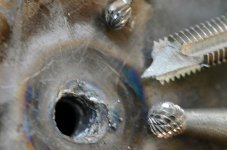
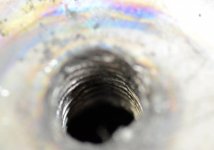
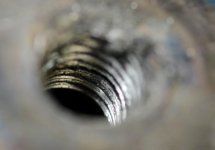
Wouldn't you known, I was tapping a number of sae 5/16 NF threads last week and I broke a tap. I Got it moving a 1/4 turn using a punch but then it stopped and wouldn't budge. I then burned out a carbide bit and a second bit wouldn't dig after that (see pics). I used a cutting torch, the last of the resources on hand, to blast it out. All went well. The photos show the results and the relative damage to the threads. After cleaning it out with another tap a bolt went in fairly snuggly. It was looser than the other freshly tapped holes but at this point I feel I don't even need a heli coil. I was able to tighten it up pretty well and the application is not crucial.

attachment.php


These photos are enlargements, the hole is about 1/4" clearance so the damage looks worse than it actually is. I just wanted to make the point that although a torch is not the greatest fix it can work, it's fast and straight forward. If this hole gives me trouble I'll fill it in with weld and start over but for now it's working.

attachment.php


attachment.php
 

Attachments

  • BrokeTap8354.jpg
    BrokeTap8354.jpg
    39.9 KB · Views: 351
  • BrokeTap8359.jpg
    BrokeTap8359.jpg
    22.7 KB · Views: 353
  • BrokeTap8362.jpg
    BrokeTap8362.jpg
    22.4 KB · Views: 355
Last edited:

6PTsocket

Well-known member
Joined
Mar 12, 2014
Messages
4,593
Those Alden ones work very well on the sizes they are made for. They are also guaranteed for life. Bust one, send it back and they send you a replacement. One end is a left hand drill bit that you use to drill a very shallow hole. Reverse the tool and the extractor end grabs like crazy. You use a drill for the whole job. When you take it off the broken stub, you will be amazed how hard it is stuck on. Most extractors are either straight or have a very long spiral. This one has a much higher pitch, tapered thread.It is more like a tapered tap, flutes and all. That is why it grabs in a very shallow hole. You are actually thread tapping it in instead of wedging it. They are not perfect. The drill bit ends seem to dull rather easily. The only advantage of drilling the starter hole CCW is that if the screw is loose it will back out before you even use the extractor. Since that is rarely the case, I use standard HSS drill bits running CW to make my pilot hole. You cannot use or or need to use a hammer to set them. The thread pitch is far too high. I have used the Hansen type. The bigger you can make the hole and the deeper you can hammer it, the flutes have more to grab and better leverage. It is often rough getting a deep, well centered hole. I have broken some too.
 

6PTsocket

Well-known member
Joined
Mar 12, 2014
Messages
4,593
In my previous post, I referred to extractors branded Alden. In this article they are branded Mastercraft. I see them At HD labeled Ontel Speedout and Amazon as just Speedout.I even saw them under some other name. They all look identical. Alden and Speedout have separate web sites. I have no idea if they are the same, coming from a common source or work equally well. I used the Alden Grabit, and they worked very well.
 

spddm0n

New member
Joined
Jan 12, 2017
Messages
1
I have a question about these bolt extractors with a 4pt square shank...what the heck do you use to hold them? What tool? There HAS to be something better than all the picks I see of a monkey wrench adjusted to the 4pt shank. I can't find any 4pt sockets? I have the same problem using my taps a lot of times. I need more torque than the basic tool to twist a tap in by hand. I would like to use a socket wrench to get better torque.

Most of the bolts I work with are broken because they are rusted in...SOLID. Is there some device or tool that can hold the 4pt shank to get better torque?

Thanks!
 

Mohawk Dave

Well-known member
Joined
Oct 7, 2012
Messages
5,068
Location
SoCal
I have a question about these bolt extractors with a 4pt square shank...what the heck do you use to hold them? What tool? There HAS to be something better than all the picks I see of a monkey wrench adjusted to the 4pt shank. I can't find any 4pt sockets? I have the same problem using my taps a lot of times. I need more torque than the basic tool to twist a tap in by hand. I would like to use a socket wrench to get better torque.

Most of the bolts I work with are broken because they are rusted in...SOLID. Is there some device or tool that can hold the 4pt shank to get better torque?

Thanks!

Either a tap handle or an 8 point socket. :beer: Or, I use Lisle tap sockets. https://www.amazon.com/dp/B0002SRFOE/?tag=atomicindus08-20

The Lisle one are square in the bottom, and have rubber rings that hold the tool tight. The backside is made for a ratchet, t-handle, etc...
 

Skin

Well-known member
Joined
Feb 24, 2010
Messages
11,713
Location
Boston
I have a question about these bolt extractors with a 4pt square shank...what the heck do you use to hold them? What tool? There HAS to be something better than all the picks I see of a monkey wrench adjusted to the 4pt shank. I can't find any 4pt sockets? I have the same problem using my taps a lot of times. I need more torque than the basic tool to twist a tap in by hand. I would like to use a socket wrench to get better torque.

Most of the bolts I work with are broken because they are rusted in...SOLID. Is there some device or tool that can hold the 4pt shank to get better torque?

Thanks!

Buy yourself a set of Lisle tap sockets.
 

Job

Member
Joined
Oct 20, 2016
Messages
17
Location
The Rust Belt
Timeless Thread

I read every post in this thread, and there is one thing I do not fully understand:

3. Tap sockets!

Because most extractors are of a tapered/wedge design, they will try and "cam-out" when you turn the fastener. By using a ratchet and tap socket, rather than a wrench, you can apply an axial load at the same time as turning the fastener. Here's a link for those not familiar: http://www.lislecorp.com/divisions/products/?product=398

I understand "axial load" to more or less indicate application of downward pressure to the fastener (or "pushing the fastener in"). If this understanding is correct, why would a tap socket be necessary to achieve this? I could just as easily push down using an eight-point socket, for example.
 
To avoid these ads, REGISTER NOW!
Top Bottom