To avoid these ads, REGISTER NOW!

Faced batt insulation and plastic vapor barrier?

191185

Active member
Joined
Mar 27, 2018
Messages
30
Hello,

Looks like I'm going to try to insulate the garage myself.

right now I'm only talking about the walls. ignore the ceiling for now.

Live in Minnesota. Garage is attached, down to the studs.

I was going to do faced batt insulation, then do the plastic air barrier.

Someone at work said not to, then I will have TWO vapor barriers ?


I thought the face was only a vapor retarder ?

If I want to use faced batt insulation on the walls, do I need to do plastic after that ?

garage was built in 2003 is attached to the house, built same time as house, normal Minnesota construction should be assumed.
 
To avoid these ads, REGISTER NOW!

Copymutt

Well-known member
Joined
Sep 3, 2016
Messages
3,390
Location
Colorado
I agree, faced ins. Is not sealed do to stapling gaps. If taped maybe till the tape deteriorates. High humidity locations, barrier goes outside studs. Low humidity, inside studs.
 

pattenp

Well-known member
Joined
Jun 4, 2008
Messages
10,175
Location
Virginia - USA
Faced insulation is a vapor barrier. Either use unfaced with plastic for vapor barrier or faced without the additional plastic.
 

kTHREE

Well-known member
Joined
Dec 30, 2016
Messages
222
Location
MN
Your shared walls to the house should already be insulated and have vapor barrier on the house side of the studs.
Are you only talking about the un shared walls?
 
OP
1

191185

Active member
Joined
Mar 27, 2018
Messages
30
Your shared walls to the house should already be insulated and have vapor barrier on the house side of the studs.
Are you only talking about the un shared walls?


Yes. I am only talking about the 3 unshared walls. the shared wall is already finished and insulated and everything, I assume from when the house was built.

the other walls are on their own..


So if I buy the faced insulation, not vapor barrier like plastic is needed, not even for Minnesota ?
 

Mick56

Well-known member
Joined
Nov 11, 2015
Messages
558
Location
Janesville Wisconsin
I'm in Wisconsin, so pretty similar to your location. I bought my house with an attached, unfinished, garage 25 years ago. I used faced insulation stapled to the studs, and then drywalled it. It has been fine ever since.
 

DFB

Well-known member
Joined
Sep 7, 2016
Messages
5,765
Location
Southern VT/Western Mass
I would just stick with using the Kraft then simply cover it with your rock. It's how I did my house and garage bay in VT we get some pretty cold winters and some seriously crappy humidity in the summers.

I've seen the full plastic vapor barrier done over kraft faced insulation but slitting the paper so your not trapping any moisture between the two surfaces. Only thing gained in that scenario is the convenience factor of using the stapling edges to install your insulation vs messing with the hassle of fitting up unfaced in your wall cavities
 

rayra

Well-known member
Joined
Dec 1, 2014
Messages
4,724
Location
Escaped from Los Angeles
I agree, faced ins. Is not sealed do to stapling gaps. If taped maybe till the tape deteriorates. High humidity locations, barrier goes outside studs. Low humidity, inside studs.

'Stapling gaps'? wth are those?

upstairscloset024.jpg
 

bugnut

ALLIANCE MEMBER
Joined
Jul 14, 2012
Messages
3,898
Location
Central Ohio
central ohio some do and some don't. I wanted to insure no air infiltration trough the torn kraft facing and the gaps, I added the plastic. no issues, my .02 $, ymmv,
 

steves_001

Well-known member
Joined
May 30, 2011
Messages
525
Location
Southern MN / Northern MN
From what I have been told by inspectors, Faced insulation should not have plastic, unfaced should. I've always just put up the faced stuff and dry-walled right over it. Never had an issue.
 

pudgybear

Well-known member
Joined
Aug 22, 2012
Messages
228
Location
Brooklyn Michigan
I always thought that if you put plastic over kraft faced insulation that it would cause moisture to build up between them, So I have never used plastic, now you are saying it is ok - will it help with the heating bill ?
 

Prospecter

Well-known member
Joined
May 16, 2015
Messages
2,415
Location
Maine
Midcoast Maine. Some do. Some don't. If you are still in the planning stages, though, have you considered other technology. Hi density cellulose would give you more R factor. A layer of foam would give you vapor barrier AND more R factor. Even for a garage, it's both less energy, less heating equipment, and quicker heat up of garage.
 

dfiler2

Well-known member
Joined
Dec 15, 2014
Messages
2,858
Location
NW Minnesota
We started using both back in the late 70's because during remodeling projects we were finding friction fit insulation that had slid down from the top and it was a fairly consistent 6 inches. The main purpose of the poly was air infiltration and moisture. I have never seen any condensation problems between poly and the kraft faced insulation, the moisture doesn't make it that far.
 

CombatNinja

Well-known member
Joined
Aug 24, 2013
Messages
1,456
The kraft paper is a vapor "retarder", not a "barrier" per se. Lots of people use the terms interchangeably but they are not really the same thing. Whatever you call it, you don't want to create a situation where you are sandwiching the insulation with barrier/retarders on both sides. Unless you live in some strange part of Minnesota that I have never experienced, I would not worry about any vapor barrier and just do the kraft faced just as your wall shared with the house is already done. And just as an FYI, doing the walls without doing the ceiling is a waste of time. Due to the chimney effect, the vast, vast majority of your heat loss will be upwards through the ceiling.
 

dfiler2

Well-known member
Joined
Dec 15, 2014
Messages
2,858
Location
NW Minnesota
The kraft paper is a vapor "retarder", not a "barrier" per se. Lots of people use the terms interchangeably but they are not really the same thing. Whatever you call it, you don't want to create a situation where you are sandwiching the insulation with barrier/retarders on both sides. Unless you live in some strange part of Minnesota that I have never experienced, I would not worry about any vapor barrier and just do the kraft faced just as your wall shared with the house is already done. And just as an FYI, doing the walls without doing the ceiling is a waste of time. Due to the chimney effect, the vast, vast majority of your heat loss will be upwards through the ceiling.

I agree if the OP is only talking about the shared wall, it seemed to me he was talking about the three outside walls. I would assume the shared wall is done.
 

LS6 Tommy

Well-known member
Joined
Dec 27, 2013
Messages
26,162
Location
Northern NJ
'Stapling gaps'? wth are those?

upstairscloset024.jpg

I apologize if I'm wrong, but with the small screen on my phone, it looks like that insulation is not properly installed. The flanges are to be stapled to the inside faces of the joists, not on the outside edges.

Tommy
 

CombatNinja

Well-known member
Joined
Aug 24, 2013
Messages
1,456
I apologize if I'm wrong, but with the small screen on my phone, it looks like that insulation is not properly installed. The flanges are to be stapled to the inside faces of the joists, not on the outside edges.

Tommy

No, that is the correct install. Stapling them inside compresses the insulation too much and it loses R-value. Stapling to the faces of the studs allows you to overlap edges, creating an infinitely better seal as well. You always see it done the other way because it makes installing drywall easier--you don't have to deal with the odd staple sticking out and you will never hit a staple with a drywall screw. It is the easy way, not the best way.
 

DFB

Well-known member
Joined
Sep 7, 2016
Messages
5,765
Location
Southern VT/Western Mass
Ya agree that's the way its meant to be done, not folded on the inside for all the reasons given in the post above. I remember I worked for one guy who had a fit when I started doing a wall the other way tucked in to expose the studs (though that is the way I have done for years) **** I was doing the wall covering too, so it was really for my convenience but lapped all the folds instead. Will give a better air seal for sure


Just looks nicer the other way :lol_hitti

My house is done that way :beer:

YMMV


Though insulation is meant to be covered by code and not left exposed for fire safety oh man I have seen a lot of walls and ceilings with just insulation especially in camps and garages but doesn't make it right.
 
To avoid these ads, REGISTER NOW!

jetpilot2112

Member
Joined
Oct 24, 2019
Messages
23
Location
Central OH
central ohio some do and some don't. I wanted to insure no air infiltration trough the torn kraft facing and the gaps, I added the plastic. no issues, my .02 $, ymmv,
Central Ohio here, too...
Not to hijack this thread, but do I want plastic between faced insulation and interior liner panels? The metal will form condensation before drywall would. (I have no vapor barrier on the outside, only metal attached to wood side girts)

Sent from my SM-N960U using Tapatalk
 

LS6 Tommy

Well-known member
Joined
Dec 27, 2013
Messages
26,162
Location
Northern NJ
No, that is the correct install. Stapling them inside compresses the insulation too much and it loses R-value. Stapling to the faces of the studs allows you to overlap edges, creating an infinitely better seal as well. You always see it done the other way because it makes installing drywall easier--you don't have to deal with the odd staple sticking out and you will never hit a staple with a drywall screw. It is the easy way, not the best way.

Then how come every inspection I've ever been involved with failed when insulation was installed that way and the Owens Corning training videos state to do it the way I posted?
It's also NOT easier to staple on the inside face of the stud instead of the edge facing out. Insulators don't give a **** about what he sheetrocker has to deal with.
:lol_hitti

Tommy
 
Last edited:

DFB

Well-known member
Joined
Sep 7, 2016
Messages
5,765
Location
Southern VT/Western Mass
Then how come every inspection I've ever been involved with failed when insulation was installed that way and the Owens Corning training videos state to do it the way I posted?
It's also NOT easier to staple on the inside face of the stud instead of the edge facing out. Insulators don't give a **** about what he sheetrocker has to deal with.
:lol_hitti

Tommy

Tommy I obviously I don't know anything about the inspections you mention but I am curious about them. Was it being failed only on the insulation install or maybe because that the wall framing was covered up and the inspector couldn't see it :dunno:
 
OP
1

191185

Active member
Joined
Mar 27, 2018
Messages
30
Thanks guys, one last question,

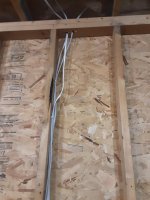
Do I need to go around with caulk, and expanding foam to seal where the 2x4`s meet the plywood ?

Or can i just start insulating?

I'm only going to hear the garage 2 to 3 days in the winter, when I'm changing oil or fixing something.
 
OP
1

191185

Active member
Joined
Mar 27, 2018
Messages
30
Like these cracks ?
 

Attachments

  • 15750489347465148401422456226585.jpg
    15750489347465148401422456226585.jpg
    85 KB · Views: 115
  • 20191129_113659.jpg
    20191129_113659.jpg
    98.3 KB · Views: 111
OP
1

191185

Active member
Joined
Mar 27, 2018
Messages
30
I'm going to do the ceiling next, just trying to figure out the walls first. Looking to start today.

Do I need to caulk / foam the cracks where the sheathing meets the 2x4's ?
 
OP
1

191185

Active member
Joined
Mar 27, 2018
Messages
30
Was thinking of using rock wool for the walls ?
 

Attachments

  • Screenshot_20191129-115507_Chrome.jpg
    Screenshot_20191129-115507_Chrome.jpg
    121.3 KB · Views: 69

CombatNinja

Well-known member
Joined
Aug 24, 2013
Messages
1,456
Then how come every inspection I've ever been involved with failed when insulation was installed that way and the Owens Corning training videos state to do it the way I posted?
It's also NOT easier to staple on the inside face of the stud instead of the edge facing out. Insulators don't give a **** about what he sheetrocker has to deal with.
:lol_hitti

Tommy

Just checked the Johns Manville install guide. They picture it being overlapped on the face of the studs. They not it can alternatively installed on the inside edges to make drywalling easier.
I frankly don't give a **** what Owens Corning or any "insulation guy" says. The vapor retarder is going to give you maximum benefit and the best possible air sealing when overlapped on the face of the studs. The only reason to do it the other way is because you are a)stupid or b) you want to make drywalling easier.
 
OP
1

191185

Active member
Joined
Mar 27, 2018
Messages
30
Does anyone know if I have to seal the cracks where the 2x4's meet the sheathing?

Do i need to use caulk/ foam, or does it not make a difference and i can skip it? Looking to start today.

Only going to heat the garage 3 days a month in the winter...

Thanks!
 

Attachments

  • 20191129_113659.jpg
    20191129_113659.jpg
    98.3 KB · Views: 49
  • 20191129_113650.jpg
    20191129_113650.jpg
    84.7 KB · Views: 45

LS6 Tommy

Well-known member
Joined
Dec 27, 2013
Messages
26,162
Location
Northern NJ
Tommy I obviously I don't know anything about the inspections you mention but I am curious about them. Was it being failed only on the insulation install or maybe because that the wall framing was covered up and the inspector couldn't see it :dunno:

The insulation job itself failed. The framing is a separate inspection that is done before the insulation can be done.

Tommy
 

LS6 Tommy

Well-known member
Joined
Dec 27, 2013
Messages
26,162
Location
Northern NJ
Just checked the Johns Manville install guide. They picture it being overlapped on the face of the studs. They not it can alternatively installed on the inside edges to make drywalling easier.
I frankly don't give a **** what Owens Corning or any "insulation guy" says. The vapor retarder is going to give you maximum benefit and the best possible air sealing when overlapped on the face of the studs. The only reason to do it the other way is because you are a)stupid or b) you want to make drywalling easier.

I wasn't going off something I was told by an "insulation guy". I was going off the manufacturer's instructions from a training program I had to take and what multiple, unrelated inspectors had failed jobs for.

In any event, since the training I got was a long time ago, I looked up the O-C installation manual. It allows for face or inset stapling, so I guess things have changed. I also looked up ASTM C1320. Interestingly enough, that standard said face stapling may be required by code in some areas and it also said high performance insulation like R13, R15, R21, R22, R30C, or R38C may not require stapling because the density of the batts is sufficient to hold them and that there is no measurable loss of moisture protection of the vapor retarder.

My previous experiences may very well have been because the inspectors used outdated local codes in the areas I've worked or were just set in their ways.

Anyway, I'm always willing to admit when I'm wrong and learn. :beer:

Tommy
 
Last edited:

DFB

Well-known member
Joined
Sep 7, 2016
Messages
5,765
Location
Southern VT/Western Mass
The insulation job itself failed. The framing is a separate inspection that is done before the insulation can be done.

Tommy

Thanks for saying. Ya even though framing is supposed to be inspected before moving on I seen enough to know that don't always happen so I had to ask.

A few years ago my boss hired an out of state contractor who took a building thru the drywall stage ended the job and left never called for an inspection once not even the concrete work...needless to say the local building inspector was quite rabid :D I had to cut open walls to view framing, replace and resize support columns, reframe certain areas to meet ADA and do the stairs treads and risers over. Second floor framing didn't meet certain specific commercial sizing requirements and the final permit was only issued with load stipulations

Insulation was the least of his worries :lol:
 
Last edited:
OP
1

191185

Active member
Joined
Mar 27, 2018
Messages
30
Can anyone help answer my question ?

Do I need to caulk / foam where the 2x4 meets the sheathing?
 

DFB

Well-known member
Joined
Sep 7, 2016
Messages
5,765
Location
Southern VT/Western Mass
Can anyone help answer my question ?

Do I need to caulk / foam where the 2x4 meets the sheathing?

Do you feel any air draft there?

Also check between the double plates and around window headers for air infiltration.


What did you decide to do...Rock wool and poly?

Kraft and poly?

Kraft only?
 
OP
1

191185

Active member
Joined
Mar 27, 2018
Messages
30
Do you feel any air draft there?

Also check between the double plates and around window headers for air infiltration.


What did you decide to do...Rock wool and poly?

Kraft and poly?

Kraft only?

I don't feel a draft, house was built in 2003, everything seems "normal" ... so should I not worry about it? How much would it really matter ?

Well, rock wool comes to about $350 for just the walls.

Kraft faced batts I figured about $130 for just the walls

I was thinking either one? What would you recommend?
 

DFB

Well-known member
Joined
Sep 7, 2016
Messages
5,765
Location
Southern VT/Western Mass
I don't feel a draft, house was built in 2003, everything seems "normal" ... so should I not worry about it? How much would it really matter ?

Well, rock wool comes to about $350 for just the walls.

Kraft faced batts I figured about $130 for just the walls

I was thinking either one? What would you recommend?

Well this is what I did on my own house and on any jobs I got paid for :D

Definitely seal any cracks or gaps where you even "think" cold air may be getting thru, Its not gonna hurt at all also consider your outlet boxes too they easily leak cold air as many installers usually don't get much insulation behind them.

IMO if your going with Kraft (what I have) or Foil Face and you might consider that too but it more money than paper. Get it up and in good and tight to the plates and studs cover up the wall and be done with it.

If you chose the rock wool option obviously your gonna need poly.

Its a garage and air exchange will be at maximum and wouldn't be like inside the house where you are introducing lots of water vapor with cooking showers etc.
 

dfiler2

Well-known member
Joined
Dec 15, 2014
Messages
2,858
Location
NW Minnesota
I agree, I don't think you can go wrong by sealing as much as you can, if you're willing to do it, go for it. Also, I think the rock wool is a great choice.
 

tjpavlov

Well-known member
Joined
May 18, 2012
Messages
1,278
Location
Providence, RI
I ran a bead of caulk between the sill plate and the foundation and into any cracks. Look for where you may have two vertical studs.

Check out Matt Risinger on YouTube. Lots of good sir sealing videos.

I would use Rockwool despite the extra cost. Way easier to work with in my experience.
 
To avoid these ads, REGISTER NOW!
Top Bottom